Quick Answer
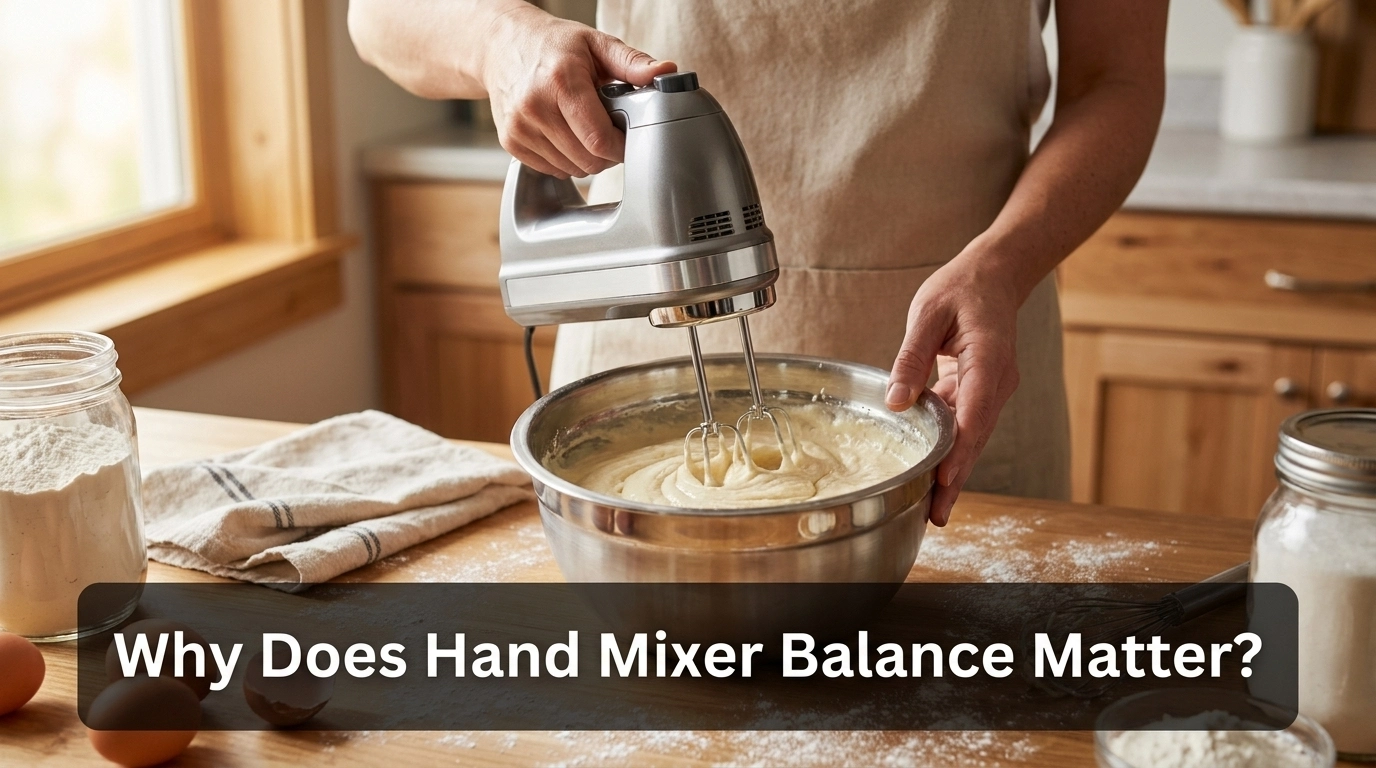
Hand mixer balance matters because it affects how comfortably you can hold, steer, and control the appliance while mixing. A well-balanced mixer places its weight where your hand can manage it easily, reducing wrist strain and helping you guide the beaters through ingredients without fighting the appliance. The best choice combines comfortable weight distribution, a secure handle, and suitable power for your recipes.
What good balance helps you achieve
- Less wrist strain: Balanced weight reduces the effort needed to keep the mixer in position.
- Better control: A stable feel helps you guide the beaters around the bowl.
- More comfort: Suitable weight distribution makes longer whipping and creaming tasks easier to manage.
- Steadier mixing: A secure grip and manageable balance help you maintain a consistent mixing position.
- Safer handling: Good control helps you keep the beaters in the bowl and avoid unnecessary splashing.
How to check balance
- Hold the unplugged mixer in your normal working position and notice whether its front or handle pulls your wrist in one direction.
- If possible, compare models of similar weight and choose the one that feels easier to grip and guide.
A hand mixer may look compact and lightweight, but its design can make a noticeable difference once you start baking. Balance affects how much effort you need to keep the beaters moving where you want them.
In this guide, I’ll explain what hand mixer balance means, why weight distribution matters, and how to evaluate balance alongside grip, motor power, and mixing performance. I’ll also cover the warning signs of an awkward design and the features worth checking before buying a new mixer.
In This Guide
What Does Hand Mixer Balance Mean?
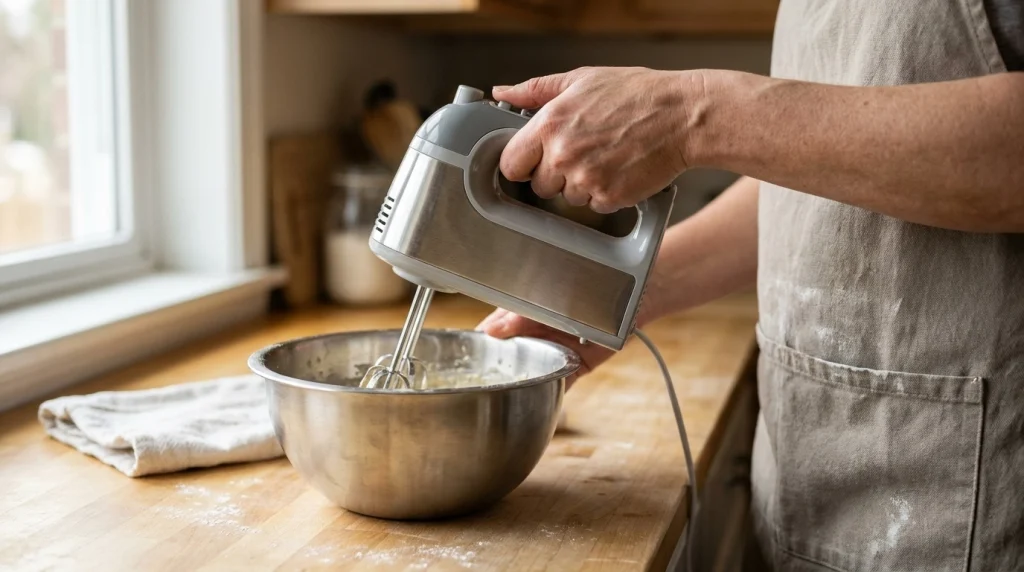
Hand mixer balance describes how the appliance’s weight is distributed in relation to your hand, wrist, and mixing attachments. A balanced design feels manageable when you hold the mixer in its normal working position rather than constantly pulling against its weight.
Understanding weight distribution and center of gravity
The center of gravity is the point around which an object’s weight is balanced. In a hand mixer, the motor, housing, handle, and other internal components influence where that point sits.
If much of the weight sits far forward of your grip, the mixer may feel as though its nose wants to dip toward the bowl. Your wrist must resist that tendency while you steer the beaters.
When the weight sits in a more manageable position, the appliance can feel easier to guide. The goal isn’t necessarily to place every component in the middle, but to create a design that works naturally with your hand position.
Balance is not the same as weight
Weight tells you how heavy a mixer is, while balance describes how that weight affects handling. Two mixers weighing 2.5 pounds can feel different if one has a forward-heavy motor housing and the other distributes its mass more comfortably.
For example, imagine holding a small bag by its center strap, then holding the same bag by a strap near one end. The bag hasn’t become heavier, but the second position may make it harder to keep level.
A hand mixer works similarly. Its total weight matters, but the distance between that weight and your grip also affects the effort required to control it.
Why balance matters more with handheld appliances
A stand mixer supports its own motor and mixing head on a base. A hand mixer relies on your arm to support the appliance while you guide its beaters through the bowl.
That difference makes ergonomics especially important. KitchenAid’s hand mixer buying guide also identifies weight and design as factors worth evaluating when choosing a model.
Balance should therefore be judged during a realistic grip, not by looking at a product photo or reading its weight specification alone.
Section takeaway: Hand mixer balance is about how the appliance’s weight behaves in your hand. A manageable center of gravity can make a heavier mixer easier to control than a lighter but awkwardly designed alternative.
Why Does Balance Matter During Mixing?
Hand mixer balance matters because it influences comfort, steering, and the effort needed to maintain a steady position. These differences become easier to notice when a recipe requires several minutes of continuous mixing.
Does good balance reduce wrist and arm fatigue?
Yes, good balance can reduce the effort needed to resist unwanted tipping or rotation. When the mixer continually pulls away from your natural grip, your wrist and forearm must work to correct that movement.
Think about whipping cream for several minutes. You need to keep the beaters immersed, move them around the bowl, and maintain a comfortable wrist position while the mixture thickens.
A poorly balanced appliance can make those small adjustments feel tiring. A well-balanced one lets you focus more on the ingredients and less on holding the machine in place.
Balance cannot eliminate all fatigue, however. Total weight, grip shape, mixing duration, and your own strength also affect comfort.
Can balance improve control over the beaters?
A well-balanced mixer is generally easier to position accurately because your hand can guide it without constantly correcting a strong forward or sideways pull. This is useful when moving between the center and edges of a mixing bowl.
Better control can help you keep the beaters at an appropriate depth. That matters when combining flour with wet ingredients or mixing a thin batter that splashes easily.
Balance alone doesn’t prevent splatter. Starting at a low speed, choosing a sufficiently deep bowl, and keeping the beaters immersed appropriately are also important.
Does balance affect mixing results?
Balance can support consistent mixing by making it easier to move the beaters through different parts of the bowl. It doesn’t directly determine how powerful the motor is or whether the beaters can handle a particular mixture.
For example, when creaming softened butter and sugar, you may need to guide the mixer around the bowl to reach ingredients along the sides. Comfortable handling makes that movement less awkward.
With a thick cookie mixture, resistance from the ingredients can make the appliance harder to steer. A balanced design may help you maintain control, but you should still follow the manufacturer’s guidance about suitable mixtures and operating speed.
Why balance matters during longer recipes
Short mixing tasks may not reveal much about comfort. A quick pancake batter takes less sustained effort than whipping egg whites or preparing frosting for several minutes.
Longer tasks give small design differences more time to affect your hand. A handle that feels comfortable initially may become less pleasant if you must constantly tighten your grip or adjust your wrist.
For frequent bakers, balance is a practical everyday feature rather than a cosmetic detail. It’s worth considering alongside speed control, attachment design, noise, and ease of cleaning.
Section takeaway: Good balance supports comfortable handling and steady movement, especially during longer mixing sessions. It helps you control the appliance, but it cannot compensate for unsuitable speed, poor technique, or an underpowered motor.
What Affects Hand Mixer Balance?
Several design choices determine how a hand mixer feels in use. The most important are weight distribution, handle geometry, motor placement, attachment position, and the way the cord affects movement.
1. Motor placement and housing design
The motor is one of the main components influencing a mixer’s center of gravity. Its position relative to the handle can affect whether the appliance feels neutral or wants to tip forward.
Housing shape matters too. A broad motor body may offer space for internal components, but the overall arrangement still needs to feel manageable when you hold the handle.
Manufacturers sometimes design around this relationship deliberately. Braun, for example, describes its SmartMix technology as positioning the motor over the attachments so the weight is directed toward the bowl rather than being borne entirely by the user’s hand.
That is a manufacturer-described design approach, not proof that every user will experience the same level of comfort. Individual hand size, recipe choice, and grip position still matter.
2. Handle shape and grip comfort
A balanced body is less useful if the handle feels slippery, too bulky, or difficult to hold. Your fingers need to secure the mixer without excessive squeezing, while your thumb should reach the main controls naturally.
Look for a handle that fits your hand and offers a secure surface. A soft-touch or textured grip can help, although the shape and fit are just as important as the material.
For more on this related design feature, KitchAdvisor’s guide to how hand mixer housing affects comfort and control explains why the outer body influences handling.
3. Total weight and attachments
The mixer body is only part of the system you hold. Beaters, whisks, dough hooks, and other compatible attachments can change the feel of the appliance, especially if their weight or length differs.
Longer attachments may also change how the appliance feels as you angle it over a bowl. Always use attachments approved for your specific model and install them according to the instructions.
Weight alone offers a useful starting point. KitchenAid notes that hand mixers commonly range from around 2 to 5 pounds, with many everyday models closer to 2 to 3 pounds.
That range is a general guide, not a universal comfort standard. A mixer at the lighter end may still feel awkward if its center of gravity sits poorly relative to the handle.
4. Cord position and body shape
A power cord can interfere with handling if it presses against your hand or drags across the work area. A swivel or flexible cord arrangement may make it easier to position the mixer comfortably.
The body should also give you enough clearance to hold it without your knuckles hitting the bowl. This is particularly important when mixing in smaller bowls or working at an angle.
These features don’t change the appliance’s actual center of gravity, but they can affect how balanced and controllable it feels during use.
5. Motor power and vibration
Motor power and balance are different characteristics. Wattage describes electrical power consumption, while balance describes how the appliance’s weight is distributed and managed during handling.
A high-wattage mixer isn’t automatically more comfortable, and a lower-wattage model isn’t automatically better balanced. Choose power based on the mixtures you prepare, then evaluate the design separately.
Noticeable new rattling, unusual vibration, or a sudden change in handling may indicate a problem rather than ordinary balance characteristics. Stop using the mixer if it appears damaged, and consult its manual or an authorized repair professional.
Section takeaway: Motor placement, handle shape, attachment design, and cord arrangement all influence the way a mixer feels. Look at the complete design instead of relying on one specification.
Does Weight or Balance Matter More?
Neither weight nor balance should be judged alone. A lighter hand mixer may be easier to lift, while a heavier model with better weight distribution may feel steadier and more natural to guide.
The right choice depends on how long you mix, what you prepare, and how comfortably the appliance fits your hand. Use the comparison below to understand the trade-offs.
| Design characteristic | Potential benefit | What to watch for |
|---|---|---|
| Lightweight body | Easier lifting and potentially less sustained arm effort | The mixer may still feel awkward if its weight is poorly distributed. |
| Well-balanced body | More manageable steering and less effort resisting unwanted tipping | Total weight and handle fit can still affect comfort. |
| Comfortable handle | A more secure grip and easier access to controls | A handle that suits one hand size may not suit another. |
| Higher motor wattage | May support the intended mixing tasks, depending on motor and gear design | Wattage alone doesn’t establish balance, comfort, or actual mixing performance. |
| Stable resting design | May make short pauses between mixing steps more convenient | Check the manufacturer’s instructions for safe resting and storage. |
Which design suits your cooking habits?
Consider how you use a hand mixer most often before deciding which characteristic deserves priority.
- For occasional baking: A comfortable, reasonably lightweight mixer with simple controls may be sufficient.
- For frequent cake baking: Prioritize balanced handling because creaming butter, beating batter, and preparing frosting can involve repeated mixing.
- For whipping cream or egg whites: Look for a manageable weight and a handle that remains comfortable during sustained use.
- For thick cookie mixtures: Consider the manufacturer’s recommended uses, suitable attachments, and low-speed control as well as balance.
- For limited grip strength: Try the handle and controls before purchasing, and pay particular attention to how the mixer feels when held at a working angle.
Does a more expensive mixer have better balance?
Not necessarily. Price may reflect attachments, construction, controls, design features, or other factors, but it doesn’t guarantee a comfortable fit for every user.
Compare the manufacturer’s specifications and, when possible, handle the actual appliance. A less expensive model that feels natural in your hand may be a better personal choice than a premium model with an awkward grip.
For a broader overview of weight and design, see this guide to typical hand mixer weight.
Section takeaway: Weight tells you how much you must support, while balance helps determine how that weight feels. The best mixer combines a manageable overall weight with a comfortable grip and suitable performance.
How Can You Test Hand Mixer Balance?
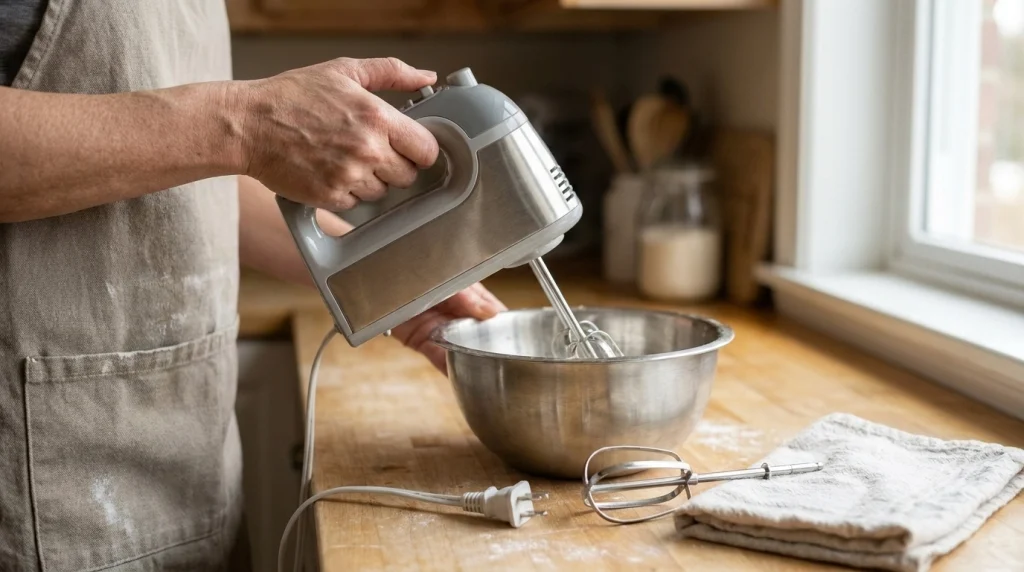
You can assess hand mixer balance by checking how the appliance feels in your normal grip and working position. A short, structured evaluation can reveal design issues that product photographs and specifications may not show.
Step 1: Check the weight in your hand
If possible, pick up the mixer before buying it. Hold it using the handle as you normally would while mixing ingredients in a bowl.
Notice whether the appliance feels manageable or immediately pulls your wrist forward. Keep your grip relaxed rather than squeezing harder to make an uncomfortable design feel secure.
Step 2: Notice where the weight sits
Hold the unplugged appliance at a typical mixing angle. Pay attention to whether the motor housing feels as though it wants to dip, twist, or roll away from your grip.
A slight forward orientation is not automatically a defect. What matters is whether you can maintain a comfortable position without constantly fighting the appliance.
Step 3: Evaluate the handle and controls
Check whether your fingers wrap naturally around the handle and whether you can reach the speed control without shifting your grip. The attachment-eject button should also be positioned so that normal holding doesn’t accidentally activate it.
Look for a secure surface that doesn’t feel slippery. If the handle forces your wrist into an uncomfortable angle, consider another design.
Step 4: Check attachment fit and clearance
With the appliance unplugged, inspect the beaters and their attachment points according to the manufacturer’s instructions. They should fit securely and match the model.
Check whether the housing gives your hand enough clearance above the rim of your usual mixing bowl. A design that forces your knuckles against the bowl can make an otherwise balanced mixer awkward to use.
Step 5: Consider the actual mixing task
If a retailer permits a safe demonstration, assess how the mixer handles at an appropriate speed in a suitable mixture. Keep your hands clear of the beaters and follow the operating instructions.
For an online purchase, look for the listed appliance weight, handle design, approved attachments, return policy, and credible feedback about comfort during extended use. Treat individual reviews as personal experiences rather than universal findings.
Hand mixer balance checklist
- The mixer feels manageable at its normal working angle.
- The handle fits your hand without excessive squeezing.
- Your wrist doesn’t need to resist a persistent forward or sideways pull.
- The speed control is easy to reach without changing your grip.
- The cord doesn’t interfere with your normal hand position.
- The appliance and its attachments appear secure and undamaged.
For product-specific operating instructions and attachment guidance, consult the manufacturer’s official documentation. For example, Braun’s hand mixer range explains how some models approach weight distribution and grip design.
Section takeaway: Test the mixer in a realistic grip, not just by lifting it briefly. Comfortable weight distribution, natural wrist positioning, and accessible controls are stronger indicators of everyday usability than weight alone.
When Does Poor Balance Become a Problem?
Poor balance becomes a practical problem when you struggle to hold the mixer comfortably, keep the beaters where you want them, or maintain a natural wrist position. However, not every handling problem comes from balance itself.
Signs that the mixer may not suit you
- Persistent forward pulling: You must continually lift the front of the appliance to keep the beaters positioned correctly.
- Frequent grip adjustments: Your hand keeps slipping or moving because the handle doesn’t feel secure.
- Uncomfortable wrist positioning: You need to bend your wrist sharply to hold the beaters in the bowl.
- Early fatigue: Your arm becomes tired during tasks you would normally expect to manage comfortably.
- Difficulty steering: Moving around the bowl feels awkward even when you use an appropriate speed and mixing technique.
These signs don’t prove that a mixer is defective. They may simply indicate that its weight distribution, handle shape, or overall size doesn’t suit your hand and cooking habits.
Could another problem be causing the discomfort?
Yes. A mixer can feel difficult to control because of factors other than its balance.
- Excessive mixing resistance: A thick mixture may be unsuitable for the appliance or its attachments.
- Incorrect speed: Starting too fast can make ingredients splash and force you to make sudden corrections.
- Poor bowl positioning: A bowl that slides or sits too far away can make you reach and twist unnecessarily.
- Damaged components: Loose beaters, unusual rattling, or sudden vibration may indicate a mechanical problem.
Start with simple adjustments. Position the bowl comfortably, use a suitable attachment, begin at a low speed, and follow the recipe and appliance instructions.
If the mixer develops unusual vibration, makes unexpected noises, or has damaged parts, stop using it and consult the manufacturer. Don’t open the housing or attempt electrical repairs unless you’re appropriately qualified and the manufacturer specifically permits the work.
When should you choose a stand mixer instead?
A stand mixer may be more comfortable for recipes that require prolonged mixing because the machine supports its own weight. It can also be more suitable for some thick mixtures, depending on its design and the manufacturer’s recommendations.
However, stand mixers occupy more counter and storage space, and their weight can make them harder to move. A hand mixer remains practical for smaller batches, quick tasks, and kitchens where storage space is limited.
Choose based on the recipes you make most often rather than assuming one type of mixer is universally better. If you prefer a handheld appliance, good balance is one of the features worth prioritizing.
Section takeaway: Persistent wrist strain and awkward steering are reasons to reassess the fit of your mixer. First rule out unsuitable mixtures, incorrect technique, and mechanical problems before blaming balance alone.
Hand Mixer Balance FAQs
1. Why is hand mixer balance important?
Hand mixer balance affects how easily you can support and steer the appliance. Good weight distribution can reduce the effort needed to resist unwanted tipping, support a comfortable wrist position, and make longer mixing tasks easier to manage.
2. Is a lighter hand mixer always better?
No. A lighter mixer may be easier to lift, but poor weight distribution or an uncomfortable handle can still make it difficult to control. Compare the total weight, center of gravity, grip, and your intended mixing tasks before choosing.
3. How do I know if my hand mixer is poorly balanced?
Hold the unplugged mixer in your usual working position. If it persistently pulls forward, twists away from your grip, or forces your wrist into an uncomfortable angle, its design may not suit you, although handle fit and technique can also contribute.
4. Does hand mixer balance affect mixing performance?
Balance can make it easier to guide the beaters consistently around a bowl. However, it doesn’t determine motor power or guarantee smooth results. Suitable speed, correct attachments, appropriate ingredients, and good mixing technique remain important.
5. What is the ideal weight for a hand mixer?
Many conventional hand mixers weigh around 2 to 3 pounds, although models can range more broadly. There is no single ideal weight for everyone. Choose a mixer that feels manageable in your hand and remains comfortable during the tasks you perform most often.
6. Does motor placement affect hand mixer balance?
Yes. The motor contributes to the appliance’s center of gravity, so its position relative to the handle and attachments influences how the mixer feels. A design that directs weight toward the bowl may reduce the effort required to support the appliance.
7. Can poor balance cause wrist pain?
An awkwardly balanced mixer can increase the effort required to hold and steer it, potentially contributing to discomfort during prolonged use. However, wrist pain has many possible causes. Stop using an uncomfortable appliance and seek medical advice if pain persists or worsens.
Final Takeaway: Choose a Hand Mixer That Feels Natural to Hold
Hand mixer balance matters because you support and steer the appliance throughout the mixing process. Good weight distribution, a comfortable handle, and accessible controls can make routine baking tasks easier and less tiring.
When comparing models, don’t focus exclusively on wattage, price, or the number on the weight specification. Consider how the appliance feels in your hand, whether you can guide its beaters naturally, and whether its attachments suit your recipes.
In 2026, the most useful approach remains simple: prioritize comfortable handling and match the mixer to your cooking habits. A well-balanced appliance that feels right in your hand is more useful than one that looks impressive on paper but feels awkward every time you bake.