Quick Answer
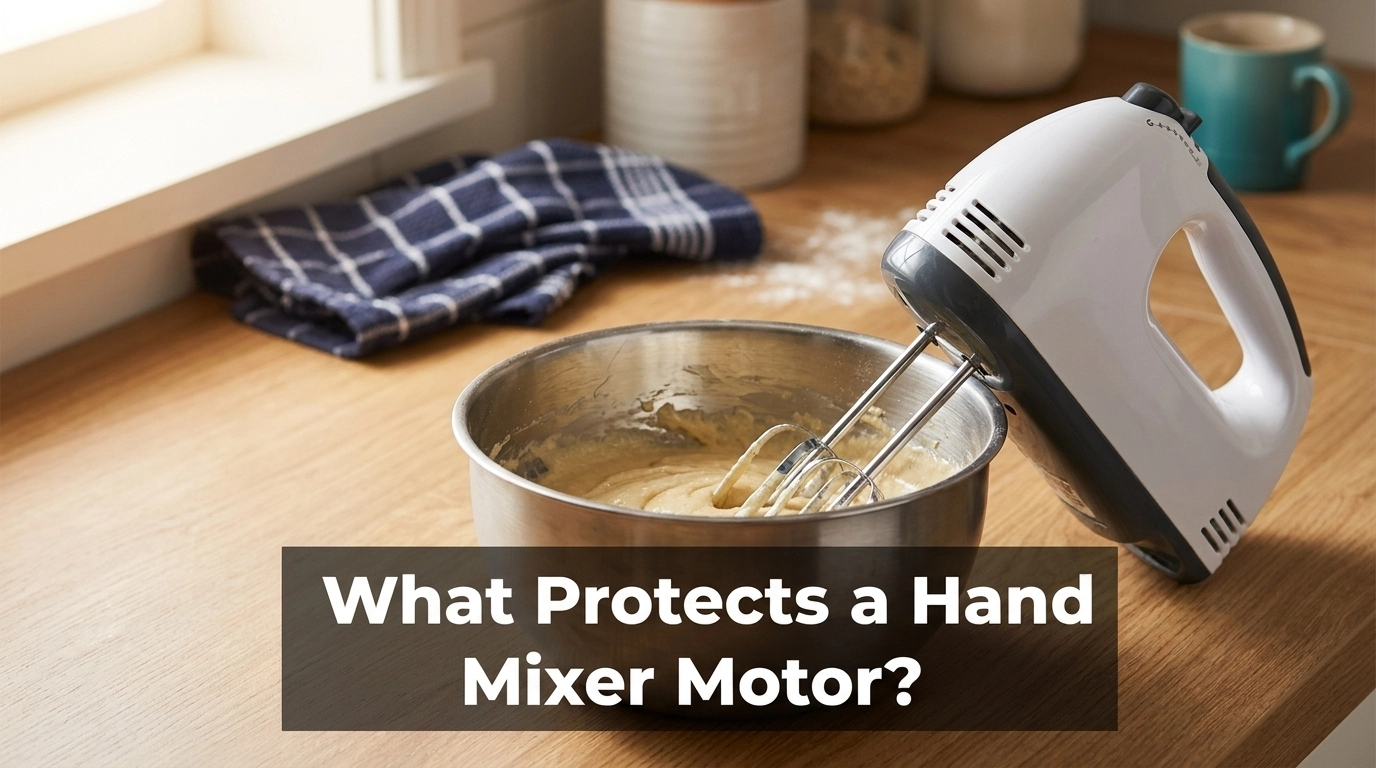
A hand mixer motor is primarily protected by thermal overload protection, a thermal fuse or cutout, and, in some models, electronic overload controls. These features help prevent excessive heat or electrical overload from damaging the motor. Correct mixing speeds, suitable ingredient quantities, and regular cooling breaks also help protect the motor during everyday use.
Main motor protection features
- Thermal overload protector: Stops the motor when excessive temperature triggers the protection system.
- Thermal fuse: In models that use one, interrupts power when a specified temperature threshold is reached.
- Electronic overload control: Some mixers detect excessive load or operating conditions and shut down automatically.
- Ventilation openings: Help release heat from the motor and internal components.
- Safe operating habits: Prevent unnecessary strain by avoiding overloaded bowls and prolonged mixing.
How to verify protection
- Check your exact model’s instruction manual for thermal cutout, overload protection, or automatic shutdown features.
- If the mixer stops because of overheating, switch it off, unplug it, and follow the manufacturer’s cooling and restart instructions.
A hand mixer may look simple, but its motor works hard when beating thick batter, creaming cold butter, or kneading a small quantity of dough. Understanding what protects a hand mixer motor helps you choose an appliance wisely and recognize when it needs a break.
In this guide, I’ll explain the main protective components, how they work together, which warning signs deserve attention, and what you can do to help your mixer last longer. I’ll also distinguish features found in some models from protections that every hand mixer necessarily has.
In This Guide
What protects a hand mixer motor?
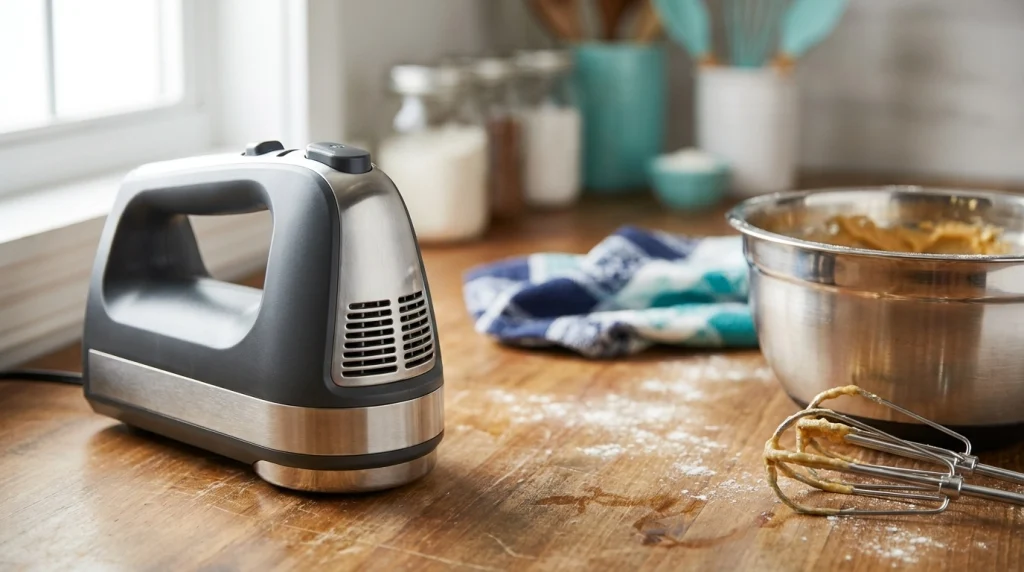
A hand mixer motor relies on a combination of electrical protection, temperature control, mechanical design, and correct operation. The exact combination depends on the manufacturer’s design and the particular model.
Thermal overload protection
Thermal overload protection is a safety feature that stops or interrupts motor operation when excessive heat reaches a specified threshold. Depending on the design, the protective device may reset automatically after cooling or require service or replacement.
Heat can build up when the motor works against a heavy load or runs longer than the manufacturer recommends. A thermal protector helps limit that heat-related damage.
For example, some Dualit hand mixers use a resettable thermal cutout. Their instructions tell users to switch off, unplug the appliance, and allow it to cool if the safety cutout activates.
Thermal fuse
A thermal fuse is a temperature-sensitive safety component that permanently interrupts its circuit when its specified temperature limit is exceeded. Unlike a resettable thermal protector, a blown thermal fuse generally needs replacement by a qualified technician.
Not every hand mixer uses the same type of thermal protection. A thermal fuse, a resettable cutout, or an electronic temperature-monitoring system may appear in different designs, so check the manufacturer’s documentation rather than assuming your model contains all three.
Electronic overload protection
Some hand mixers use electronic controls to detect an excessive load or an operating condition that could damage the motor. The control system can then stop the appliance to reduce the risk of continued strain.
This protection can be particularly useful when beaters become stuck in a dense mixture. However, electronic overload detection is not a universal feature, and its behavior varies between models.
Motor ventilation and cooling
Ventilation openings allow air to move around internal components and help the appliance release heat. They support the motor’s thermal management but do not replace an overload protector.
Blocking these openings with a hand, cloth, or nearby object can restrict airflow. Keeping them clear is a simple way to help prevent unnecessary heat buildup.
Section takeaway: Thermal cutouts, thermal fuses, electronic controls, and ventilation serve different purposes. Your hand mixer’s manual is the best source for identifying its actual protection system.
How do motor protection systems work?
Motor protection systems respond to different risks, including excessive temperature and excessive electrical or mechanical load. Some operate automatically, while others depend on the user switching off the appliance and allowing it to cool.
What happens when a motor gets too hot?
During normal operation, the motor generates heat as it converts electrical energy into mechanical movement. A heavy mixture, restricted ventilation, or an extended mixing session can increase that heat.
When a temperature-sensitive protector reaches its operating threshold, it interrupts the motor’s power supply. The motor stops, reducing the risk of continued overheating.
A resettable protector may restore operation after the motor cools sufficiently. A thermal fuse, by contrast, generally remains open until a technician replaces it.
How does overload protection prevent damage?
Overload protection addresses situations where the motor faces more resistance than it can safely handle. Thick dough, oversized ingredient quantities, or jammed beaters can create this condition.
Depending on the design, a mixer may use a current-sensitive device, electronic controls, or temperature-based protection. Some systems respond quickly to excessive load, while simpler designs may rely more heavily on thermal protection.
These mechanisms are not interchangeable. A temperature protector may take time to respond because the motor must heat up before the device reaches its threshold.
Why are speed controls important?
Speed controls let you match the beater movement to the ingredients. Starting at a low speed can reduce splashing and help the motor begin working without an abrupt increase in load.
Speed settings alone do not guarantee motor safety. Running a mixer at low speed against an excessively thick mixture can still strain its motor.
For safer operation, follow the manufacturer’s guidance on ingredient quantities, attachment types, speeds, and maximum continuous running times.
What role do electrical components play?
The power cord, plug, internal wiring, switch, and control circuit deliver or regulate electricity to the motor. Sound electrical connections help the appliance operate as intended.
These components are not all motor overload protectors. A damaged cord or loose connection can create a separate electrical hazard, even if the motor includes thermal protection.
For general appliance safety information, consult the U.S. Consumer Product Safety Commission’s safety education resources. Stop using a mixer with a damaged cord, a burning smell, or signs of electrical arcing.
Section takeaway: Motor protection works by interrupting unsafe operating conditions, but it cannot make every overload harmless. Correct use remains essential.
What causes a hand mixer motor to overheat?
A hand mixer typically overheats when the motor produces heat faster than the appliance can release it. Excessive mixing load and operation beyond the recommended duty cycle are common causes.
Mixing ingredients that are too thick
Dense dough and stiff mixtures place more resistance on the beaters than light cake batter or whipped cream. The motor may draw more current or work harder to maintain movement.
Use dough hooks only when your model supports them, and respect the manual’s limits for dough consistency and quantity. Many lightweight hand mixers are designed mainly for beating and mixing rather than prolonged heavy kneading.
Exceeding the recommended mixing time
Every motor has operating limits, and some hand mixers require cooling breaks after relatively short periods of use. There is no single safe running time that applies to every brand or model.
For instance, a manufacturer’s instructions may specify a maximum continuous run time or a minimum rest period. Follow that exact guidance instead of relying on a general rule found online.
Blocking ventilation openings
Air vents help hot air escape from the housing. Flour dust, food residue, or a hand covering the openings can interfere with airflow.
With the appliance unplugged and cool, inspect accessible exterior vents for visible buildup. Clean them only as the manufacturer permits, and never push objects into the housing.
Using the wrong attachment or speed
Beaters, whisks, and dough hooks have different purposes. An attachment unsuitable for the ingredients can increase strain or produce poor mixing results.
Choose the attachment specified for your task and begin at a suitable low speed. Increase speed gradually when the mixture allows it.
Mechanical or electrical faults
A worn bearing, damaged gear, obstructed drive mechanism, or failing electrical component can also cause abnormal operation. A sudden change in noise or repeated shutdowns deserves attention.
Do not assume every overheating problem comes from a heavy recipe. If the mixer becomes unusually hot during a light task, or its protection activates repeatedly, stop using it and seek qualified service.
Important: Unplug the mixer before inspecting its exterior or cleaning accessible vents. Never open a sealed housing or attempt to bypass a thermal fuse, overload protector, or other safety device.
Section takeaway: Reduce unnecessary motor strain by matching the attachment and speed to the mixture, respecting run-time limits, and keeping ventilation clear.
How can you tell when motor protection activates?
A hand mixer that suddenly stops may have activated its thermal or overload protection, but a power interruption or component failure can cause similar symptoms. Look at what happened immediately before the shutdown.
The mixer stops during mixing
If the mixer stops while working through a heavy mixture, excessive load or overheating may be responsible. Some models shut down automatically and can operate again after the prescribed cooling period.
Switch the speed control off, unplug the mixer, remove some ingredients if the bowl is overloaded, and follow the manual’s restart procedure. Do not keep switching the appliance on to force it to run.
The housing becomes unusually hot
A motor housing can become warm during use, but excessive heat, a burning odor, smoke, or unusual discoloration should not be ignored. These signs may indicate a fault rather than normal operation.
Switch off and unplug the appliance if you can do so safely. If you notice smoke, sparking, or a strong burning smell, discontinue use and arrange professional assessment.
The mixer works again after cooling
Successful operation after cooling is consistent with a resettable thermal protector, particularly if the manual describes that feature. However, recovery alone does not prove that the protection system caused the original shutdown.
If the mixer repeatedly stops under ordinary loads, investigate the cause rather than treating each shutdown as a normal part of operation.
Check these warning signs
- Repeated shutdowns: The motor may be overheating, overloaded, or developing a fault.
- Burning odor: Stop using the appliance and arrange inspection.
- Unusual grinding: A mechanical problem may be affecting the drive system.
- Damaged cord or plug: Discontinue use because of the electrical hazard.
- No restart after cooling: The cause may be a failed protector, fuse, switch, motor, or power connection.
For a useful real-world reference, some KitchenAid product support guidance explains that thermal overload protection on certain stand mixers can stop the motor until it cools. That example illustrates the principle, but stand mixers and hand mixers can use different designs.
Section takeaway: A shutdown can be a protective response, but repeated trips, burning smells, and abnormal noise call for investigation rather than repeated restarts.
How do different motor protection features compare?
Not all hand mixers use the same combination of safety features. Comparing their functions helps you understand what a particular feature can—and cannot—do.
| Protection feature | Main purpose | Reset or maintenance |
|---|---|---|
| Resettable thermal cutout | Interrupts operation when excessive temperature triggers the device. | May reset after cooling, depending on the design. |
| Thermal fuse | Permanently interrupts a circuit at its specified temperature threshold. | Generally requires professional replacement after activation. |
| Electronic overload control | Detects specified abnormal load or operating conditions. | May recover after a prescribed reset or cooling period. |
| Ventilation openings | Help release heat from internal components. | Keep accessible openings clear as directed by the manual. |
| Speed control | Lets the user adjust mixing speed to suit the ingredients. | Use the correct setting; it is not a substitute for overload protection. |
This table describes typical functions, not a checklist of parts present in every appliance. The exact thresholds, reset behavior, and combination of features depend on the manufacturer’s design.
Which protection feature matters most?
For overheating concerns, a properly designed thermal protection system is especially important. Electronic overload detection can provide another layer of protection where the manufacturer includes it.
However, the number of advertised safety features is not enough to judge an appliance’s overall quality. Build quality, suitable attachments, operating limits, electrical safety, warranty coverage, and available service support all matter.
When comparing models, look for a clear instruction manual that explains maximum mixing times, permitted ingredients, overload symptoms, and the correct recovery procedure. These practical details can be more useful than a vague claim that a mixer has a powerful motor.
What about safety certification?
Safety certification and motor overload protection are related to appliance safety, but they are not identical. A certification mark indicates conformity with the applicable requirements for the product and certification scheme; it does not mean a motor can never overheat.
You can consult UL Solutions’ appliance safety resources to learn about product safety assessment. For an individual hand mixer, verify the model and any certification claims rather than assuming every product has the same approval.
Section takeaway: Choose a hand mixer with clearly documented safety features and operating instructions. No single feature eliminates every risk of motor damage.
How can you prevent hand mixer motor damage?
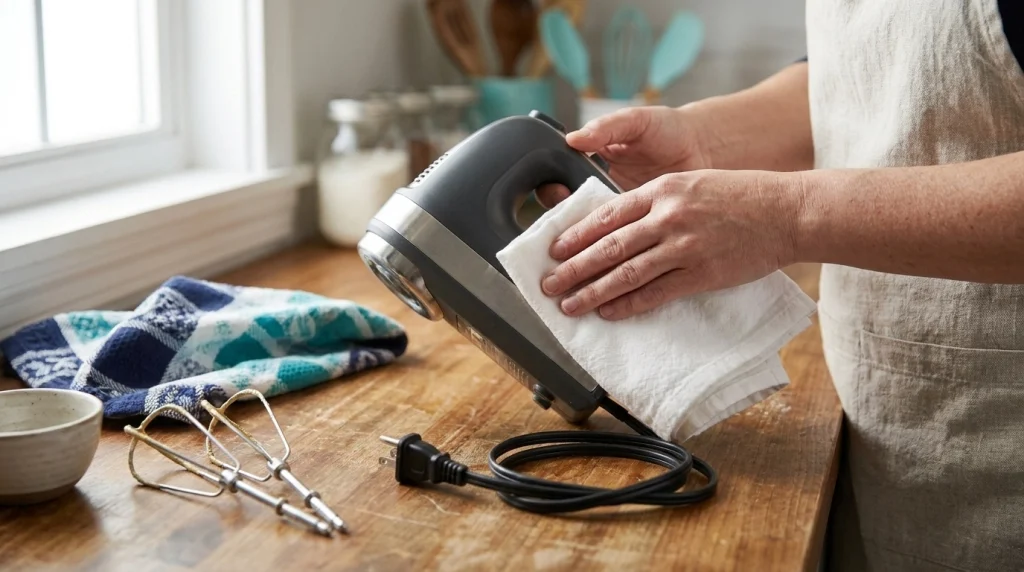
The most effective way to protect a hand mixer motor is to avoid placing unnecessary demands on it. A suitable recipe load, correct attachment, and reasonable operating time can reduce strain before a safety device needs to intervene.
Follow the manufacturer’s mixing limits
Check the manual for recommended quantities, permitted mixtures, speed settings, and maximum continuous operating time. These limits vary by model, so avoid applying a stand mixer’s capabilities to a compact hand mixer.
For thick mixtures, work in smaller batches when the instructions permit it. Stop if the beaters struggle to turn or the motor begins sounding noticeably different.
Start slowly and increase speed gradually
Begin with the lowest suitable speed when combining ingredients. This helps limit splashing and gives you an opportunity to judge the mixture’s resistance.
Increase the speed only when needed. Higher speed is not automatically better, especially when the ingredients are dense or the beaters are becoming difficult to move.
Allow cooling breaks
Give the mixer the rest period specified by its manufacturer, particularly during repeated batches. If a thermal cutout activates, follow the documented cooling procedure instead of immediately trying again.
For example, Dualit’s published instructions for certain hand mixers specify cooling after the thermal cutout operates. The required recovery time should come from your own model’s manual, not another manufacturer’s instructions.
Keep the appliance clean and dry
After use, unplug the mixer and clean the beaters according to the instructions. Wipe the body with a suitable cloth rather than immersing the motor housing in water.
- Clear the vents: Remove accessible dust or residue using the approved cleaning method.
- Inspect the cord: Look for cuts, exposed wires, or damage near the plug and housing.
- Check the attachments: Make sure beaters or hooks fit securely and are not visibly bent or damaged.
- Store it safely: Keep the appliance dry and protect the cord from sharp bends or crushing.
Know when to stop troubleshooting
Basic checks are appropriate when a mixer stops unexpectedly, but internal electrical repairs require greater caution. A failed thermal fuse, damaged winding, faulty control board, or worn internal component should be assessed by a qualified technician.
Pro tip: Never bypass a thermal fuse or overload switch to get a mixer running again. Consult the manufacturer’s service guidance or a qualified appliance repair technician instead.
These precautions help you avoid turning a temporary overheating issue into a more serious appliance failure. They also reduce the temptation to keep using a mixer that has already shown signs of a fault.
Section takeaway: Good mixing habits, clean ventilation, proper cooling, and prompt attention to unusual behavior are essential parts of motor protection.
Frequently asked questions
1. Does every hand mixer have a thermal fuse?
No. Hand mixers use different protection designs, and not every model contains a thermal fuse. Some use resettable thermal cutouts or other protective controls. Check your exact model’s manual or contact the manufacturer to identify the components it uses.
2. Can a hand mixer motor burn out even with overload protection?
Yes. Protection reduces the risk of damage but cannot guarantee that the motor will never fail. Repeated heavy loads, prolonged operation, mechanical faults, or electrical problems can still cause damage, especially when the appliance is used outside its specified limits.
3. Why does my hand mixer stop and start working again later?
A resettable thermal protector may interrupt operation when the motor overheats and allow it to restart after cooling. However, an intermittent power connection or another fault can cause similar symptoms. Follow the manual and seek service if shutdowns recur.
4. How long should I let an overheated hand mixer cool?
The correct cooling period depends on the model and its instructions. Some manufacturers specify a particular waiting time, while others direct users to wait until the motor has cooled sufficiently. Switch off, unplug, and follow the exact procedure in your manual.
5. Does a more powerful hand mixer need less motor protection?
No. A higher wattage rating describes electrical power consumption under specified conditions; it does not eliminate heat buildup or guarantee protection against overload. A powerful motor can still be damaged by unsuitable mixtures, excessive running time, or a mechanical or electrical fault.
6. Can I replace a thermal fuse myself?
Replacing a thermal fuse involves working with an internal electrical safety component, and an incorrect replacement can create a fire or shock hazard. Do not bypass the fuse or open a sealed housing. Use an authorized service provider or qualified appliance technician.
7. What should I do if my hand mixer smells like burning?
Switch it off and unplug it if safe to do so, then discontinue use. A burning odor can indicate overheating, damaged insulation, or another fault. Do not restart the appliance simply because it has cooled; arrange professional inspection before using it again.
Final takeaway: Protect the motor before problems start
A hand mixer motor is protected by the safety features built into its particular design, which may include thermal overload cutouts, thermal fuses, or electronic overload controls. Ventilation and appropriate operating practices also help manage heat and reduce unnecessary strain.
When choosing or maintaining a hand mixer, read the manual, respect its mixing limits, and give the motor time to cool when required. Most importantly, treat repeated shutdowns, unusual heat, burning odors, and damaged electrical parts as reasons to stop and investigate—not as problems to push through.
Understanding these protections helps you use your hand mixer more confidently while recognizing the point at which professional repair is the safer choice.