Quick Answer
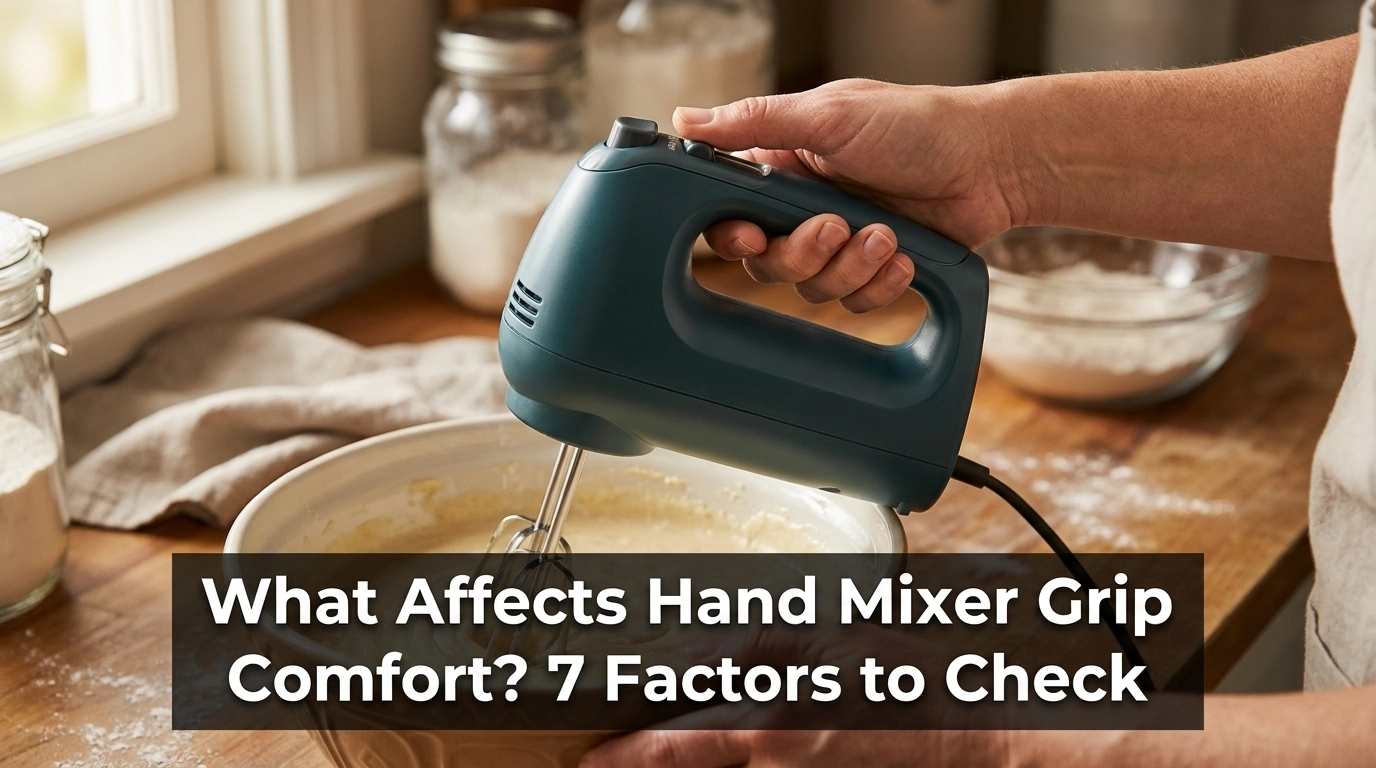
Hand mixer grip comfort depends on handle shape, thickness, surface texture, weight distribution, wrist angle, control placement, and vibration. The best design lets you hold the mixer securely without squeezing too hard or bending your wrist awkwardly. When comparing models, consider the complete handle and body design, as explained in this hand mixer buying guide.
The main factors affecting comfort
- Handle shape: A natural contour helps your fingers and palm maintain a relaxed hold.
- Grip thickness: A handle should fit your hand without forcing your fingers to stretch or curl tightly.
- Surface texture: A secure, non-slip finish can reduce the effort needed to hold the appliance.
- Weight and balance: Excessive weight or a front-heavy body can increase wrist and forearm fatigue.
- Control placement: Easy-to-reach speed buttons reduce awkward finger movements during mixing.
- Vibration and workload: Motor vibration, thick batter, and long mixing sessions can make an otherwise comfortable grip tiring.
A quick comfort check
- Hold the unplugged mixer in your usual position and check whether your wrist stays relatively straight.
- Make sure you can reach the controls without loosening your grip, and choose a model that feels manageable for your typical recipes.
What affects hand mixer grip comfort becomes important when a quick mixing job turns into several minutes of beating, whipping, or creaming. A mixer can have plenty of power yet feel awkward if its handle, weight, or controls don’t suit your hand.
When evaluating kitchen appliances, I look beyond the feature list to consider how the design supports everyday use. This guide explains the main comfort factors, how they interact, and what to check before choosing a hand mixer in 2026.
In This Guide
- How do handle shape and size affect grip comfort?
- Which grip materials and textures feel more comfortable?
- How do weight and balance affect hand fatigue?
- How do wrist angle and control placement influence comfort?
- How do vibration and mixing workload affect grip comfort?
- How can you choose and test a comfortable hand mixer?
- Hand mixer grip comfort FAQs
How Do Handle Shape and Size Affect Grip Comfort?
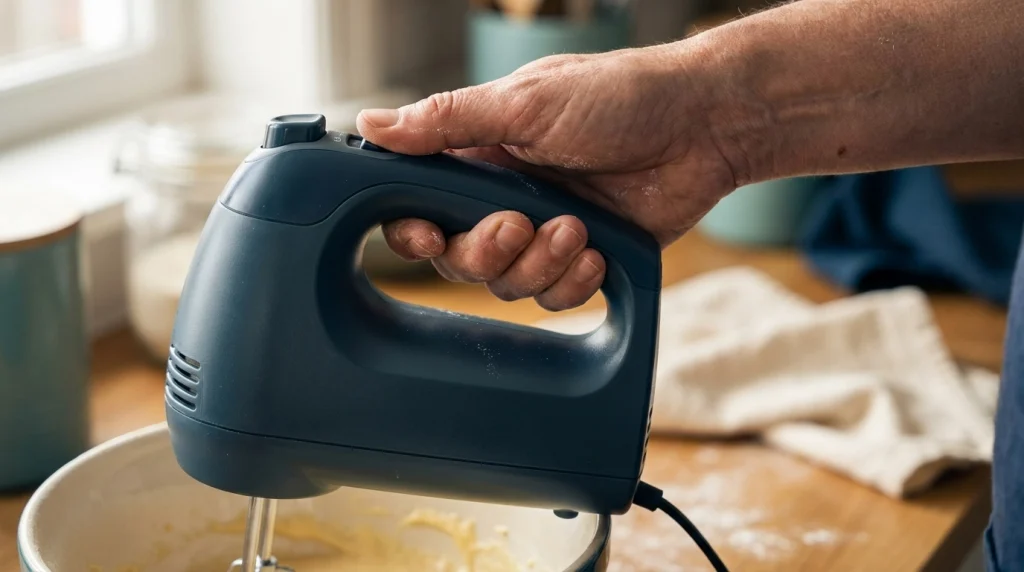
Handle shape and size determine how naturally your hand wraps around a hand mixer. A comfortable handle supports a relaxed grip, while an awkward shape can create pressure points and force your fingers to work harder.
Handle contours and finger placement
An ergonomic handle is shaped to support a natural hand position. Its curves, contact surfaces, and available space influence how comfortably your palm and fingers support the appliance.
A handle doesn’t need deep grooves to feel comfortable. Some people prefer a gently contoured design because it allows several natural holding positions without forcing their fingers into fixed spaces.
- Palm support: The handle should sit securely without creating a sharp pressure point.
- Finger clearance: Your fingers should wrap around the grip without feeling cramped.
- Thumb position: Your thumb should rest comfortably while leaving the controls accessible.
- Grip flexibility: The design should accommodate small changes in hand position during mixing.
Handle thickness and hand size
Grip thickness matters because hands differ in size, finger length, and comfortable reach. A handle that’s too thick may prevent a secure wrap, while an overly thin handle can encourage excessive squeezing.
There isn’t one ideal handle diameter for every user. The right fit depends on your hand proportions, the appliance’s weight, and how long you typically hold it.
For example, someone with smaller hands may struggle to reach around a bulky handle while operating the speed control. Someone with larger hands may find the same handle comfortable but dislike a narrow grip that concentrates pressure on their fingers.
Section Takeaway: Choose a handle that fits your hand naturally, with enough room for comfortable finger placement and a relaxed hold.
Which Grip Materials and Textures Feel More Comfortable?
Grip materials affect how securely a hand mixer sits in your hand and how much pressure you need to maintain control. A suitable texture helps prevent slipping, while an excessively slick or uncomfortable surface can make prolonged use more tiring.
Hard plastic versus soft-touch surfaces
Many hand mixers use molded plastic housings, sometimes with rubber-like or soft-touch sections where the hand rests. Each finish offers a different balance of firmness, traction, cleaning convenience, and feel.
| Grip surface | Potential benefit | What to check |
|---|---|---|
| Smooth hard plastic | Firm feel and a simple surface | Whether your hand slips or the edges press uncomfortably |
| Textured plastic | Added surface traction | Whether the texture feels rough against your fingers |
| Soft-touch coating | A less slippery, more cushioned feel on some designs | The actual grip, durability, and cleaning instructions |
| Rubberized grip sections | Improved contact and traction when properly designed | Whether the material feels sticky, bulky, or difficult to clean |
These are general material characteristics, not test results for specific mixers. Actual comfort depends on the material formulation, handle shape, surface finish, and your preferences.
For examples of manufacturer-described soft-touch designs, see the official Bosch hand mixer range, which highlights grip and handling features.
Can a non-slip handle reduce hand strain?
A non-slip handle can improve control by reducing the need to squeeze tightly. That can be helpful when your hands are slightly damp from normal kitchen work, although you should always dry your hands before handling an electrical appliance.
Texture alone doesn’t guarantee comfort. Deep ridges, hard seams, or a coating that feels tacky may irritate your fingers during extended mixing.
Also consider cleaning. Flour, butter, and batter can collect around seams or textured recesses, so check whether the grip can be wiped clean according to the manufacturer’s instructions.
Section Takeaway: Look for a secure, comfortable finish rather than assuming that softer or more textured materials are automatically better.
How Do Weight and Balance Affect Hand Fatigue?
A hand mixer’s weight and balance determine how much effort your hand and wrist need to support and guide it. A lightweight mixer may be easier to hold overhead, but poor weight distribution can still make it feel awkward.
Why total weight isn’t the whole story
Weight is the force your hand must support against gravity, while balance describes how that weight is distributed throughout the appliance. The mixer’s center of gravity is the point around which its mass is balanced.
KitchenAid’s hand mixer buying guide describes models weighing roughly 2–5 pounds, with many falling between 2 and 3 pounds. That’s a broad range, and even two mixers with similar weights may feel different in use.
Consider two hypothetical mixers that each weigh 2.5 pounds. One may sit naturally in your hand, while the other may feel nose-heavy because more of its mass sits toward the beaters.
The second design can require more wrist effort to maintain a steady position. This illustrates why listed weight should be considered alongside the appliance’s shape and balance.
How weight distribution changes the experience
A mixer that feels front-heavy may encourage your wrist to bend or your fingers to tighten around the handle. A better-balanced design can make steering feel more natural, even if the appliance isn’t the lightest available.
Balance also changes with the angle at which you hold the mixer. Moving the beaters around a large bowl or reaching into the sides of a deep bowl can require repeated adjustments.
- Light body: May suit short tasks and users who prefer less weight in the hand.
- Balanced body: Can feel easier to guide without constant wrist corrections.
- Front-heavy body: May demand more effort to keep the beaters at the desired angle.
- Bulky body: Can feel cumbersome when moving around a narrow or deep mixing bowl.
Why power and weight should be considered together
Motor wattage doesn’t tell you how comfortable a mixer will feel. Higher wattage alone doesn’t prove better balance, lower vibration, or easier handling.
Some manufacturers deliberately position internal components to direct more of the appliance’s weight toward the bowl. Braun, for example, describes its SmartMix design as directing weight toward the bowl rather than the user’s hand.
That design claim can help you identify a feature worth evaluating, but it doesn’t guarantee the same comfort for every hand or recipe.
For frequent baking, prioritize a manageable weight, a stable-feeling grip, and a body that remains easy to steer throughout your usual mixing tasks.
Section Takeaway: Don’t choose by weight alone; consider how the mixer feels when supported, tilted, and guided around a bowl.
How Do Wrist Angle and Control Placement Influence Comfort?
A comfortable hand mixer allows you to keep your wrist in a relatively natural position while reaching the controls without changing your grip. Awkward handle angles or poorly placed buttons can increase effort and make speed adjustments less convenient.
Handle angle and wrist position
The relationship between the handle, motor housing, and beaters affects how your hand aligns with the mixing bowl. A design that suits your grip can reduce the need to bend your wrist sharply while moving the beaters.
There isn’t a single handle angle that works equally well for every person. Your height, bowl position, hand size, and usual mixing technique all affect the position that feels natural.
When possible, hold the mixer as you would during normal preparation. Check whether you can keep your wrist reasonably straight while guiding the beaters around the bowl’s edges.
Raise or reposition the bowl if necessary during this assessment. A poor working height can make even a well-designed handle feel uncomfortable.
Speed buttons and thumb reach
Controls should be accessible without forcing your thumb or fingers into an awkward position. You should be able to change speeds while maintaining a secure grip.
- Easy reach: The speed selector sits within comfortable thumb or finger reach.
- Clear feedback: Settings are easy to identify without prolonged searching.
- Manageable resistance: Buttons and sliders don’t require excessive force.
- Safe operation: The controls don’t encourage accidental speed changes while gripping the handle.
Control layout matters because mixing often involves small adjustments. Starting slowly when adding flour, then increasing speed once the ingredients are incorporated, is easier when the selector is simple to operate.
A conveniently placed eject button is useful, too, but it should be clearly separated from normal speed controls where the design allows. Always switch off and unplug the mixer before removing beaters for cleaning or inspection.
Why bowl position matters as much as handle design
Holding a mixer far away from your body can increase the effort needed to support your arm. Working with the bowl close enough for comfortable reach may help you avoid unnecessary shoulder and wrist strain.
Choose a stable counter height and a bowl that allows the beaters to reach the ingredients without forcing you to tilt the appliance excessively. These adjustments can improve comfort without purchasing a different mixer.
Section Takeaway: A good grip works with your wrist position, control reach, and bowl setup rather than compensating for an awkward working posture.
How Do Vibration and Mixing Workload Affect Grip Comfort?
Motor vibration, ingredient resistance, and mixing duration can all affect how tiring a hand mixer feels. A grip that feels comfortable during a brief whisking task may become less comfortable when creaming butter or mixing a thick batter.
Motor vibration and handling stability
Some vibration is a normal part of motor operation, but excessive rattling or an abrupt change in vibration can make an appliance harder to control. A firm, comfortable grip helps you guide the mixer, although it shouldn’t require constant, forceful squeezing.
Vibration can come from several sources, including normal motor operation, the interaction between beaters and ingredients, or a problem with an attachment. Don’t assume that every vibration indicates a fault.
If the mixer suddenly becomes unusually noisy, shakes excessively, or develops a new rattling sound, switch it off and unplug it. Check the attachments and consult the manufacturer’s instructions before using it again.
Never open the motor housing or bypass a safety feature to investigate a vibration problem.
How ingredient thickness affects grip effort
Thicker mixtures can resist the beaters more than light liquids or whipped cream. The added resistance may require more careful steering and make the handle feel harder to control.
Use a hand mixer within its intended workload. A standard hand mixer isn’t necessarily designed for prolonged kneading or very stiff dough, even when it has a powerful motor.
For better handling during everyday baking:
- Start at the lowest appropriate speed to reduce splashing and sudden movement.
- Use a bowl large enough to accommodate the ingredients and moving beaters.
- Follow the manual’s guidance for dough, batter thickness, and operating duration.
- Pause when needed, following the manufacturer’s instructions, rather than forcing the mixer through resistant ingredients.
Why mixing duration matters
Longer sessions keep your hand engaged for more time. Even a manageable appliance can become tiring if you repeatedly prepare large batches or hold it in one position for several minutes.
For example, whipping a small quantity of cream may demand less sustained effort than creaming butter and sugar for a large cake. The actual difference depends on the recipe, bowl, mixer design, and mixing time.
Switching hands isn’t always a practical solution because most controls and grips are designed around a particular holding position. Instead, choose a comfortable setup, take appropriate breaks, and follow the appliance’s duty-cycle instructions.
Section Takeaway: Match the mixer to the ingredients and session length, and investigate sudden changes in vibration rather than gripping harder to compensate.
How Can You Choose and Test a Comfortable Hand Mixer?
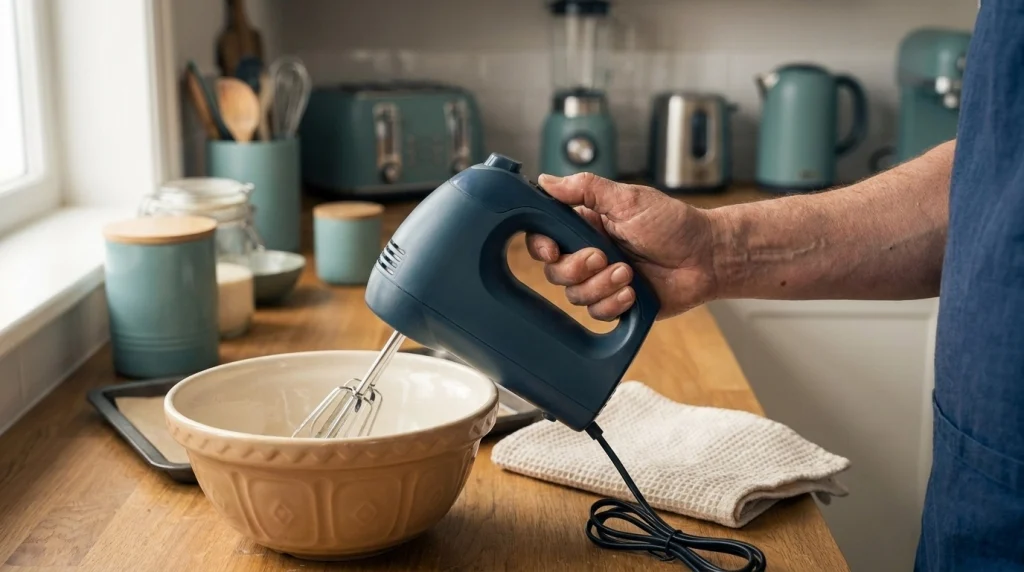
The best way to assess hand mixer grip comfort is to evaluate fit, control, weight, and handling together. If you can’t hold a model before purchasing it, use manufacturer specifications and detailed product photographs to narrow your options.
Use this five-point comfort checklist
When comparing hand mixers, check the following features before deciding which model suits your kitchen.
- Handle fit: Confirm that the grip looks suitable for your hand size and preferred holding position.
- Weight: Check the listed weight and whether it includes attachments or packaging.
- Surface finish: Look for a comfortable, secure grip rather than a slippery or sharply edged handle.
- Control access: Make sure the speed selector and other frequently used controls appear easy to reach.
- Workload suitability: Check whether the mixer supports the batters, creams, and other mixtures you prepare regularly.
Compare the main comfort factors
This table summarizes how different design characteristics may affect handling. These are general ergonomic comparisons, not measured results from specific mixer models.
| Factor | Potential comfort benefit | Warning sign |
|---|---|---|
| Contoured handle | Supports a natural hand position | Grooves force your fingers into awkward positions |
| Non-slip finish | Improves grip security | Texture feels rough or uncomfortable |
| Manageable weight | Reduces the load you must support | Arm or wrist tires quickly |
| Balanced body | Makes the mixer easier to guide | The front constantly pulls downward |
| Accessible controls | Allows adjustments without shifting your grip | Your thumb must stretch or your fingers must loosen |
| Low, controlled starting speed | Helps reduce sudden splashing and movement | The mixer starts too abruptly for your preferred technique |
Try a safe, practical grip test
If a retailer allows you to handle a display model, use this simple assessment before buying it.
- Hold the mixer: Notice whether your fingers wrap naturally around the handle.
- Check your wrist: See whether you can maintain a comfortable position without bending sharply.
- Reach the controls: Confirm that the buttons are accessible without losing your secure hold.
- Assess the balance: Notice whether the body feels manageable when held in a typical mixing position.
- Consider your recipes: Compare the design with the types and quantities of food you regularly prepare.
Keep the appliance switched off and unplugged during this handling assessment. Never test the beaters by running a mixer in the air or near your fingers.
When buying online, check the manufacturer’s published weight, handle images, user manual, warranty terms, and customer feedback about comfort. Treat individual reviews as personal experiences rather than proof that a model will suit everyone.
For broader appliance-safety information, consult the U.S. Consumer Product Safety Commission. For model-specific handling and operating limits, the manufacturer’s instructions should take priority.
Section Takeaway: Evaluate grip comfort before comparing extra features or maximum wattage. A mixer that fits your hand and workload is often the more practical choice.
Hand Mixer Grip Comfort FAQs
1. What makes a hand mixer comfortable to hold?
A comfortable hand mixer combines a suitable handle size, secure surface, manageable weight, balanced body, and accessible controls. The handle should fit your hand without forcing a tight squeeze, while the overall design should let you guide the beaters without awkward wrist movements.
2. Is a lightweight hand mixer always more comfortable?
No. A lightweight mixer can reduce the load on your arm, but poor balance or an awkward handle can still make it difficult to control. Consider the appliance’s weight distribution, grip shape, and control placement together instead of choosing solely by its listed weight.
3. Are rubber grips better than plastic handles?
Not necessarily. Rubberized or soft-touch sections may improve traction, while smooth plastic can offer a firm, simple surface. Comfort depends on the material’s texture, the handle’s shape, and your preferences, so look for a secure grip that doesn’t create pressure points or feel uncomfortable.
4. Can a hand mixer cause wrist fatigue?
Yes. Holding and steering a mixer requires sustained effort, particularly during longer sessions or when mixing thick ingredients. A front-heavy body, awkward wrist position, slippery handle, or excessive grip pressure may increase discomfort. Better positioning and a suitable mixer can help reduce unnecessary strain.
5. Does a higher-wattage hand mixer provide better grip comfort?
No. Wattage describes electrical power consumption, not handle comfort or balance. A higher-wattage model may suit certain mixing tasks, but grip comfort also depends on weight distribution, vibration, handle design, and control placement. Choose power according to your recipes and handling according to your needs.
6. How can I make my current hand mixer easier to hold?
Start by drying your hands, adjusting the bowl to a comfortable height, and keeping your wrist in a natural position. Use appropriate speeds and avoid forcing the mixer through thick mixtures. If discomfort persists, consider a better-fitting model and follow the manufacturer’s operating instructions.
7. What should people with small hands look for in a hand mixer?
People with small hands should prioritize a handle they can wrap around comfortably, reachable controls, manageable weight, and a balanced body. Product photographs can help narrow the choices, but holding the appliance in person provides a more reliable assessment of fit whenever possible.
Comfort should never require you to ignore persistent pain, numbness, or tingling. Stop using the appliance if these symptoms develop, and seek appropriate medical advice if they persist or recur.
Final Takeaway: Prioritize Fit, Balance, and Control
What affects hand mixer grip comfort is a combination of ergonomic design and the demands of your kitchen routine. Handle shape, thickness, surface material, weight distribution, wrist angle, control placement, and vibration all influence how natural the appliance feels during use.
My recommendation is to prioritize a secure, well-fitting handle and manageable balance before paying extra for more speed settings or higher wattage. Compare the specifications with your usual recipes, and test the grip whenever possible.
A comfortable mixer should let you focus on the ingredients rather than constantly adjusting your hand. Choosing carefully can make everyday baking more manageable and enjoyable.
Affiliate disclosure: This article is intended to provide general educational guidance. If affiliate links are added to this page, the site may earn a commission from qualifying purchases at no additional cost to the reader.
How This Guide Was Researched
This guide draws on general ergonomic principles and publicly available hand mixer buying information from KitchenAid, Bosch, and other relevant appliance resources. Product-specific comfort measurements and hands-on comparative testing were not conducted for this article, so model-dependent observations are presented as general considerations rather than verified test results.