Quick Answer
A hand mixer is balanced through its weight distribution, handle position, motor placement, and attachment alignment. A well-designed model keeps the center of gravity close to the user’s grip or positions more weight over the beaters, helping reduce wrist strain and improve control. The best way to judge balance is to check how naturally the mixer sits in your hand and how much effort it takes to keep the beaters steady in a bowl.
What affects hand mixer balance?
- Center of gravity: The location of the mixer’s combined weight influences how it tilts in your hand.
- Handle design: A comfortable grip helps your wrist maintain a natural position.
- Motor placement: Positioning the motor above the attachments can direct more weight toward the bowl.
- Overall weight: A lighter mixer can reduce lifting effort, but poor weight distribution may still make it awkward.
- Attachment alignment: Properly fitted beaters help the mixer run smoothly without unnecessary wobbling.
- Mixing technique: Keeping the beaters immersed and moving steadily helps maintain control.
How can you check the balance?
- Hold the switched-off mixer by its normal handle and notice whether its weight pulls your wrist forward or backward.
- Check that the mixer rests securely when placed upright, if its design supports that position.
- Consult the manufacturer’s guidance on hand mixer weight and design before choosing a model.
When choosing a hand mixer, balance matters just as much as power and speed. A mixer can have plenty of motor power yet feel uncomfortable if its weight pulls your wrist away from a natural position.
In this guide, I’ll explain how center of gravity, handle shape, motor placement, and attachments influence balance. You’ll also learn how to assess comfort, identify common balance problems, and choose a mixer that feels easier to control during everyday baking.
In This Guide
How Does Hand Mixer Balance Work?
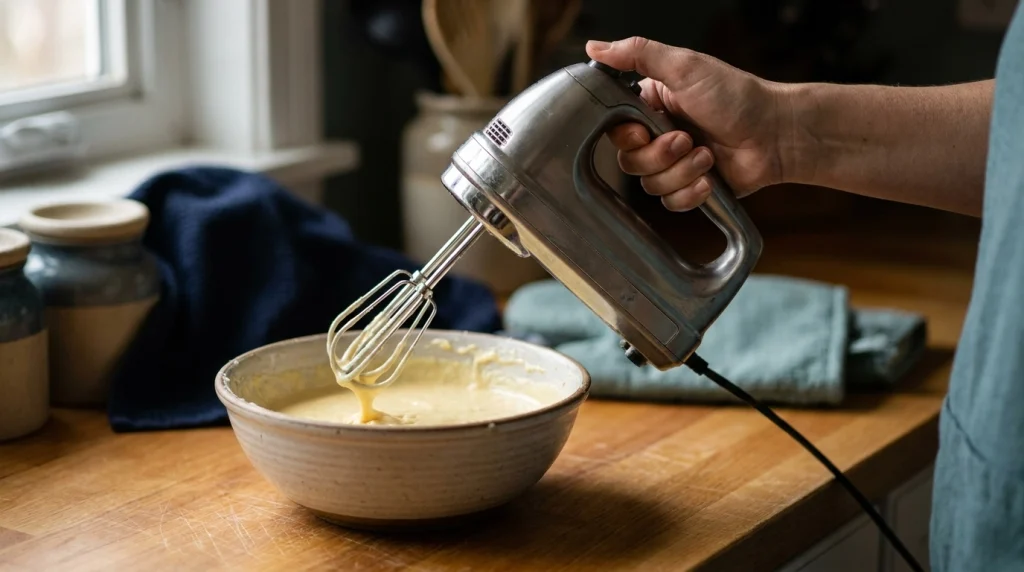
A hand mixer is balanced when its weight and shape allow you to hold and guide it without constantly correcting its tilt. The relationship between its center of gravity, handle, and beaters determines how it feels during use.
What is the center of gravity of a hand mixer?
The center of gravity is the point where an object’s weight can be considered to act. In a hand mixer, it depends on the combined mass and position of the motor, housing, handle, cord, and other components.
If that point sits far from your hand, the mixer can create a greater turning force on your wrist. Engineers call this turning force a moment or torque, and it helps explain why two mixers of similar weight can feel different.
For example, imagine holding a 1 kg object close to your wrist, then holding the same object farther away. The second position feels harder to support because the weight acts through a longer lever arm.
The same principle applies to a hand mixer. A bulky housing extending forward can feel nose-heavy, while a design that brings the weight closer to the grip may feel easier to control.
How do the handle and beaters work together?
The handle gives your hand a point from which to support and steer the appliance. The beaters extend below the housing, so their position also affects how the mixer behaves as you move it around a bowl.
A comfortable design lets you guide the attachments without bending your wrist sharply or squeezing the handle too tightly. Your hand should feel in control rather than continually fighting the appliance’s weight.
Balance is not simply a matter of making the mixer perfectly horizontal. It means creating a practical relationship between weight, grip, attachment position, and the movement needed for the intended mixing task.
Why does balance matter during baking?
Good balance can make repeated movements feel less tiring, particularly when you’re creaming butter and sugar or whipping cream for several minutes. It can also help you maintain a steady mixing path and avoid scraping the beaters unnecessarily against the bowl.
However, balance alone doesn’t determine mixing performance. Motor power, beater design, speed control, and the thickness of the ingredients all affect how well a mixer handles a recipe.
- Better control: A comfortable grip makes it easier to guide the beaters through the mixture.
- Less wrist effort: Suitable weight distribution can reduce the force needed to resist unwanted tilting.
- Steadier movement: A manageable mixer is easier to move between the center and edges of a bowl.
- More comfortable use: Handle shape and grip texture can help reduce discomfort during routine tasks.
Section Takeaway: A well-balanced hand mixer feels predictable in your hand. Its weight, grip, and attachment position work together instead of making your wrist constantly compensate.
What Affects a Hand Mixer’s Balance?
Hand mixer balance depends on several design choices rather than one isolated feature. Weight distribution, handle geometry, motor location, and attachment fit all influence how stable and comfortable the appliance feels.
1. Overall weight and weight distribution
Weight affects how much effort you need to lift and hold a mixer, but total weight doesn’t tell the whole story. A slightly heavier model may feel more comfortable than a lighter one if its mass sits closer to your hand.
KitchenAid’s published buying guidance describes hand mixers weighing roughly 2–5 pounds, with many models around 2–3 pounds. These figures are a general category reference, not a recommended target for every user or a guarantee of good balance.
When comparing models, consider the weight alongside the housing shape and the distance between the grip and the heaviest components. The combination matters more than a single number.
2. Motor placement
The motor is often one of the heaviest components inside an electric hand mixer. Moving it changes the appliance’s center of gravity and can alter how much force your hand needs to apply.
Some models use a vertical motor arrangement that positions the motor directly over the attachments. Braun describes this approach in its MultiMix 3 range as SmartMix technology, designed to direct more of the mixer’s weight into the bowl rather than the user’s hand.
This design illustrates an important point: a balanced mixer does not necessarily have to feel weightless. Instead, its structure can direct the load in a way that reduces the effort required to hold it steady.
3. Handle shape and grip texture
The handle determines how comfortably your hand can support the mixer’s weight. A grip that fits your hand and allows your wrist to stay in a natural position can make the appliance easier to control.
Look for a handle that allows your fingers to wrap around it without excessive squeezing. A soft or textured grip may also help prevent slipping when your hands become damp during food preparation.
Control placement matters, too. A speed switch or dial should be reachable without forcing you to loosen your grip or twist your wrist awkwardly.
4. Beater alignment and attachment design
Attachments influence balance differently from the main housing. Properly fitted beaters should sit securely in their sockets and rotate as intended, while the attachment design affects how ingredients move through the bowl.
Some mixers include wire beaters, whisks, or dough hooks. These accessories can differ in weight and shape, so the appliance may feel slightly different depending on the attachment installed.
Never assume that a wobbling attachment is a normal balance characteristic. If a beater looks bent, sits unevenly, or makes unusual contact with its partner, switch off and unplug the mixer before inspecting it according to the manual.
5. Cord position and exterior shape
A power cord can pull against your hand if it catches on a cabinet, bowl, or countertop edge. A swivel cord outlet or a thoughtfully placed cord can make movement less awkward.
The mixer’s outer shape also affects how easily you can maneuver it around the bowl. A design that feels stable in a straight position may still be awkward if its housing obstructs your view of the mixture.
Section Takeaway: Judge the entire design, not just the weight printed on the product page. Motor position, handle comfort, attachment fit, and cord placement all contribute to practical balance.
How Do Handle Shape, Weight, and Motor Placement Affect Balance?
Handle shape determines how you hold a mixer, while weight and motor placement influence the forces your hand must resist. These features work together, so the most comfortable design depends partly on your hand size and typical mixing tasks.
What makes a handle ergonomically balanced?
An ergonomic handle is shaped to support a comfortable, controlled grip during normal use. It should allow you to guide the mixer without excessive wrist bending, finger pressure, or awkward reaching for the controls.
A handle’s ideal shape is not identical for everyone. Someone with smaller hands may prefer a slimmer grip, while another user may appreciate a broader handle that spreads pressure more comfortably across the palm.
Try to maintain a relatively straight wrist when holding the mixer. If you need to bend your wrist sharply just to keep the beaters level, the handle angle or overall design may not suit you.
Is a lighter hand mixer always better balanced?
No. A lighter hand mixer generally requires less effort to lift, but poor weight distribution can still make it feel unstable or nose-heavy.
Consider these practical differences:
- Light but front-heavy: May feel easy to lift initially but tiring to keep level.
- Moderate weight with a close center of gravity: May feel more controlled because less turning force acts around your grip.
- Heavier with a comfortable handle: May feel secure for short jobs but become tiring during extended mixing.
Your own comfort should guide the decision. If you regularly whip cream or mix cake batter for several minutes, sustained holding effort may matter more than a small difference in total weight.
How does motor placement improve comfort?
Motor placement changes the relationship between the appliance’s weight and its attachment points. A design that positions more of the motor’s mass directly above the beaters may transfer more of the load toward the bowl.
For example, Braun’s MultiMix 3 hand mixer range advertises a vertical motor arrangement intended to reduce effort during mixing. That is a manufacturer-described design benefit, not proof that every user will experience the same comfort improvement.
Compare that approach with a traditional housing whose motor sits farther back or forward relative to the grip. Either arrangement can work well, but the final result depends on the full geometry of the mixer.
Does balance affect how well a mixer handles thick batter?
Balance can help you steer the appliance, but it cannot replace adequate motor capacity. Thick cookie dough creates more resistance than thin pancake batter, so even a comfortable mixer may require more effort during demanding jobs.
Match the mixer to your recipes. Use the manufacturer’s recommended attachments and speeds, and avoid forcing a small appliance through dough that exceeds its stated capabilities.
| Design feature | Potential benefit | What to check |
|---|---|---|
| Low overall weight | Less lifting effort | Whether the front still feels heavy |
| Motor above attachments | May direct more weight toward the bowl | Actual grip comfort and wrist position |
| Contoured handle | More natural hand position | Fit, grip size, and control access |
| Textured grip | More secure handling | Whether the surface feels comfortable |
| Stable resting base | May reduce tipping when set down as designed | Whether the model is intended to stand upright |
Section Takeaway: Good balance comes from how the handle, motor, and attachments work together. Choose a design that feels comfortable in your hand and suits the thickness and duration of your usual mixing jobs.
How Can You Test a Hand Mixer’s Balance?
You can assess a hand mixer’s balance by checking its weight distribution, grip comfort, resting stability, and control placement. A simple inspection before mixing helps you spot design issues without risking damage to the appliance.
Step 1: Check the mixer while switched off
Start with the mixer unplugged or switched off and safely disconnected from its power source. Remove the attachments if the manufacturer recommends doing so for inspection.
Hold the mixer by its normal handle and pay attention to where the housing seems to pull. Notice whether the front dips, the rear feels heavy, or the appliance rests naturally in your palm.
- Does the handle fit your hand without forcing your fingers into an uncomfortable position?
- Can you hold the appliance without squeezing excessively?
- Does the weight feel reasonably close to your grip?
- Can you reach the speed control without shifting your entire hand?
This check is subjective, but useful. It helps you identify whether the mixer’s shape suits your hand before you begin a recipe.
Step 2: Check the resting position
Some hand mixers are designed to stand upright on their base, while others are intended to rest on their side or on a supplied stand. Follow the manufacturer’s instructions rather than assuming every model should stand independently.
If the mixer has a designated resting position, place it on a dry, level countertop and check whether it sits securely. A mixer that repeatedly tips from its intended resting position may be inconvenient and could spill ingredients nearby.
Don’t balance the appliance precariously or leave it resting where its beaters could contact the counter edge. The goal is to confirm its intended stability, not to test how far it can tilt before falling.
Step 3: Evaluate the grip during normal mixing
Once the mixer passes the initial inspection, you can assess it during an ordinary recipe. Read the manual, fit the correct attachments, and begin with a suitable mixture in a stable bowl.
- Place the beaters inside the bowl before switching the mixer on.
- Start at the lowest recommended speed.
- Guide the mixer steadily through the ingredients without pressing the beaters hard against the bowl.
- Notice whether your wrist remains comfortable and whether you can steer the appliance without fighting its weight.
- Switch it off before moving the bowl, scraping ingredients from the sides, or making adjustments.
KitchenAid’s hand mixer operating guidance also recommends starting slowly and increasing speed as needed. This approach helps you maintain control while ingredients begin to combine.
Step 4: Distinguish balance from mixing performance
A mixer may feel balanced but still struggle with thick ingredients because its motor or attachments aren’t suited to the task. Conversely, a powerful mixer may feel uncomfortable if its housing places too much weight away from your hand.
Observe these differences when assessing comfort:
- Weight-related strain: Your wrist tires even when the mixture offers little resistance.
- Mixing resistance: The appliance becomes harder to guide mainly when the ingredients thicken.
- Possible attachment issue: A beater appears misaligned, wobbles unusually, or makes abnormal contact.
- Possible mechanical issue: The mixer produces unexpected grinding, persistent vibration, or unusual noises.
Stop using the mixer if you notice abnormal vibration, damaged attachments, or signs of an electrical or mechanical fault. Unplug it before checking anything, and use the manufacturer’s support service when the cause isn’t clear.
Section Takeaway: Check balance in two stages: inspect the appliance while switched off, then assess its comfort during normal, safe mixing. Separate ordinary weight-related effort from problems caused by resistance or damaged parts.
What Causes Poor Balance, and How Can You Fix It?
A hand mixer that feels awkward may have an unsuitable weight distribution, an uncomfortable handle, a cord that pulls against your hand, or an attachment problem. The correct solution depends on whether the issue comes from the design, your technique, or a mechanical fault.
Why does a hand mixer feel front-heavy?
A front-heavy mixer places more of its weight toward the beater end relative to your grip. That arrangement can make the housing feel as though it wants to dip forward, increasing the effort needed to maintain your preferred angle.
If the appliance is functioning normally, try adjusting your grip slightly while keeping your wrist comfortable. You can also support the bowl securely and guide the beaters with smaller, controlled movements.
Don’t compensate by gripping harder than necessary. If the mixer remains uncomfortable during ordinary tasks, a different design with more suitable weight distribution may be a better fit.
Why does my wrist get tired while mixing?
Wrist fatigue can result from the mixer’s weight, an awkward handle angle, a tight grip, or prolonged use. Thick mixtures and long mixing sessions can increase the effort involved.
Try these practical adjustments:
- Choose a bowl height that lets you keep your shoulder relaxed and wrist relatively straight.
- Use the recommended attachment for the recipe.
- Start at a low speed and increase it gradually when appropriate.
- Keep the mixer moving smoothly rather than holding it rigidly in one position.
- Follow the manufacturer’s guidance on operating time and cooling breaks.
If discomfort continues, stop and rest rather than forcing yourself to finish the recipe. Consider a lighter model, a better-fitting handle, or a stand mixer for tasks that demand prolonged effort.
What if the mixer vibrates or the beaters wobble?
Unusual vibration isn’t automatically a balance problem. It may indicate a bent attachment, incorrect attachment installation, damage, or an internal mechanical fault.
Switch the mixer off and unplug it before inspecting the attachments. Check the owner’s manual for the correct installation method and examine the beaters for visible bends or damage.
Never touch moving beaters to test whether they’re aligned. Don’t open the motor housing or attempt internal electrical repairs unless you’re appropriately qualified and the manufacturer explicitly supports that work.
Pro tip: If vibration persists after you have checked the attachments safely, stop using the mixer and contact the manufacturer or a qualified appliance repair technician rather than dismantling the unit.
How can you prevent the cord from affecting balance?
A cord that catches on a bowl or pulls against your wrist can make a well-designed mixer feel awkward. Before mixing, position the cord so it has enough slack to move without dragging across ingredients or pulling the housing sideways.
If your model has a swivel cord connection, use it according to the manual. Never stretch the cord tightly, allow it to touch hot surfaces, or use the appliance if the cable or plug is damaged.
Can the wrong mixing technique make a balanced mixer feel unstable?
Yes. Holding the mixer at an extreme angle, pushing the beaters against the bottom of the bowl, or starting at an unnecessarily high speed can make it harder to control.
Keep the attachments immersed as appropriate for the recipe and guide them through the mixture without forcing them. If ingredients collect around the edges, switch off the appliance before using a spatula to scrape the bowl.
Section Takeaway: Don’t assume every uncomfortable mixer is defective. Correct your grip and cord position first, but stop using the appliance if you notice persistent vibration, damaged attachments, or other signs of a fault.
How Do You Choose a Well-Balanced Hand Mixer?
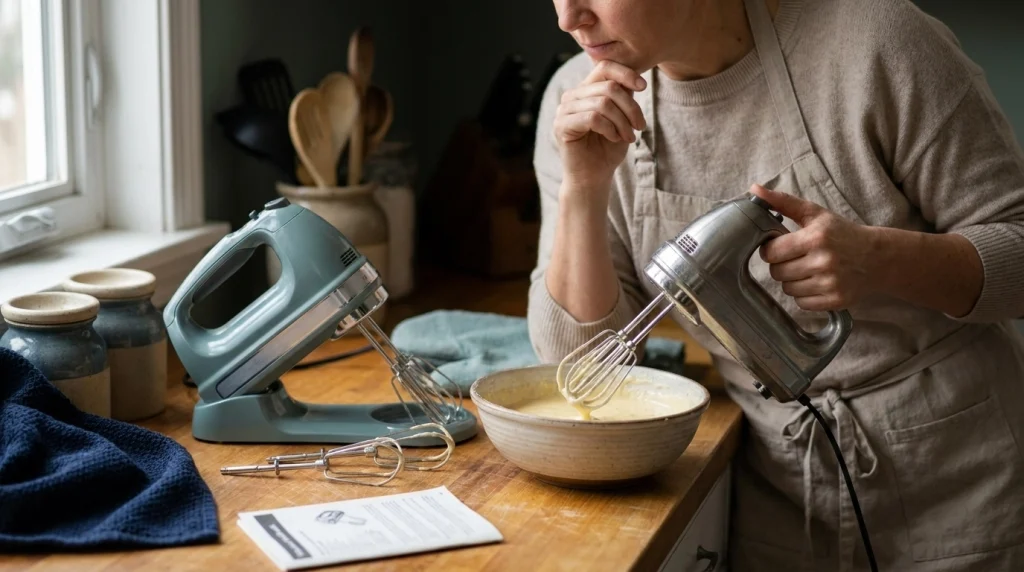
The best-balanced hand mixer is one that fits your hand, keeps your wrist in a comfortable position, and feels manageable during the recipes you prepare most often. Compare the complete design instead of choosing by wattage, weight, or appearance alone.
Which features should you compare?
When shopping in 2026, use the manufacturer’s specifications and, where possible, handle the appliance before purchasing. The following checklist can help you compare models consistently.
| Feature | What to look for | Why it matters |
|---|---|---|
| Weight | A manageable total weight | Affects lifting and holding effort |
| Weight distribution | A housing that doesn’t feel excessively nose-heavy | Can reduce unwanted tilting |
| Handle | A comfortable grip that suits your hand | Supports natural wrist positioning |
| Speed control | Easy access without changing your grip | Makes adjustments easier during mixing |
| Attachments | Secure fittings and suitable tools for your recipes | Supports correct operation and control |
| Resting design | A stable, manufacturer-approved resting position | Reduces inconvenience when pausing |
Should you prioritize balance or motor power?
Neither feature should be considered in isolation. A suitable mixer needs enough power for your intended ingredients while remaining comfortable to hold and maneuver.
Manufacturers may list wattage, speed settings, attachment types, weight, and other specifications on their product pages. Wattage alone doesn’t reliably predict how comfortable a mixer feels or how effectively it handles every recipe.
For a household that mainly prepares pancake batter, whipped cream, and light cake mixtures, a comfortable, easy-to-control model may be more useful than a heavier model with features that rarely get used. Frequent preparation of thick cookie dough calls for closer attention to the manufacturer’s stated capabilities.
What if you cannot test the mixer in person?
Use product specifications, official manuals, and clearly documented design details to narrow your choices. Look for the actual weight, handle shape, attachment arrangement, and any manufacturer explanation of how the motor is positioned.
Read customer feedback carefully, focusing on repeated comments about wrist comfort, front-heavy handling, and stability rather than relying on a single review. Treat individual experiences as useful clues, not guaranteed outcomes.
For an example of a manufacturer explaining its approach, Braun’s MultiMix 3 hand mixer information describes its motor placement and intended weight-distribution benefit. Compare those design details with other models and your own comfort needs.
How should you make the final decision?
Use this short checklist before choosing:
- Confirm the mixer’s actual weight and dimensions.
- Check whether the handle fits your hand comfortably.
- Look for a motor and housing arrangement that feels manageable.
- Make sure the speed controls are easy to reach.
- Confirm that the included attachments match your cooking needs.
- Read the manual for operating limits, cleaning instructions, and safety guidance.
Also check the manufacturer’s warranty and service options. A comfortable design is valuable, but so are clear operating instructions and access to support if something goes wrong.
Section Takeaway: Prioritize comfortable handling, appropriate motor capacity, and secure attachments together. The right balance is the one that makes your everyday mixing tasks feel controlled without unnecessary strain.
Frequently Asked Questions
1. Where should the center of gravity be on a hand mixer?
There is no single ideal position for every hand mixer. The center of gravity should work with the handle and attachment arrangement so the appliance feels manageable and doesn’t create excessive turning force around your wrist.
2. Does a heavier hand mixer have better balance?
No. A heavier mixer may feel stable, but it can also cause more fatigue during extended use. Weight distribution, handle shape, and motor placement are just as important as total weight when judging comfort.
3. Why does my hand mixer tilt forward?
Your mixer may have more weight toward the beater end, or its handle may not suit your grip. Adjust your hand position without forcing your wrist, and consider a different design if the forward pull remains uncomfortable.
4. Can motor placement make a hand mixer easier to hold?
Yes. Motor placement changes the center of gravity and how the appliance’s weight acts around your hand. Some manufacturers position the motor directly above the attachments to direct more weight toward the bowl, although the comfort benefit varies by design and user.
5. Should a hand mixer stand upright without tipping?
Only if the model is designed to rest upright in that position. Check the owner’s manual and use the designated resting position on a level surface rather than assuming every mixer has a stable upright base.
6. Why does my hand mixer vibrate during use?
Unusual vibration can come from an improperly fitted or damaged beater, a mechanical fault, or resistance from ingredients the mixer cannot handle comfortably. Switch it off, unplug it, and inspect the attachments safely; seek manufacturer support if the vibration continues.
7. How can I reduce wrist fatigue when using a hand mixer?
Choose a mixer with a comfortable handle and manageable weight distribution. Keep your wrist relatively straight, use the correct attachment and speed, avoid forcing the beaters through thick mixtures, and take breaks according to the manufacturer’s operating guidance.
Final Takeaway: Look Beyond the Weight
A hand mixer is balanced through the combined design of its handle, motor position, housing, and attachments. Good balance helps you control the beaters with less unnecessary wrist effort, but it doesn’t replace suitable motor capacity or correct mixing technique.
Before buying, compare the weight and grip, check the manufacturer’s design information, and assess how naturally the mixer sits in your hand. If you already own a mixer that feels awkward, try adjusting your technique and cord position before deciding whether the design simply doesn’t suit you.
The most useful choice is a mixer that feels comfortable, stays predictable during normal use, and handles your regular recipes within its stated limits.
Ready to compare options? Start with the manufacturer’s specifications and the hand mixer buying guide to compare weight, attachments, controls, and other practical design features before making your decision.