Quick Answer
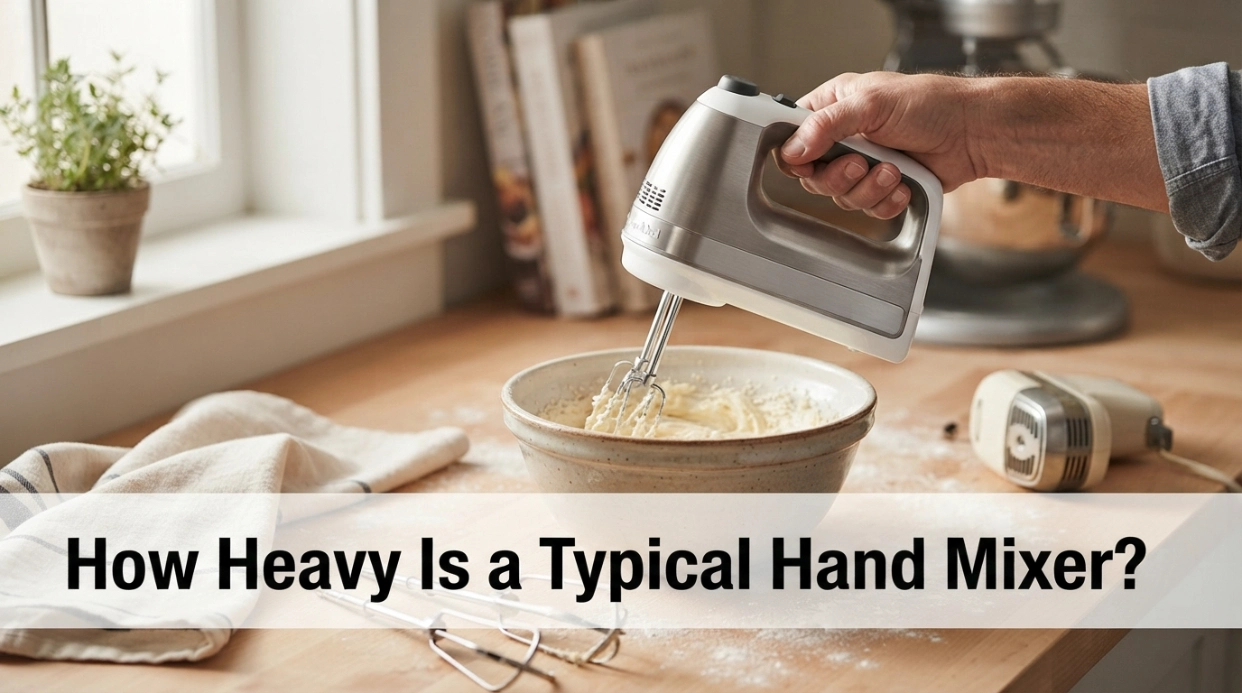
A typical hand mixer weighs about 2 to 5 pounds, although most everyday models sit closer to 2 to 3 pounds. That range is also reflected in KitchenAid’s hand mixer buying guidance. A lighter mixer is usually easier to hold for long whipping or creaming jobs, while heavier models may include larger motors, extra controls, storage systems, or more substantial housings.
What to expect
- Common range: Roughly 2 to 5 pounds for a conventional electric hand mixer.
- Typical sweet spot: Around 2 to 3 pounds suits many everyday baking jobs.
- Under 3 pounds: Often easier to control during longer whipping and beating sessions.
- Over 3 pounds: Can still be comfortable when the handle and weight distribution are well designed.
- Check the specification: Make sure a listed weight refers to the mixer itself rather than its shipping carton or storage accessories.
If you’re wondering how heavy a typical hand mixer is, the number on the scale is only part of the answer. Balance, handle shape, motor placement, and the length of your mixing session can make two similarly weighted mixers feel surprisingly different.
When I assess a hand mixer, I look at weight together with ergonomics. A compact mixer that feels balanced can be more comfortable than a lighter unit that constantly pulls your wrist forward.
In This Guide
How Heavy Is a Typical Hand Mixer?
Most hand mixers weigh somewhere between 2 and 5 pounds. KitchenAid says most models fall closer to the 2-to-3-pound portion of that range.
That’s light compared with a full-size stand mixer. However, a hand mixer remains in your hand during almost the entire mixing process.
Definition: A hand mixer is a portable electric kitchen appliance that powers removable beaters, whisks, or similar attachments while you manually guide the appliance through ingredients in a separate bowl.
A two-pound appliance may sound almost weightless on paper. Hold it over frosting for six minutes, though, and your wrist starts noticing every ounce.
That is why I consider roughly 2 to 3 pounds a useful everyday target for many home bakers. It offers portability without automatically requiring an ultra-small motor or stripped-down design.
What counts as a lightweight hand mixer?
There is no official industry cutoff for “lightweight.” For practical shopping, I would treat anything around 2 to 2.75 pounds as relatively light.
- About 2–2.75 pounds: Light for the category and attractive for frequent whipping or users sensitive to wrist fatigue.
- About 2.75–3.5 pounds: A common-feeling middle range for mainstream hand mixers.
- About 3.5–5 pounds: Noticeably heavier, especially during long continuous mixing sessions.
These are useful shopping bands rather than formal product classifications. Always compare the manufacturer’s listed measurement and what that measurement includes.
Section Takeaway: A conventional hand mixer is commonly around 2 to 5 pounds, with many mainstream models clustered near 2 to 3 pounds.
Why Do Hand Mixers Weigh Different Amounts?
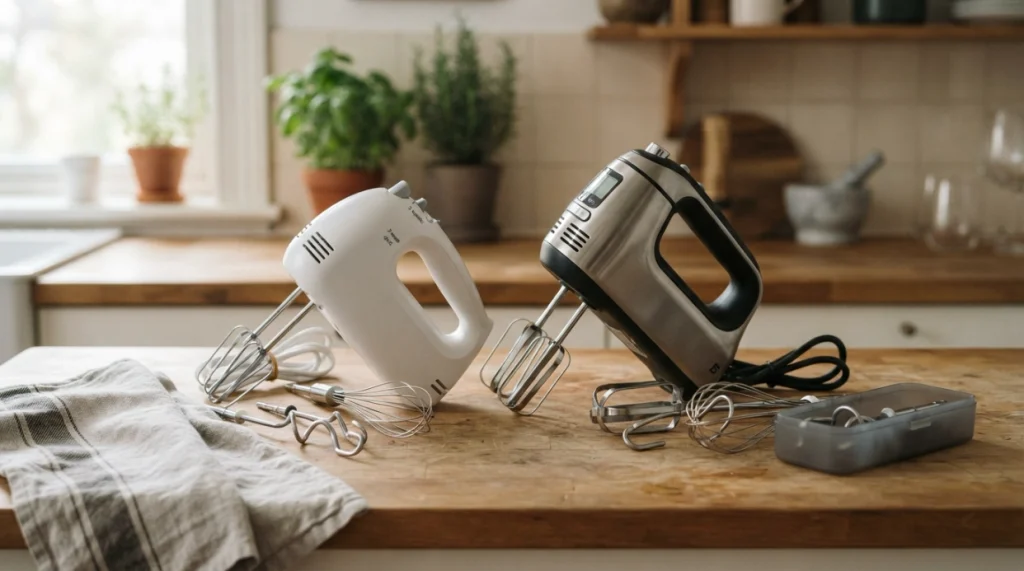
Hand mixer weight changes because manufacturers use different motors, housings, controls, attachments, and internal gear systems. Two mixers with similar outside dimensions can therefore have noticeably different weights.
Motor and internal drive system
The motor is one of the major components inside the housing. Motor design, gearing, cooling needs, and supporting hardware can all affect total mass.
Wattage alone does not tell you how heavy a mixer will be. KitchenAid notes that hand mixer power can vary widely and that motor type also matters.
Housing materials
Many everyday hand mixers use plastic external housings because plastic keeps weight and manufacturing costs manageable. Decorative metal parts or more substantial internal frames can increase mass.
A heavier exterior does not automatically mean greater durability. Construction quality matters more than weight by itself.
Controls and extra features
Basic mixers may have only a speed selector and eject button. More feature-rich designs can include electronic speed management, digital controls, lights, boost functions, or storage arrangements.
- More speed settings: May require more complex control components.
- Electronic controls: Add circuitry beyond a simple mechanical selector.
- Storage cases: Can make a packaged product appear much heavier than the mixer body.
- Extra attachments: Increase the total boxed weight but may not affect handheld weight.
- Long cords: Add a smaller amount of weight and can influence balance.
Beaters and attachments
Standard metal beaters do not add huge amounts of weight, but manufacturers may quote specifications differently. A listing might describe the bare appliance, the mixer with beaters, or everything sold in the package.
This is why I avoid comparing two weight numbers until I know what each manufacturer measured.
Section Takeaway: Motor construction, housing materials, controls, attachments, and the way manufacturers report specifications all influence a hand mixer’s stated weight.
Does Hand Mixer Weight Matter in Daily Use?
Yes. Weight matters because you support and steer the appliance while its beaters create movement and resistance in the bowl.
The effect becomes more obvious during recipes that require several minutes of continuous beating. Whipped cream, meringue, buttercream, and creamed butter and sugar are good examples.
Long mixing sessions magnify small differences
A difference of half a pound may not seem important when you first pick up two mixers. After several minutes, that difference can become easier to feel.
Arm position matters too. Holding a mixer higher over a deep bowl generally creates more strain than keeping your elbow relaxed beside a shallow bowl.
Balance can matter more than the scale
A well-balanced three-pound hand mixer may feel easier to use than an awkward 2.5-pound one. The motor’s position relative to the handle changes how much the appliance tries to rotate your wrist.
I therefore pay attention to where the weight sits. A handle placed near the mixer’s center of mass usually gives you better control.
Heavy mixtures change the experience
Thicker mixtures create more resistance around the beaters. You then spend more effort guiding the appliance and preventing it from twisting or wandering.
- Whipped cream normally creates little resistance.
- Cake batter creates more noticeable drag.
- Thick cookie mixtures can demand much more control.
- Dough should only be mixed with compatible attachments and within the manufacturer’s stated limits.
Do not assume a heavier mixer is automatically suitable for dense dough. Follow the appliance manual and use only approved attachments.
Pro tip: If a mixer overheats, develops an electrical smell, sparks, or has a damaged cord, stop using it. Check the manual or contact a qualified appliance technician rather than opening or bypassing safety components yourself.
For broader electrical-appliance safety context, the U.S. Consumer Product Safety Commission provides guidance covering household electrical products.
Section Takeaway: Mixer weight matters most during longer jobs, but balance, bowl height, handle design, and mixture thickness strongly affect how heavy the appliance feels.
How Does Hand Mixer Weight Compare Across Real Models?
Real product specifications show why a single “average” number cannot describe every hand mixer. Even mainstream models can sit on different sides of the common 2-to-3-pound range.
As of 2026, the examples below use manufacturer-published figures. Notice that KitchenAid labels its number as gross weight, while Cuisinart labels its figure as unit weight.
| Model / Reference | Listed Weight | How Source Labels It | What It Shows |
|---|---|---|---|
| Typical hand mixer category | About 2–5 lb | General range | KitchenAid says most models are around 2–3 lb. |
| KitchenAid KHM512 5-Speed | 2.6 lb | Gross weight | Near the lighter end of the mainstream range. |
| Cuisinart HM-50 Power Advantage | 3.05 lb | Unit weight | Close to the middle of a typical everyday range. |
The labels are important. A “gross weight” figure is not necessarily measured the same way as a “unit weight” figure.
Retail listings can create even more confusion because they sometimes show shipping weight. That number may include the box, manuals, beaters, storage case, and protective packaging.
How should you compare weight specifications?
- Look for “net” or “unit” weight first. Those terms are usually more useful for estimating what you will hold.
- Check whether accessories are included. A storage case or dough hooks can change packaged weight.
- Compare the manufacturer’s terminology. Do not treat gross and net figures as identical.
- Use dimensions as context. A compact body may distribute weight differently from a longer mixer.
Published specifications can also change between model revisions or regional versions. Check the exact model number before buying.
Section Takeaway: Real models confirm that roughly 2.5 to just over 3 pounds is common, but specification labels must be compared carefully.
What Weight Hand Mixer Should You Choose?
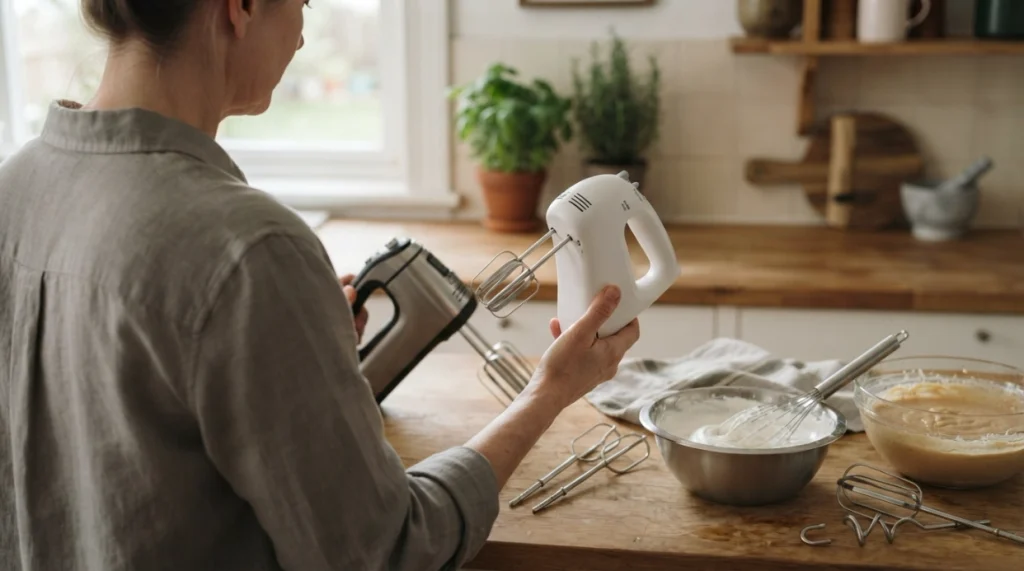
For many home cooks, a mixer around 2 to 3 pounds is a sensible starting point. It is light enough for regular handling without making weight the only buying criterion.
Your ideal choice depends on what you mix and how long you normally run the appliance.
Choose a lighter model when…
- You frequently whip cream or egg whites for several minutes.
- You have limited grip strength or wrist mobility.
- You move the appliance in and out of a high cabinet.
- You mainly make light batters, frosting, or whipped mixtures.
- You value portability more than extra electronic features.
A slightly heavier mixer may still make sense when…
- The handle feels balanced and comfortable in your hand.
- The model includes controls or attachments you will genuinely use.
- You usually mix for short periods.
- The motor housing remains easy to steer through your normal recipes.
Try not to buy by weight alone. Speed control, attachment design, noise, cord position, cleaning, warranty, and low-speed control can matter just as much.
Safety construction matters as well. UL Solutions’ overview of IEC 60335-1 explains the broader safety standard covering household and similar electrical appliances.
My practical rule
If two mixers meet your feature needs, I would usually favor the one that feels easier to hold and steer. An appliance you dislike holding tends to stay in the cabinet.
For online shopping, start around the 2-to-3-pound range and then check reviews or manufacturer information about handle comfort and balance. That approach is more useful than chasing the absolute lightest number.
Section Takeaway: Around 2 to 3 pounds is a practical target for many buyers, but comfortable balance and useful features matter more than shaving off a few ounces.
Hand Mixer Weight FAQ
Is a 3-pound hand mixer heavy?
No. A three-pound hand mixer sits close to the normal range for many mainstream models. It may feel tiring during long mixing sessions, though, especially if the handle is poorly balanced or you hold the bowl and mixer in awkward positions.
What is considered a lightweight hand mixer?
A hand mixer around 2 to 2.75 pounds can reasonably be considered lightweight for shopping purposes. There is no universal industry definition, so compare exact model specifications rather than relying only on marketing terms such as “lightweight.”
Are cordless hand mixers lighter than corded mixers?
Not necessarily. Cordless mixers remove the power cord but require a battery inside the appliance. Battery weight can offset some of the weight saved elsewhere, so check the complete unit specification before assuming cordless means lighter.
Why does my hand mixer feel heavier than its specification suggests?
Weight distribution can make a light appliance feel heavy. A front-heavy motor, tall bowl, uncomfortable handle angle, thick mixture, or long mixing session can increase wrist and forearm fatigue even when the scale number looks modest.
Does a heavier hand mixer have a stronger motor?
Not automatically. Motor design, gearing, electronics, cooling, and efficiency all influence performance. A higher appliance weight does not prove that a mixer delivers more useful mixing power or handles heavier dough safely.
Should seniors choose the lightest possible hand mixer?
A lighter mixer can reduce the amount of weight held during use, but grip shape and balance are also important. A slightly heavier model with a comfortable centered handle may be easier to control than an extremely light but awkward design.
Does the listed hand mixer weight include the beaters?
It depends on the manufacturer. Some specifications use unit weight, while others show gross or packaged weight. Check the exact wording and model documentation before comparing two mixers by a single number.
Final Takeaway
A typical hand mixer weighs roughly 2 to 5 pounds, and many everyday models fall around 2 to 3 pounds. That makes the category far easier to lift and store than most stand mixers.
Still, the best weight is the one you can comfortably control through your normal recipes. Look beyond the scale and consider balance, handle design, attachments, speed control, and how long you usually mix.
If you are choosing between similar models, check whether each weight specification describes the unit, gross product, or shipping package. That one detail can prevent a misleading comparison.
