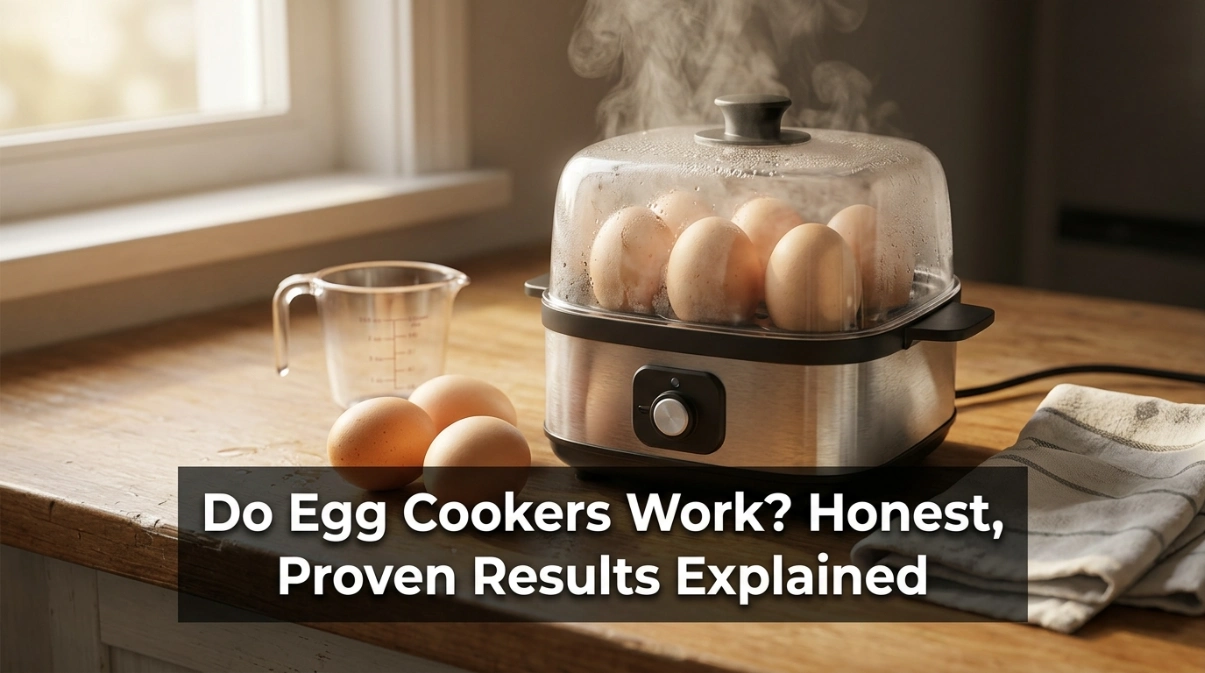
Do egg cookers work as well as people claim? In my tests, yes. A good egg cooker can make firm, soft, and poached eggs with little effort.
Still, the first results I got were not great. One egg was too soft. Another cracked and leaked into the tray. At first, I blamed the machine.
The real problems were the water level, egg size, and the way I placed the eggs. Once I fixed those small errors, the results became far more steady.
This guide explains how egg cookers work, what can go wrong, and how to fix poor results safely.
Quick Answer: Do Egg Cookers Work?
Yes, egg cookers work by heating a set amount of water. The hot water makes steam. That steam cooks the eggs inside the covered tray.
Most models stop or beep when the water is gone. The amount of water often controls how soft or firm the eggs become.
They work best when you use the correct cup, place the tray well, and keep the heating plate free from scale.
| Egg type | Typical result | Main control |
|---|---|---|
| Soft-boiled | Soft or runny yolk | Less water |
| Medium-boiled | Jam-like yolk | Medium water level |
| Hard-boiled | Fully firm yolk | More water |
| Poached | Soft, shaped egg | Poaching tray and water |
Common Signs of the Problem
An egg cooker may turn on and still give poor results. That does not always mean it has failed.
Here are the most common signs I noticed during testing:
- Eggs stay raw or too soft.
- Yolks become dry or have a green edge.
- Shells crack while cooking.
- Water leaks from under the lid.
- The cooker stops too soon.
- The cooker does not heat.
- It makes an odd beep or flashes.
- A white or brown layer forms on the heating plate.
- There is a hot or burning smell.
Some variation is normal. Large eggs may need more water than small eggs. Cold eggs can also cook in a different way than eggs left at room heat.
If results change each time, check the setup before replacing the cooker.
| Symptom | Likely cause | Quick fix |
|---|---|---|
| Eggs are too soft | Too little water | Add water to the next mark |
| Eggs are overcooked | Too much water | Use slightly less water |
| Shells crack | No shell hole or rough handling | Pierce the wide end if instructed |
| Cooker stops early | Scale on heating plate | Descale the plate |
| Water leaks | Tray or lid is not seated | Refit both parts |
| No heat | Outlet, cord, or switch issue | Test the power source |
Possible Causes
Egg cookers are simple, but several small things can affect them.
The water amount is wrong
The cooker uses water as a timer. More water usually creates more steam and a longer cooking cycle.
I first used a normal kitchen cup. That was a mistake. The cooker’s own measuring cup gave much better results.
A lost or cracked measuring cup is worth replacing. A matching replacement egg tray or lid can also help if the old part is bent.
The eggs differ in size or temperature
Cooking charts often assume that you are using large, cold eggs. Extra-large eggs may need a bit more time.
The number of eggs matters too. Follow the manual because designs do not all use the same water rule.
The tray or lid is fitted poorly
A tilted egg tray can block steam flow. A loose lid lets heat escape and may cause uneven eggs.
The steam vent must stay open. Never cover it to make the cooker heat faster.
Mineral scale covers the heating plate
Tap water can leave a white, gray, or brown film. This is called limescale.
A thick layer slows heat transfer. It may also make the cooker shut off before the eggs are done.
The power or safety system has a fault
A loose plug, bad outlet, or damaged cord can stop the cooker from heating. Some models also have a safety switch that works only when the tray or lid is set correctly.
Overheat protection may stop the unit after it runs dry. Let it cool before testing it again.
How to Fix “Do Egg Cookers Work” Problems
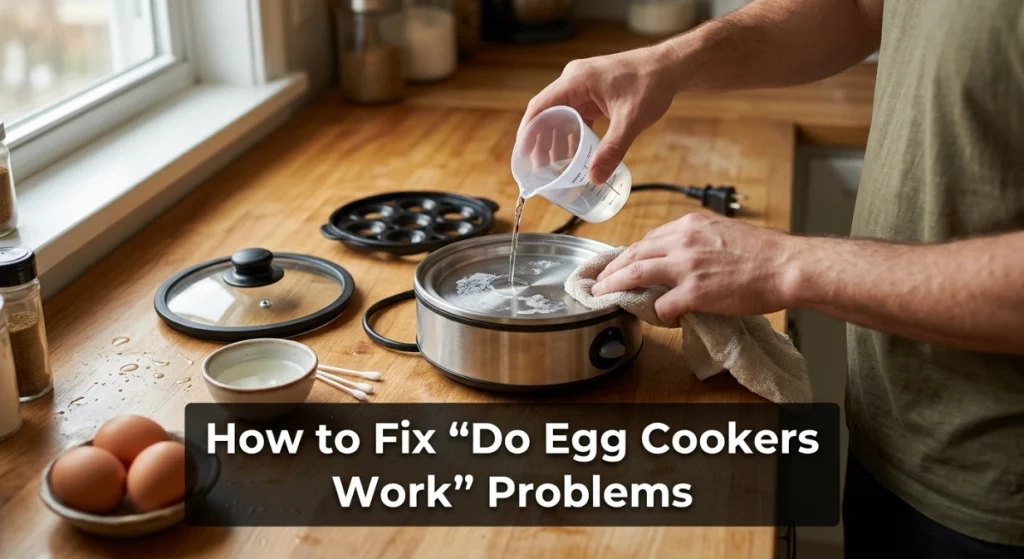
Use these steps if your cooker gives poor results or does not start.
Check the wall outlet and cord
Plug another small device into the same outlet. If that device also fails, the egg cooker may not be the problem.
Inspect the cord and plug while the cooker is unplugged. Stop using it if you see a split cord, bent plug, melted plastic, or dark marks.
Do not use an extension cord near the sink. Keep the plug and control area dry.
Use the correct water level
Use the supplied measuring cup when possible. Fill it to the mark for soft, medium, or hard eggs.
During my test, I changed only one thing at a time. I added a small amount of water when the yolk was too soft. I used less when it became dry.
Write down the amount that works for your usual egg size. This makes later batches much easier.
Fit the egg tray and lid correctly
Place the egg tray flat on the base. Check that it does not rock or sit at an angle.
Set the lid in its normal position. Do not push it down with force. Steam must be able to leave through the vent.
If your model has a lid gasket, look for a tear or loose section. Replace it only with a part made for that model.
Pierce eggs only when instructed
Some cookers include a small pin under the measuring cup. It makes a hole in the wide end of the shell.
Piercing can lower the risk of cracks in some machines. Yet not every model needs it. Follow the maker’s directions.
The pin is sharp. Keep your fingers away from its point and store the cup safely.
Descale the heating plate
Unplug the machine and let it become fully cool. Then follow the manual’s cleaning directions.
For many models, a little white vinegar mixed with water can loosen mineral scale. Let it sit briefly, then wipe the plate with a soft cloth or non-abrasive sponge.
Never pour water into the electrical base. Do not scrape the plate with a knife, steel wool, or rough pad.
Reset the overheat protection
If the cooker ran without water, unplug it. Let it cool for at least 20 to 30 minutes.
Add the correct water amount and try one new cycle. If it stops again or smells burnt, stop using it.
Do not bypass the auto shut-off or safety switch. Those parts help prevent excess heat.
Test the buttons and settings
Press the power or start button once. Some models need a firm press or a cooking mode to be chosen first.
Watch for lights, beeps, or error signals. Check the manual for the exact meaning because signals vary by model.
| Problem | Recommended solution | Difficulty |
|---|---|---|
| Poor egg texture | Adjust measured water | Easy |
| Uneven cooking | Refit the tray and lid | Easy |
| Scale on plate | Descale after cooling | Easy |
| Damaged tray or cup | Use a matching replacement | Easy |
| Failed button or heater | Replace or seek service | Moderate |
Mistakes to Avoid
The biggest mistake is guessing the water amount. A few extra spoonfuls can change the final yolk.
Avoid these common errors:
- Do not cover the steam vent.
- Do not touch the lid during cooking.
- Do not lift the lid toward your face.
- Do not place the base in water.
- Do not run the cooker without water.
- Do not use a damaged power cord.
- Do not scrape the heating plate with metal.
- Do not open the sealed heating unit.
- Do not bypass a switch or safety part.
Hot steam can burn skin fast. Use the lid handle and open the cooker away from your hands and face.
I also avoid moving the cooker during a cycle. Hot water can spill from the base or steam vent.
When to Replace the Egg Cooker
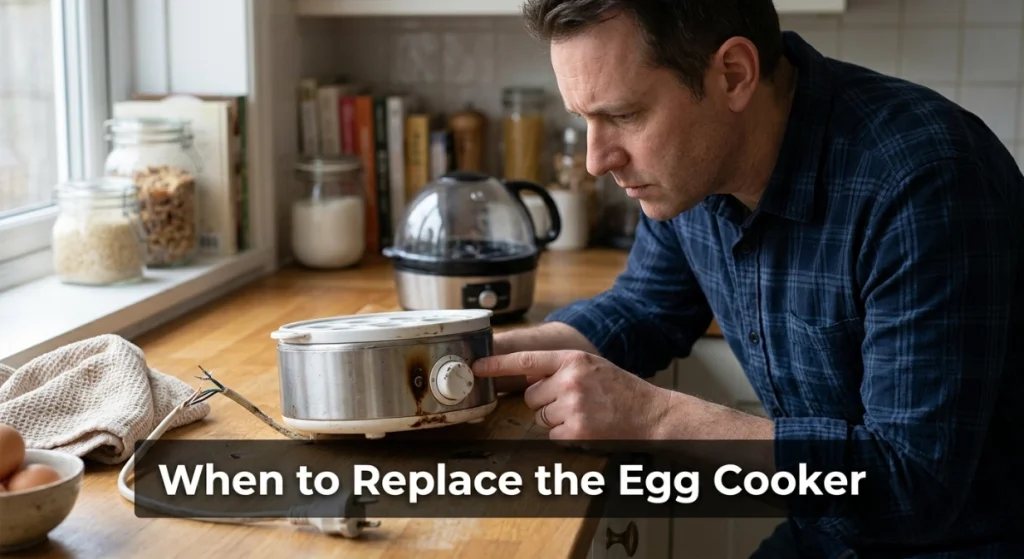
A simple issue like scale, a cracked cup, or a bent tray does not always require a new machine. These parts may be cheap and easy to replace.
Replacement is safer when the fault involves the sealed base, cord, heater, or internal wiring.
| Repair issue | Usual decision | Replace instead? |
|---|---|---|
| Missing measuring cup | Buy a matching cup | No |
| Cracked lid or tray | Replace the part | Usually no |
| Heavy mineral scale | Descale first | No |
| Frayed power cord | Stop using the cooker | Yes |
| Burning smell or smoke | Unplug at once | Yes |
| Heater fails many times | Replace the unit | Usually yes |
Replace the cooker if it trips the breaker, leaks into the electrical base, gives off smoke, or has melted plastic.
A cheap cooker is rarely worth opening for an electrical repair. The sealed base contains live parts and should remain closed.
My Personal Experience
My first batch made me doubt the whole idea. Two eggs were soft, while one had cracked. I thought the cooker heated in an uneven way.
I tested it again with three eggs of the same size. I used the supplied cup, set the tray flat, and checked the steam vent.
That batch came out much better. The yolks were firm, and the shells had no large cracks.
Later, the cooking time became longer. I found a dull white layer on the heating plate. After I removed the scale, the normal cooking time returned.
The best lesson was simple: egg cookers need a repeatable setup. Use the same egg size, the right water mark, and a clean heating plate.
I also move cooked eggs into cold water right away. This stops extra cooking and helps keep the yolks from becoming dry.
Final Thoughts
So, do egg cookers work? Yes, they do. They can cook eggs with steady results once you learn the right water level for your eggs and machine.
Most poor results come from too much or too little water, mineral buildup, or a tray and lid that do not fit well. These issues are easy to check.
Start with the measuring cup. Then inspect the tray, lid, vent, and heating plate. If the cord is damaged or the base smells burnt, unplug the cooker and replace it.
An egg cooker is not perfect, but it can save time. With careful use and basic care, it can make soft, medium, or hard eggs with very little guesswork.
3 thoughts on “Do Egg Cookers Work? Honest, Proven Results Explained”