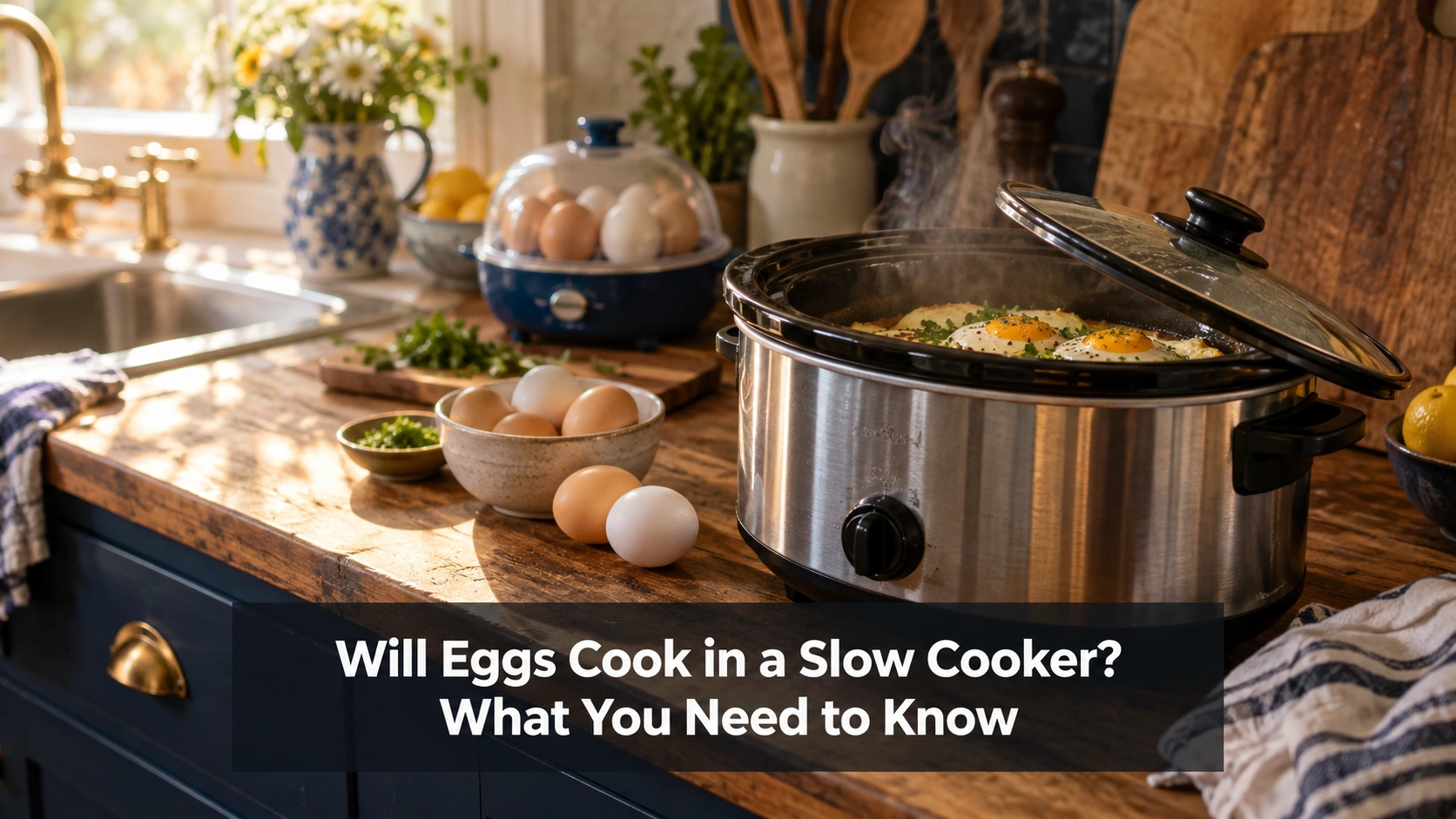
Quick Answer
Yes, eggs can cook in a slow cooker, but it isn’t the most predictable method for plain hard-boiled eggs. A slow cooker can also cook egg-based dishes successfully when the recipe provides enough moisture and heat reaches a safe temperature. For egg dishes, I recommend checking the center with a food thermometer and following USDA egg-safety guidance.
What to Know Before Cooking Eggs
- Yes, they cook: Slow cookers can provide enough heat to cook eggs, especially in moist egg-based recipes.
- Hard-boiled is different: Cooking whole eggs in their shells is possible, but timing and texture can vary by cooker.
- Use a thermometer: Egg dishes should reach 160°F (71°C) for a reliable safety check.
- Skip Keep Warm: The Keep Warm setting is for holding already-cooked food, not for cooking raw eggs.
- Don’t rush cooling: Refrigerate cooked eggs promptly if you aren’t eating them right away.
Best Approach
- Use a slow cooker for egg casseroles, breakfast bakes, and similar moist dishes when the recipe is designed for slow cooking.
- For consistently hard-boiled eggs, a saucepan, steamer, or dedicated egg cooker is usually easier to control.
I’ve used slow cookers for plenty of breakfast jobs, but whole eggs are one place where I prefer a more controlled appliance. The answer to “will eggs cook in a slow cooker?” is yes, although the best method depends on what kind of egg you want.
In this guide, I’ll explain what happens to eggs in a slow cooker, how to cook them more reliably, and when an egg cooker makes more sense.
In This Guide
Can eggs cook in a slow cooker?
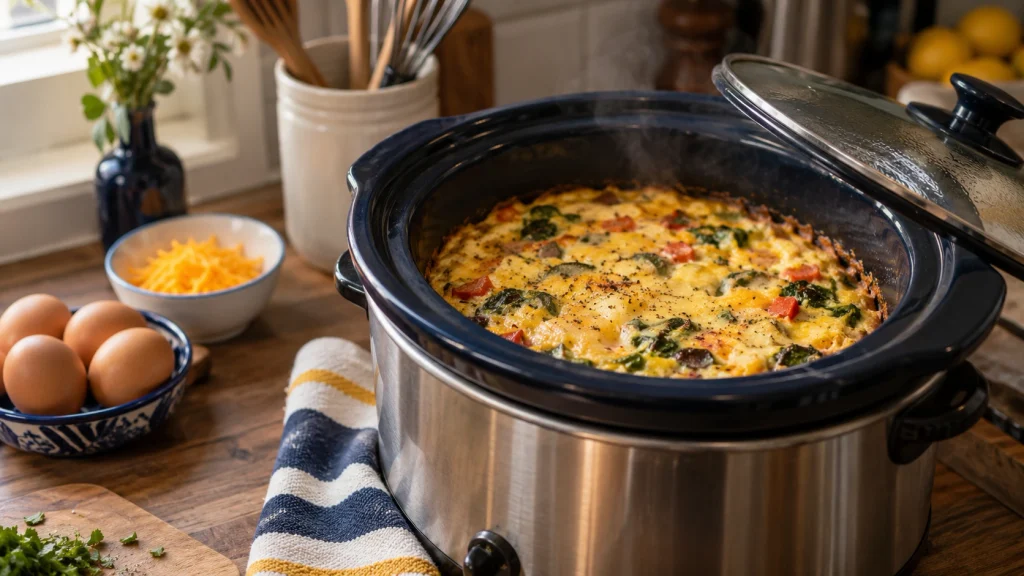
Yes, eggs can cook in a slow cooker when the appliance reaches the required cooking temperature. Slow cookers generally operate around 170°F to 280°F, depending on the setting and appliance. :contentReference[oaicite:0]{index=0}
However, that does not mean every slow-cooker egg method produces the same result. Whole eggs, scrambled eggs, egg casseroles, and breakfast bakes behave quite differently.
What types of eggs work best?
Moist egg dishes are usually the easiest fit for a slow cooker. The enclosed cooking environment helps retain moisture while the heating element gradually raises the temperature.
- Egg casseroles: A practical slow-cooker option for breakfast or brunch.
- Scrambled egg mixtures: These can work when cooked as part of a suitable recipe.
- Breakfast bakes: Eggs combine well with vegetables, cheese, potatoes, and other ingredients.
- Whole eggs in shells: Possible, but less convenient and less predictable than conventional methods.
The biggest issue is control. A saucepan gives you direct control over boiling water, while an egg cooker is designed around the specific job of cooking eggs.
Why aren’t slow cookers ideal for plain hard-boiled eggs?
A slow cooker heats gradually, and different models distribute heat differently. The size, shape, lid design, starting temperature, and amount of food can all affect how quickly eggs heat.
That makes it harder to give one universal cooking time. I wouldn’t treat a slow-cooker timer as proof that the eggs are safe or fully cooked.
Section Takeaway: A slow cooker can cook eggs, but it works best for complete egg dishes rather than precision cooking of plain hard-boiled eggs.
How does a slow cooker cook eggs?
A slow cooker cooks through steady heat from the heating base, combined with the heat retained inside the covered vessel. The gradual process is useful for many foods, but it changes how you should think about eggs.
Eggs are heat-sensitive. Their proteins change structure as they warm, which is why an egg can move from liquid to firm surprisingly quickly once sufficient heat reaches the center.
What happens to an egg inside the shell?
When a whole egg heats, the white and yolk gradually firm. The shell acts as a barrier, so heat must travel from the outside toward the center.
This is one reason whole eggs require patience in a slow cooker. The cooking time depends on how efficiently heat reaches the eggs rather than simply how long the appliance has been switched on.
What happens to beaten eggs?
Beaten eggs behave differently because the liquid mixture has more direct contact with the surrounding heat. Adding milk, cheese, vegetables, or other ingredients also changes the texture and cooking rate.
For mixed egg dishes, the USDA recommends cooking to 160°F (71°C) and checking with a food thermometer. :contentReference[oaicite:1]{index=1}
Kitchen tip: Don’t judge an egg casserole only by how firm the surface looks. Check the thickest part, because the center can lag behind the edges.
Does the slow cooker setting matter?
Yes. Most slow cookers have at least Low and High settings, and High generally cooks faster than Low. USDA guidance notes that slow cookers commonly operate between 170°F and 280°F. :contentReference[oaicite:2]{index=2}
Keep Warm is different. USDA guidance specifically says not to use Keep Warm to cook food because that setting is intended to hold food after it has already reached a safe temperature. :contentReference[oaicite:3]{index=3}
Section Takeaway: Slow-cooker egg cooking depends on gradual heat transfer, so the appliance setting and recipe structure matter as much as the clock.
How do you cook eggs in a slow cooker?
The most dependable approach is to use the slow cooker for a complete egg recipe rather than trying to duplicate a stovetop hard-boiling method. For a mixed egg dish, the goal is even heating and a safe center temperature.
How to cook a slow-cooker egg casserole
- Start with refrigerated eggs: Keep perishable ingredients chilled until preparation.
- Prepare the mixture: Beat the eggs and combine them with the recipe’s other ingredients.
- Prepare the cooker: Grease the insert if your recipe calls for it.
- Add the mixture: Spread it evenly rather than creating an unusually deep layer.
- Cook according to the recipe: Use the recommended Low or High setting instead of guessing from another appliance.
- Check the center: Use a food thermometer to verify that the egg dish reaches 160°F.
- Serve or chill: Serve promptly or cool and refrigerate properly.
The exact cooking time will vary by recipe and cooker. I would rather check temperature than promise a universal number that could fail with a different slow-cooker model.
Can you cook whole eggs in a slow cooker?
You can experiment with whole eggs, but I don’t consider a slow cooker the first-choice tool for hard-boiled eggs. The process is slower and gives you less precise control than boiling or steaming.
If you want to try it, use clean, uncracked eggs and a slow cooker that is in good working condition. Avoid relying on the Keep Warm function to cook raw eggs.
Once the eggs are cooked, cool and refrigerate them promptly. The FDA advises using hard-cooked eggs within one week when properly refrigerated. :contentReference[oaicite:4]{index=4}
What if you want soft-boiled eggs?
A slow cooker is even less appealing for soft-boiled eggs. Soft yolks require tighter control over time and temperature than a typical slow cooker provides.
For that result, I would use a saucepan, steamer, or dedicated egg cooker. Those methods make it easier to repeat the same texture from one batch to the next.
A simple rule I use
If the recipe contains several ingredients and is meant to cook slowly, a slow cooker makes sense. If the entire goal is one precise egg texture, use an appliance designed for that job.
Section Takeaway: For slow-cooker eggs, follow a tested recipe and verify the center temperature rather than relying only on cooking time.
Slow cooker vs. egg cooker: Which is better?
If your main goal is cooking eggs, a dedicated egg cooker is usually the more convenient choice. A slow cooker becomes more useful when eggs are only one component of a larger meal.
| Feature | Slow Cooker | Dedicated Egg Cooker |
|---|---|---|
| Primary purpose | Slow-cooked meals | Egg preparation |
| Hard-boiled eggs | Possible, but less controlled | Designed for the task |
| Egg casseroles | Very suitable | Usually not the intended use |
| Cooking capacity | Varies widely by model | Usually focused on egg capacity |
| Precision for egg texture | Moderate to low | Usually higher |
| Best use | One-pot meals and breakfast bakes | Repeatable egg cooking |
When should you choose an egg cooker?
An egg cooker makes more sense if you regularly prepare hard-boiled, medium-boiled, or soft-boiled eggs. Its heating chamber and water-based cooking process are built around egg preparation.
That specialization matters when consistency is important. You can also avoid dedicating a large countertop appliance to a small batch of eggs.
When should you choose a slow cooker?
A slow cooker wins when you’re preparing a complete breakfast. Egg strata, breakfast casseroles, baked-style egg mixtures, and other slow-cooked dishes can make better use of its capacity.
It’s also useful when you already own one and don’t want another appliance. Just remember that convenience should not replace temperature verification.
Section Takeaway: Choose an egg cooker for repeatable egg textures and a slow cooker for larger, complete egg-based meals.
What mistakes should you avoid when slow-cooking eggs?
Most problems come from treating a slow cooker like a saucepan. The appliance works differently, so small changes in technique can affect the final result.
- Using Keep Warm to cook: This setting is for holding food after cooking, not bringing raw eggs to a safe temperature.
- Guessing doneness by time: Different slow cookers and recipes heat at different rates.
- Overfilling the cooker: An unusually deep mixture can take longer to heat through.
- Opening the lid repeatedly: Every lid opening releases accumulated heat and can extend cooking.
- Starting with questionable eggs: Don’t use cracked, dirty, or improperly stored eggs.
- Leaving cooked eggs out: Perishable egg dishes should be refrigerated promptly.
Why does the center stay undercooked?
The center is often the last part of a thick egg mixture to heat. This is why appearance alone can be misleading.
Slow-cooker guidance from food-safety authorities recommends using a food thermometer rather than assuming several hours of cooking automatically guarantees safety. :contentReference[oaicite:5]{index=5}
Why can eggs become rubbery?
Egg proteins become firmer as they continue cooking. Excessive cooking can produce a dense or rubbery texture, especially in simple egg mixtures.
That’s another reason I prefer a thermometer over an arbitrary extra-long cooking time. Once the dish reaches its safe target, continuing to cook may hurt texture without adding useful safety.
My testing habit: When I’m learning a new countertop appliance, I check one batch at several points instead of assuming another model will behave identically.
Section Takeaway: Avoid using time, appearance, or the Keep Warm setting as your only measure of egg safety.
How can you safely cook and store slow-cooked eggs?
Egg safety matters regardless of the appliance. Raw eggs can contain harmful bacteria, so proper refrigeration, thorough cooking, and clean equipment all matter.
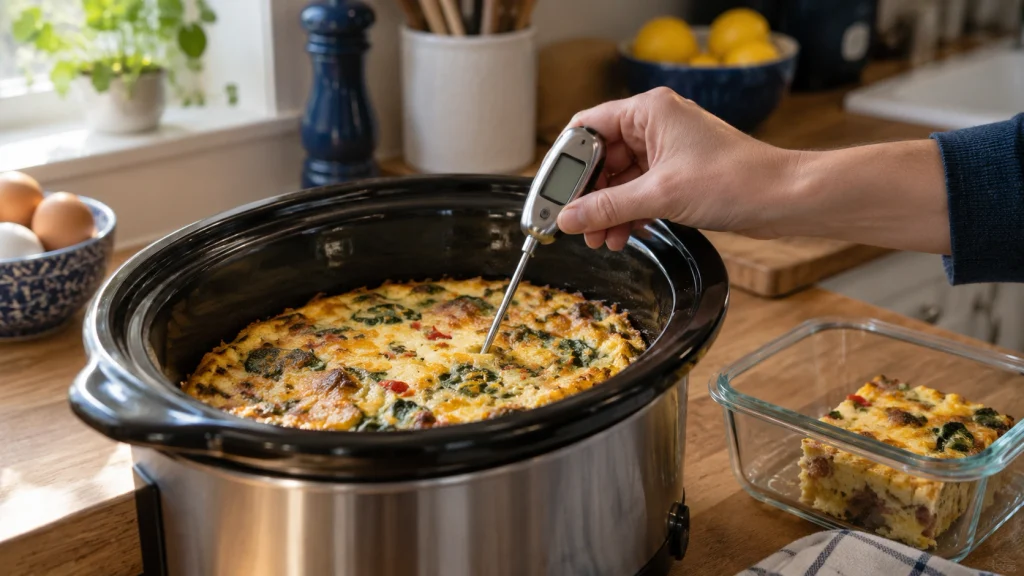
The USDA recommends cooking egg dishes to 160°F (71°C) and cooking eggs until both the white and yolk are firm. :contentReference[oaicite:6]{index=6}
What temperature should egg dishes reach?
For mixed egg dishes such as casseroles, the target is 160°F. Check the thickest or coolest-looking part of the dish with a food thermometer.
Don’t place the thermometer against the slow-cooker insert when taking the reading. You want the temperature of the food itself.
How should cooked eggs be stored?
Cooked eggs should be refrigerated promptly rather than left on the counter. The FDA says cooked eggs and egg dishes should not remain unrefrigerated for more than two hours, or one hour when temperatures exceed 90°F. :contentReference[oaicite:7]{index=7}
- Hard-cooked eggs: Refrigerate and use within one week.
- Egg dishes: Refrigerate leftovers and use within 3 to 4 days.
- Large leftovers: Divide them into shallow containers so they cool faster.
- Serving later: Reheat cooked leftovers thoroughly rather than using a slow cooker as the primary reheating appliance.
USDA guidance does not recommend reheating leftovers in a slow cooker because food can remain in the temperature danger zone too long. :contentReference[oaicite:8]{index=8}
Who should be especially careful?
Food-safety precautions are particularly important for young children, older adults, pregnant people, and anyone with a weakened immune system. The FDA identifies these groups as being at greater risk from serious Salmonella illness. :contentReference[oaicite:9]{index=9}
For those groups, I would be especially strict about firm eggs, accurate temperature checks, refrigeration, and clean preparation surfaces.
Section Takeaway: Treat slow-cooked eggs like any other perishable egg dish: cook thoroughly, verify temperature, and refrigerate leftovers promptly.
Frequently Asked Questions
Can you cook raw eggs in a slow cooker?
Yes, raw eggs can be cooked in a slow cooker, especially as part of a casserole or other moist egg dish. Cook the finished dish to 160°F (71°C) and verify the center with a food thermometer rather than relying only on cooking time.
Can you make hard-boiled eggs in a slow cooker?
Whole eggs can be cooked in a slow cooker, but the method is less predictable than boiling or steaming. Slow cookers vary in heating behavior, so a dedicated egg cooker or saucepan generally offers better control for consistent hard-boiled eggs.
Can eggs cook on Low in a slow cooker?
Yes, eggs can cook on the Low setting when used in an appropriate slow-cooker recipe. The cooking process will generally take longer than on High, and the final egg dish should still reach the recommended safe internal temperature.
Can you cook eggs on Keep Warm?
No. Keep Warm is intended to hold food after it has already been safely cooked. USDA guidance specifically advises against using the Keep Warm setting to cook raw food because it may not bring the food to a safe temperature quickly enough.
How do you know when slow-cooker eggs are done?
For an egg mixture or casserole, use a food thermometer and check the thickest part. The USDA recommends 160°F (71°C) for egg dishes, while whole eggs should have firm whites and yolks for the safest result.
Is a slow cooker better than an egg cooker?
Not for most plain egg preparations. A dedicated egg cooker is better suited to repeatable boiled or steamed egg textures, while a slow cooker is more useful for larger egg-based meals such as breakfast casseroles.
Can you leave cooked eggs in a slow cooker overnight?
It’s not a good idea to use a slow cooker as an overnight storage method for cooked eggs unless the food is being safely held under appropriate hot-holding conditions. For leftovers, prompt refrigeration is the safer and more practical choice.
Final Takeaway: Can a Slow Cooker Cook Eggs?
Yes, a slow cooker can cook eggs. The best results come from treating it as a slow-cooking appliance for complete egg dishes rather than as a replacement for a saucepan or dedicated egg cooker.
For breakfast casseroles and moist egg recipes, a slow cooker can be convenient and useful. For precise hard-boiled or soft-boiled eggs, I’d choose a more specialized method.
Most importantly, don’t guess when food safety is involved. Check egg dishes with a food thermometer, aim for 160°F, and refrigerate cooked eggs promptly.
If you’re shopping specifically for an egg cooker, focus on the cooking style you use most, the number of eggs you prepare at once, ease of cleaning, automatic shutoff, and the controls provided by the model.
As of 2026, the basic rule remains simple: use the slow cooker when it suits the recipe, and use an egg cooker when precision is the priority.