Quick Answer
If you’re wondering why does my egg cooker keep beeping, the most common reason is that the cooker has reached the end of its cooking cycle. Many models detect when the water has evaporated and then beep and shut off. If it keeps beeping before the eggs are done, check the water level, heating plate, control setting, power connection, and mineral buildup. Your egg cooker’s automatic shut-off system can also help explain the behavior.
Common reasons for repeated beeping
- Normal completion: The water has evaporated and the cooking cycle has finished.
- Too little water: An incorrect water measurement can make the cooker finish early.
- Mineral buildup: Scale on the heating plate can interfere with normal heat sensing.
- Wrong setting: A soft, medium, hard, poached, or omelet setting may require different water amounts.
- Control fault: Repeated beeping with no normal shut-off may indicate a sensor or electrical problem.
- Moisture or damage: Water entering the electrical body can create unsafe behavior and requires extra caution.
Quick verification tip
- Unplug and cool the cooker, clean the heating plate, then use the manufacturer’s measuring cup and water mark for your next test cycle.
I’ve found that egg cooker beeping sounds more alarming than it usually is. In most basic models, the buzzer is simply the appliance telling you that its cooking cycle has ended.
The confusing part is when the beeping starts too early, continues after the eggs are removed, or happens repeatedly with no obvious reason. That’s when the water level, heating plate, sensor, and controls deserve a closer look.
In This Guide
- Why does an egg cooker beep?
- Why does my egg cooker keep beeping before the eggs are done?
- Can the water level or heating plate cause repeated beeping?
- How do you stop an egg cooker from beeping?
- When does repeated beeping mean the egg cooker has a problem?
- How can you prevent an egg cooker from beeping unexpectedly?
- Egg cooker beeping FAQs
Why Does an Egg Cooker Beep?
An egg cooker usually beeps when its cooking cycle reaches a programmed stopping point. Many automatic models monitor water evaporation and temperature rather than directly measuring how cooked the egg is.
For example, some egg cookers use a thermal sensor to detect when the water has evaporated from the heating plate. Once that happens, the appliance can shut off and sound a buzzer.
What does the beep normally mean?
A single beep or short series of beeps at the end of cooking is generally normal. The exact sound pattern varies by manufacturer and model.
- End of cycle: The water has evaporated and cooking is complete.
- Auto shut-off: The heating system has stopped or is stopping.
- Ready alert: Some models use the buzzer simply to tell you the eggs are ready.
- Control alert: Certain models may use different sounds for operating conditions or faults.
Dash, for example, describes its Deluxe Egg Cooker as using heat sensors to prevent overcooking. Its current model also includes a measuring cup designed to provide the required water amount.
That matters because the buzzer isn’t necessarily a warning. In many traditional electric egg cookers, it’s part of the normal cooking sequence.
Section Takeaway: A beep at the end of a normal cycle is usually expected. The real troubleshooting question is whether the cooker beeps at the wrong time or refuses to stop.
Why Does My Egg Cooker Keep Beeping Before the Eggs Are Done?
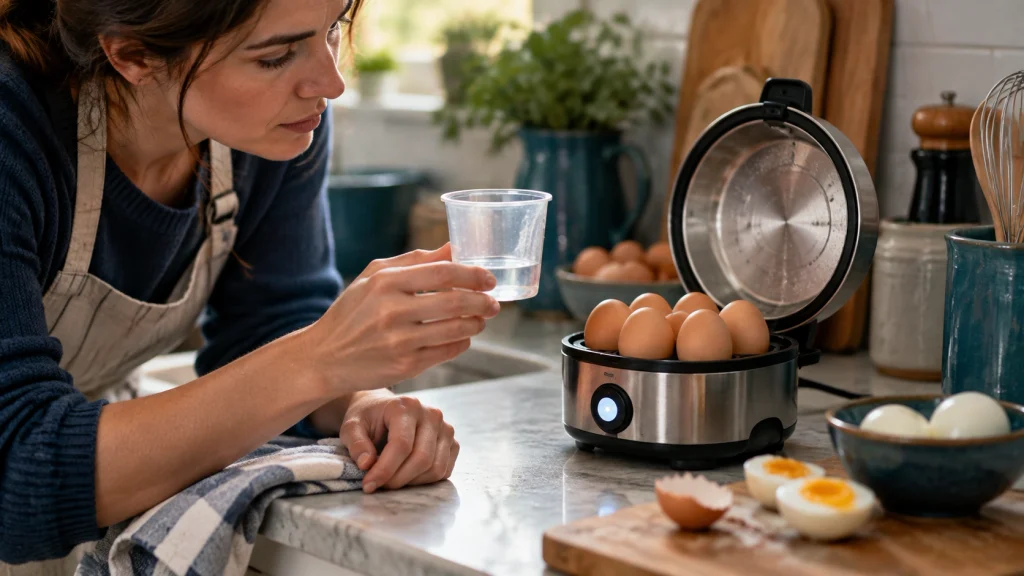
If your egg cooker keeps beeping before the eggs are fully cooked, start with the water measurement. The appliance may think the cooking cycle has finished because the water disappeared faster than expected.
This is especially important with water-based automatic egg cookers. The heating plate turns water into steam, and the cooker uses the resulting temperature change to determine when cooking should stop.
1. You added too little water
The measuring cup is not just a convenience. Its markings are usually matched to the cooking system, so using less water can shorten the cycle.
Different settings can require different water amounts. Soft-boiled, medium-boiled, hard-boiled, poached, and omelet settings may not use the same measurement.
2. The eggs are larger than the manual assumes
Egg size can change the cooking result even when the cooker operates normally. Several manufacturer manuals specify particular egg sizes and explain that larger eggs can require adjustments.
If the eggs are XL or jumbo, don’t automatically assume that an early beep means the appliance is defective. Check the manual before changing the water measurement.
3. You are cooking at a different altitude
Altitude can affect boiling behavior because water boils at a lower temperature as elevation increases. Some egg cooker instructions therefore recommend adjusting water quantities at higher elevations.
For most users, this isn’t the first thing to investigate. Check the measuring cup and heating plate first.
4. The heating plate has mineral buildup
Hard-water minerals can leave a white, chalky, or discolored layer on the heating plate. That buildup can affect heat transfer and may change how the cooker behaves.
I’ve seen this become an easy-to-miss troubleshooting point because the appliance can look clean from a distance. The thin scale layer becomes obvious only when the metal surface is inspected closely.
| What you notice | Likely cause | First thing to check |
|---|---|---|
| Beeps once when eggs are finished | Normal completion alert | Manual and indicator light |
| Beeps much earlier than usual | Too little water or sensor behavior | Measuring cup and water mark |
| Eggs remain undercooked after beep | Water amount, egg size, or setup | Cooking instructions |
| Beeping continues after cooking | Normal buzzer or control issue | Power switch and manual |
| Beeping with no water or cooking | Possible sensor or electrical fault | Unplug and inspect safely |
Section Takeaway: An early beep usually deserves a water-level check first. If the water measurement is correct, inspect the heating plate and compare the behavior with your model’s manual.
Can the Water Level or Heating Plate Cause Repeated Beeping?
Yes. Water level and heating-plate condition are two of the most important things to check when an egg cooker behaves differently from normal.
Why water matters so much
An automatic egg cooker doesn’t usually know whether the yolk is soft or firm by touching the egg. Instead, many models use the amount of water and the heating system to create a repeatable cooking cycle.
Think of the water measurement as part of the cooker setting. Changing it changes the amount of time the heating plate can remain in its normal cooking phase.
- Too little water: The cooker may finish sooner than expected.
- Too much water: Cooking may take longer and the eggs may become firmer.
- Wrong measuring mark: The selected cooking style may not match the water amount.
- Inconsistent measuring: Different batches can produce noticeably different results.
What the heating plate does
The heating plate is the metal surface where the water is heated. In many automatic egg cookers, its temperature behavior helps determine when the cooking cycle is complete.
Mineral deposits can form when tap water repeatedly evaporates from the plate. A cooker used frequently with hard water can show this buildup faster.
For routine care, follow the cleaning method supplied by your manufacturer. Don’t scrape the plate aggressively or use a cleaner that the manual doesn’t recommend.
How do you know whether water is the problem?
Let the cooker cool completely, then repeat a simple test with the supplied measuring cup. Use the same number and size of eggs and the exact water mark specified for that cooking mode.
If the cooker behaves normally during that test, your earlier measurement was likely part of the problem. If it still starts beeping unusually, continue with the electrical and sensor checks below.
Section Takeaway: Water controls the cooking cycle on many automatic egg cookers. A clean heating plate and accurate measurement are the best starting points for troubleshooting.
How Do You Stop an Egg Cooker From Beeping?
The safest approach is to determine whether the beep is a normal completion signal or an abnormal repeated alert. Don’t immediately unplug, reset, or open the appliance while it’s hot.
Try this troubleshooting sequence
- Turn the cooker off: Use the normal power control if your model provides one.
- Unplug it: Disconnect the appliance from the outlet before cleaning or inspecting it.
- Let it cool: Give the heating plate and lid enough time to cool completely.
- Check the water: Compare your measurement with the manufacturer’s instructions.
- Clean the plate: Remove mineral residue using the method approved by the manufacturer.
- Check the controls: Make sure the selected setting matches the cooking method.
- Run one controlled test: Use the recommended water amount and egg size.
What if the buzzer won’t stop?
Some egg cookers are designed to continue sounding until you move the power control or otherwise acknowledge the completed cycle. That’s not necessarily a defect.
Other models stop automatically when the heating cycle ends. The manual is the best source for the exact behavior of your unit.
For example, manufacturer instructions for several automatic egg cookers describe a buzzer that sounds after the water has evaporated and the cooking process has completed.
Safety Tip
If the cooker smells burnt, sparks, trips a breaker, gives you an electric shock, becomes unusually hot, or behaves erratically, stop using it and unplug it when safe to do so. Do not bypass a thermal sensor or other safety feature.
Section Takeaway: Start with a cool, unplugged cooker and a controlled water measurement. Never silence an unexplained electrical problem by defeating a safety feature.
When Does Repeated Beeping Mean the Egg Cooker Has a Problem?

Repeated beeping becomes more concerning when it happens without a normal cooking cycle or when other symptoms appear at the same time. The sound alone isn’t enough to diagnose a failed component.
Signs you should stop using the cooker
- Burning smell: A persistent electrical or burnt-plastic odor is not a normal cooking signal.
- Smoke: Stop using the appliance immediately if smoke appears.
- Sparking: Sparks or visible arcing indicate a serious electrical problem.
- Repeated breaker trips: A cooker that repeatedly trips protection should not be forced to operate.
- Electric shock: Any shock from an appliance is a reason to stop using it and have the situation assessed.
- Water inside the base: Moisture around electrical components creates an avoidable safety risk.
- Random controls: Buttons activating by themselves can indicate a control or sensor fault.
The U.S. Consumer Product Safety Commission recommends keeping countertop appliances away from sinks and water sources and keeping their cords away from hot surfaces. Those precautions are especially relevant to an appliance that combines water, heat, and electricity.
UL Solutions explains that household-appliance safety standards address hazards including electrical, thermal, mechanical, and fire risks. That doesn’t mean every egg cooker carries a UL certification, but it illustrates why electrical safety features shouldn’t be bypassed.
Could the sensor be faulty?
It is possible, especially when correct water measurements and a clean heating plate don’t change the behavior. However, sensor failure should be treated as a diagnosis to confirm, not an assumption.
A sensor fault can require internal testing that isn’t appropriate for a casual kitchen troubleshooting job. For a sealed appliance, manufacturer support or a qualified appliance technician is the safer route.
Pro tip: Don’t open a sealed egg cooker, bypass its thermal sensor, or alter its wiring to stop the beeping. Follow the manufacturer’s manual or have the appliance checked by a qualified repair technician.
Section Takeaway: Repeated beeping plus smoke, sparks, shocks, overheating, or strange controls is not a normal cooking alert. Stop using the appliance rather than trying to defeat its safety system.
How Can You Prevent an Egg Cooker From Beeping Unexpectedly?
The easiest way to prevent unnecessary beeping is to keep the cooker clean and use the same measurement process every time. Consistency makes unusual behavior much easier to spot.
Use the supplied measuring cup
If your cooker came with a dedicated measuring cup, use it rather than estimating with a kitchen spoon. The markings are usually designed around the appliance’s heating characteristics.
Keep the heating plate clean
Wipe the heating plate after the cooker has cooled and follow the manufacturer’s cleaning instructions. Regular maintenance helps prevent mineral residue from accumulating.
Use the correct water
If your manual recommends filtered or distilled water, there’s a practical reason for that recommendation. Water with fewer minerals can leave less residue after repeated evaporation.
Don’t assume that more water is automatically safer. The correct quantity depends on the model and selected cooking method.
Keep the electrical base dry
Wash removable accessories according to the manufacturer’s instructions, but don’t submerge the electrical base unless the manufacturer specifically says it is designed for that treatment.
Keep the power cord away from hot surfaces and water. CPSC kitchen-safety guidance specifically recommends these basic precautions for countertop appliances.
Know your model’s normal beep
As of 2026, egg cookers still vary considerably in how they signal completion. Some use a buzzer, while others combine a buzzer with an indicator light or automatic shut-off.
Before troubleshooting, check what your particular model considers normal. That single step can save you from treating a perfectly ordinary completion beep as a fault.
Section Takeaway: Accurate water measurement, a clean heating plate, and dry electrical components prevent many avoidable problems. Learn your model’s normal end-of-cycle behavior so you can recognize a genuine fault.
Egg Cooker Beeping FAQs
Why does my egg cooker beep when the eggs aren’t fully cooked?
An egg cooker can beep early when too little water was added, the wrong cooking mark was used, or the eggs differ from the size specified by the manufacturer. Check the measuring cup, egg size, heating plate, and cooking instructions before assuming the appliance has failed.
Why does my egg cooker keep beeping after the eggs are done?
Some egg cookers are designed to beep when the cooking cycle ends and may continue until you switch the appliance off or acknowledge the alert. Check the operating instructions for your model before treating continued beeping as a malfunction.
Can hard-water buildup make an egg cooker beep?
Mineral buildup can affect the heating plate and change how an automatic cooker responds to heat and water evaporation. If you see white, chalky, or discolored residue, unplug and cool the cooker before cleaning it according to the manufacturer’s instructions.
Should I unplug an egg cooker while it is beeping?
If the cooking cycle has finished and your manufacturer’s instructions call for unplugging the appliance, you can disconnect it normally. If the beeping is accompanied by smoke, sparks, overheating, or an electrical smell, stop using the appliance and disconnect power when it is safe to do so.
Why does my egg cooker beep immediately after I turn it on?
An immediate beep can indicate that the cooker is detecting a completed or abnormal condition, depending on the model. Check whether the heating plate contains the correct amount of water and whether the indicator light or display shows an error condition.
Can I fix an egg cooker sensor myself?
It’s generally not a good DIY repair for a sealed countertop appliance. A sensor is part of the appliance’s temperature-control and safety system, so opening the housing or bypassing it can create electrical and overheating risks.
When should I replace my egg cooker instead of troubleshooting it?
Consider replacement when the cooker has persistent abnormal beeping after basic checks, shows electrical damage, repeatedly trips protection, smells burnt, sparks, overheats, or has a failed control system. A newer appliance may also make more sense when repair costs approach replacement cost.
Section Takeaway: Most egg cooker beeping has a simple explanation. Start with the water level, cooking setting, heating plate, and normal end-of-cycle behavior before assuming the appliance is broken.
Final Takeaway: Why Does My Egg Cooker Keep Beeping?
If you’re asking why does my egg cooker keep beeping, don’t assume the buzzer means something is wrong. In many models, it simply signals that the water has evaporated and the automatic cooking cycle has finished.
The important distinction is timing. A beep at the expected end of cooking is normal, while repeated or premature beeping deserves troubleshooting.
- Check the water: Use the supplied measuring cup and correct cooking mark.
- Check the plate: Remove mineral buildup using approved cleaning methods.
- Check the setting: Make sure the selected cooking method matches the water amount.
- Check the manual: Confirm whether your model’s buzzer should stop automatically.
- Stop if unsafe: Smoke, sparks, shocks, burning smells, or overheating are reasons to discontinue use.
I’ve learned that the fastest troubleshooting method is usually the least complicated one. Start with what the cooker can actually detect—water, heat, and its programmed cycle—then move toward more serious possibilities only when the simple checks fail.
If the cooker still beeps abnormally after a correct water measurement, a clean heating plate, and a proper test cycle, don’t keep experimenting with it. Check the manufacturer’s support instructions or have the appliance professionally assessed.