Quick Answer
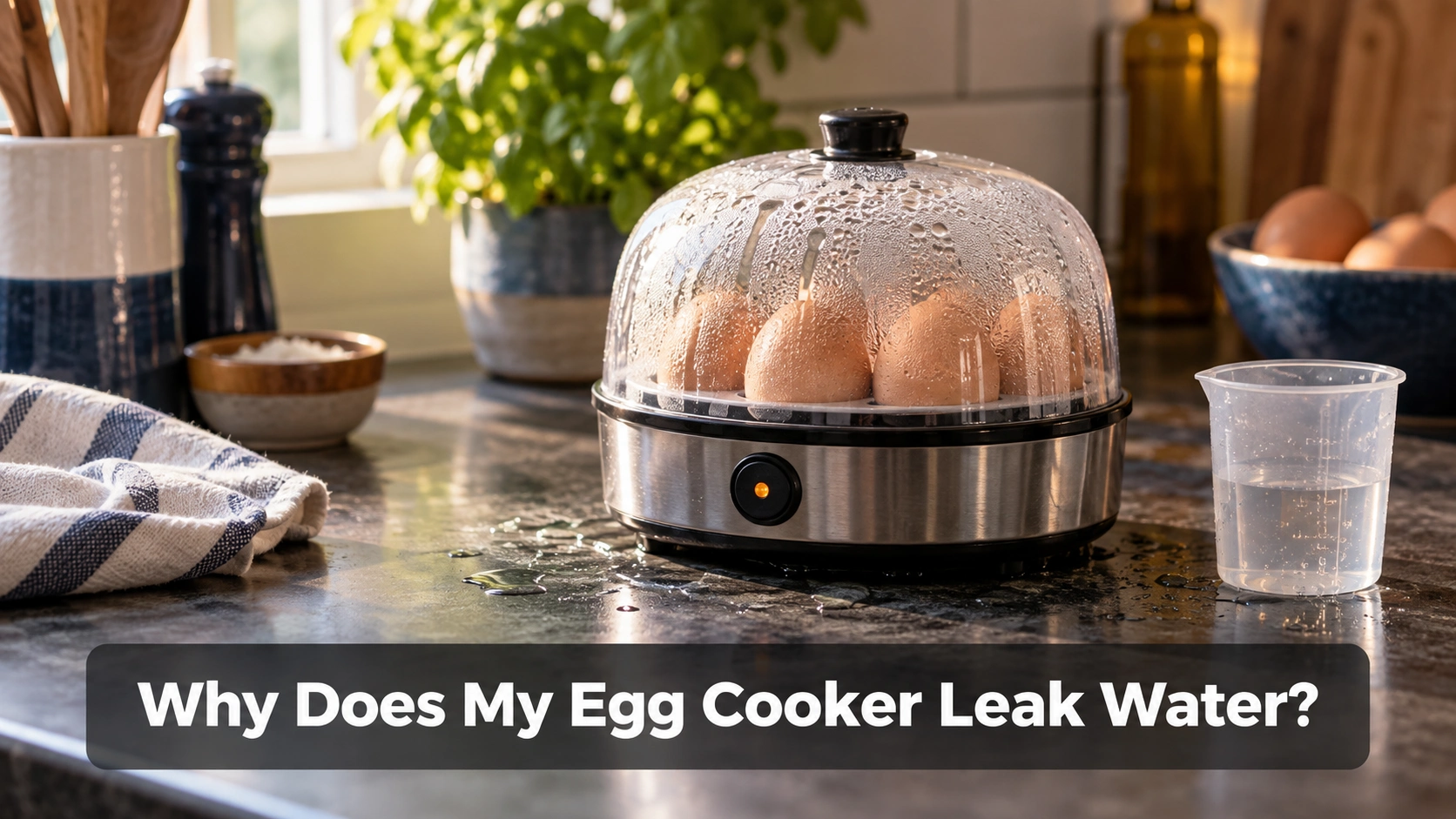
If you’re wondering why does my egg cooker leak water, the most common causes are too much water, an incorrectly seated lid or tray, condensation escaping around the lid, and mineral buildup on the heating plate. A small amount of condensation can be normal, but water reaching the electrical base is not. Start by unplugging the cooker, letting it cool, and checking the water measurement, lid fit, tray position, and steam vent.
Most Common Causes
- Too much water: Excess water can create more steam and leave liquid after the cooking cycle.
- Wrong measurement: Using a random cup instead of the supplied measuring cup can change the intended water volume.
- Poor lid fit: A crooked lid can allow steam and condensed water to escape around the rim.
- Blocked vent: Food residue or mineral deposits can interfere with normal steam release.
- Mineral buildup: Scale on the heating plate can change how efficiently water turns into steam.
- Internal damage: Cracks, damaged seals, or water entering the electrical housing can mean the appliance should stop being used.
Quick Verification
- Run the next cycle with the exact water amount specified by your model’s manual.
- Keep the cooker on a level, dry counter and make sure the tray and lid sit correctly.
- Stop using the cooker if water reaches the power cord connection, controls, or electrical housing.
If you’ve searched for why does my egg cooker leak water, you’re probably dealing with a messy counter after what should have been an easy batch of eggs.
I’ve found that egg cookers are simple appliances, but their small water reservoirs leave little room for measurement mistakes. In this guide, I’ll walk through the causes I check first, how to tell normal condensation from a genuine leak, and when I would stop troubleshooting.
In This Guide
- Why does my egg cooker leak water?
- Is water around an egg cooker normal?
- Can too much water make an egg cooker leak?
- Can the lid, tray, or steam vent cause leaking?
- Can mineral buildup cause an egg cooker to leak?
- How do you fix a leaking egg cooker?
- When should you replace a leaking egg cooker?
- Egg cooker leaking FAQs
Why does my egg cooker leak water?
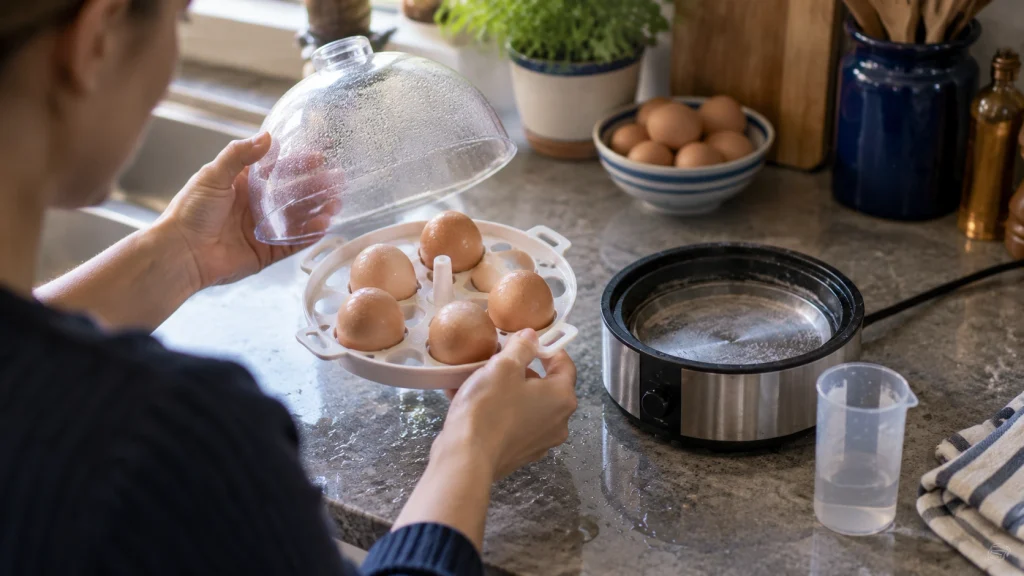
An egg cooker leak is usually excess water or escaping condensation, not a mysterious internal failure. Most electric egg cookers heat a measured amount of water on a heating plate and use the resulting steam to cook the eggs.
Manufacturers commonly instruct users to measure water according to the cooker’s markings rather than simply filling the base by eye. Instructions for models from Black+Decker, DASH, and other manufacturers show this basic operating pattern. :contentReference[oaicite:0]{index=0}
What should you check first?
- Water amount: Confirm that you used the correct line for the number and type of eggs.
- Heating plate: Look for scale, residue, or leftover water from the previous cycle.
- Egg tray: Make sure the tray is sitting flat rather than tilted.
- Lid: Check that the lid is seated evenly around the entire rim.
- Steam vent: Make sure the vent opening isn’t blocked by food or residue.
- Base: Check whether the water is simply condensation dripping down the outside.
One mistake I always check is the measuring cup. Egg cookers are designed around surprisingly small quantities of water, so a small measuring error can change the entire cooking cycle.
Section Takeaway: Most leaks start with water quantity, lid fit, condensation, or assembly. Check those before assuming the cooker is broken.
Is water around an egg cooker normal?
A little condensation can be normal, but water escaping from the base or reaching electrical components is not. Steam naturally forms when the heating plate turns water into vapor, and some of that vapor can condense on the lid.
Many egg cooker instructions specifically warn that steam escapes through the lid vent during operation. Black+Decker’s EG100 instructions, for example, describe steam leaving the cover through a release hole. :contentReference[oaicite:1]{index=1}
Where is the water appearing?
| Where you see water | Likely explanation | What to do |
|---|---|---|
| Inside the lid | Normal steam condensation | Allow it to cool before wiping |
| Around the lid edge | Lid alignment or excess condensation | Check lid seating and water level |
| On the counter | Overflow, condensation, or tilted assembly | Inspect tray, lid, and water amount |
| Under the electrical base | Potential internal leak or overflow | Unplug and stop using the unit |
I pay particular attention to where the water ends up. A wet lid is one thing; liquid appearing around the power connection is a completely different situation.
Electrical appliances should also be kept away from sinks and other water sources. CPSC guidance specifically recommends keeping appliance cords away from water and using appropriate GFCI protection for countertop appliances. :contentReference[oaicite:2]{index=2}
Section Takeaway: Condensation is expected during steam cooking. Water near the electrical portion of the cooker deserves immediate attention.
Can too much water make an egg cooker leak?
Yes. Too much water is one of the first things I would investigate. Egg cookers depend on a measured water volume, and their manuals commonly provide different markings for soft, medium, and hard eggs.
DASH instructions, for example, direct users to fill the measuring cup according to the desired egg consistency and number of eggs before pouring the water onto the heating plate. :contentReference[oaicite:3]{index=3}
Why does extra water matter?
When you add more water than the cooker expects, the heating cycle has more liquid to evaporate. Depending on the model, that can leave water behind or produce more condensation than the lid and vent arrangement comfortably handles.
The measuring marks aren’t decorative. They are part of the appliance’s operating method.
- Use the supplied cup: Its markings are designed for the specific cooker.
- Read the correct scale: Soft, medium, hard, and poaching settings may use different water amounts.
- Don’t top up during cooking: Follow the manufacturer’s instructions instead.
- Keep the heating plate clear: Don’t pour water into the tray unless your manual specifically says to.
Could too little water cause leaking?
Too little water usually causes a different problem, such as undercooked eggs or an early shutoff. Manufacturer troubleshooting instructions commonly point users back to the recommended water measurement when cooking results are wrong. :contentReference[oaicite:4]{index=4}
That distinction helps. If your cooker leaks while also leaving eggs undercooked, don’t automatically assume the leak itself is the only fault.
Section Takeaway: Measure water exactly as your manual specifies. Don’t compensate for a leak by randomly changing the water amount.
Can the lid, tray, or steam vent cause leaking?
Yes. A poorly seated lid or tray can redirect steam and condensed water toward the edge of the cooker. The lid needs to sit correctly so steam follows the path intended by the appliance’s design.
Check the lid first
Remove the lid after the cooker has completely cooled. Clean away egg residue, grease, or mineral deposits around the rim.
Then reinstall it without forcing it. It should sit evenly rather than rocking from side to side.
Check the egg tray
A tray that isn’t seated correctly can leave the lid sitting higher on one side. That small gap may be enough to change where condensation runs.
Remove the tray and reinstall it carefully. Make sure no egg shell, food residue, or accessory is trapped underneath it.
Check the steam vent
Steam vents are meant to release steam, not be sealed shut. Never cover or intentionally block a vent to stop water from escaping.
If the vent has visible residue, clean it according to the manufacturer’s instructions. Don’t poke deep into an electrical appliance with a sharp metal object.
Section Takeaway: A cooker can appear to be leaking when steam is simply escaping from an incorrectly fitted lid or blocked vent. Assembly is worth checking before replacing the appliance.
Can mineral buildup cause an egg cooker to leak?
Mineral buildup can interfere with normal heating and steam production, especially when hard tap water leaves deposits on the heating plate. It may look like brown spots, white scale, or a rough film on the metal surface.
Several egg cooker manuals recommend cleaning mineral deposits from the heating plate with a mild vinegar-and-water solution or the method specified by the manufacturer. :contentReference[oaicite:5]{index=5}
What does scale do?
Scale changes the surface of the heating plate. It can also make cleaning harder and may affect how consistently water heats.
That doesn’t mean every leak is caused by scale. I treat buildup as a maintenance issue first, then retest the cooker before blaming the hardware.
How I would clean the heating plate
- Unplug it: Disconnect the cooker and wait until the heating plate is completely cool.
- Remove accessories: Take out the lid, egg tray, and other removable parts.
- Follow the manual: Use the manufacturer’s recommended cleaning solution and method.
- Wipe gently: Avoid abrasive tools that can damage the heating surface.
- Dry completely: Make sure the cooker is dry before another cooking cycle.
Don’t immerse the electrical base in water unless the manufacturer specifically says that part is designed for immersion. Most countertop electrical appliances should instead be wiped according to their care instructions.
Section Takeaway: Descaling is maintenance, not a repair. If cleaning doesn’t stop the leak, move on to checking assembly and possible physical damage.
How do you fix a leaking egg cooker?
The safest fix is a controlled inspection rather than opening the appliance. I would work from the simplest cause to the most serious one.
Use this troubleshooting sequence
- Unplug the cooker: Never inspect a wet electrical appliance while it’s connected to power.
- Let it cool: Hot water and steam can cause burns.
- Dry the exterior: Remove visible water so you can identify where new water appears.
- Check the measuring cup: Confirm the correct marking for your intended cooking cycle.
- Inspect the heating plate: Look for mineral buildup or food residue.
- Check the tray: Make sure it sits flat and is not cracked or warped.
- Check the lid: Look for cracks, chips, distortion, or a poor fit.
- Inspect the steam vent: Make sure it is clean and unobstructed.
- Retest carefully: Only test the appliance if no electrical damage or internal water entry is visible.
If the same leak returns after these checks, I wouldn’t keep running the cooker repeatedly to see whether it improves. Repeated testing isn’t worth the risk if water is reaching electrical components.
For household electrical appliances, safety standards address hazards including electrical, thermal, mechanical, and fire risks. UL Solutions describes IEC 60335-1 as a general safety standard for household and similar electrical appliances. :contentReference[oaicite:6]{index=6}
Pro tip: Never open a sealed egg cooker, bypass an overheat or shutoff feature, or attempt an internal electrical repair yourself. Check the manufacturer’s manual or have a qualified appliance repair technician inspect the unit.
What if the cooker leaks only after cooking ends?
That pattern can point toward condensation rather than a cracked water reservoir. After the heating cycle, hot vapor continues to condense on cooler surfaces.
Let the cooker cool naturally, then inspect the lid and rim. If water consistently appears from the same physical point on the base, treat that as a stronger sign of a hardware problem.
Section Takeaway: Start with measurement, assembly, cleaning, and inspection. Don’t disassemble the electrical housing to solve a countertop water leak.
When should you replace a leaking egg cooker?
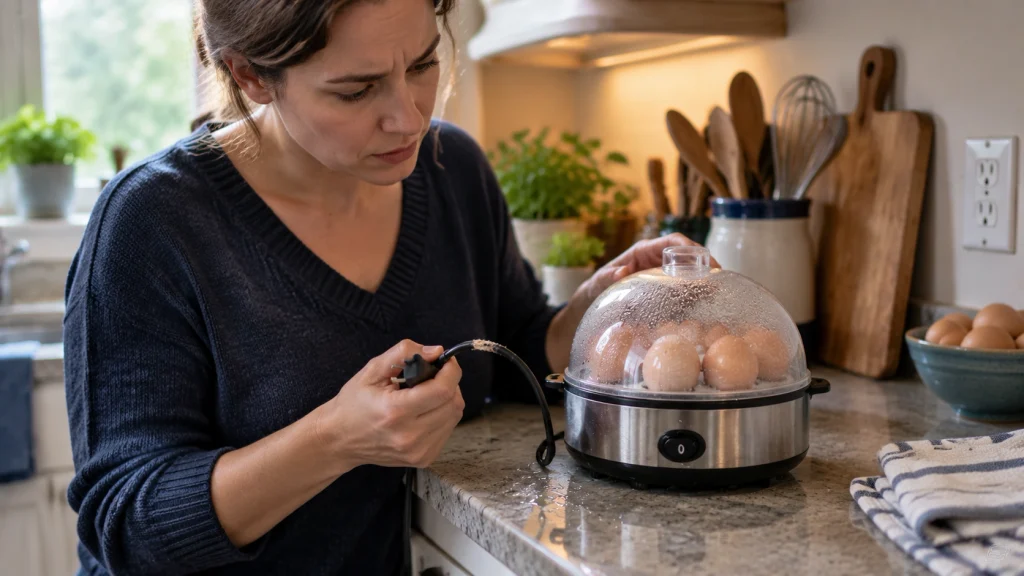
Replace or professionally inspect an egg cooker when water reaches the electrical housing, the power connection, or visibly damaged internal areas. A cracked lid or removable tray is different from damage to the powered base.
Stop using it if you notice these signs
- Water near the power connection
- Cracked electrical housing
- Frayed or damaged power cord
- Burning smell or unusual smoke
- Repeated electrical trips
- Visible melting or heat damage
- Persistent leaking from the sealed base
Don’t rely on a cooker simply because it still turns on. Electrical equipment can remain functional while developing a safety problem.
When replacing an appliance, I would also check whether the new model has clear manufacturer instructions, appropriate safety certification for your market, easy-to-clean parts, and a properly designed steam vent.
UL Solutions notes that its safety mark indicates certification against applicable safety requirements, although consumers should still follow the manufacturer’s instructions for safe use. :contentReference[oaicite:7]{index=7}
Section Takeaway: A cheap replacement is often preferable to experimenting with a cooker that leaks into its electrical housing.
Egg Cooker Leaking FAQs
Why is my egg cooker leaking from the lid?
An egg cooker can leak around the lid when excess condensation forms or when the lid is not seated correctly. Check the water measurement, lid alignment, tray position, and steam vent after the appliance has cooled completely.
Why does my egg cooker have water left after cooking?
Some water remaining after cooking can indicate that more water was added than the selected cooking cycle requires. Use the measuring cup and water marking specified by your model rather than estimating the amount.
Is steam coming out of my egg cooker normal?
Yes. Steam is part of how most electric egg cookers work, and many models have a vent designed to release steam. Never block the vent, and use caution when removing the lid because hot steam can escape.
Can hard water make an egg cooker leak?
Hard water can leave mineral deposits on the heating plate. Buildup can interfere with normal heating and should be cleaned according to the manufacturer’s instructions. However, mineral deposits are not proof of an internal leak.
Why is water coming from the bottom of my egg cooker?
Water coming from the bottom is more concerning than condensation on the lid. Unplug the cooker, let it cool, and inspect the base. If water is entering the electrical housing or the leak persists, stop using the appliance and consult the manufacturer or a qualified technician.
Can I still use an egg cooker that leaks a little?
Only minor condensation around the lid may be normal. If actual water escapes from the base, reaches electrical components, or appears from a crack or damaged housing, stop using the cooker until the cause has been safely identified.
How often should I clean an egg cooker?
Clean the removable parts after use and keep the heating plate free of residue. Descale the plate when mineral deposits appear, following the frequency and cleaning method provided by the manufacturer for your particular model.
Final Takeaway
If you’re still asking why does my egg cooker leak water, start with the simplest explanation: water measurement, condensation, lid alignment, tray placement, and mineral buildup.
Those checks solve many ordinary problems without touching the electrical parts. If water reaches the powered base, the cord, or a damaged housing, stop troubleshooting and treat it as a safety issue.
As of 2026, the basic design of many egg cookers remains simple: a heating plate, measured water, cooking tray, lid, and steam vent. When you understand that water-and-steam path, finding the source of a leak becomes much easier.
My rule is simple: clean it, measure carefully, check the fit, and retest only when the appliance is clearly safe. If the leak keeps returning from the base, replacing the cooker is usually the smarter choice than trying to repair a sealed electrical appliance.