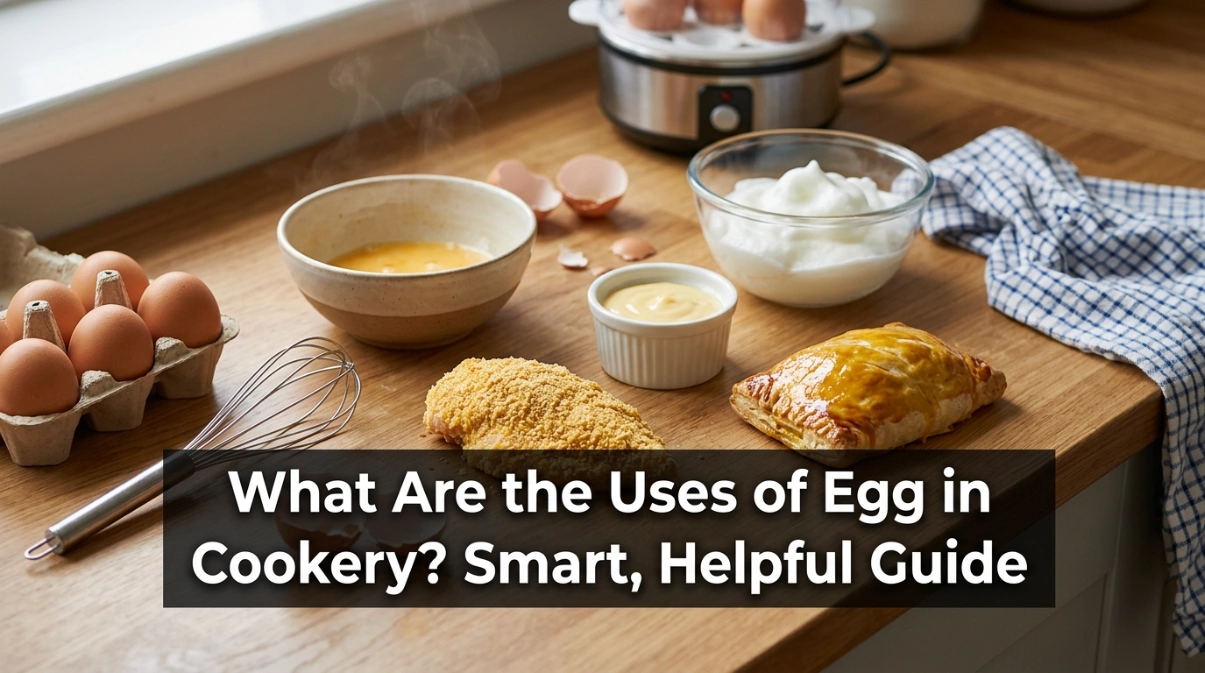
If you are asking what are the uses of egg in cookery, the answer goes far beyond boiled or fried eggs. Eggs can bind, thicken, coat, glaze, add air, and help foods hold their shape.
I also find that many so-called egg problems are really method problems. Too much heat, the wrong amount of water, or poor mixing can change the final result fast.
In this guide, I will explain the main uses of eggs in simple terms. I will also cover common cooking problems and the egg-cooker checks that matter when you use one.
What Are the Uses of Egg in Cookery?

Eggs have several jobs in cooking and baking. The exact job changes with the recipe and with the part of the egg you use.
Egg whites are rich in proteins that set when heated. Yolks add fat, color, flavor, and help oil and water stay mixed in foods such as mayonnaise.
| Use of Egg | What the Egg Does | Common Example |
|---|---|---|
| Binding | Holds ingredients together | Meatballs, patties |
| Thickening | Makes mixtures thicker when heated | Custard, sauce |
| Aerating | Traps air to make food light | Meringue, sponge cake |
| Emulsifying | Helps fat and liquid stay mixed | Mayonnaise |
| Coating | Helps crumbs or flour stick | Breaded foods |
| Glazing | Adds shine and color | Pastry, bread |
| Enriching | Adds flavor, fat, and texture | Cakes, dough |
| Setting | Gives food structure | Quiche, baked custard |
These roles explain why eggs appear in so many recipes. Removing an egg without replacing its job can change texture, rise, moisture, or structure.
When I work with an electric egg cooker, I treat it as a tool for only some of these uses. It is best for boiled eggs, poached eggs, steamed egg dishes, and sometimes small omelets.
The egg tray, lid, steam vent, and water measuring cup all matter. If the original measuring cup is lost, I prefer a correct replacement cup or the manufacturer’s stated water amount rather than guessing.
Common Signs of the Problem
The focus keyword does not describe one broken egg cooker. Still, problems often appear when eggs are used with the wrong cooking method.
You may notice rubbery boiled eggs, watery scrambled eggs, a curdled custard, flat cakes, or breading that falls away from food. An egg cooker may also leave eggs too soft or too firm.
| Symptom | Likely Cause | Quick Fix |
|---|---|---|
| Eggs turn rubbery | Too much heat or time | Cook for less time |
| Custard curdles | Heat is too high | Use gentler heat |
| Cake lacks lift | Poorly beaten eggs | Beat as directed |
| Coating falls off | Egg wash is too thin | Drain excess egg |
| Cooker eggs are underdone | Too little water | Measure water again |
| Cooker leaks steam badly | Lid is not seated well | Refit lid safely |
One bad result does not always mean the appliance has failed. I first check the cooking method before blaming the heating plate or controls.
Possible Causes
Eggs react strongly to heat. Their proteins change and set as they cook, so a small change in temperature or time can make a clear difference.
Common causes of poor results include:
- Cooking eggs for too long
- Using heat that is too high
- Adding too much or too little liquid
- Failing to beat eggs enough for an airy recipe
- Overbeating egg whites
- Adding hot liquid to eggs too fast
- Using the wrong amount of water in an egg cooker
- Blocking the steam vent
- Allowing mineral buildup on the heating plate
Another common mistake is expecting the whole egg to perform every job in the same way. Whites are especially useful for foams, while yolks are better for rich sauces and emulsions.
How to Use Eggs in Cookery and Fix Common Problems
Once I know what job the egg should perform, troubleshooting becomes much easier. I can adjust heat, mixing, water, or cooking time instead of changing everything at once.
Use Eggs as a Binder
Eggs help loose ingredients stay together. This is useful in meatballs, burgers, croquettes, vegetable patties, and similar dishes.
Too much egg can make the mix wet or dense. I add only the amount the recipe needs and let dry ingredients such as breadcrumbs absorb some moisture before adding more.
Use Eggs for Thickening
Eggs thicken custards, puddings, sauces, and some soups because their proteins set with heat. Gentle heating is the key.
If I pour very hot liquid straight into eggs, they may scramble. A safer method is to add a little warm liquid first while stirring, then slowly mix in more.
Use Egg Whites for Air and Volume
Beaten whites can trap tiny air bubbles. That trapped air helps meringue, soufflé, and some cakes become light.
The bowl should be clean and free of grease. Even a small amount of yolk or oil can make it harder for whites to whip well.
I also stop when the recipe reaches the needed peak stage. Beating far beyond that point can make the foam dry and harder to fold into other ingredients.
Use Yolks to Emulsify
Egg yolk can help oil and water-based ingredients stay together. Mayonnaise and some creamy sauces use this property.
If the mixture separates, adding the oil too quickly may be the cause. Slow mixing gives the yolk time to hold the mixture together.
Use Egg for Coating
A beaten egg creates a sticky layer that helps flour, breadcrumbs, or crushed crumbs stay on food.
I usually remove excess flour first, dip the food in egg, then add the crumb layer. A very wet surface can cause the coating to slide off.
Use Egg Wash for Color and Shine
Beaten egg brushed onto bread or pastry helps create a glossy, browned surface.
A whole-egg wash gives good color and shine. Yolks tend to create deeper color, while whites can give a lighter shine.
Check Water in an Egg Cooker
Electric egg cookers often control cooking time through the amount of water added. This is why the measuring cup is more important than it may look.
Too little water can leave eggs soft. Too much can make them firmer than expected or increase the cooking time.
Use the amount recommended for your machine. Do not assume that every egg cooker uses the same water level.
Check the Egg Tray and Lid
The tray should sit flat and securely. The lid should also be positioned as intended so steam can move through the cooker correctly.
Never block the steam vent. Hot steam can cause serious burns, so I keep my hands and face away from the vent when the cooker is running.
Remove Mineral Buildup
White or chalky marks on the heating plate are often mineral deposits left by water. Heavy buildup may reduce normal heating performance.
After the appliance is unplugged and fully cool, follow its care instructions for descaling. White vinegar is commonly useful on compatible surfaces, but the appliance manual should come first.
Use a non-abrasive sponge or soft cloth. Scraping a heating plate with a knife or metal tool can damage its surface.
| Problem | Recommended Solution | Difficulty |
|---|---|---|
| Eggs too soft | Check water and cooking time | Easy |
| Eggs too hard | Reduce water or time as directed | Easy |
| Mineral deposits | Descale the heating plate | Easy |
| Damaged tray | Replace with compatible tray | Easy |
| Cracked lid | Use a correct replacement lid | Easy |
| Burning smell | Stop using and inspect safely | Important |
Mistakes to Avoid
One mistake I avoid is treating every egg dish as if it needs high heat. Eggs often cook better with moderate, controlled heat.
I also avoid guessing the egg cooker’s water level. The correct amount can change based on egg quantity and the desired level of doneness.
Do not seal or cover a steam vent to make the appliance cook faster. Steam needs a safe route out of the cooker.
Never reach inside the electrical base, bypass a safety switch, or open a sealed heating unit. If there is exposed wiring, repeated overheating, sparking, or a strong electrical burning smell, unplug the cooker and stop using it.
Be careful when lifting the lid after cooking. Open it away from your face so escaping steam moves in the opposite direction.
When to Replace the Egg Cooker
A stained heating plate does not automatically mean the cooker needs replacing. Mineral buildup can often be removed with normal maintenance.
I would think about replacement if the power cord is damaged, the appliance repeatedly overheats, the heating system works only at times, or there is a persistent electrical smell.
A cracked removable tray, lid, or measuring cup may not require a whole new cooker. A compatible replacement part can be the simpler answer.
Safety comes first, though. I would not keep using an appliance that sparks, exposes electrical parts, or behaves unpredictably.
My Personal Troubleshooting Approach

When I work through an egg-cooking problem, I start with the simplest cause. I check what the egg is meant to do in the recipe before changing ingredients.
For baking, I check mixing and the role of the egg. For sauces, I look at heat. For breading, I check surface moisture and coating order.
With an egg cooker, I start with the water amount, tray position, lid, steam vent, and heating plate. These checks solve many common cooking issues without touching electrical parts.
The biggest lesson is that eggs are not just an ingredient. They perform different jobs, and each job needs a slightly different method.
Final Thoughts
So, what are the uses of egg in cookery? Eggs can bind, thicken, emulsify, aerate, coat, glaze, enrich, and give structure to food.
They can also be cooked as a food on their own by boiling, poaching, scrambling, frying, baking, or steaming. An egg cooker is useful for several of these simple cooking methods.
When something goes wrong, identify the egg’s job first. Then check heat, mixing, timing, and water amount.
For electric egg cookers, keep the tray fitted correctly, measure the water carefully, keep the steam vent open, and maintain the heating plate. Those simple habits give safer and more consistent results.