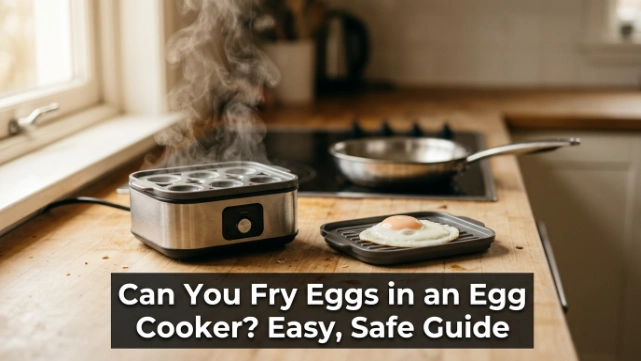
Can you fry eggs in an egg cooker? The short answer is no—not in a standard steam-based model. You can only fry an egg if your cooker has a griddle or frying plate made for direct cooking.
I learned this after trying to make a fried-style egg in my basic cooker. The egg cooked, but it looked more poached than fried. It had soft edges and no crisp base.
That result makes sense. Most egg cookers use steam rather than dry heat and oil. Still, you may be able to make a tasty steamed egg, omelet, or fried-style egg with the right insert.
Common Signs of the Problem
A standard egg cooker is made to boil or steam eggs. Some models also include a small tray for poached eggs or omelets.
Problems begin when you expect that tray to work like a frying pan. The egg may cook, but the texture will be different.
| Symptom | Likely Cause | Quick Fix |
|---|---|---|
| Egg has no crisp edge | Cooker uses steam | Use a frying pan for a true fried egg |
| Egg sticks to the tray | Tray is dry or scratched | Use a light coat of oil if the manual permits |
| White stays runny | Too little water or short cycle | Add the correct water amount |
| Water or egg leaks | Tray is overfilled | Use one egg or a smaller portion |
| Cooker smells burnt | Oil or egg touched the heating plate | Unplug and let it cool |
The most important warning sign is smoke or a burning smell. Unplug the cooker at once if that happens.
If your cooker came with only a boiling rack, do not crack an egg onto it. Look for a model-specific omelet or poaching tray instead. A replacement egg tray must be approved for your exact cooker and fit without blocking the steam vent.
Possible Causes
The main issue is often not a fault in the cooker. It is a difference between frying and steaming.
Frying uses direct heat and a little fat. Steam cooking uses hot water vapor inside a closed lid. That is why the finished eggs do not look or taste the same.
Other possible causes include:
- The cooker does not have a frying or griddle setting.
- The wrong egg insert is being used.
- Too much egg was added to a small tray.
- The measuring cup held too little water.
- Oil spilled onto the heating plate.
- The lid or steam vent was not fitted correctly.
- Limescale reduced heat transfer from the plate.
- The cooker shut off before the egg was fully set.
I also found that model names can be confusing. A product may be called a “rapid egg cooker,” but that does not mean it can fry food.
Check the instruction book before adding oil. If the manual only lists boiled, poached, scrambled, or omelet eggs, the appliance is not designed for true frying.
How to Fix: Can You Fry Eggs in an Egg Cooker?
You cannot turn a steam-only cooker into a real frying appliance. However, you can make a safe fried-style egg if the cooker includes an approved solid tray.
Check What Type of Cooker You Have
Look at the cooking area after unplugging the unit. A standard model has a heating plate, an egg rack, a water cup, and a vented lid.
A multifunction model may also have a flat griddle. If the manual lists “fried egg” or “griddle,” follow those directions.
Never cook food directly on an exposed heating plate. That plate is meant to heat water, not oil or raw egg.
Use Only the Approved Egg Tray
Fit the omelet or poaching tray in its normal position. It should sit flat and leave space for steam to move around it.
Do not replace it with a random plastic bowl. Heat can warp an unsafe container, while a poor fit may block the lid or steam vent.
If permitted by the manual, wipe the tray with a very thin layer of cooking oil. Too much oil can spill into the cooker and cause smoke.
Measure the Water Carefully
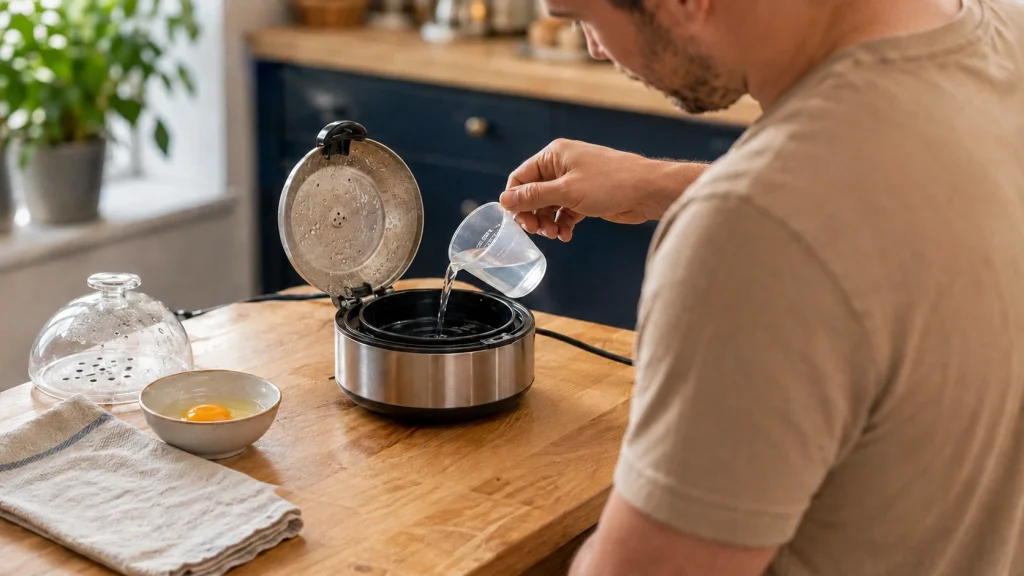
Add water with the cup supplied with the cooker. Use the mark for an omelet, poached egg, or the closest approved setting.
More water often means a longer cooking cycle. It does not make the egg fry or create crisp edges.
When I used too little water, the auto shut-off stopped the cooker while part of the white was still clear. Using the correct mark gave me a firm, even egg.
Cook a Fried-Style Egg
Crack one egg into a small bowl first. This helps you remove shell pieces before they reach the tray.
Pour the egg into the lightly greased insert. Fit the lid, keep the steam vent open, and start the approved cycle.
Do not lift the lid while steam is flowing. Hot steam can burn your fingers and face very fast.
At the end, check that the white is firm. The FDA advises cooking eggs until both the white and yolk are firm, while egg dishes should reach 160°F or 71°C. Pasteurized eggs are a safer choice when a softer yolk is desired. FDA egg-safety guidance
Remove Sticking and Limescale
Let the appliance cool before cleaning it. Wash the removable tray with warm water, mild soap, and a non-abrasive sponge.
Do not immerse the electric base. Wipe it with a soft, damp cloth after unplugging it.
White or brown marks on the heating plate may be mineral buildup. Descale the plate only as the manual directs, often with diluted white vinegar or an approved descaling solution.
| Problem | Recommended Solution | Difficulty |
|---|---|---|
| Egg sticks | Lightly grease an approved tray | Easy |
| Egg stays runny | Correct the water amount | Easy |
| Steam escapes badly | Refit the lid and clear the vent | Easy |
| Plate has limescale | Descale after unplugging | Easy |
| Cooker smokes | Stop using it and inspect for spills | Moderate |
Let the Safety Features Work
Many egg cookers beep or shut off when the water is gone. This is normal and protects the heating element from excess heat.
Do not bypass the auto shut-off, overheat protection, or safety switch. If the cooker stops often despite the right water amount, let it cool and test it once more.
Stop using it if the fault returns. A damaged safety system is not a safe home repair.
Mistakes to Avoid
My first mistake was expecting steam to brown the bottom of an egg. It cannot produce the same crisp texture as a hot pan.
Avoid these common errors:
- Do not pour oil onto the heating plate.
- Do not crack an egg directly onto the boiling rack.
- Do not block the steam vent.
- Do not overfill a poaching or omelet tray.
- Do not touch the lid or vent during cooking.
- Do not run the cooker without the required water.
- Do not scrape the plate with steel wool or a knife.
- Do not open the sealed electric base.
- Do not bypass a switch or thermal fuse.
Never try to repair internal wires while the unit is connected to power. Electrical work inside a sealed cooker should be left to a qualified repair technician.
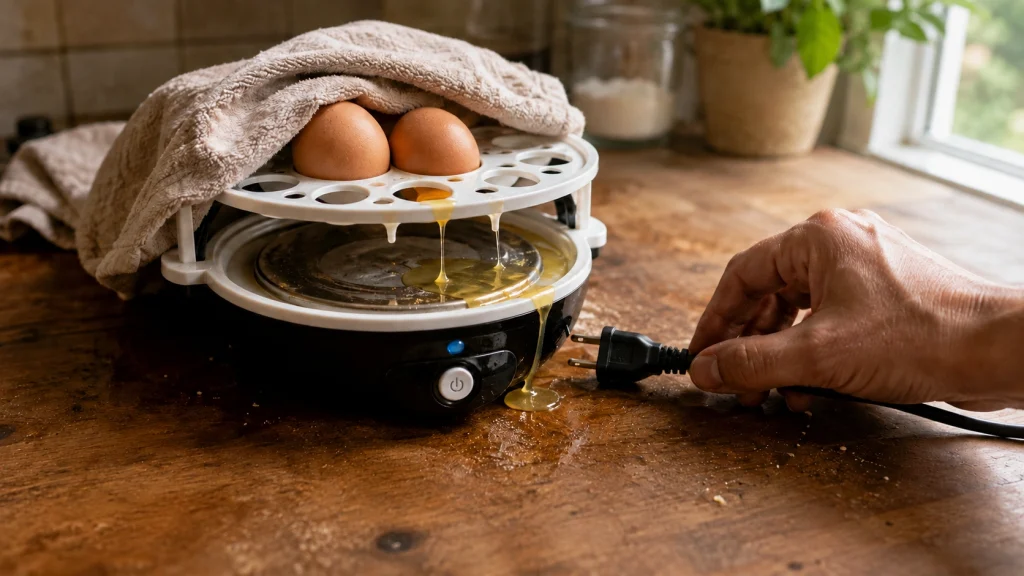
If oil, water, or raw egg enters the base, unplug the unit. Do not turn it on again until the manufacturer confirms that it is safe.
When to Replace the Egg Cooker
Replacement may be wiser when the cooker smokes with no food spill, trips the outlet, or has a damaged cord. The same applies if its heating plate is loose, cracked, or badly corroded.
A missing tray or measuring cup is different. A low-cost, model-specific replacement part may make the cooker useful again.
| Repair Issue | Usual Decision | Replace Instead? |
|---|---|---|
| Missing tray or cup | Buy an approved part | Usually no |
| Damaged lid | Replace if available | Maybe |
| Frayed power cord | Stop using the cooker | Yes |
| Failed shut-off system | Do not attempt a home repair | Yes |
| Cracked electric base | Stop using it | Yes |
My Personal Experience
In my test, I used the solid omelet tray rather than the boiling rack. I wiped it with a tiny amount of oil and added one egg.
The egg cooked well once I used the correct water mark. It released from the tray without tearing, but it still had a soft steamed base.
Using extra oil did not improve it. The oil gathered around the edge and made the tray harder to wash.
My best result came from accepting what the cooker could do. It made a neat fried-style egg for toast, but a small frying pan was still better for brown, crisp edges.
Final Thoughts
So, can you fry eggs in an egg cooker? Only models with a proper frying or griddle plate can make a true fried egg.
A standard steam cooker can make a safe fried-style egg in an approved solid tray. Check the manual, measure the water, keep the vent clear, and never put raw egg or oil on the heating plate.

1 thought on “Can You Fry Eggs in an Egg Cooker? Easy, Safe Guide”