
Yes, you can make jammy eggs in an egg cooker. The whites should be firm, while the yolks stay thick, soft, and creamy.
My first batch was not quite right. One yolk was runny, while another was almost hard. After a few small tests, I found that water level and fast cooling made the biggest difference.
This guide shows you how to get better results. It also explains what to check when your eggs come out too soft, too firm, cracked, or uneven.
Common Signs of the Problem
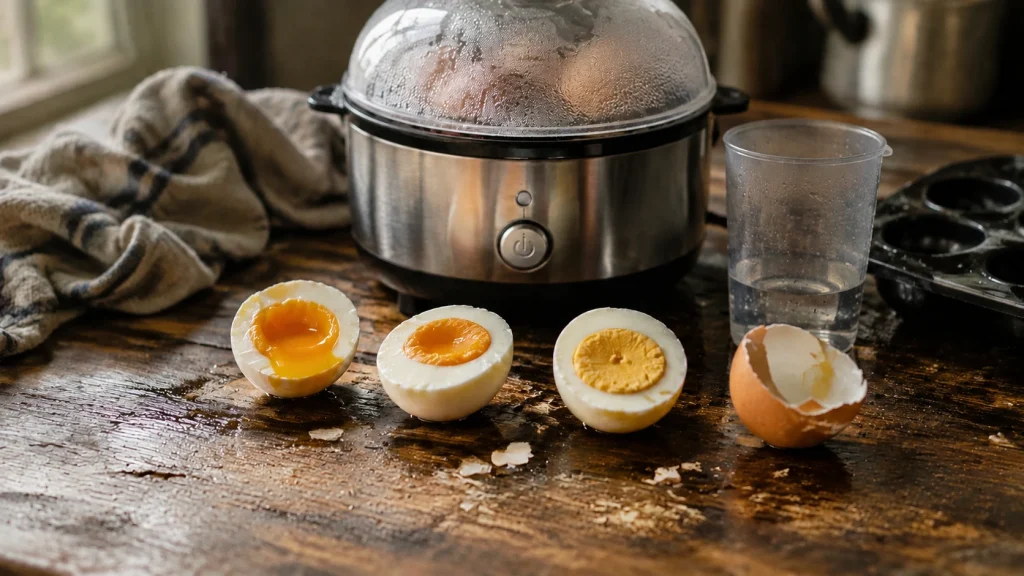
A good jammy egg has a fully set white. Its yolk should be soft in the middle but not raw or watery.
If the result is wrong, you may see one or more of these signs:
- The white is loose near the yolk.
- The yolk runs like a soft-boiled egg.
- The yolk is dry or pale.
- Some eggs cook more than others.
- The shells crack while steaming.
- Water remains after the cooker stops.
- The cooker turns off too soon.
- The lid spits water from the steam vent.
Here is a quick way to match each sign with its likely cause.
| Symptom | Likely cause | Quick fix |
|---|---|---|
| Yolk is too runny | Too little water | Add a small amount of water |
| Yolk is too firm | Too much water or slow cooling | Use less water and chill at once |
| Eggs cook unevenly | Mixed egg sizes | Use eggs of the same size |
| Shells crack | Cold eggs or blocked steam vent | Let eggs rest briefly and clear the vent |
| Cooker stops early | Scale on the heating plate | Descale the plate |
I also learned that the small water measuring cup matters. The lines on it are made for that cooker and may not match a normal kitchen cup.
If your cup is lost or hard to read, a replacement measuring cup can help. Choose one made for your model, since water marks differ between egg cookers.
Possible Causes
Jammy eggs sit between soft-boiled and hard-boiled eggs. That narrow cooking range makes small changes easy to notice.
The most common causes are simple:
- You used the hard-boiled water mark.
- You added too little water.
- The eggs were much larger or smaller than usual.
- Some eggs were cold, while others were warm.
- The eggs stayed in the hot cooker after it beeped.
- The steam vent was partly blocked.
- Limescale covered the heating plate.
- The egg tray did not sit flat.
- The lid was loose or damaged.
Room-temperature eggs often cook a little faster than cold eggs. Large eggs also need more heat than medium eggs.
Your first batch should be a test batch. Once you know the right water level for your cooker, repeat the same egg size, temperature, and cooling method.
How to Fix: Can You Make Jammy Eggs in an Egg Cooker?
The soft setting is the best place to start. Yet some cookers make very runny eggs on that setting.
I found that a small change above the soft mark gave me a better jammy center. Do not fill to the hard-boiled line unless your cooker’s manual tells you to do so.
Use Eggs of the Same Size
Choose eggs from the same carton. Try not to mix medium, large, and extra-large eggs in one batch.
I had poor results when I cooked one medium egg beside three extra-large eggs. The small egg became firm before the larger ones were ready.
Cold eggs are fine if you use them each time. Consistency matters more than bringing every egg to room temperature.
Measure the Water With Care
Add water to the soft-boiled mark first. If the yolk is too loose, add a little more water during the next test.
Do not make a large change at once. An extra teaspoon may be enough, though the exact amount depends on the cooker and number of eggs.
Most basic egg cookers do not have a true “jammy” button. They control cooking by boiling away a set amount of water.
More water creates more steam time. Less water ends the cooking cycle sooner.
Set the Egg Tray and Lid Correctly
Place the egg tray flat over the heating plate. An uneven tray can cause some eggs to receive more steam than others.
Check that the lid sits in its normal position. Do not press it down, cover the vent, or add weight to it.
Steam must escape through the lid vent. A blocked vent may cause hot water to spit from the lid.
Pierce the Eggs Only When Directed
Some egg cookers include a small piercing pin on the measuring cup. Read the maker’s instructions before using it.
If piercing is required, make one small hole at the wide end of each egg. Keep your fingers clear of the sharp pin.
Piercing can reduce cracks in some cookers. Yet it is not required for every model, so follow the instructions that came with yours.
Cool the Eggs at Once
Fast cooling was the key step in my tests. The yolks kept cooking when I left the eggs under the warm lid.
When the cooker beeps or shuts off, unplug it if the manual directs you to do so. Lift the lid away from your face and hands.
Move the eggs into ice water for three to five minutes. This stops carryover heat and helps keep the center jammy.
| Result | Next adjustment | Difficulty |
|---|---|---|
| Very runny center | Add slightly more water | Easy |
| Firm center | Use less water | Easy |
| Firm edges, soft center | Chill sooner | Easy |
| Uneven batch | Match egg size and position | Easy |
| Early shut-off | Descale the heating plate | Moderate |
Check for Mineral Buildup
A white or brown film on the heating plate is often mineral buildup. It can slow heat transfer and change the cooking time.
Wait until the unit is cool and unplugged. Then clean the plate with the method listed in the manual.
For many models, a little white vinegar and water can loosen scale. Never pour liquid into the electrical base or soak the cooker.
Use a soft cloth or non-abrasive sponge. Metal scrubbers can scratch the plate and make future buildup harder to remove.
Run a One-Egg Test
Testing one egg saves food and makes each change easier to judge. I started at the soft water mark and changed only the water amount.
After cooling the egg, I cut it in half. If it was too loose, I added a little more water to the next cycle.
Write down the amount that works. A small mark on a separate note is safer than adding new lines to the measuring cup.
Mistakes to Avoid
The biggest mistake is treating the hard-boiled setting as the safe choice. It often turns a jammy yolk dry and firm.
Avoid these common errors:
- Do not guess the water amount.
- Do not mix egg sizes during a test.
- Do not leave cooked eggs inside the warm unit.
- Do not block the steam vent.
- Do not lift the lid toward your face.
- Do not touch the heating plate while it is hot.
- Do not place the electrical base in water.
- Do not run the cooker without the egg tray.
- Do not bypass the auto shut-off or safety switch.
I once opened the lid as soon as the alarm sounded. A strong puff of steam reached my hand. Now I wait a moment and tilt the lid away from me.
Never open the sealed heating unit or try to repair its wiring. A bad power cord, burning smell, repeated overheating, or sparking needs expert service or replacement.
When to Replace the Egg Cooker
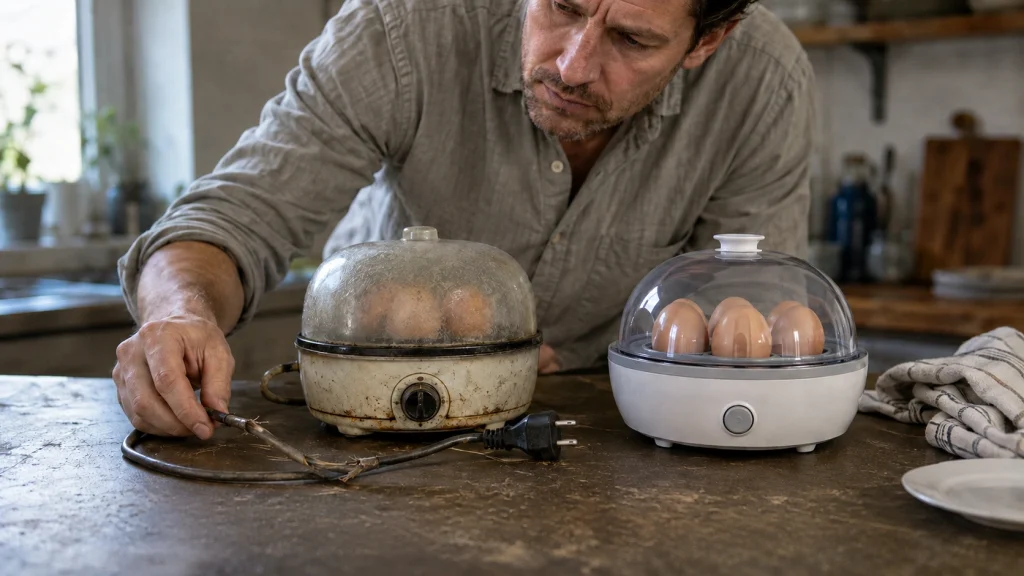
A wrong yolk texture does not mean the cooker is broken. Most jammy egg problems come from water, egg size, or cooling time.
Replacement makes sense when the appliance has a real safety or heating fault.
| Repair issue | Likely cost level | Replace instead? |
|---|---|---|
| Lost measuring cup | Low | No |
| Cracked removable lid | Low to moderate | Only if no safe part fits |
| Damaged egg tray | Low to moderate | Only if no exact replacement exists |
| Frayed power cord | High or unsafe to repair | Usually yes |
| Burning smell or sparks | Unsafe | Yes |
| Heating plate stays cold | Moderate to high | Usually yes |
Stop using the cooker if its cord is split or its plug becomes very hot. The same rule applies if the base leaks, sparks, smokes, or smells burned.
A replacement lid or egg tray must fit the exact model. A poor fit can let steam escape or place the eggs too close to the heating plate.
My Personal Experience
My first goal was to get a thick orange yolk that could spread on toast. I began with four cold, large eggs and the soft-boiled water line.
That batch was too runny. For the next test, I used the same eggs but added a small amount of water. The yolks became thicker, but they kept firming while they sat inside the cooker.
On my third test, I moved them into ice water as soon as the cooker stopped. That gave me the soft, jam-like middle I wanted.
I also tested a batch after removing scale from the heating plate. The cooker heated more evenly, and the finish time became more consistent.
The main lesson was to change one thing at a time. Water amount, egg size, and fast cooling had more effect than any special trick.
Final Thoughts
So, can you make jammy eggs in an egg cooker? Yes. Start with the soft-boiled setting, use equal-size eggs, and measure the water with care.
If the yolk is too loose, add a little more water next time. If it is too firm, use less water and cool the eggs sooner.
Keep the tray flat, the steam vent open, and the heating plate free of scale. With one or two small test batches, most egg cookers can make smooth, creamy jammy eggs safely and with consistent results.
