Quick Answer
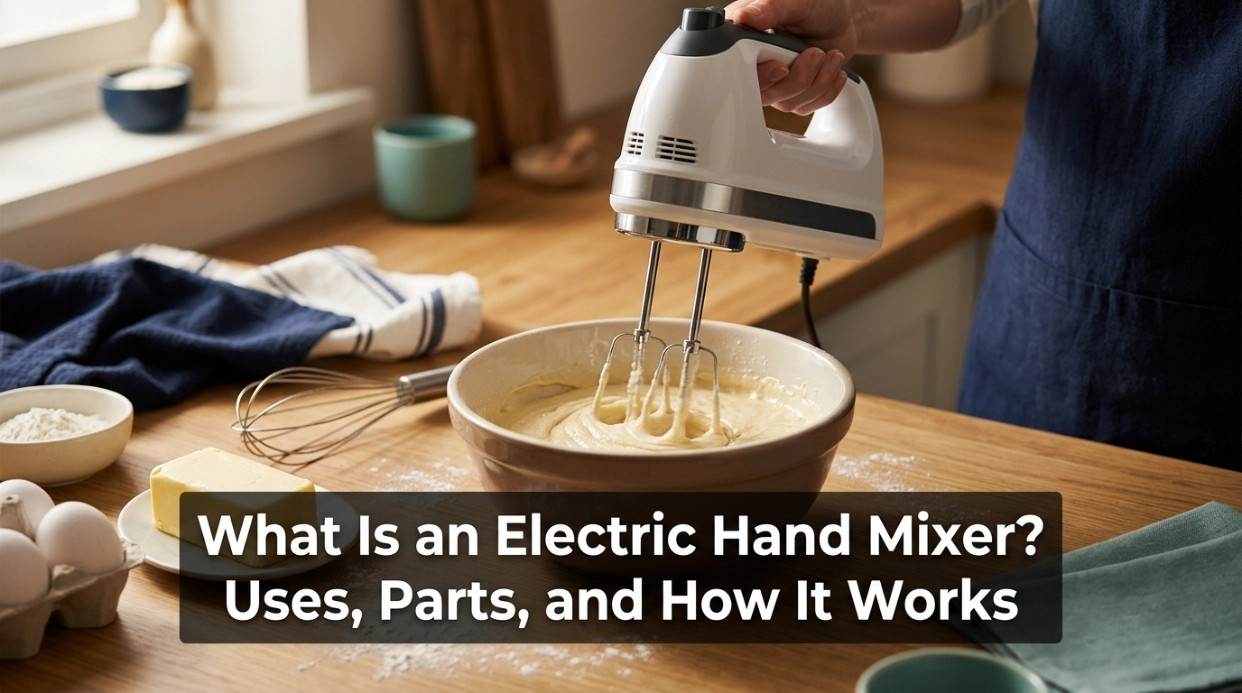
An electric hand mixer is a compact, handheld kitchen appliance that uses a motor to rotate removable beaters or other attachments. You guide it through ingredients in a separate bowl to mix batter, beat eggs, cream butter and sugar, whip cream, or perform other light-to-moderate mixing jobs. A useful hand mixer usage guide can help you match attachments and speeds to different recipes.
What an electric hand mixer does
- Mixes batters: It quickly combines wet and dry ingredients for cakes, muffins, pancakes, and brownies.
- Beats ingredients: Rotating beaters handle jobs such as creaming softened butter with sugar.
- Whips air: Higher speeds and whisk attachments can aerate cream, egg whites, and frosting.
- Offers speed control: Multiple settings let you start gently and increase speed as ingredients combine.
- Saves space: Its handheld design requires far less storage space than a full-size stand mixer.
Simple rule to remember
- Start at a low speed, use the correct attachment, and avoid forcing the mixer through ingredients heavier than the manufacturer recommends.
If you’re asking, “What is an electric hand mixer?” think of it as the powered middle ground between a manual whisk and a stand mixer. It gives you motorized mixing without permanently occupying part of your counter.
I find its biggest appeal is simplicity. You insert the attachments, choose a suitable bowl, mix your recipe, eject the attachments, and put the appliance away.
In This Guide
What Is an Electric Hand Mixer?
An electric hand mixer is a portable food-preparation appliance with a motor inside its handheld housing. The motor turns removable beaters, a whisk, dough hooks, or other compatible attachments.
You hold the appliance while the attachments rotate inside a separate mixing bowl. Unlike a stand mixer, the machine does not support the bowl or position the attachments for you.
Definition: An electric hand mixer is a handheld motor-driven kitchen appliance that rotates removable attachments to mix, beat, whip, cream, or sometimes knead ingredients.
The basic design has existed for decades because it solves a simple problem well. Repetitive hand whisking takes effort, while a stand mixer can feel excessive for one bowl of batter.
Why is it called a hand mixer?
The word “hand” describes how you control the appliance. You hold its handle and manually move the spinning attachments around the bowl.
This movement matters because the attachments only work on ingredients they can reach. Guiding the mixer around the bowl helps bring unmixed ingredients into the active mixing area.
- Handheld body: Contains the motor, controls, handle, and attachment drive.
- Separate bowl: You can usually choose a suitable bowl rather than using a dedicated mixer bowl.
- Removable attachments: Standard beaters handle most common mixing tasks.
- Variable speeds: Different settings provide more control over mixing intensity.
Current hand mixers vary considerably. KitchenAid’s current buying guidance, for example, describes models with roughly 3 to 9 speed settings and notes that hand mixer wattage can range from about 60 watts to more than 400 watts.
Wattage alone doesn’t tell you how capable a mixer will feel. Motor design, gearing, attachment shape, and speed control also influence performance.
Section Takeaway: An electric hand mixer gives you powered mixing in a compact appliance that you position by hand. It is designed mainly for quick, small-to-medium mixing jobs.
How Does an Electric Hand Mixer Work?
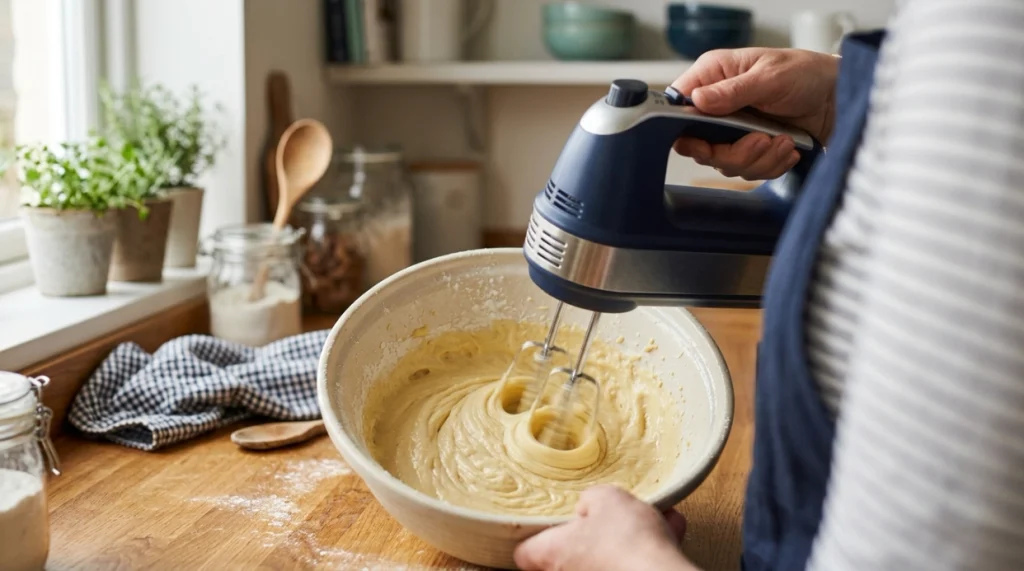
An electric hand mixer converts electrical energy into rotary movement. Its internal motor and drive mechanism transfer that movement to the attachments underneath the housing.
Those rotating attachments move ingredients repeatedly through the bowl. The exact effect depends on attachment shape, speed, ingredient thickness, and how you move the mixer.
What happens after you switch it on?
- Electricity powers the motor. A corded mixer draws power from an outlet, while a cordless model uses its battery.
- The motor begins rotating. Internal components transfer the motor’s movement toward the attachment sockets.
- The attachments spin. Standard mixers commonly use two beaters working together.
- The beaters move ingredients. They create circulation and mechanical mixing throughout the food.
- You guide the appliance. Moving it around the bowl exposes more ingredients to the rotating tools.
Why do different speeds matter?
Low speed gives you better control at the beginning of a recipe. This is useful when loose flour, powdered sugar, or thin liquid could otherwise leave the bowl.
Higher settings create more vigorous movement. They are useful when you need faster beating or aeration.
- Low: Starting mixtures and combining dry with wet ingredients.
- Medium: General batter mixing, creaming, and many everyday tasks.
- High: Whipping cream, egg whites, and other mixtures that need aeration.
I use the speed number as a guide rather than an absolute rule. A “speed 3” on one model may not behave exactly like speed 3 on another.
The food tells you more. Start gently, watch the texture, and increase speed only when the recipe and mixer allow it.
Section Takeaway: A hand mixer works by transferring motor rotation into its attachments. Speed, attachment design, and your movement around the bowl determine how that energy affects the ingredients.
What Can You Use an Electric Hand Mixer For?
A hand mixer works best for recipes that require repeated mixing, beating, creaming, or whipping. It is particularly useful when a manual whisk would become tiring but a stand mixer is unnecessary.
Its sweet spot is usually lighter and moderate mixtures. Thick mixtures require more caution because every model has different workload limits.
Common hand mixer jobs
- Cake and cupcake batter: Combine ingredients efficiently after loose flour begins incorporating.
- Brownie batter: Mix wet ingredients and moderate batters without bringing out a larger appliance.
- Butter and sugar: Cream softened butter and sugar for cakes, cookies, and frostings.
- Whipped cream: Use beaters or a compatible whisk to introduce air.
- Egg whites: Beat them toward soft or stiff peaks when your recipe requires it.
- Buttercream: Beat softened butter with sugar and other ingredients into frosting.
- Cheesecake filling: Blend softened ingredients until the recipe’s required consistency is reached.
- Mashed potatoes: Mix carefully when a smoother texture is desired, while avoiding unnecessary overworking.
- Light dough: Some models include dough hooks and specifically permit certain dough tasks.
What should you not use a hand mixer for?
A hand mixer is not automatically a substitute for every powered kitchen appliance. Standard beaters move and combine food rather than chopping it with sharp blades.
- Hard chopping: Use a food processor or appropriate chopper instead.
- Pureeing soup: An immersion blender is designed for that job.
- Crushing ice: Standard mixer beaters are not blender blades.
- Extremely stiff dough: Do not force a mixer beyond its manufacturer’s stated capability.
- Long heavy kneading: A suitably rated stand mixer may be the more practical choice.
One of the easiest mistakes is assuming that supplied dough hooks make every hand mixer a bread-kneading machine. Attachment availability does not remove the motor’s workload limits.
Check the manufacturer’s instructions before mixing dense dough. Stop if the appliance struggles, overheats excessively, or behaves abnormally.
How Is a Hand Mixer Different From Other Mixing Tools?
A hand mixer sits between a manual whisk and a stand mixer in effort, size, and capability. It also differs from an immersion blender because the attachments perform a different type of food preparation.
| Feature | Electric Hand Mixer | Stand Mixer | Manual Whisk | Immersion Blender |
|---|---|---|---|---|
| Power source | Electric or rechargeable battery | Electric | Manual | Electric or rechargeable battery |
| How it moves | You guide rotating attachments | Machine holds and moves attachment | You create all movement | You guide a blade or blending head |
| Best suited to | Beating, whipping, creaming, batter | Longer, larger, or heavier mixing jobs | Tiny batches and delicate manual control | Pureeing and blending |
| Typical hand mixer data | About 3–9 speeds; roughly 60 W to 400 W+ across current designs | Model-specific | No motor | Model-specific |
| Storage needs | Low | Higher | Very low | Low |
Hand mixer vs. stand mixer
A stand mixer holds its mixing tool in a fixed machine assembly, often above its own bowl. You do not need to hold the motor throughout the process.
A hand mixer needs more involvement from you. In return, it is quicker to store, easier to move, and convenient for many small recipes.
Hand mixer vs. whisk
A whisk gives you direct manual control and works well with very small amounts. However, sustained whipping can become tiring.
An electric hand mixer supplies the repetitive motion for you. That makes tasks such as whipping cream and beating egg whites much easier on your arm.
Hand mixer vs. immersion blender
An immersion blender commonly uses a blade assembly to puree or blend food. A conventional hand mixer uses beaters or whisks to mix and aerate rather than chop.
They overlap in portability, not purpose. I would choose the tool based on the texture I need at the end.
Section Takeaway: Choose a hand mixer for portable powered beating, whipping, and moderate mixing. Choose another tool when chopping, pureeing, lengthy kneading, or ultra-delicate manual control matters more.
What Parts and Attachments Does a Hand Mixer Have?
Most hand mixers share several basic components, although exact designs differ by brand and model. Understanding them makes the appliance easier to use correctly.
Main hand mixer parts
- Motor housing: The main body contains the electric motor and drive components.
- Handle: Lets you control the appliance while mixing.
- Speed selector: Changes the operating speed or power level.
- Attachment sockets: Hold compatible beaters, whisks, or hooks.
- Eject mechanism: Releases removable attachments after the mixer stops.
- Power cord or battery: Supplies energy to the motor.
- Air vents: Help the motor manage heat during operation.
Common attachments
Standard beaters are the everyday attachment. They suit batters, frosting, creaming, and many general mixing tasks.
Wire whisks are designed for aeration. They are useful for whipped cream, egg whites, and other light mixtures when compatible with the mixer.
- Dough hooks: Available with certain models for approved dough tasks.
- Flex-edge beaters: Offered on some designs to increase bowl contact.
- Blending rods: Included with selected multi-accessory models.
- Storage cases or bags: Keep the mixer and attachments together.
Never assume attachments are interchangeable between different brands or models. Use only parts specifically approved for your mixer.
As of 2026, current manufacturer ranges show everything from basic multi-speed mixers to cordless models and higher-speed units with several attachments. The KitchenAid hand mixer buying guide is one example of how current models differ in speeds, power systems, and accessories.
How Do You Choose and Use a Hand Mixer Safely?
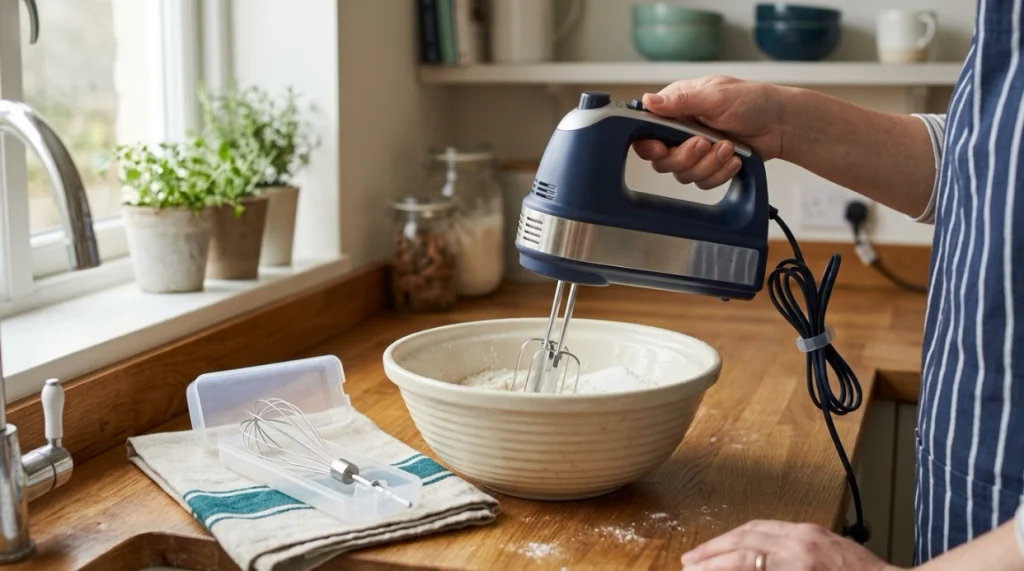
Start by matching the mixer to the foods you prepare most often. More speeds and attachments can add flexibility, but they are not automatically necessary for every kitchen.
What should you look for before buying?
- Low-speed control: A gentle first setting helps reduce flour clouds and liquid splashing.
- Comfortable handle: The mixer stays in your hand during operation, so balance matters.
- Useful attachments: Buy attachments that match recipes you genuinely prepare.
- Easy eject button: Attachments should release without unnecessary struggle.
- Simple cleaning: Check whether removable attachments are dishwasher-safe.
- Cord management: A swivel or locking cord can make maneuvering easier.
- Storage: A case or clip can keep loose beaters together.
Do not judge a hand mixer only by wattage. Current manufacturer guidance notes that motor type and overall design also affect performance.
For broader product-safety context, UL Solutions covers testing and certification for small appliances, including household food-preparation appliances.
How should you use an electric hand mixer safely?
Keep electricity, moving attachments, and liquids under control. Basic habits matter more than complicated techniques.
- Insert attachments before starting: Make sure they are seated correctly while the appliance is unplugged or powered off.
- Start slowly: Begin at the lowest useful speed before increasing it.
- Keep the housing dry: Never immerse the motor body in water.
- Watch the cord: Keep it away from hot burners, sharp edges, and the mixing attachments.
- Keep hands clear: Never put fingers or utensils into moving beaters.
- Stop before ejecting: Turn the mixer off and wait until attachments stop completely.
- Unplug before cleaning: Disconnect corded appliances from power before handling removable parts.
- Respect workload limits: Stop rather than forcing a struggling mixer through an unsuitable mixture.
The U.S. Consumer Product Safety Commission’s Home Electrical Safety Checklist also advises keeping countertop appliances away from sinks, protecting cords from hot surfaces, and unplugging appliances when they are not in use.
If your mixer produces an electrical shock, persistent burning smell, damaged cord, smoke, or abnormal sparking, stop using it.
Pro tip: Do not open a sealed hand mixer or bypass an electrical or mechanical safety feature unless the manufacturer specifically provides a user-service procedure. Consult the manual or a qualified appliance repair technician instead.
Section Takeaway: The best hand mixer is one that fits your recipes, feels comfortable, and offers usable low-speed control. Safe operation means keeping electricity away from water, hands away from moving attachments, and the motor within its intended workload.
Electric Hand Mixer FAQ
Is a hand mixer the same as an electric mixer?
A hand mixer is one type of electric mixer. The broader term “electric mixer” can also describe stand mixers and other powered mixing machines, while a hand mixer specifically refers to a portable unit you hold during operation.
Is an electric hand mixer good for beginners?
Yes. Its basic controls and removable attachments make a hand mixer approachable for beginners. Start at low speed, follow the recipe, and learn how different foods respond before experimenting with faster settings or heavier mixtures.
Can an electric hand mixer knead dough?
Some models can knead certain doughs when they include compatible dough hooks and the manufacturer permits the task. Do not assume every hand mixer can handle dense bread dough, because motor capability and recommended workloads vary.
Can a hand mixer whip cream?
Yes. Whipped cream is a classic hand mixer task. Standard beaters can work, while a compatible whisk attachment may be even better suited to aeration. Watch the cream closely because powered mixing can take it beyond the desired stage quickly.
Can you use a hand mixer in any bowl?
Use a stable bowl large enough to contain the ingredients and moving attachments. Avoid bowls or surfaces that the attachments could damage, and follow the mixer’s manual if the manufacturer gives specific bowl guidance.
How many speeds should a hand mixer have?
There is no perfect number for everyone. Current models commonly provide several speeds, and manufacturer guidance shows designs ranging from roughly three to nine settings. Good low-speed control is often more useful than simply having the highest number of speeds.
Is a hand mixer better than a stand mixer?
Neither is universally better. A hand mixer is compact and convenient for everyday batters, cream, eggs, and frosting, while a suitably rated stand mixer is often more practical for lengthy mixing, heavier dough, or larger batches.
Final takeaway: An electric hand mixer is a compact powered mixer designed for convenient beating, whipping, creaming, and everyday batter preparation. Match the attachment and speed to the food, start slowly, and respect the appliance’s workload limits for better results and longer service life.
If you’re deciding whether one belongs in your kitchen, think about your most frequent recipes. For occasional baking and quick mixing jobs, a hand mixer can provide plenty of useful power without the size of a full stand mixer.