Quick Answer
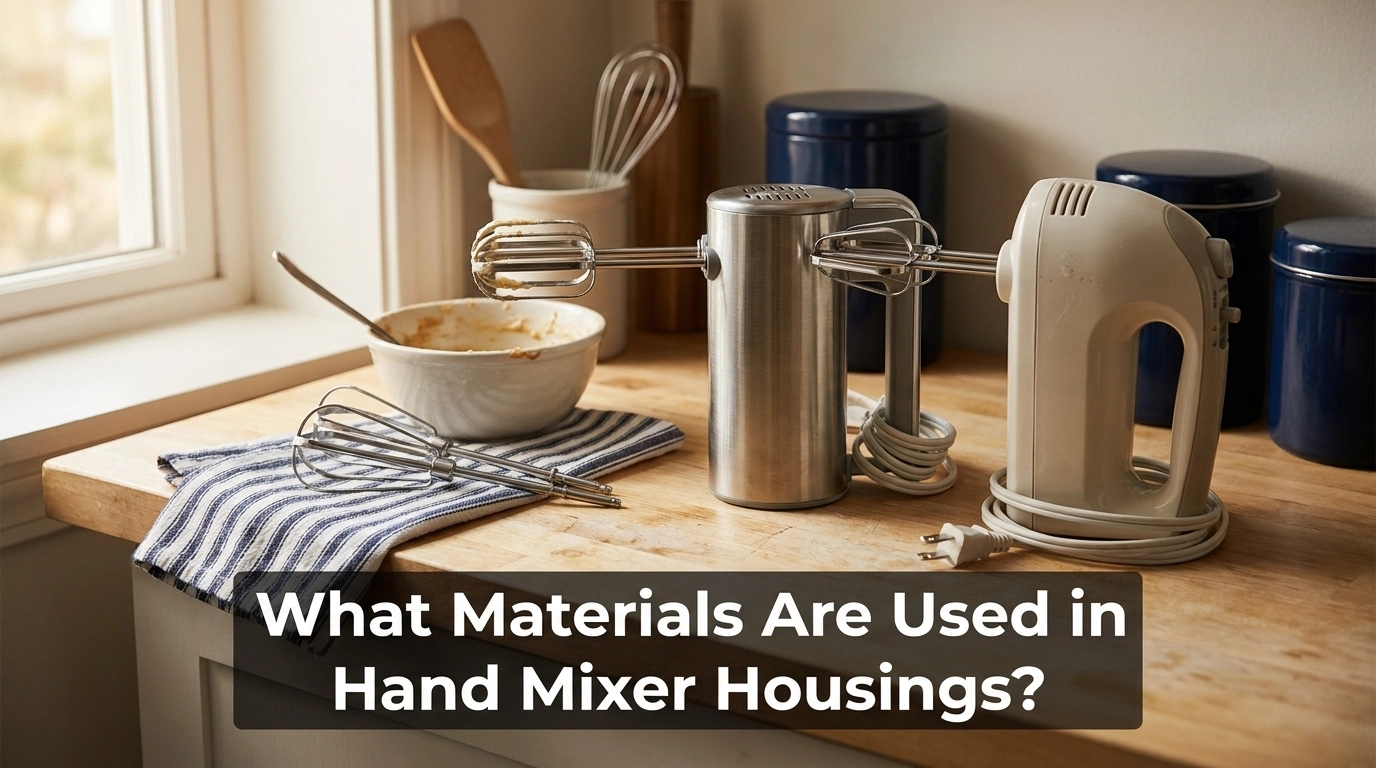
Hand mixer housings are commonly made from molded plastic, including ABS and other engineering plastics, although some models feature stainless steel panels or mixed-material construction. The housing is the outer shell that protects the motor, wiring, gears, and controls while influencing weight, grip, durability, and appearance. To judge a specific mixer, check its official material specifications rather than assuming a metallic finish means the entire body is metal.
Common housing materials at a glance
- ABS plastic: A common engineering plastic valued for its balance of toughness, weight, and moldability.
- Other molded plastics: Polypropylene and other polymers may appear in selected housing components, depending on the design.
- Stainless steel: May form the outer shell or selected panels on some models, often providing a metallic appearance.
- Mixed materials: Plastic bodies may include metal trim, reinforced mounting points, or other structural components.
- Surface finishes: Glossy coatings, painted finishes, and brushed-metal effects can change appearance without changing the underlying housing material.
What should you check?
- Look for the manufacturer’s material specification, housing description, and care instructions.
- Inspect the shell for cracks, loose seams, exposed internal parts, and signs of heat damage.
When comparing hand mixers, I would look beyond color and styling to understand what the outer body is made from. Housing material can affect how the appliance feels in your hand, how it handles everyday knocks, and how easily you can wipe away flour or batter.
This guide explains the main materials, their practical differences, and the details worth checking before you buy a mixer or evaluate an older one. I’ll also clarify why housing material alone doesn’t determine overall appliance quality.
In This Guide
What Is a Hand Mixer Housing Made Of?
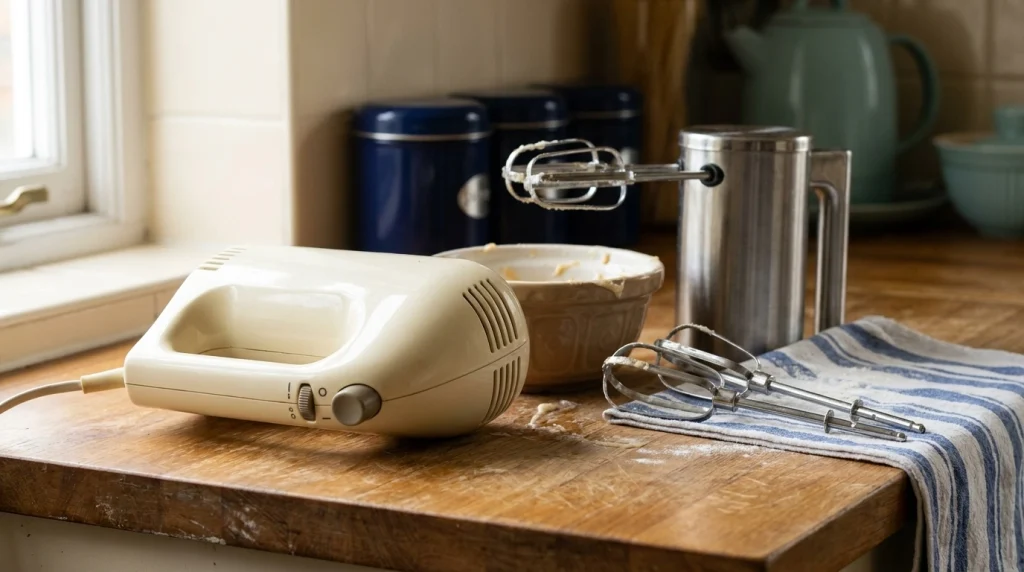
A hand mixer housing is the outer shell that surrounds the appliance’s motor, gears, wiring, and control mechanisms. Manufacturers commonly use molded plastic, although some models incorporate stainless steel or combine several materials.
The housing is not the same as the beaters, shafts, or other removable attachments. Those parts perform the mixing, while the housing encloses the mechanism that powers them.
What does the housing do?
The outer shell serves several purposes beyond giving the mixer its shape.
- Protects internal components: The shell helps keep the motor, wiring, and moving mechanisms enclosed during normal operation.
- Supports controls: It provides mounting points for the speed selector, eject button, and other controls.
- Provides a grip: Its shape and surface affect how comfortably you hold and guide the mixer.
- Supports airflow: Designed openings allow cooling air to move through the appliance where required.
- Shapes the appearance: Its color, finish, and contours contribute to the overall design.
These functions explain why the housing deserves attention when comparing appliances. A well-fitted shell matters even when two mixers use the same basic plastic.
For a closer look at the components inside this outer body, see the complete guide to hand mixer parts.
Which Materials Are Used in Hand Mixer Housings?
Hand mixer manufacturers select housing materials according to design requirements, manufacturing cost, desired weight, and appearance. Plastic is common, but the precise polymer and any metal components vary by model.
1. ABS plastic
ABS stands for acrylonitrile butadiene styrene. This engineering thermoplastic is used in many consumer products because it combines useful impact resistance, rigidity, and the ability to form detailed shapes.
For hand mixers, ABS can accommodate curved handles, control openings, ventilation slots, and attachment housings. Manufacturers can also produce it in different colors and finishes.
- Advantages: Relatively lightweight, moldable, and available in many finishes.
- Limitations: Quality depends on the formulation, wall thickness, assembly, and operating conditions.
- Best fit: Everyday mixers designed around manageable weight and practical manufacturing costs.
ABS is not automatically stronger than every other plastic. A well-designed housing matters as much as the material name.
2. Polypropylene and other plastics
Polypropylene, often abbreviated PP, is another thermoplastic used in household products. Its relatively low weight and chemical resistance can make it useful for selected appliance components.
Other engineering plastics may also appear in a mixer, particularly where the manufacturer needs a specific balance of rigidity, heat tolerance, impact performance, or manufacturing flexibility.
However, don’t assume every plastic hand mixer uses polypropylene or that every visible plastic panel is made from ABS. The manufacturer’s documentation is the most reliable way to identify the exact material.
3. Stainless steel
Some hand mixers use stainless steel for the outer housing, while others feature metal panels or decorative sections over a primarily plastic body. Stainless steel provides a distinctive metallic appearance and generally resists ordinary corrosion when appropriately selected and maintained.
Its practical trade-offs include potentially greater weight, manufacturing cost, and the possibility of fingerprints or visible surface scratches. A metallic shell also does not eliminate the need for suitable internal insulation and electrical protection.
Check whether a product listing says “stainless steel housing” or simply “stainless steel finish.” Those descriptions can refer to different constructions.
4. Mixed-material construction
Many appliances combine materials rather than relying on a single substance. A hand mixer might have a molded plastic body, a metal accent panel, internal metal supports, and stainless steel beaters.
These materials serve different purposes, so a specification listing “plastic and stainless steel” doesn’t necessarily mean both materials form the main outer shell.
When reading a product description, separate the housing material from the attachment material. That small distinction prevents a common buying mistake.
Is Plastic or Stainless Steel Better for a Hand Mixer?
Neither material is universally better. Plastic generally favors lower weight and design flexibility, while stainless steel can offer a metallic finish and a solid feel, depending on the construction.
The better choice depends on how frequently you bake, how long you hold the appliance, and which features matter most to you.
| Comparison factor | Plastic housing | Stainless steel housing |
|---|---|---|
| Weight | Often lighter | Often heavier |
| Appearance | Many colors and finishes | Metallic appearance |
| Impact resistance | Varies by polymer and design | Varies by metal thickness and construction |
| Cleaning | Usually easy to wipe | Usually easy to wipe; fingerprints may show |
| Corrosion | Does not rust like steel | Generally corrosion-resistant, depending on grade and care |
| Cost | Often economical to manufacture | Can cost more, depending on construction |
| Long-term performance | Depends on material and assembly quality | Depends on material, assembly, and internal design |
Important: This table describes general material tendencies, not guaranteed results for every model. Exact weight, durability, and price require product-specific specifications.
Which material suits everyday baking?
For occasional cakes, cookies, whipped cream, and pancake batter, a well-made plastic housing is usually a sensible choice. Its lighter weight can make the mixer easier to maneuver around a bowl.
For frequent baking, don’t focus on metal construction alone. Check the handle shape, overall weight, speed control, ventilation, warranty, and how securely the body fits together.
I would also compare the complete appliance weight rather than judging the shell by touch alone. Motor placement and internal components can influence balance just as much as the outer material.
For more context, this guide to typical hand mixer weight explains why two similarly sized appliances can feel different in use.
How Does Housing Material Affect Everyday Use?
Housing material affects how a mixer feels and holds up, but material is only one part of the design. Shape, surface texture, construction quality, and internal layout all contribute to the experience.
Weight and grip comfort
A lightweight housing can reduce the effort required to hold a mixer over a bowl. This can be helpful when whipping cream or preparing several batches of batter.
However, a lightweight appliance is not automatically comfortable. A poorly shaped handle or front-heavy motor can still place unnecessary strain on your wrist.
Resistance to impacts and scratches
Plastic housings can withstand ordinary handling, but a hard drop may crack a thin section or damage a mounting point. The result depends on the polymer, shell thickness, impact location, and construction.
Metal housings can resist certain impacts without cracking, although they may dent or scratch. Neither material guarantees that the internal motor or controls will survive a fall.
Cleaning and maintenance
Most mixer housings need only a gentle wipe with a slightly damp cloth. Smooth finishes are often easier to clean, while textured areas may provide a more secure grip.
- Switch off and unplug the mixer before cleaning its exterior.
- Keep water away from ventilation openings, controls, and the cord entry point.
- Use a soft cloth and follow the manufacturer’s cleaning instructions.
- Avoid abrasive pads and harsh cleaners unless the manufacturer explicitly permits them.
- Never immerse the motor housing in water unless the appliance is specifically designed for that purpose.
Beaters may have different cleaning requirements from the housing. Removable stainless steel attachments can sometimes be dishwasher-safe, but you should verify this in the model’s manual.
Heat management and ventilation
The housing also forms part of the mixer’s cooling arrangement. Vents and internal airflow paths help manage heat produced by the motor during normal operation.
Material alone cannot tell you whether a mixer will run cool. Motor design, ventilation openings, operating load, and recommended duty cycle also matter.
If the body becomes unusually hot, the shell warps, or you notice a burning smell, stop using the appliance and consult the manufacturer’s guidance. Don’t cover its vents or continue running it in the hope that the problem will disappear.
How Can You Identify the Material of a Hand Mixer Housing?

The most reliable way to identify a housing material is to check the official product specification or user manual. Appearance and touch can offer clues, but they cannot reliably establish the exact material or its grade.
Read the manufacturer’s specifications
Start with the product page, technical data sheet, or instruction manual. Look for wording that identifies the body or housing specifically.
Descriptions such as “ABS housing,” “plastic body,” and “stainless steel housing” are more informative than a general materials list that includes the beaters and accessories.
Understand the limits of visual inspection
A glossy silver surface may be stainless steel, a painted plastic panel, or another finish. A brushed appearance is not proof of metal construction.
Similarly, a plastic body may contain internal metal supports or reinforced mounting points that aren’t visible from the outside. Don’t scratch, cut, or dismantle the shell to identify it.
Check the model number and manual
Manufacturers sometimes sell several versions of a mixer with similar names or appearances. The model number helps you match the correct specification sheet to the exact appliance.
Also check the care instructions and warranty terms. These documents can clarify how to clean the housing, what damage is covered, and whether replacement parts are available.
For a broader understanding of the appliance’s design, read how a hand mixer works, including the relationship between its motor, gears, attachments, and outer body.
How Durable and Safe Are Different Hand Mixer Housings?
A durable housing should remain securely assembled and keep internal components enclosed during normal use. Material selection helps, but good engineering, assembly, ventilation, and electrical protection are equally important.
Signs of a well-constructed housing
When evaluating a mixer, look for practical signs of sound construction rather than relying on a premium-looking finish.
- Secure seams: The outer panels fit together without unexplained gaps or movement.
- Stable controls: Speed selectors and eject buttons sit securely in their openings.
- Undamaged cord entry: The power cord has no visible cuts, exposed conductors, or loose entry points.
- Clear ventilation: Cooling openings are unobstructed and free of obvious damage.
- Appropriate documentation: The manufacturer provides clear operating, cleaning, and safety instructions.
These checks cannot certify an appliance’s electrical safety, but they can help you identify visible problems before use.
When should you stop using a mixer?
A cracked or loose housing deserves particular attention when damage occurs near the power cord, speed controls, or beater sockets. Those areas can contain or support important electrical and mechanical components.
Stop using the mixer if the shell exposes internal parts, shows melting, develops a burnt smell, or becomes loose enough to affect safe handling. Don’t tape over a structural crack and assume the appliance is safe.
Pro tip: Never open a sealed mixer, bypass a safety feature, or attempt electrical repairs unless you have the appropriate qualifications and the manufacturer permits the repair. Consult the manual or a qualified appliance repair technician.
Does a metal housing mean a safer appliance?
No. Stainless steel is not a substitute for proper insulation, wiring, protective construction, and applicable electrical safety testing.
In the United States, the UL 982 household food-preparation equipment standard covers relevant categories of motor-operated kitchen appliances. The appropriate requirements depend on the product and market.
For broader information about household appliance safety standards, see UL’s overview of IEC 60335-1. When buying, look for legitimate compliance information relevant to your country rather than assuming a particular housing material proves safety.
As of 2026, the sensible approach remains the same: evaluate the complete appliance, follow its instructions, and stop using any unit with potentially dangerous damage.
Frequently Asked Questions
Are most hand mixer housings made of plastic?
Many conventional electric hand mixers use molded plastic housings because plastic can provide a useful balance of weight, cost, and design flexibility. Some models use stainless steel or mixed-material construction, so check the manufacturer’s specifications for the exact model.
Is ABS plastic good for a hand mixer housing?
ABS is a common engineering thermoplastic that offers useful rigidity, impact resistance, and moldability. It can work well for a hand mixer body, but its performance depends on material formulation, shell thickness, assembly quality, and operating conditions.
Are stainless steel hand mixers more durable than plastic ones?
Not necessarily. Stainless steel may resist some impacts without cracking, while plastic can offer good durability at a lower weight. Housing thickness, internal supports, assembly, and the quality of the complete appliance determine how well either design holds up.
Can a plastic hand mixer housing melt?
Plastic can soften or deform when exposed to excessive heat, although the temperature at which this occurs depends on the specific polymer and design. If a mixer housing warps, discolors from heat, or smells burnt, stop using it and seek manufacturer guidance.
Is a stainless steel finish the same as a stainless steel housing?
No. A stainless steel finish may describe the appearance of a surface rather than the material beneath it. A product with a metallic-looking exterior could still use a plastic body, so check whether the manufacturer explicitly identifies the housing as stainless steel.
How should I clean a hand mixer housing?
Switch off and unplug the appliance, then wipe the exterior with a soft, slightly damp cloth. Keep moisture away from vents and electrical openings, avoid immersing the motor housing, and follow the model’s cleaning instructions.
What matters more: housing material or build quality?
Both matter, but the material name alone is not a reliable quality ranking. A well-assembled plastic housing may be more practical than a poorly fitted metal one. Consider grip, balance, secure seams, ventilation, warranty, and the manufacturer’s documented specifications together.
Final Takeaway
Hand mixer housings commonly use molded plastics such as ABS and other polymers, while some models incorporate stainless steel or mixed materials. Each approach offers different advantages in weight, appearance, impact resistance, and manufacturing cost.
For most home cooks, the best choice is a mixer with a comfortable grip, securely fitted housing, suitable ventilation, and clear manufacturer documentation. Don’t pay extra for a metallic appearance unless the construction and other features justify it.
Before buying, verify the exact housing material and compare the complete appliance rather than judging its exterior alone. If your current mixer has cracks, loose panels, heat damage, or exposed internal parts, stop using it until the manufacturer or a qualified technician confirms the appropriate next step.