Quick Answer
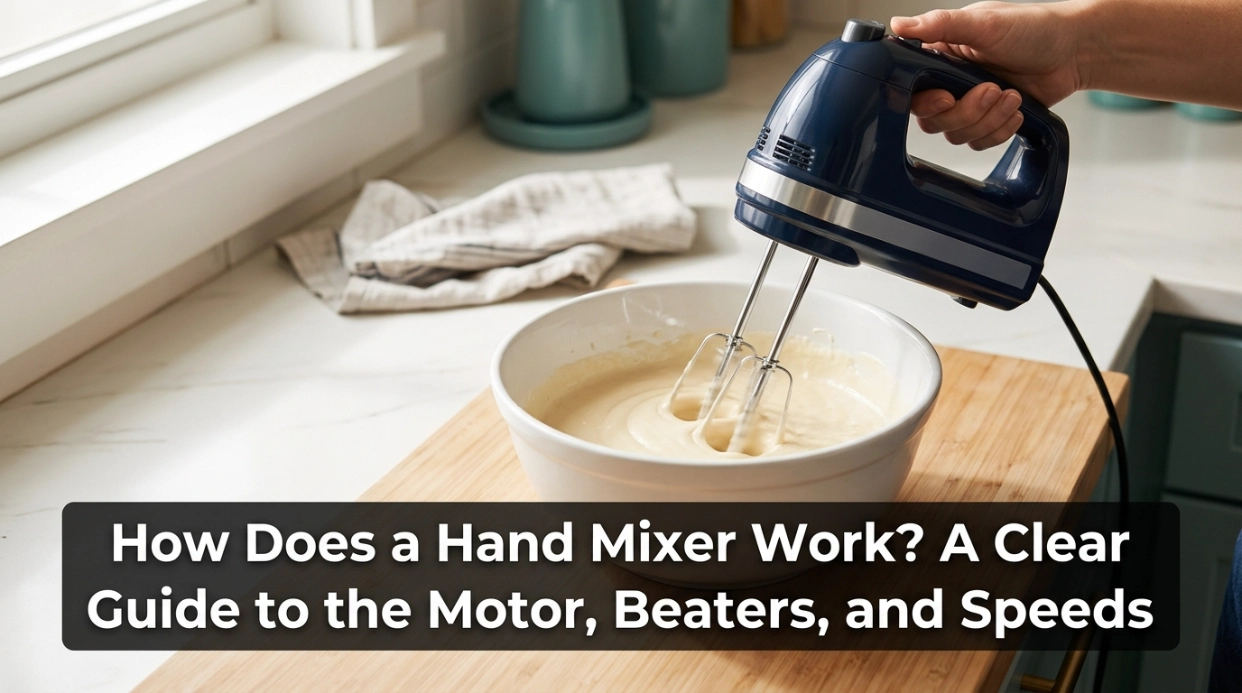
A hand mixer uses a small electric motor and internal gears to spin two removable beaters, reducing fast motor rotation into useful mixing torque. You control the beater speed with the selector, while attachment shape and hand movement affect circulation; KitchenAid’s hand mixer use guide also recommends starting slowly and increasing speed as needed.
What happens when you switch it on?
- Power enters: Electricity reaches the internal motor when the control is switched on.
- Motor spins: The motor shaft rotates at high speed inside the housing.
- Gears transfer motion: A compact gear train slows and redirects the motor’s rotation.
- Beaters counter-rotate: The two beaters typically turn in opposite directions to pull ingredients through the mixing zone.
- Speed changes: The control system changes motor output so you can stir, beat, or whip.
Best practice
- Start on the lowest practical speed, then move higher after dry and wet ingredients begin to combine.
If you have ever wondered how does a hand mixer work, the answer is simpler than the noise and spinning beaters make it seem. A hand mixer converts electrical energy into controlled rotary motion, then uses the beaters to move, shear, combine, and sometimes aerate food.
In this guide, I will break down how an electric hand mixer works from the motor to the bowl. I will also explain why speed, attachment choice, bowl position, and mixture thickness change the result.
In This Guide
What Happens Inside a Hand Mixer?
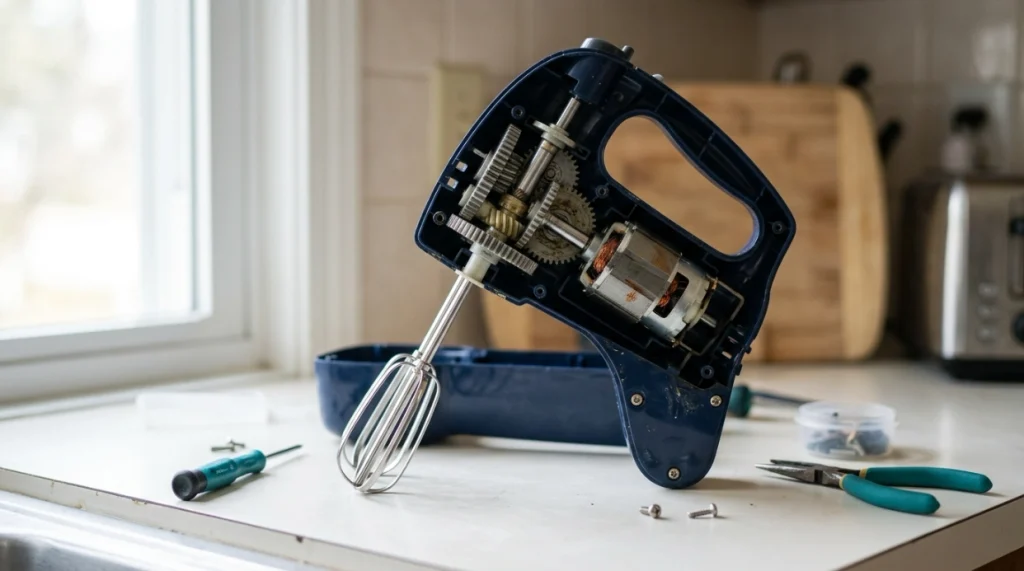
A hand mixer uses a compact motor and gear train to turn two beater sockets below the body. The motor creates the rotation, while the gears make that rotation useful for mixing.
Definition: A hand mixer is a portable electric food-preparation appliance that powers removable beaters, whisks, or similar attachments while you guide the appliance around a bowl by hand.
The motor creates fast rotary motion
When you switch on a corded model, current flows to the motor. Cordless models do the same job with energy from a rechargeable battery.
The motor shaft spins faster than the beaters should rotate in food. The mixer therefore needs a mechanical stage between the motor and the attachments.
- Motor: Converts electrical energy into rotation.
- Drive shaft: Carries the motor’s rotation toward the gearbox.
- Gear train: Changes speed, direction, and torque.
- Output sockets: Hold and turn the beater shafts.
The gears slow and redirect the motion
Many traditional hand mixers use a worm-gear or reduction-gear arrangement. Oxford’s gear-mechanism example shows a common layout where motor-driven gears turn the two beaters in opposite directions.
The exact gearbox varies by model, but reducing speed also creates more useful turning force at the beaters. That extra torque matters as a mixture becomes thicker.
Section Takeaway: The motor supplies fast rotation, but the gearbox turns that speed into controlled beater motion with more usable torque.
What Do the Main Hand Mixer Parts Do?
The main parts work as one system, but each has a different job. Knowing them makes the mixer easier to understand and troubleshoot.
| Part | What it does | What you notice |
|---|---|---|
| Motor | Creates rotational power | Sound, vibration, and load changes |
| Gearbox | Transfers and reduces motor speed | Steady beater rotation under load |
| Speed control | Changes operating speed | Slow stirring through fast whipping |
| Beater sockets | Lock attachments to the drive | A click or seated fit when installed |
| Beaters or whisk | Contact and move the ingredients | Mixing, beating, or aeration |
| Eject mechanism | Releases removable attachments | Quick removal for cleaning |
Some attachments are not interchangeable between the two sockets. One shaft may have a collar or different shape, so always match the attachment to the opening shown in the manual.
The housing also matters. It keeps the rotating and electrical parts covered while giving your hand a stable grip above the mixing bowl.
Why two beaters?
Two counter-rotating beaters create a strong mixing zone between them. Their overlapping paths move ingredients inward, downward, and back through the rotating wires or blades.
That is why you should guide the mixer around the bowl instead of holding it in one fixed spot. Your movement brings ingredients from the edges into the active mixing area.
Section Takeaway: The beaters do the visible work, but the motor, gearbox, sockets, and speed control determine how effectively they can do it.
Why Does Hand Mixer Speed Matter?
Speed changes how aggressively the beaters move ingredients and how much air they can incorporate. Low speed favors control, while high speed favors rapid beating and whipping.
Current hand mixers commonly offer several speed settings, often around three to nine depending on the model. Hamilton Beach’s hand mixer range shows how models combine multiple speeds with beaters, whisks, and other attachments.
Low speed: combine without making a mess
Low speed is best for starting flour, cocoa, powdered sugar, or other dry ingredients. It reduces the chance of throwing powder over the counter.
- Start cake or pancake batter.
- Fold dry ingredients into wet ingredients.
- Add chocolate chips, nuts, or other chunky ingredients when your manual allows it.
- Begin mixing thin liquids that may splash.
Medium speed: mix and cream
Medium settings work well once ingredients are partly combined. This range is often used for batters, frosting, mashed foods, and creaming softened butter with sugar.
The exact number is model-specific. A speed marked “3” on one mixer may not match speed “3” on another.
High speed: beat and whip
High speed is useful when the goal is rapid aeration. Whipped cream and egg whites are common examples because the attachment must repeatedly pull air into the liquid.
More speed is not always better. Thick mixtures can overload a small hand mixer, so the recipe and owner’s manual should decide the upper limit.
Section Takeaway: Start low for control, then increase only when the mixture and attachment need more speed.
How Do the Beaters Actually Mix Food?
The beaters do more than spin ingredients in circles. They create shear, circulation, impact, and sometimes aeration at the same time.
Mixing and shearing
As the beater wires move past the food, they drag neighboring layers at different speeds. That shear helps break small lumps and distribute ingredients more evenly.
In cake batter, this action helps spread flour, fat, sugar, eggs, and liquid through the bowl. In frosting, it helps smooth fat and sugar into a more uniform mixture.
Circulation through the beater zone
Counter-rotating beaters pull food through the space between them. Your hand movement expands that active zone across the rest of the bowl.
- Near the beaters: Mixing is intense and fast.
- At the bowl wall: Ingredients can remain less mixed.
- When you move the mixer: Fresh material enters the beater path.
- When you scrape the bowl: Stuck ingredients rejoin the mixture.
Aeration changes texture
Whisking and high-speed beating can trap air bubbles in cream, egg whites, and some batters. Proteins or fats help stabilize those bubbles and change texture.
Attachment shape matters too, because a wire whisk often suits aeration better than a standard beater. From a practical testing point of view, I watch the food’s texture rather than the speed number alone.
Section Takeaway: A hand mixer works because the beaters continuously move ingredients through zones of shear and circulation, while faster whisking can also add air.
How Is a Hand Mixer Different From a Stand Mixer or Whisk?
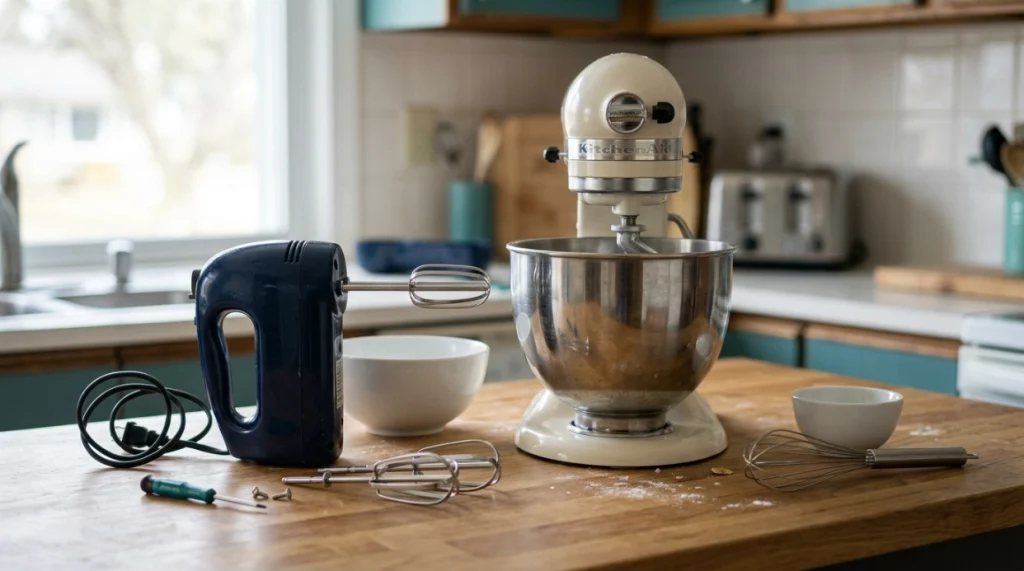
A hand mixer sits between a manual whisk and a stand mixer. It adds motor power without fixing the mixing head to a heavy base.
| Feature | Hand mixer | Stand mixer | Manual whisk |
|---|---|---|---|
| Power source | Electric or battery | Electric | Hand power |
| Tool movement | You move the mixer around the bowl | Attachment moves from a fixed machine position | You move the whisk manually |
| Common speed control | Several settings; often 3–9 | Several settings, model-specific | Controlled by your hand |
| Best fit | Batters, frosting, cream, egg whites, light-to-moderate mixing | Longer jobs, larger batches, heavier mixtures when rated for them | Small quick jobs and delicate manual control |
| Counter space | Small | Larger | Minimal |
The hand mixer’s biggest mechanical difference is that you provide the positioning. A stand mixer controls attachment position with its frame, while a hand whisk depends entirely on your arm for both motion and placement.
That portability makes a hand mixer useful for small kitchens and quick jobs. It also means you must keep the beaters correctly positioned and avoid letting the housing touch the food.
Section Takeaway: A hand mixer gives you electric mixing power with manual positioning, making it more portable than a stand mixer and less tiring than a whisk.
How Should You Use a Hand Mixer Safely?
Use a hand mixer as a powered appliance with exposed moving attachments. Keep hands, utensils, loose clothing, and long hair away from the beaters while they rotate.
Manufacturers commonly instruct users to switch off and unplug the mixer before inserting or removing beaters. That simple step prevents the attachments from starting while your fingers are near the drive sockets.
- Unplug first: Disconnect power before fitting, removing, or cleaning attachments.
- Start low: Put the beaters into the food before increasing speed.
- Keep it dry: Do not immerse the motor housing or cord in water.
- Respect the load: Stop if the mixer stalls, overheats, smells unusual, or sounds mechanically rough.
- Use the right attachment: Do not use standard beaters for a task that requires dough hooks or another purpose-built tool.
UL Solutions covers small-appliance testing and certification for household food-preparation appliances. The U.S. Consumer Product Safety Commission also explains how ground-fault circuit interrupters can reduce electric-shock risk when electrical leakage occurs.
Pro tip: If the motor runs but the beaters do not turn, the speed control fails, or you suspect internal gear damage, stop using the mixer. Check the manufacturer’s manual or use a qualified appliance repair technician rather than opening a sealed electrical housing yourself.
Section Takeaway: Safe use comes down to disconnecting power before touching attachments, keeping electricity away from water, and stopping when the mixer shows signs of mechanical or electrical trouble.
Hand Mixer FAQ
Do both beaters on a hand mixer spin the same way?
No. In the common two-beater design, the beaters rotate in opposite directions. The internal gear train creates that counter-rotation so the two attachments work together without simply pushing the mixture around in one direction.
Why does a hand mixer have gears?
The motor can spin faster than the beaters need to turn in food. Gears reduce and redirect that speed, transmit rotation to both beater sockets, and provide more useful turning force for the mixing load.
Why should I start a hand mixer on low speed?
Low speed gives you control before the mixture becomes uniform. It helps keep flour and powdered ingredients inside the bowl, reduces liquid splashing, and lowers the sudden load on the beaters when they first contact thicker food.
Can a hand mixer knead bread dough?
Some models can handle certain doughs with dedicated dough hooks, but capability varies. Use only the attachments and speed settings listed in your owner’s manual, because stiff dough can overload a hand mixer that was designed mainly for batters and whipping.
Why does my hand mixer slow down in thick batter?
A thicker mixture creates more resistance against the beaters, so the motor and gears must work harder. A small speed drop can happen under load, but stalling, overheating, burning smells, or grinding noises are reasons to stop and check the manual.
Does a higher-watt hand mixer always mix better?
No. Wattage tells you about electrical power input, not the complete mixing performance. Gear design, motor type, speed control, beater shape, cooling, and how well the mixer maintains speed under load all affect how it feels in use.
What is the best way to move a hand mixer around the bowl?
Guide it steadily around the bowl so ingredients from the edges pass through the beaters. Avoid pressing hard into the bottom, and pause when needed to scrape the sides with the mixer switched off.
As of 2026, the basic hand mixer principle is still straightforward: electricity powers a motor, gears translate that motion, and the beaters turn the mechanical energy into useful mixing. Once you understand that chain, speed choice and attachment choice make much more sense.
If your mixer behaves differently from this general pattern, check its owner’s manual first. Designs vary, and the manual is the best source for model-specific attachment positions, duty limits, cleaning rules, and speed recommendations.
