Quick Answer
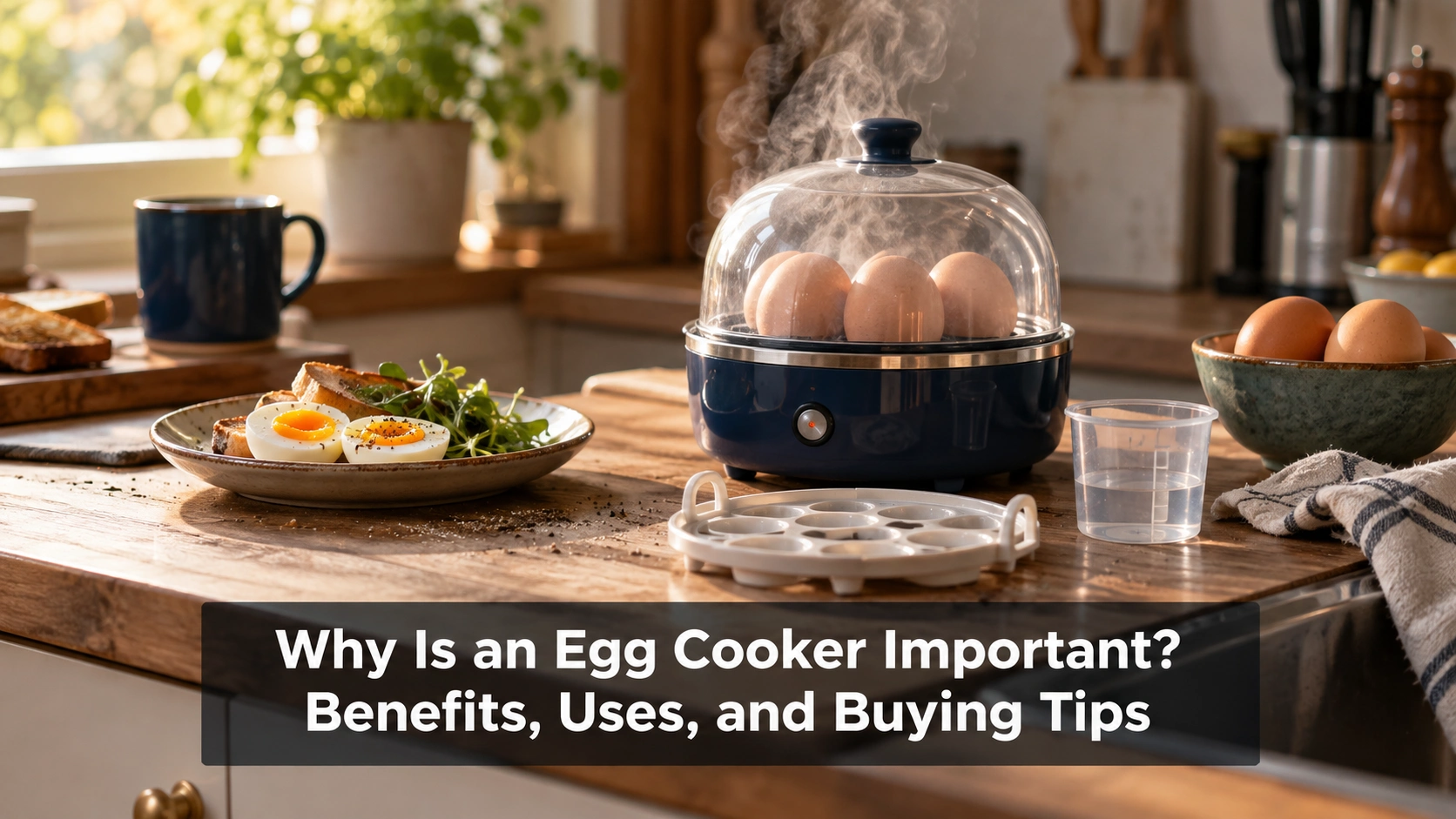
An egg cooker is important because it makes egg preparation more consistent, convenient, and hands-off than traditional stovetop cooking. It controls the heating process with measured water and steam, helping you prepare soft-, medium-, or hard-cooked eggs with less guesswork. If you regularly eat eggs, an egg cooker can also simplify breakfast and meal preparation. For a broader explanation of how these appliances operate, see what an egg cooker does.
Why an egg cooker matters
- Consistent cooking: Measured water and automatic heating reduce timing guesswork.
- Less attention: You can prepare eggs without continuously watching a boiling pot.
- Repeatable results: The same cooking method makes it easier to reproduce your preferred doneness.
- Simple cleanup: Many models have removable trays and compact cooking surfaces.
- Flexible use: Some models include accessories for poached eggs, omelets, or other steamed foods.
Quick buying check
- Choose capacity based on how many eggs you normally prepare at once.
- Look for an automatic shut-off or end-of-cycle signal.
- Check that the tray, lid, and measuring accessories are easy to clean.
I used to think an egg cooker was one of those gadgets that solved a problem a saucepan already handled. After using several compact models, I changed my mind.
The biggest advantage isn’t that an egg cooker makes eggs magically better. It’s that the appliance removes several small decisions from the process, which matters when eggs are part of your everyday breakfast.
In This Guide
Why is an egg cooker important?
An egg cooker is important mainly because it makes a repetitive cooking task easier to control. Instead of managing a pot, water level, burner, timer, and cooling process separately, the appliance combines much of that work into one compact system.
For people who eat eggs several times a week, that convenience adds up quickly. The appliance can be especially useful during busy mornings when you want breakfast cooking in the background.
Consistency is the biggest advantage
Egg doneness depends heavily on heat, time, egg size, starting temperature, and cooking method. A dedicated cooker reduces some of those variables by using a defined amount of water and a heating plate.
That doesn’t mean every egg will be identical. Eggs differ in size, and manufacturers design their measuring systems differently.
Still, the process becomes easier to repeat.
It reduces hands-on cooking
With a saucepan, I normally have to bring water to a boil, monitor the eggs, watch the clock, and move the eggs into cooling water at the right time. An egg cooker handles much of the active heating stage for me.
That hands-off design is one reason these appliances appeal to busy households, students, office workers, and anyone preparing breakfast before work.
It makes egg preparation more predictable
If you prefer soft-boiled eggs one day and hard-boiled eggs the next, repeatability becomes valuable. You can use the appropriate water measurement or setting instead of rebuilding your cooking routine every morning.
In my own testing, water measurement was one of the first things I checked whenever results seemed wrong. The cooker often wasn’t the problem; the process was.
Section Takeaway: An egg cooker matters because it turns a small but repetitive cooking job into a more controlled routine. Its greatest value is convenience and repeatability, not complicated technology.
How does an egg cooker work?
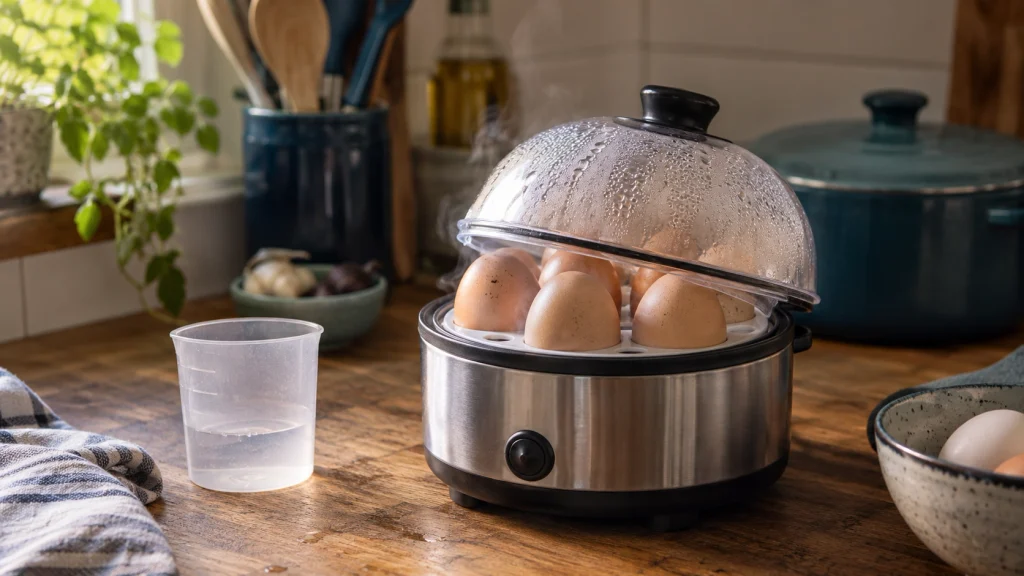
An egg cooker is a small electric appliance that uses a heating element or heating plate to heat water and produce steam. The steam cooks eggs held above or around the heated water.
Most basic models contain a heating base, egg tray, lid, water-measuring cup, and power connection. More advanced models may add poaching trays, omelet inserts, switches, or electronic controls.
What is the heating plate?
The heating plate sits inside the base and transfers heat into the measured water. As the water heats, it produces steam that surrounds the eggs.
The heating plate is usually the part that needs the most care. Mineral deposits can accumulate on it when hard water is used repeatedly.
Why does the measuring cup matter?
The measuring cup isn’t just a storage accessory. On many egg cookers, the water amount determines how long the appliance heats before the cooking cycle ends.
Using more or less water than the manufacturer specifies can therefore change the final texture. That’s why I treat the supplied measuring guide as part of the cooking system rather than an optional extra.
How does the cooker know when to stop?
Many simple egg cookers rely on the water being heated away, after which the appliance changes its operating state or signals that the cycle is finished. Other models use electronic controls or programmed settings.
The exact mechanism varies by model, so the manual should always take priority over generic instructions.
Testing tip: If your eggs suddenly become too soft or too hard, check the water measurement, egg size, tray position, and heating plate before assuming the appliance has failed.
What are the main benefits of using an egg cooker?
The main benefits are convenience, repeatability, lower hands-on effort, compact cooking, and easy portion control. These advantages become more noticeable when eggs are a regular part of your meals.
1. More consistent egg texture
A dedicated cooking cycle can make it easier to repeat soft-, medium-, or hard-cooked results. You still need to follow the model’s instructions, but the method is less dependent on watching a stovetop clock.
For anyone who dislikes guessing when an egg is ready, that’s a meaningful benefit.
2. Less monitoring
You don’t need to stand beside a boiling saucepan throughout the cooking cycle. Once the eggs and measured water are in place, the appliance can handle the heating stage.
That makes an egg cooker useful when you’re preparing toast, coffee, fruit, or other breakfast items at the same time.
3. Convenient batch cooking
Capacity varies considerably between models, but many household egg cookers are designed to prepare several eggs in one cycle. That can be useful for families or people preparing eggs for several meals.
Always compare the manufacturer’s stated egg capacity with the number of eggs you actually cook. A seven-egg appliance isn’t necessarily the best choice if you normally prepare only one or two.
4. Compact countertop footprint
Egg cookers are generally much smaller than multifunction cooking appliances. That makes them practical for kitchens with limited counter space, dorm rooms where permitted, and small apartments.
The trade-off is another appliance to store. If cabinet space is already tight, measure the appliance before buying.
5. Simple preparation
The basic routine is straightforward:
- Add the recommended amount of water.
- Place the eggs in the supplied tray.
- Fit the lid correctly.
- Start the appliance according to its instructions.
- Remove and cool the eggs when the cycle ends.
6. Some models do more than boiled eggs
Depending on the design, an egg cooker may include inserts for poached eggs, omelets, or other steamed preparations. That can improve the appliance’s value if you’ll genuinely use those functions.
Don’t assume every egg cooker has the same capabilities. The included trays and manufacturer’s instructions determine what the appliance is designed to do.
Section Takeaway: The strongest reasons to use an egg cooker are consistency, convenience, and reduced monitoring. Extra functions are useful only when they match your cooking habits.
Is an egg cooker better than a saucepan?
An egg cooker isn’t universally better than a saucepan. It is better for people who value repeatability and convenience, while a saucepan is more versatile and requires no dedicated appliance.
| Feature | Egg Cooker | Saucepan |
|---|---|---|
| Main method | Steam from heated water | Boiling or simmering water |
| Hands-on monitoring | Usually lower | Usually higher |
| Egg capacity | Depends on model | Depends on saucepan size |
| Cooking flexibility | Limited to supported functions | Much broader |
| Counter storage | Requires dedicated space | Uses existing cookware |
| Repeatability | High when used correctly | Depends more on technique |
When the saucepan wins
A saucepan makes more sense if you cook many different foods and rarely prepare eggs. It also lets you adjust cooking time and technique freely.
You don’t have to buy, store, clean, or maintain another electrical appliance.
When the egg cooker wins
An egg cooker makes more sense when you eat eggs frequently and want a repeatable routine. It is especially convenient when several people in the household want similar egg preparations.
The decision is therefore about cooking habits, not whether one method is technically superior.
Section Takeaway: Choose an egg cooker for repeatability and convenience. Keep using a saucepan if versatility matters more than dedicated egg preparation.
Who actually needs an egg cooker?
You probably don’t need an egg cooker simply because you like eggs. The appliance earns its counter space when it solves a recurring problem in your kitchen.
It can be useful for busy breakfast routines
If your morning routine includes eggs several days a week, reducing active cooking steps can make breakfast easier. You can start the cooker while preparing other parts of the meal.
This is one of the strongest practical reasons to own one.
It can help people who struggle with timing
Getting boiled eggs right on a stovetop can be frustrating when the cooking method changes from one kitchen to another. A dedicated appliance gives you a repeatable starting point.
It doesn’t eliminate variables, but it reduces them.
It may be useful for meal preparation
People who regularly prepare boiled eggs for lunches, salads, or snacks may appreciate a dedicated appliance. The value increases when you’re preparing multiple eggs regularly.
However, follow safe food-storage practices after cooking. An egg cooker doesn’t make cooked eggs automatically safe to store indefinitely.
Who may not need one?
- Occasional egg eaters: A saucepan is probably enough if you cook eggs only occasionally.
- Small kitchens: Dedicated counter space may be more valuable for other appliances.
- Minimalists: Another single-purpose appliance may not fit your kitchen philosophy.
- Confident stovetop cooks: If your eggs already come out exactly how you want, the improvement may be small.
Section Takeaway: An egg cooker is most useful for frequent egg eaters who want less monitoring and more repeatable results. Occasional users may get more value from their existing cookware.
How should you choose an egg cooker?
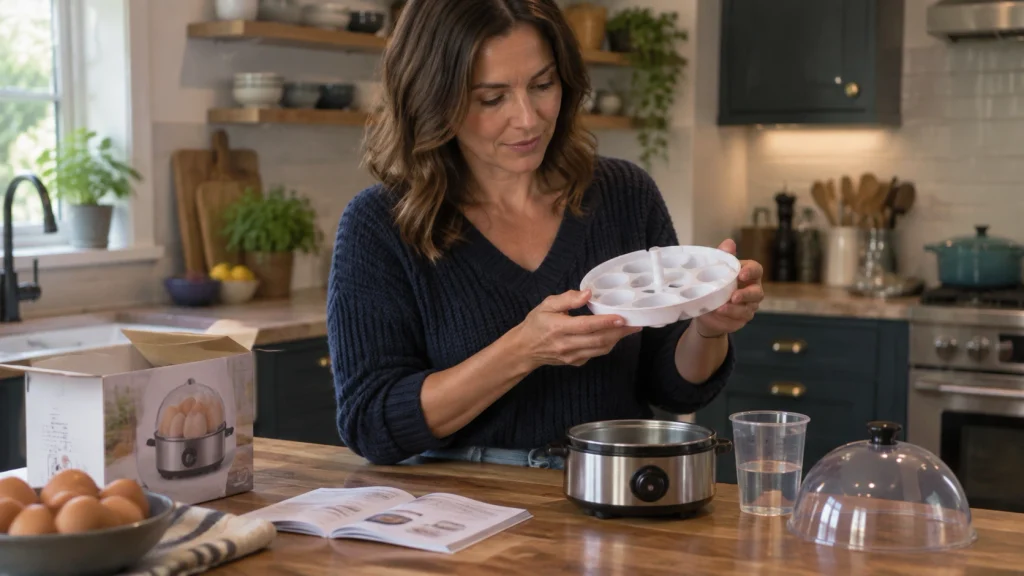
The best egg cooker for you depends on capacity, controls, construction, cleaning, and the type of eggs you actually prepare. Don’t pay for features that will sit unused.
Check the egg capacity first
Capacity is one of the simplest specifications to compare. Look for a model that comfortably handles your normal batch rather than choosing solely by the largest advertised number.
If you normally cook two eggs, a huge capacity may add little value.
Look at the controls and end-of-cycle signal
Basic egg cookers may use a simple switch or button, while other models provide electronic controls. An audible signal can be useful if you are preparing other foods nearby.
Don’t assume a beep means the eggs are safe to leave sitting indefinitely. Treat the signal as the end of the cooking cycle and follow the manufacturer’s instructions.
Consider the materials and construction
Look for a stable base, a properly fitting lid, durable trays, and a heating surface that can be cleaned according to the manual. Food-contact components should also be clearly identified by the manufacturer.
Transparent lids can make it easier to see the cooking process, while opaque lids can still work perfectly well.
Check cleaning requirements
Egg residue can become unpleasant quickly if trays are difficult to remove. I prefer designs where the egg tray and accessories come away easily and the heating surface can be wiped without awkward corners.
Never immerse an electrical base unless the manufacturer explicitly says that it is designed for that treatment.
Don’t ignore safety information
Electrical cooking appliances should be used according to their instructions and electrical ratings. In the United States, UL 1026 covers a broad category of household electric cooking and food-serving appliances, although not every egg cooker is necessarily certified to that standard. :contentReference[oaicite:0]{index=0}
Certification markings should never be assumed from an online product photograph. Check the actual product labeling and documentation.
As of 2026, consumer-product safety guidance also emphasizes checking applicable requirements and certification documentation rather than relying solely on marketing claims. :contentReference[oaicite:1]{index=1}
Buying rule: Prioritize the features you’ll use every week: suitable capacity, dependable controls, easy cleaning, stable construction, and clear safety documentation.
Section Takeaway: Capacity and cleaning should come before flashy extras. A simple, well-built egg cooker can be more useful than a feature-heavy model you rarely use.
What common egg cooker mistakes should you avoid?
Most egg cooker problems start with a small setup mistake rather than a serious appliance failure. Water measurement, incorrect assembly, and poor cleaning are the first things I would check.
Using the wrong amount of water
The supplied measuring cup usually exists for a reason. Changing the water volume can change the cooking cycle and therefore the final egg texture.
If your eggs are consistently too soft or too firm, start here.
Ignoring egg size
Egg cookers are calibrated around particular cooking conditions, but eggs aren’t identical. Extra-large eggs can behave differently from smaller eggs under the same steam conditions.
If your results change after switching egg sizes, don’t immediately assume the appliance is defective.
Leaving mineral buildup on the heating plate
Repeated heating can leave mineral deposits on the heating surface, particularly when using hard water. Those deposits can interfere with normal operation over time.
Follow the manufacturer’s cleaning or descaling instructions rather than scraping the surface aggressively.
Forcing the lid or tray
The lid and tray should fit according to the appliance’s design. If something suddenly becomes difficult to remove, stop and inspect it rather than applying excessive force.
A damaged plastic component can create a new safety problem.
Using the cooker beyond its design
A standard steam-based egg cooker isn’t automatically a frying pan, pressure cooker, or general-purpose steamer. Some models support additional foods, but those capabilities depend on the supplied accessories and manufacturer’s instructions.
Electrical cooking appliances are subject to safety requirements, and egg boilers are specifically recognized within international household-appliance safety standards. :contentReference[oaicite:2]{index=2}
Continuing to use a damaged appliance
A cracked housing, damaged power cord, exposed electrical component, burning smell, or unusual electrical behavior is a reason to stop using the appliance until it has been properly assessed.
Recent consumer-safety alerts have included egg-cooking appliances with electric-shock hazards, showing why construction quality and safety documentation matter. :contentReference[oaicite:3]{index=3}
Pro tip: Never open an electrical egg cooker, bypass a safety feature, or attempt an internal electrical repair yourself. Unplug the unit and consult the manufacturer’s manual or a qualified appliance repair technician.
Section Takeaway: Start troubleshooting with water, assembly, cleaning, and egg size. Stop using an appliance when you see electrical damage or other signs of a genuine safety fault.
Egg Cooker FAQs
Is an egg cooker really necessary?
No, an egg cooker isn’t necessary for most kitchens. A saucepan can cook eggs effectively, but an egg cooker can be worthwhile if you prepare eggs frequently and want a more repeatable, hands-off routine.
What is the main purpose of an egg cooker?
The main purpose of an egg cooker is to simplify egg preparation using controlled heating and steam. Depending on the model, it may prepare soft-, medium-, or hard-cooked eggs and may also support poaching or omelets.
Does an egg cooker make healthier eggs?
An egg cooker doesn’t automatically make eggs healthier than eggs prepared in a saucepan. Its main benefits are convenience, consistency, and cooking control rather than a special nutritional advantage.
Can an egg cooker replace a saucepan?
No. An egg cooker is designed for specific egg-cooking tasks, while a saucepan is far more versatile. An egg cooker can supplement your cookware, but it generally shouldn’t be considered a replacement for a general-purpose pan.
Why are my egg cooker results inconsistent?
Inconsistent results can come from incorrect water measurement, different egg sizes, poor tray positioning, mineral buildup, or changes in the appliance itself. Check the manufacturer’s instructions and inspect these basic factors before assuming the cooker has failed.
Are egg cookers safe to use?
Egg cookers can be safe when they are properly designed, maintained, and used according to their instructions. Check product labeling, applicable certification information, electrical condition, and manufacturer safety guidance before regular use.
How long should an egg cooker last?
There isn’t one universal lifespan because construction quality, frequency of use, maintenance, and electrical conditions differ. Replace or professionally assess a unit when it develops damaged wiring, cracked electrical housing, overheating, or other unsafe behavior.
Final Takeaway: Why is an egg cooker important?
An egg cooker is important because it solves a simple but common kitchen problem: making eggs with less attention and more repeatability. For frequent egg eaters, that can make a noticeable difference to the morning routine.
It’s not a must-have appliance for everyone. If you rarely eat eggs or already get perfect results from a saucepan, your existing cookware may be enough.
But if you want convenient batch cooking, predictable results, and fewer stovetop steps, an egg cooker can earn its place on the counter.
The smartest approach is to choose based on your actual routine. Focus on capacity, ease of cleaning, controls, construction quality, and safety documentation rather than buying the model with the longest feature list.
If you’re building an egg-focused kitchen setup, start with the appliance that solves your most frequent problem. For many households, that’s exactly what an egg cooker does.