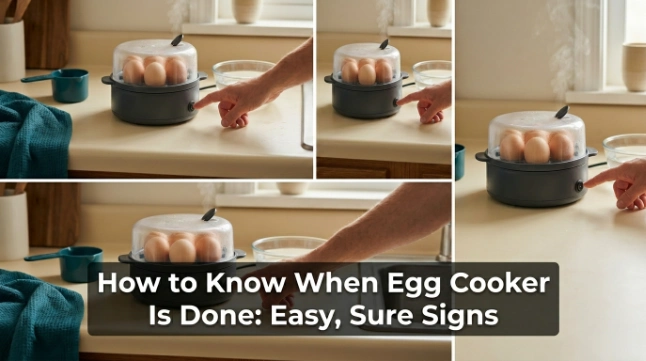
The easiest way to know when an egg cooker is done is to wait for its beep, indicator light, or automatic shut-off. Most models give at least one of these signals when all the water has turned to steam.
I learned this after stopping my cooker too soon several times. The eggs looked ready outside, but the yolks were still much softer than I wanted.
I also made the opposite mistake. I left cooked eggs inside a hot cooker after the alarm. That gave them firm, dry yolks.
This guide explains the normal finish signals. It also shows what to check if your cooker does not beep, switch off, or cook the eggs as expected.
Common Signs That Your Egg Cooker Is Done
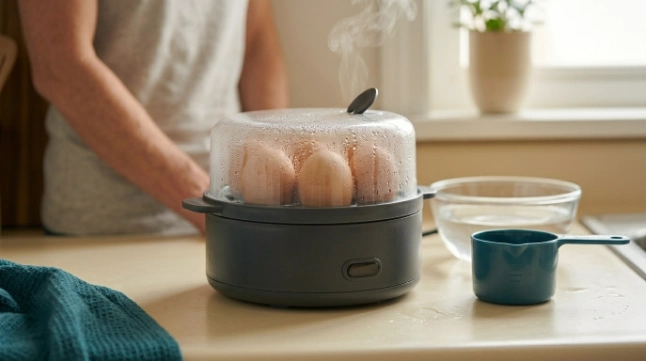
Egg cookers use water to control cooking time. The heating plate boils the measured water and turns it into steam.
When the water is gone, the cooker may beep or switch off. Some basic models do not turn off on their own, so you must respond to the alarm.
Here are the most common signs:
- The cooker makes a loud beep or buzz.
- The indicator light switches off.
- The light changes color or starts flashing.
- Steam from the lid becomes much weaker.
- The measured water has boiled away.
- The cooker turns off by itself.
- The cooking timer reaches zero.
Do not lift the lid just because you see steam. Steam appears early and continues through much of the cooking cycle.
| Signal | What It Usually Means | What to Do |
|---|---|---|
| Beep or buzz | The cooking cycle has ended | Turn off or unplug the unit |
| Light goes out | Auto shut-off has activated | Remove the eggs carefully |
| Weak steam | Most water has boiled away | Wait for the official signal |
| No signal | Setting, power, or scale issue | Check the cooker safely |
The exact signal depends on the model. No brand appears in the focus keyword, so it is wise to check the instructions for your own cooker.
I keep the water measuring cup beside my machine. If yours is missing, use a correct replacement measuring cup made for that model when possible.
The original cup may have marks for soft, medium, and hard eggs. A random kitchen cup may not give the same result.
Possible Causes of an Unclear or Missing Done Signal
The cooker should make its finish signal clear. If it keeps heating or gives no beep, one of a few simple issues may be responsible.
Too Much Water
More water means a longer cooking cycle. If you fill the heating plate by guess, the cooker may run much longer than expected.
This was my first mistake. I thought more water would make the eggs cook better, but it only made the finish time hard to judge.
The Wrong Water Setting
Many measuring cups use different lines for soft, medium, and hard eggs. Some also have separate marks based on the number of eggs.
Using the wrong line may give you a result you did not expect. The cooker can finish normally while the eggs still seem too soft or too firm.
Mineral Buildup on the Heating Plate
Tap water can leave a white or brown layer on the plate. This is called limescale.
A thick layer can slow heat transfer. It may also cause uneven boiling, odd noises, or a longer cooking cycle.
A Poorly Fitted Tray or Lid
The egg tray must sit flat. The lid should also rest in its normal position, with the steam vent open.
A blocked vent or badly fitted lid can change how steam moves. Never seal the vent to speed up cooking.
The Cooker Has No Auto Shut-Off
Some egg cookers only sound an alarm. They keep the heating plate warm until you switch them off.
This can look like a fault when it is normal for the model. Check the manual before assuming the shut-off system is broken.
A Faulty Beeper, Light, or Control
The eggs may cook even if the buzzer or indicator light fails. This makes the finish point hard to notice.
Stop using the cooker if it will not stop heating, smells burned, leaks near electrical parts, or acts in an unsafe way.
How to Fix “How to Know When Egg Cooker Is Done”
Use the following checks in order. Most are simple and do not require tools.
Learn Your Cooker’s Main Finish Signal
Run one normal cycle while staying near the cooker. Watch the light and listen for a beep.
Note what happens when the water runs out. The beep, light, or shut-off should become your main finish signal.
Do not depend on cooking time alone. Egg size, water temperature, room temperature, and mineral buildup can change the timing.
Measure the Water Correctly
Place the cooker on a flat, dry surface. Add the exact amount of water shown for your egg count and preferred yolk.
Use the supplied cup and read the mark at eye level. Do not add extra water unless the maker tells you to do so.
| Desired Egg | Typical Finish Result | Best Check |
|---|---|---|
| Soft-boiled | Set white and runny yolk | Use the soft-water mark |
| Medium-boiled | Set white and creamy yolk | Use the medium-water mark |
| Hard-boiled | Firm white and firm yolk | Use the hard-water mark |
These marks differ by cooker. The table explains the method, not an exact water amount for every machine.
Check the Egg Tray and Lid
Make sure the egg insert sits flat on the base. Place each egg in its proper opening.
Fit the lid without forcing it. Check that the steam vent is clear and points away from your face and hands.
A replacement egg tray or lid may help if the original part is cracked or badly warped. Use a part designed for your exact model.
Descale the Heating Plate
Unplug the cooker and let it cool fully. Wipe away loose dirt with a soft cloth or non-abrasive sponge.
For deeper cleaning, use diluted white vinegar if the maker permits it. Let it sit on the plate briefly, then wipe and rinse as directed.
Never place the electrical base in water. Do not scrape the plate with a knife, steel wool, or another sharp tool.
Test the Beep and Indicator Light
Add the correct water and run a supervised cycle. Stay close enough to hear the cooker and see its light.
If the eggs cook but there is no signal, the buzzer or indicator may be faulty. Use the cooker only if the manual provides another clear and safe way to track completion.
Do not open the base to repair a buzzer or wire. A small electrical fault can expose you to shock or fire.
Reset Overheat Protection
If the cooker stops too early, unplug it. Let it cool for at least 20 to 30 minutes.
Check that you added water before trying again. Some models reset after cooling, while others require a step listed in the manual.
Never bypass an overheat switch or safety switch. These parts help prevent the heating plate from becoming dangerously hot.
Check the Egg After the Signal
When the cooker signals that it is done, switch it off or unplug it if required. Lift the lid away from your face.
Move the eggs into cold water for about five minutes. This stops further cooking and makes the shells easier to handle.
Test one egg before changing the water amount. If it is too soft, add only a little more water during the next cycle.
Mistakes to Avoid
The biggest mistake is using steam as the only sign of completion. Steam tells you that the cooker is heating, not that the eggs are ready.
Avoid these other common errors:
- Guessing the water amount
- Using marks meant for a different number of eggs
- Blocking the lid’s steam vent
- Opening the lid during the cycle
- Leaving finished eggs on a hot plate
- Touching the lid or plate while hot
- Running the cooker without water
- Immersing the electrical base in water
Do not pierce an egg while holding it in your hand. If your measuring cup has a piercing pin, place the egg on a firm surface and use the guard carefully.
Never open a sealed heating unit. Do not repair internal wires, bypass a switch, or replace a fuse with an unsuitable part.
When to Replace the Egg Cooker
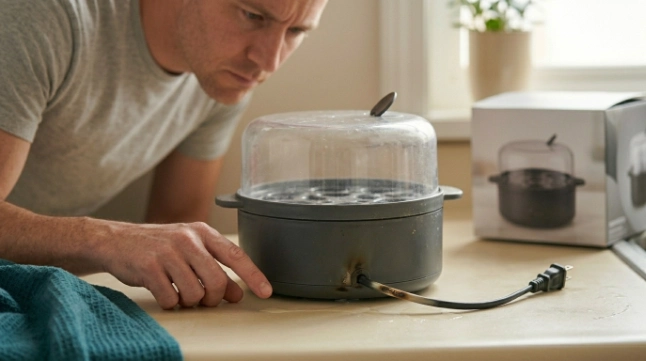
A failed beep alone may not mean the whole cooker is ruined. However, the unit still needs a safe and clear way to end its cycle.
Replacement is often the better choice when the cooker overheats, trips the outlet, produces smoke, or has a burned power cord. Stop using it at once if water reaches electrical parts.
| Repair Issue | Safe Next Step | Replace Instead? |
|---|---|---|
| Missing measuring cup | Buy the correct cup | No |
| Cracked removable lid | Fit an approved replacement | Not usually |
| Failed auto shut-off | Stop using the cooker | Yes |
| Burned cord or base | Do not attempt home repair | Yes |
| Water leaking into base | Unplug and retire the unit | Yes |
A low-cost egg cooker is rarely worth an internal electrical repair. A qualified technician may inspect an expensive model, but home wiring work is not safe.
My Personal Experience
My cooker seemed slow even though the heating plate was hot. I first blamed the machine, but the real problem was my water measurement.
I had used the hard-boiled mark for fewer eggs than I was cooking. The added water made the cycle last much longer.
I tested it again with the right mark. I watched the light, waited for the buzzer, and unplugged the cooker as soon as it finished.
The next batch came out much better. I then placed the eggs in cold water, which stopped the yolks from becoming too firm.
I also found a chalky layer on the heating plate. After I removed it with diluted vinegar and a soft cloth, the water boiled more evenly.
The main lesson was simple. The cooker’s official signal matters more than my guess about how long the eggs should take.
Final Thoughts
If you are wondering how to know when egg cooker is done, listen for the beep and watch the indicator light or auto shut-off. These are the most reliable signs.
Use the correct water mark, fit the tray and lid well, and keep the heating plate free of mineral scale. Check your manual because finish signals vary by model.
Remove the eggs soon after the cycle ends and cool them in cold water. If the cooker never stops heating or shows signs of electrical damage, unplug it and replace it rather than attempting an unsafe repair.