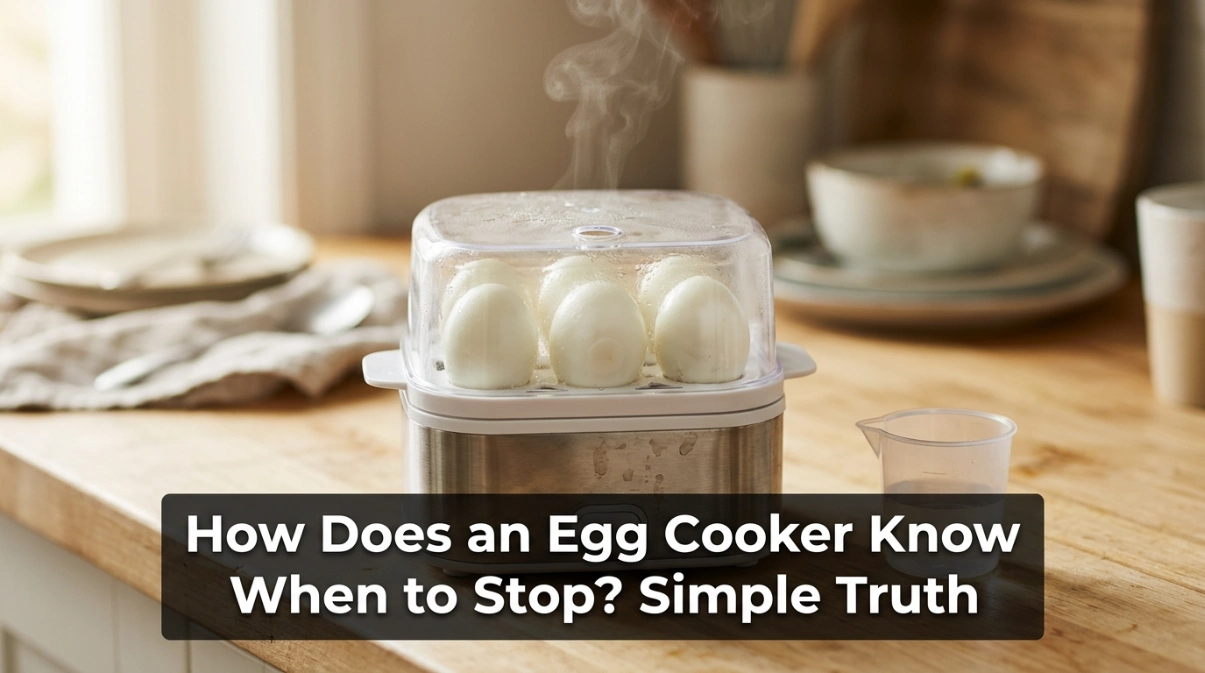
How does an egg cooker know when to stop? In most basic models, it does not check the egg itself. It tracks the water and the heat inside the cooker.
I learned this after my cooker stopped much sooner than I had expected. I first thought its timer was faulty. The real cause was much simpler: I had added too little water.
Most egg cookers stop, beep, or switch modes when the water has boiled away. A heat sensor then detects a fast rise in the heating plate’s temperature.
Some models use an electronic timer instead. This guide explains both systems and shows what to check when your cooker stops at the wrong time.
Common Signs of the Problem
The end of a normal cooking cycle is easy to notice. The cooker may beep, turn off, or change its light from red to green.
A fault may be present if the cycle is far too short or long. The eggs may also come out raw, rubbery, cracked, or unevenly cooked.
| Symptom | Likely Cause | Quick Fix |
|---|---|---|
| Stops too soon | Too little water | Measure the water again |
| Runs too long | Too much water | Use the marked water level |
| Eggs stay soft | Wrong setting or water amount | Select the correct egg type |
| No beep at the end | Sounder or control fault | Watch the power light |
| Plate overheats | Mineral buildup or sensor fault | Descale and test again |
| Steam escapes heavily | Lid or tray is out of place | Reseat both parts |
I also check whether the cooker stops heating or merely sounds an alarm. Some units beep but keep the heating plate warm.
That difference matters. Never assume a beep means the cooker has cut all power unless the manual confirms it.
If your measuring cup is lost or its marks have faded, a correct replacement measuring cup can help. I would choose one made for the exact model because water marks can vary between cookers.
Possible Causes

The water level controls cooking time in many simple egg cookers. More water takes longer to boil away, so the eggs cook longer.
Once the water is gone, the heating plate gets hot very fast. A thermostat or heat sensor detects that change and ends the cycle.
Electronic models may use a set timer, temperature sensor, or preset program. These units can stop after a fixed time even when a little water remains.
Common reasons for poor stopping include:
- Too little or too much water
- Use of an unmarked cup
- Mineral scale on the heating plate
- An egg tray that is not seated flat
- A lid that is tilted or cracked
- A blocked steam vent
- Water leaking from the cooker
- The wrong button or cooking setting
- A weak thermostat or heat sensor
- A faulty control panel
Cold eggs can also affect the result. They may need slightly more cooking than eggs kept at room temperature.
Egg size matters as well. A large egg takes more time to heat through than a small one, even if the cooker stops at the same point.
How to Fix How Does an Egg Cooker Know When to Stop Issues
Check How the Cooker Ends Its Cycle
Start by reading the model’s instructions. Look for terms such as auto shut-off, ready alarm, standby mode, and keep-warm mode.
These terms do not mean the same thing. Auto shut-off normally stops active heat, while a ready alarm may only tell you that the eggs are done.
Place the cooker on a dry, level counter. Stay nearby during the test and watch its light when the alarm sounds.
Measure the Water Carefully
Use the supplied cup and choose the mark for soft, medium, or hard eggs. Set the cup on a flat surface when checking the level.
I once held the cup in my hand while filling it. The tilted cup made the level look correct, but I had added too little water.
Do not copy the water level from another brand. Heating plates, trays, and shut-off systems are not all designed in the same way.
| Problem | Recommended Solution | Difficulty |
|---|---|---|
| Cycle ends early | Add the correct water amount | Easy |
| Cycle takes too long | Reduce excess water | Easy |
| Results vary each time | Use the same egg size and cup | Easy |
| Water leaks out | Check the tray and lid fit | Easy |
| Cooker never stops | Unplug it and stop testing | Do not repair at home |
Inspect the Egg Tray and Lid
Unplug the cooker and let it cool. Then remove and reseat the egg tray so it sits flat over the heating plate.
Check the lid for cracks or warping. A poor lid fit lets too much steam escape and can change how quickly the water runs out.
Make sure the steam vent is open. Do not block it with a towel, wall, cabinet, or other object.
Hot steam must have a safe path out. Keep your hands and face away from the vent while the cooker is working.
Descale the Heating Plate
A white or brown layer on the plate is often mineral buildup. This layer can slow heat transfer and cause uneven temperature readings.
For cleaning, I unplug the unit and wait until it is cold. I then use the maker’s descaling method or a small amount of diluted white vinegar if the manual permits it.
Never immerse the electrical base in water. Use a soft cloth or non-abrasive sponge so the plate does not become scratched.
Wipe away all residue before the next test. Heavy scale may need more than one gentle treatment, but I avoid sharp tools.
Test the Settings and Buttons
If the cooker has soft, medium, and hard settings, select each one with care. A button that does not click or light up may not record the choice.
Disconnect the power for several minutes if the instructions allow a basic reset. Plug it directly into a working wall outlet and try one supervised cycle.
Avoid using a loose power strip or damaged extension cord. An unstable supply can cause flashing lights or an early shutdown.
Test the Auto Shut-Off Safely
Add the correct amount of water and use eggs of one size. Fit the tray and lid, then start the normal cycle.
Stay close, but do not touch the hot lid. Note when the alarm sounds and whether the heating light turns off.
If all water is gone yet the heating plate stays on, unplug the cooker. Do not repeat the test or pour cold water onto the hot plate.
A small amount of water may remain in some electronic models. That is not always a fault if the eggs are cooked and the machine ends its program normally.
Mistakes to Avoid

The biggest mistake is treating every cooker like a simple timer. Water amount is often the main form of time control.
Do not add extra water just to be safe. Too much water can overcook the eggs and make the cycle run far longer than expected.
Other mistakes I avoid include:
- Guessing the water level
- Mixing very small and very large eggs
- Blocking the lid’s steam vent
- Lifting the lid during cooking
- Running the base while it is wet
- Scraping the plate with metal
- Ignoring a burning smell
- Leaving a faulty cooker unattended
Never open the sealed heating base. Internal parts can hold dangerous electrical voltage and are not meant for home repair.
Do not bypass a thermostat, safety switch, fuse, or overheat protector. These parts help prevent burns, fire, and damage.
If the cord becomes hot, the plug sparks, or smoke appears, unplug the unit only if it is safe to do so. Stop using it at once.
When to Replace the Egg Cooker
Replacement makes sense when the cooker no longer ends its cycle safely. It is also wise when the base leaks, the cord is damaged, or the plate keeps heating after the water is gone.
A cracked removable lid or tray may be replaceable. Use a part designed for the model so steam can escape as intended.
| Repair Issue | Typical Choice | Replace Cooker? |
|---|---|---|
| Lost measuring cup | Buy the correct cup | No |
| Cracked removable lid | Replace with an exact-fit lid | Usually no |
| Damaged egg tray | Install a matching tray | Usually no |
| Faulty alarm only | Use caution and check support | Maybe |
| Damaged cord | Stop using the unit | Yes |
| Failed auto shut-off | Stop using the unit | Yes |
| Burning smell or smoke | Unplug immediately | Yes |
A low-cost cooker is rarely worth an internal electrical repair. The cost and safety risk can be greater than the value of the unit.
Check the warranty before replacing it. The maker may offer a safe exchange if the thermostat or control board has failed.
My Personal Experience
My first test went badly because I focused on time alone. I filled the plate by eye and expected the cooker to run for a fixed number of minutes.
It beeped early, and the yolks were still soft. I blamed the auto shut-off before checking the cup.
For my next batch, I removed the mineral film from the heating plate. I then used the exact hard-egg mark on the supplied measuring cup.
I also used eggs of the same size and made sure the tray sat flat. The cooker ran longer and stopped when the plate became dry and its temperature rose.
The eggs came out firm without becoming tough. That test showed me that the sensor was working and my setup had caused the first bad result.
I later tested the same cooker with excess water. It did not stop at the normal time because the plate still had water to boil.
My best lesson was simple: the water is often the cooker’s clock. Correct water, a clean plate, and a well-fitted lid make the stopping point far more reliable.
Final Thoughts
So, how does an egg cooker know when to stop? Most basic models sense the sharp heat rise that occurs after the measured water has boiled away.
More advanced models may use a timer, temperature sensor, or preset program. Some beep and shut off, while others move into a keep-warm mode.
If your cooker stops too early or too late, check the water amount first. Then inspect the tray, lid, steam vent, settings, and heating plate.
Stop using the cooker if it will not end the heating cycle, smells burnt, leaks into the base, or has a damaged cord. Safe replacement is better than opening or bypassing its internal controls.
1 thought on “How Does an Egg Cooker Know When to Stop? Simple Truth”