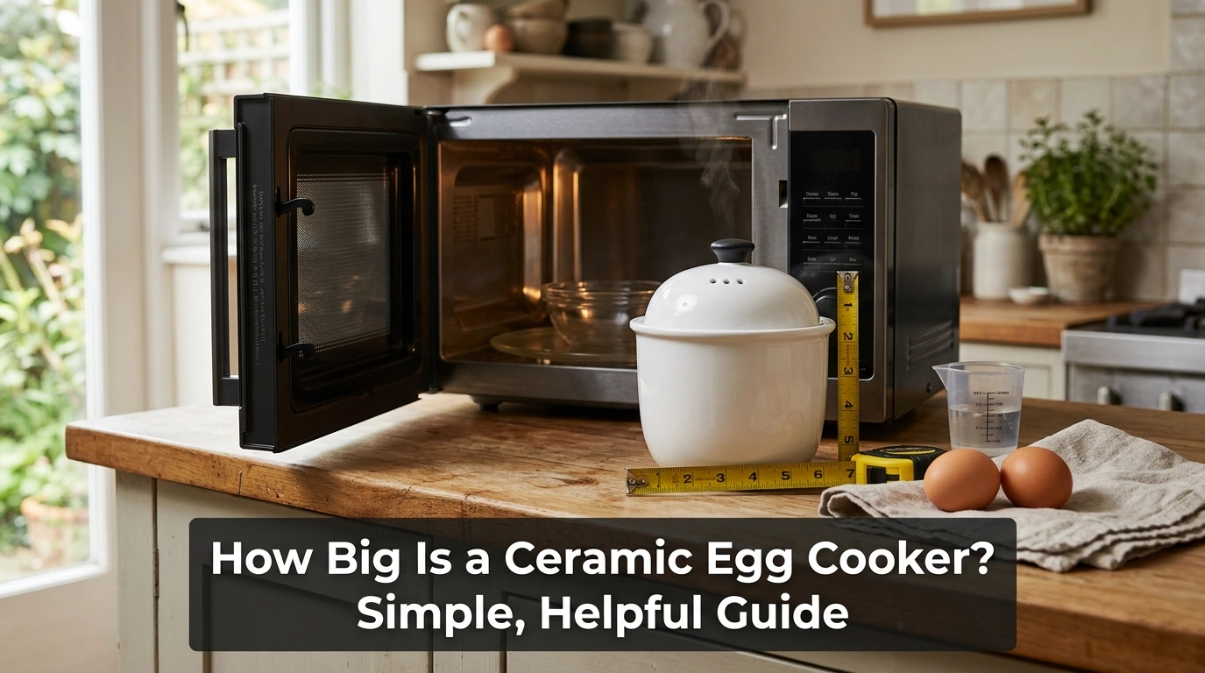
How big is a ceramic egg cooker? Most single-serve ceramic egg cookers are about 4 to 6 inches wide and 4 to 7 inches tall. They often hold 1 to 4 eggs.
The exact size depends on the shape and brand. Some have a tall mug design. Others look like a small covered bowl.
I learned this after buying one that looked tiny in the photo. It was wide enough for my microwave, but the tall lid did not fit well on my short cabinet shelf.
In this guide, I will show you how to check the size, capacity, lid clearance, and microwave fit. I will also cover common size problems and safe ways to solve them.
Quick Size Answer
A common ceramic egg cooker has a capacity of about 12 to 16 fluid ounces. Its base is often close to the size of a large coffee mug.
Here are the typical measurements I found while comparing common designs:
| Cooker Style | Typical Size | Egg Capacity |
|---|---|---|
| Small ceramic cup | 4–5 inches wide | 1–2 eggs |
| Tall ceramic cooker | 4–5 inches wide, 6–7 inches tall | 2–4 eggs |
| Wide ceramic bowl | 5–7 inches wide | 2–4 eggs |
These are general ranges. Always check the product listing or measure the cooker before buying a lid, storage pouch, or other part.
A replacement lid must match both the width and the rim shape. A generic lid may sit on top but still let hot liquid leak from the side.
Common Signs of the Problem
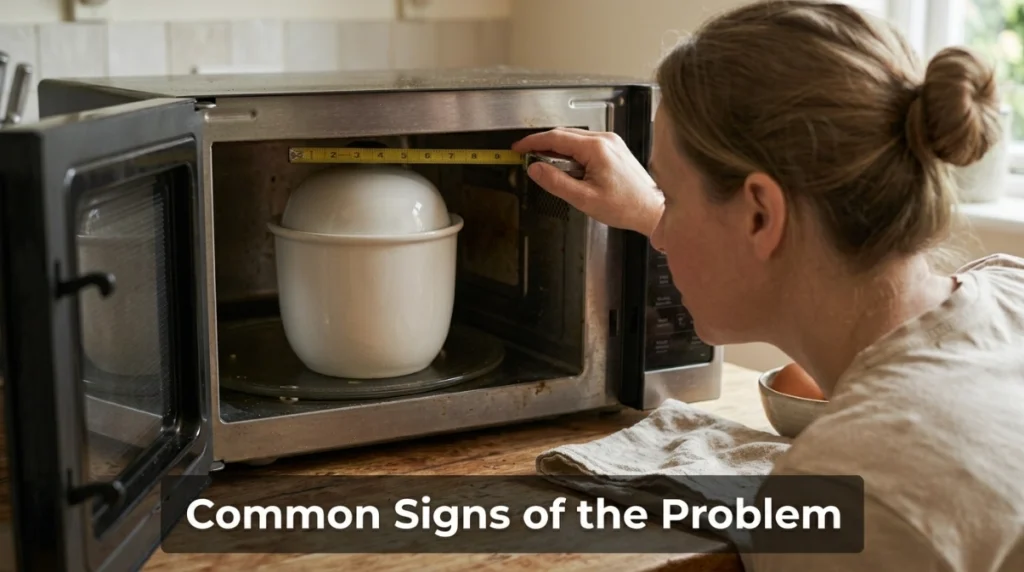
Size becomes a problem when the cooker does not fit the microwave, cabinet, or meal you want to make. You may also notice poor results if you add too many eggs.
My first clue was the lid touching the top of my microwave. It still turned, but the small amount of clearance made me uneasy.
| Symptom | Likely Cause | Quick Fix |
|---|---|---|
| Lid hits microwave roof | Cooker is too tall | Use a shorter cooker |
| Turntable cannot rotate | Base is too wide | Move it to the center |
| Eggs spill over | Cooker is overfilled | Use fewer eggs |
| Lid lifts while cooking | Steam or food volume is too high | Reduce the portion |
| Cooker will not fit a shelf | Handle or lid adds width | Measure the full shape |
Some ceramic cookers have handles that add one or two inches to the total width. Product listings may show only the bowl width.
The same issue can happen with a large knob on the lid. Measure the full height with the lid in place, not just the ceramic base.
Possible Causes
The cooker itself may not be unusually large. The real issue may be how its size was measured or how it is being used.
Common causes include:
- The listed capacity was mistaken for physical size.
- The handle was not included in the width.
- The lid knob was not included in the height.
- Too many eggs were placed inside.
- Extra meat, cheese, or vegetables took up needed space.
- The cooker was designed for a larger microwave.
- The microwave has a low roof or small turntable.
- A replacement lid is the wrong size.
I once judged capacity by filling the cooker close to the rim. That did not work. Eggs expand as they heat, and trapped steam can push the mixture upward.
Leave open space above the food. This helps stop spills and lets the egg cook more evenly.
How Big Is a Ceramic Egg Cooker? Check It Correctly
The safest answer comes from three measurements: width, height, and usable capacity. A tape measure and a measuring cup are all you need.
Measure the Full Width
Place the cooker on a flat surface. Measure from its widest outer point to the point directly across from it.
Include the handle, side grips, or raised tabs. These parts can stop the cooker from fitting on a narrow shelf.
For a round cooker without a handle, measure straight across the center. This is its diameter.
Check the Height With the Lid On
Fit the lid as you would during cooking. Measure from the bottom of the cooker to the top of the lid knob.
Do not press the lid down to make the cooker seem shorter. A ceramic lid may be designed to sit loosely so steam can escape.
I like to leave at least one inch of space above the lid in a microwave. More room is better if the cooker has a steam vent.
Measure Its Usable Capacity
Fill a measuring cup with water. Pour the water into the ceramic cooker while keeping track of the amount.
Stop well below the rim. The safe working space is smaller than the full volume because eggs can rise while heating.
A 16-ounce cooker may not safely hold 16 ounces of egg mixture. Its practical cooking capacity may be closer to 10 or 12 ounces.
After this test, dry and clean the cooker with a soft cloth or non-abrasive sponge. Avoid rough pads that can scratch the glaze.
Count How Many Eggs Fit
Crack one egg into a separate cup first. This makes it easier to remove shell pieces and check that the egg is fresh.
Pour it into the cooker and note the level. Repeat only if the instructions say the cooker can hold more eggs.
| Egg Amount | Suggested Cooker Capacity | Difficulty |
|---|---|---|
| 1 egg | 8 ounces or more | Easy |
| 2 eggs | 12 ounces or more | Easy |
| 3–4 eggs | 16 ounces or more | Moderate |
Egg sizes differ. Four small eggs take up less room than four extra-large eggs, so leave enough space for expansion.
Test the Microwave Fit
Put the empty cooker in the center of the microwave turntable. Do not turn on an empty microwave.
Slowly rotate the turntable by hand. Check that the handle, lid, and sides do not touch the microwave walls.
Next, close the door and look at the space above the lid. The cooker should sit flat and allow the turntable to move without resistance.
Use the cooker only if its maker says it is microwave-safe. Gold trim, metallic paint, cracks, and unknown glazes can make a ceramic item unsafe for microwave use.
Check the Lid and Steam Vent
The lid should rest in its normal position without rocking due to food underneath it. Its vent must stay open.
Do not seal the steam vent with foil, tape, or a gasket. Pressure must have a safe way to escape.
A loose-fitting lid is not always a fault. Many ceramic egg cookers use a vented or slightly loose lid to manage steam.
Allow for Storage Space
Measure the cabinet or drawer before buying the cooker. Check depth, height, and usable width.
I also measure the door opening. A cooker can fit inside a cabinet yet still be hard to place through a narrow opening.
If you store the lid separately, protect it from hard cookware. A soft anti-scratch storage pouch or folded cloth may help prevent chips.
Choosing the Right Size
Choose the cooker based on your normal serving size, not the largest meal you may make once a year.
A small model is often enough for one or two eggs. A larger 16-ounce design is more useful if you add cheese, vegetables, or cooked meat.
| Need | Recommended Solution | Size Priority |
|---|---|---|
| One quick egg | Small cooker | Compact width |
| Two-egg breakfast | Medium cooker | 12-ounce capacity |
| Eggs with fillings | Larger cooker | Extra headroom |
| Small microwave | Short, narrow cooker | Full outer size |
| Easy storage | Simple round shape | No large handle |
A large cooker gives food more room, but it may heat more slowly. It is also heavier, especially when filled.
A very small cooker warms fast. Yet it can spill if the egg mixture sits too close to the top.
Mistakes to Avoid
Do not rely only on a product photo. Photos can make a single-serve cooker look much larger or smaller than it is.
Avoid these common mistakes:
- Measuring the base but ignoring the handle.
- Checking height without the lid.
- Filling the cooker to the rim.
- Blocking the steam vent.
- Using a cracked or chipped ceramic cooker.
- Assuming all replacement lids have the same fit.
- Heating an empty ceramic cooker.
- Moving hot ceramic with bare hands.
Ceramic can become very hot in a microwave. Use dry oven gloves and place the cooker on a heat-safe surface.
Open the lid away from your face. Hot steam can escape fast and cause a burn.
Never force a tight lid onto a cooker that was designed for a loose cover. Do not drill new vents or make changes to the ceramic body.
If the glaze is deeply cracked, food can enter the damaged area. Stop using the cooker rather than trying to seal it with glue.
When to Replace the Ceramic Egg Cooker
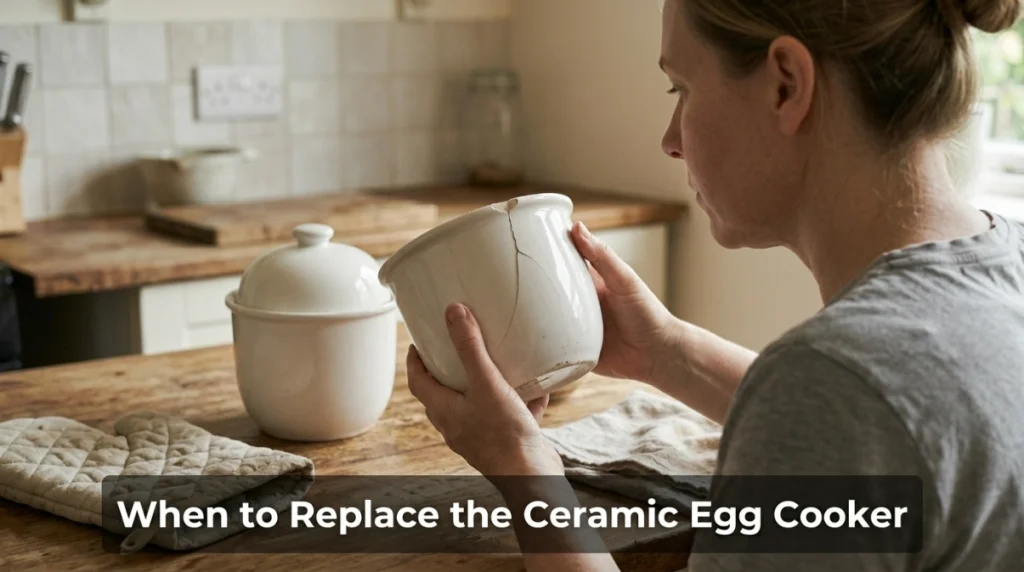
Size alone is not a reason to throw away a safe cooker. You can keep it for smaller meals or use another microwave-safe dish when you need more room.
Replacement makes sense when the cooker is too large for the microwave and cannot rotate. It may also be time to replace it if every normal portion spills over.
Replace it at once if you notice:
- A crack through the ceramic wall
- A loose piece near the rim
- A sharp chip
- Widening glaze cracks
- A lid that no longer sits safely
- A damaged or blocked steam vent
- An unexplained burning smell
A replacement lid can be useful if the base is safe and the maker sells an exact match. Check the model, diameter, rim shape, and vent design first.
Do not use a random airtight lid. It may trap steam that the original design allowed to escape.
My Personal Experience
When I first checked my ceramic egg cooker, I measured only its bowl. I got a width of about five inches and thought it would fit anywhere.
I forgot about the handle and lid knob. The full shape needed far more space than the base measurement suggested.
I then tested its capacity with water. Although it could hold close to 16 ounces at the rim, that was not its safe cooking space.
Two eggs with a small amount of cheese worked well. Three large eggs rose too high and made the lid messy.
The best method was simple. I left plenty of room at the top, kept the vent clear, and centered the cooker on the microwave plate.
I also let it rest before lifting the lid. That short pause reduced the rush of steam, though I still opened it away from my face.
The key lesson was to measure the whole cooker. Width, height, handle length, lid clearance, and usable volume all matter.
Final Thoughts
So, how big is a ceramic egg cooker? Most models are about 4 to 6 inches wide, 4 to 7 inches tall, and hold around 12 to 16 ounces.
That is usually enough space for one to four eggs. The safe amount depends on egg size, added ingredients, and the room left below the rim.
Measure the cooker with its handle and lid included. Then check microwave clearance, turntable movement, storage space, and the open steam vent.
A cooker that fits well is safer and easier to use. It also gives eggs enough room to rise without spilling.