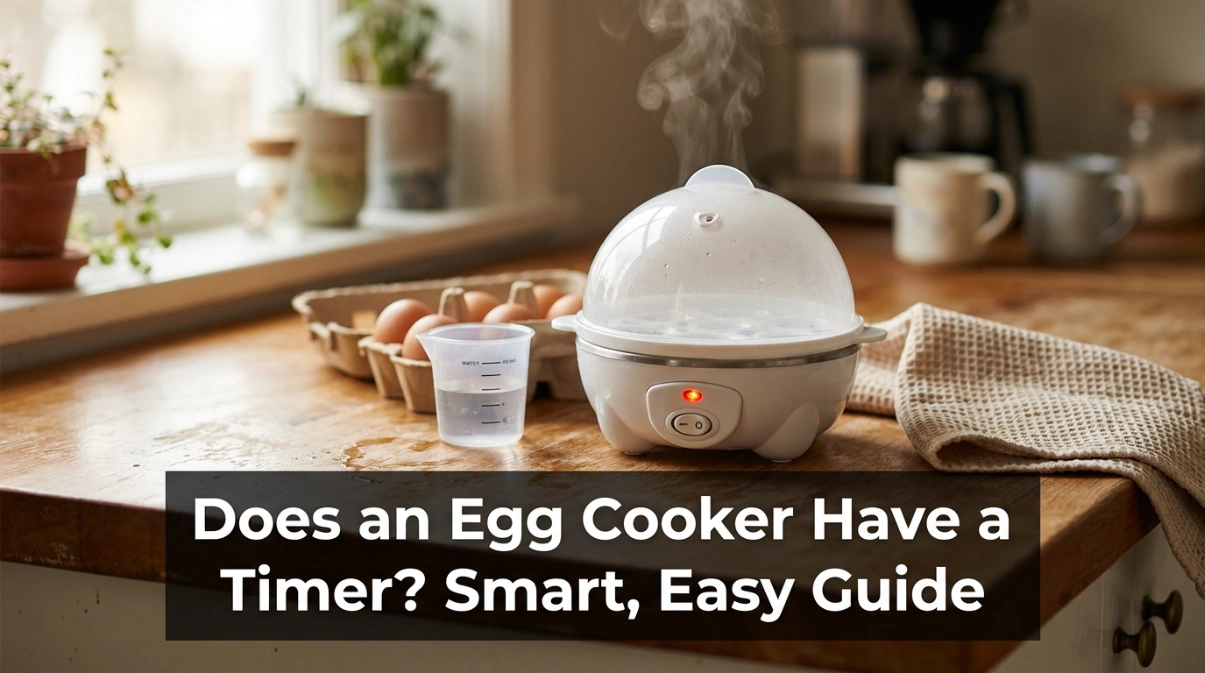
Does an egg cooker have a timer? Some models do, but many basic egg cookers do not use a normal clock timer. They use water and heat to control the cook time.
I was confused by this when I first used one. I saw one power button but no screen or time setting. I thought a part was missing.
After testing it, I learned how the simple system works. The cooker heats a set amount of water. When the water is gone, it beeps, stops heating, or does both.
This guide explains how to tell what type you own. I will also show you what to check if its alarm, timer, or auto shut-off does not work.
Common Signs of the Problem
A basic egg cooker may have no timer display at all. That is often normal. The water in the heating plate controls how long the eggs cook.
A model with a digital control panel may let you choose a cook mode or set a time. It may also have buttons for soft, medium, or hard eggs.
Here are the signs I noticed while testing different settings:
| Symptom | Likely Cause | Quick Fix |
|---|---|---|
| No timer display | Basic water-timed model | Use the marked measuring cup |
| Cooker beeps too soon | Too little water | Add the correct water amount |
| Eggs cook after the beep | No auto shut-off | Switch off and unplug it |
| No beep or light | Power or alarm fault | Test the outlet and controls |
| Eggs stay soft | Wrong water level | Use the hard-egg mark |
| Unit will not start | Tray, lid, or switch issue | Reseat all removable parts |
A missing timer is not always a fault. Check the manual or control panel first. A single switch often means the cooker uses water instead of a clock.
The water measuring cup is very important in this type of cooker. If yours is lost, use a replacement cup made for the same model. Cup marks can vary between brands.
A cracked egg tray or lid can also affect steam flow. I would replace a damaged part with one that fits the exact model. A poor fit can lead to leaks and uneven eggs.
Possible Causes
The main issue is often a mix-up about what “timer” means. An egg cooker can time the process without showing minutes on a screen.
It uses water as the timer
Many small egg cookers heat until the water has turned to steam. More water means a longer cook. Less water means a shorter cook.
This is why the cup may have marks for soft, medium, and hard eggs. It may also have marks for the number of eggs.
It has an alarm but no auto shut-off
Some units beep when the eggs are ready but keep the heating plate on. The beep is only a warning. You must switch off the cooker yourself.
I made this mistake during an early test. I heard the alarm but left the eggs inside. The whites became firm and dry.
It has auto shut-off but no sound
Other models stop heating when the water runs out. They may make a click instead of a loud beep.
The power light may also turn off. In that case, the light acts as the end signal.
The water amount is wrong
Too little water can make the cooker finish too soon. Too much can make it run longer than expected.
Egg size and starting temperature can also change the result. Large, cold eggs may need more heat than small eggs at room temperature.
Mineral scale is affecting the heat
Tap water can leave white or brown marks on the heating plate. This is limescale.
A thick layer can slow heat transfer. It may cause odd cook times or make the safety system stop the unit too soon.
The control panel has a fault
Digital models may have buttons, lights, and a true timer. A wet or damaged button may fail to respond.
A loose plug or faulty outlet can cause the display to flash. It may also reset the timer during use.
How to Fix “Does an Egg Cooker Have a Timer?”
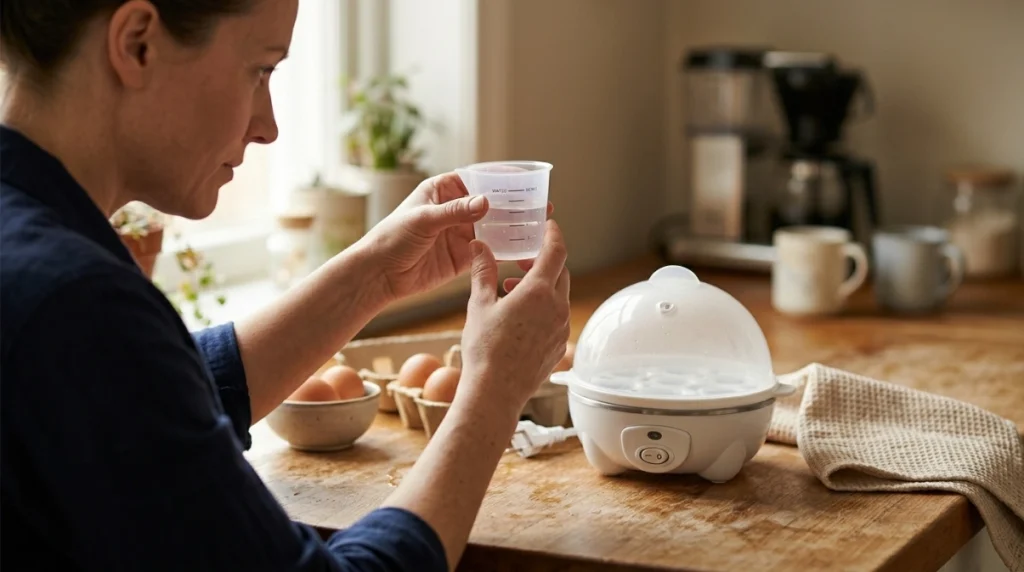
Start with the simple checks below. Do not open the base or touch any wires inside it.
Identify the type of timer
Look at the front of the cooker. A screen with minute buttons means it likely has a true digital timer.
One power switch with no screen often means it uses water to set the cook time. The measuring cup is part of the timing system.
| Cooker Type | How Timing Works | What You Need to Do |
|---|---|---|
| Basic cooker | Water runs out | Measure water with care |
| Alarm model | Beeps at the end | Turn it off when it beeps |
| Auto shut-off model | Heat stops on its own | Remove eggs with care |
| Digital model | Electronic timer or mode | Set the correct program |
Check the manual and labels
Look under the base for the model number. Search the manual for “buzzer,” “timer,” “ready signal,” or “auto shut-off.”
These terms do not mean the same thing. A buzzer tells you the cycle is done. Auto shut-off cuts power to the heating element.
Test the power source
Push the plug all the way into the wall outlet. Avoid a loose extension cord.
Test the outlet with another small item. If that item also fails, the outlet may be the cause.
Check the power cord for cuts, melted spots, or bent pins. Stop using the cooker if the cord is damaged.
Measure the water with care
Use the cup and chart made for your cooker. Pick the mark for the egg count and the result you want.
Do not guess on the first test. A small change in water can change the cook time more than expected.
If the eggs finish too soon, add a little more water during the next test. If they become too firm, use a little less.
Inspect the egg tray and lid
Make sure the egg tray sits flat. The lid should rest in its normal place and should not rock.
Check that the steam vent is open. Do not plug or cover it. Hot steam needs a safe way to escape.
A blocked vent can cause excess heat and pressure. Keep your hands and face away from the vent while the cooker runs.
Descale the heating plate
Unplug the cooker and let it cool. The plate must be cold before you touch it.
For cleaning, use the method in the manual. Many plates can be treated with a small amount of white vinegar and water.
Let the mix sit for a short time. Wipe it with a soft cloth or non-abrasive sponge. Never place the powered base in water.
Do not use steel wool or a knife. Scratches can damage the plate and make future buildup worse.
Reset the heat protection
Some cookers stop when they get too hot. This can happen if you run the unit with no water.
Turn it off and unplug it. Let it cool for at least 20 to 30 minutes. Add the right amount of water before testing it again.
Do not try to bypass the safety switch. It helps prevent heat damage and fire.
Test the buttons and signals
On a digital cooker, press each button with dry hands. Check whether the screen changes or a light comes on.
Unplug the unit for a few minutes if the panel appears frozen. Plug it back in and try one normal cycle.
If it keeps flashing or showing an error, stop using it. The control board may have a fault that is not safe to repair at home.
Mistakes to Avoid
Do not assume every beep means the heat has stopped. Watch the light or switch to confirm.
Do not leave a basic cooker running while you are away. Stay close until you know how your model ends its cycle.
Avoid these common mistakes:
- Running the cooker without water
- Filling water above the stated mark
- Blocking the lid’s steam vent
- Lifting the lid toward your face
- Touching the hot plate after use
- Pouring water over the powered base
- Opening the sealed heating unit
- Bypassing the safety switch
- Using a damaged cord or plug
A burning smell is not a normal timer signal. Unplug the cooker at once if you smell burnt plastic or see smoke.
Some harmless plate marks may smell on the first cycle. Yet a sharp electrical smell, melted cord, or hot control panel means the unit should not be used.
When to Replace the Egg Cooker
A lost cup, tray, or lid may be easy to replace. A fault inside the base is a different matter.
Small egg cookers are often sealed. Safe electrical repair may cost more than a new unit.
| Repair Issue | Best Action | Replace Instead? |
|---|---|---|
| Lost measuring cup | Buy an exact-fit cup | No |
| Cracked tray or lid | Replace the damaged part | Usually no |
| Heavy scale | Descale the plate | No |
| Alarm no longer works | Use an outside timer with care | Maybe |
| Auto shut-off fails | Stop using the cooker | Yes |
| Cord or base overheats | Unplug and retire it | Yes |
| Burning smell or smoke | Stop use at once | Yes |
Replace the cooker if it will not shut off, overheats, leaks into the base, or has a damaged power cord. These faults can pose a shock or fire risk.
An outside kitchen timer can help if the built-in buzzer is quiet. It should not replace a failed auto shut-off system.
My Personal Experience
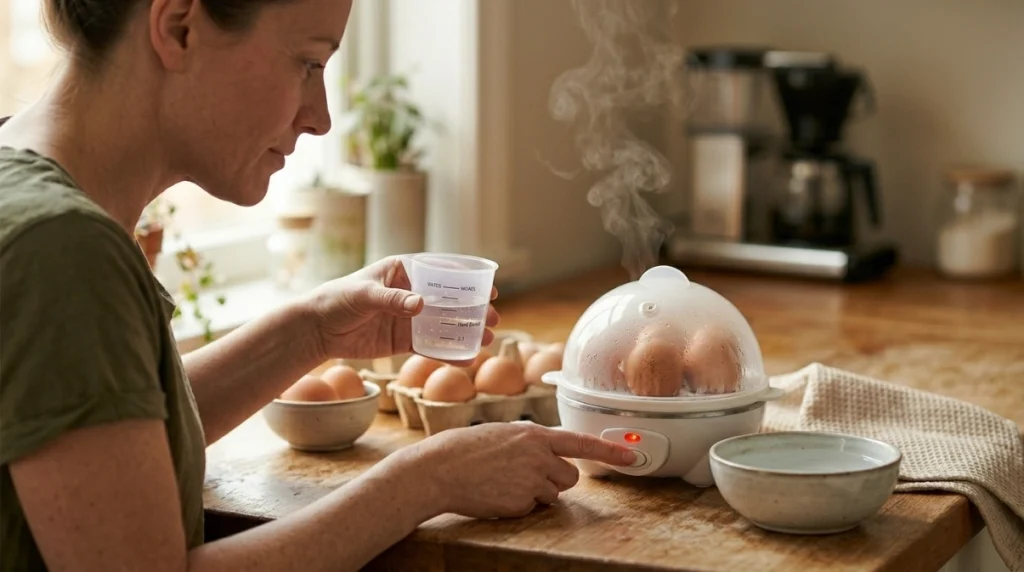
The first unit I tested had no screen. I kept looking for a timer button, but it only had an on-and-off switch.
I added water to the hard-boiled mark and started it. The unit beeped when the plate was almost dry, but the switch stayed on.
That test taught me to treat the alarm as a call to act. I switched off the cooker, unplugged it, and moved the eggs into cool water.
On my next batch, I used too much water. The cycle ran longer, and the yolks became dry. The timer was not faulty; my water level was wrong.
I then found some scale on the heating plate. A gentle wipe with diluted white vinegar helped the plate heat more evenly.
The best result came from three simple steps. I used the proper cup, stayed near the cooker, and checked whether the heat stopped after the beep.
Final Thoughts
So, does an egg cooker have a timer? It depends on the model. Digital units may have a true timer, while basic models often use water to control cook time.
A beep may only tell you the eggs are ready. It does not always mean the cooker has shut off.
Use the correct water amount and keep the steam vent clear. Check the light, switch, or display at the end of each cycle.
If the cooker overheats, smells burnt, or fails to shut off, unplug it. Replacing an unsafe unit is better than trying to open or repair its sealed base.
2 thoughts on “Does an Egg Cooker Have a Timer? Smart, Easy Guide”