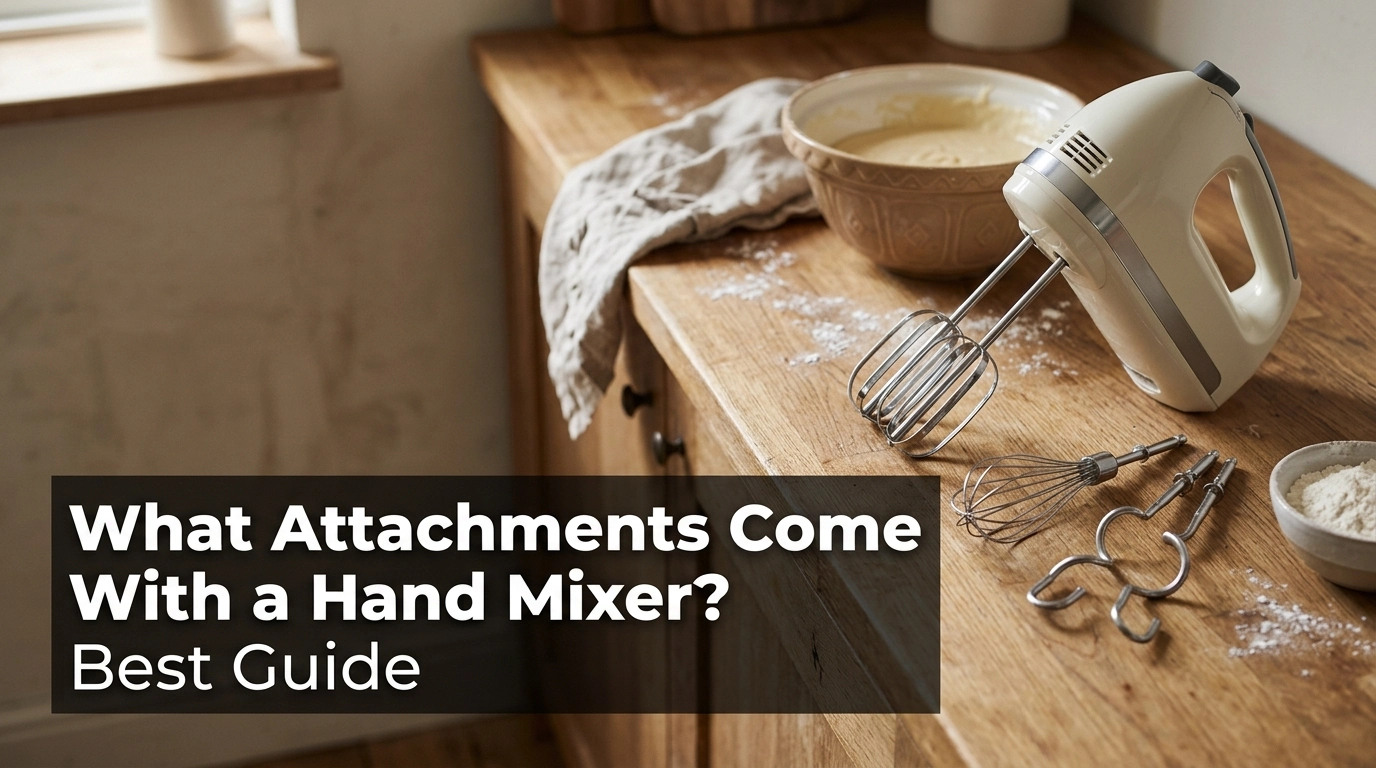
What attachments come with a hand mixer? Most hand mixers come with two beaters. Some also include dough hooks, a whisk, or other tools. The exact set depends on the model and brand.
When I looked at the common hand mixer attachments, I found that each tool has a clear job. The beaters work well for cake batter, while a whisk helps add air to cream and egg whites.
In this guide, I will explain the main attachments, what they do, and how to use them. I will also cover common mistakes, safe cleaning, and when you may need extra parts.
Common Signs of the Problem
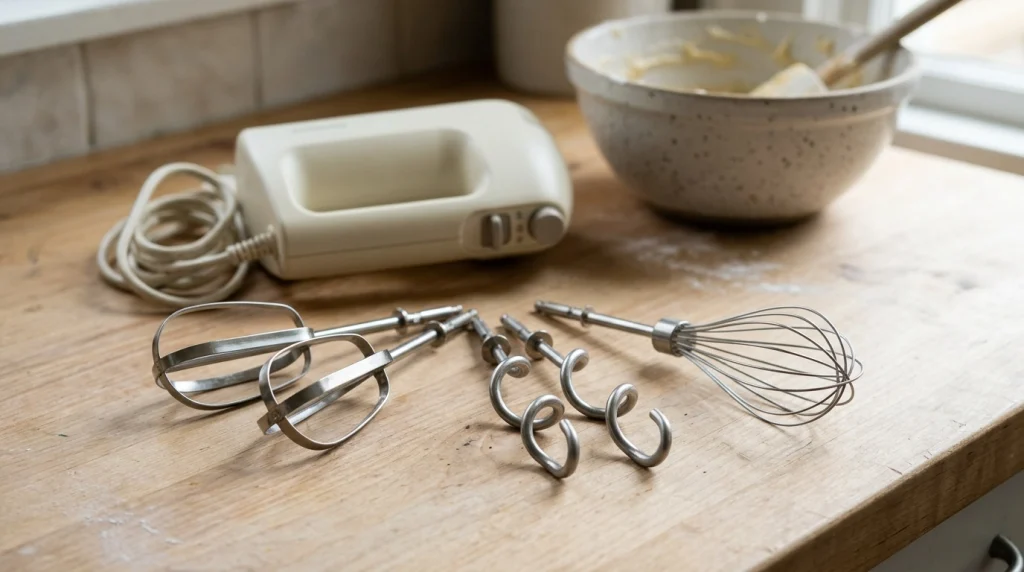
If you are unsure which attachment to use, look at its shape. Most hand mixer tools are easy to tell apart once you know what to look for.
Here are the main signs and what they mean.
| Attachment | What It Looks Like | Main Use |
|---|---|---|
| Standard beaters | Two metal beaters with loops | Cake batter, eggs, and cream cheese |
| Wire whisk | A rounded set of thin wires | Whipping cream and egg whites |
| Dough hooks | Curved or spiral metal hooks | Mixing some soft doughs |
| Single whisk or extra tool | Varies by model | A special task listed in the manual |
A hand mixer may not include every tool in this table. Some basic models come with beaters only. Higher-end models may include a whisk, dough hooks, or a storage case.
Do not assume that every attachment fits every mixer. The connector shape and size can differ, even between models from the same brand.
Possible Causes
There is no single standard set of hand mixer attachments. The tools you get depend on the model, its price, and the tasks it is built to handle.
These are the most common reasons for differences.
- Basic design: Some mixers are made for simple mixing and include only standard beaters.
- Extra features: Some models include a whisk or dough hooks for more types of food.
- Package options: One model may be sold in several bundles with different tools.
- Missing parts: A used or second-hand mixer may not have all its original attachments.
- Compatibility: Replacement tools may look right but fail to lock into your mixer.
The product box and user manual are the best places to check what came with your exact model. If a tool is missing, check the model number before buying a replacement.
A spare set of beaters or a compatible whisk can be useful if you bake often. Still, I would check the maker’s parts list first rather than buy a tool based on its appearance alone.
How to Choose and Use Hand Mixer Attachments
The right attachment makes mixing easier. It can also help you avoid splashes, lumpy batter, or a tool that struggles with the job.
1. Use Standard Beaters for Everyday Mixing
Standard beaters are the most common hand mixer attachments. They usually come as a pair and have metal loops that turn through the mixture.
Use them for cake batter, pancake mix, scrambled eggs, frosting, and many soft mixtures. They are a good starting point for most everyday recipes.
I would start at a low speed when mixing flour or thin batter. Once the ingredients come together, raise the speed if the recipe calls for it. This helps limit splashes and keeps flour from flying out of the bowl.
2. Use a Whisk for Light, Airy Mixtures
A whisk attachment has many thin wires. Its shape helps mix air into foods that need a light texture.
It is useful for whipping cream, beating egg whites, and making some light sauces. Some mixers include a whisk in the box, while others require a separate purchase.
Use a clean, dry bowl when beating egg whites. Even a small amount of fat or yolk can make it harder for the whites to form stiff peaks.
A whisk is not always a substitute for standard beaters. Check your mixer’s manual to make sure it supports the attachment and the task.
3. Use Dough Hooks Only for Suitable Dough
Dough hooks are shaped to move and fold dough. They may come with some hand mixers, but not all models are designed to handle them.
They can help with light yeast dough if the manufacturer allows it. A hand mixer is not always strong enough for thick bread dough, so check the manual before trying a heavy recipe.
Start at the speed recommended by the maker. Stop if the motor slows, the mixer gets unusually hot, or the hooks become stuck. Do not force the machine to keep turning.
4. Check the Attachment Fit Before Switching On
Each tool must fit the correct slot. Some mixers use different-sized openings to ensure that each beater goes into the right side.
With the mixer unplugged, insert each attachment as the manual directs. You may hear or feel it lock into place, depending on the design.
Never push hard on a tool that will not fit. It may be the wrong part, or it may need to be turned to the correct position.
5. Clean Attachments After Each Use
Food can dry on beaters, whisk wires, and dough hooks. I find that cleaning them soon after use is easier than trying to remove stuck batter later.
Unplug the mixer before removing its attachments. Wash removable tools with warm water and dish soap if the manual allows it. Dry them well before storing them.
Clean the mixer body with a soft, damp cloth. Never immerse the motor housing in water or let water enter the attachment slots.
Some attachments are dishwasher-safe, but others are not. Check the manual before putting metal tools in a dishwasher, especially if they have a special coating or plastic parts.
6. Find the Right Replacement Part
If an attachment is missing or damaged, look up the full model number. Check the maker’s official parts page or contact its support team.
A replacement beater set, whisk, or dough hook may be available. Do not buy a part just because it looks similar to the original.
| Problem | Recommended Solution | Difficulty |
|---|---|---|
| One beater is missing | Find a matching replacement pair | Easy |
| Whisk does not lock in | Check model compatibility and fitting steps | Easy |
| Dough hooks strain the motor | Stop and check the manual’s limits | Easy |
| Attachment is bent or cracked | Replace it with an approved part | Easy |
If the attachment shaft is bent or the fitting is damaged, do not use it. A loose or damaged tool may come free while the mixer is running.
Mistakes to Avoid
Choosing the wrong tool can affect your mixture and put extra strain on the motor. A few simple habits can help you avoid trouble.
- Do not use standard beaters for every task without checking the recipe.
- Do not force a dough hook into a mixer that does not support it.
- Do not insert or remove attachments while the mixer is plugged in.
- Do not touch moving beaters or whisk wires.
- Do not rinse the motor housing under a tap.
- Do not use bent, loose, or cracked attachments.
Also, avoid starting at full speed. Low speed gives you more control when adding flour, milk, or other loose ingredients.
If the motor smells burnt, makes an unusual noise, or becomes very hot, switch it off and unplug it. Let it cool, then check the manual. Stop using it if the issue returns.
Never open the sealed motor housing or try to repair its electrical parts yourself. Contact the maker or a qualified repair service if the mixer appears faulty.
When to Replace the Attachments
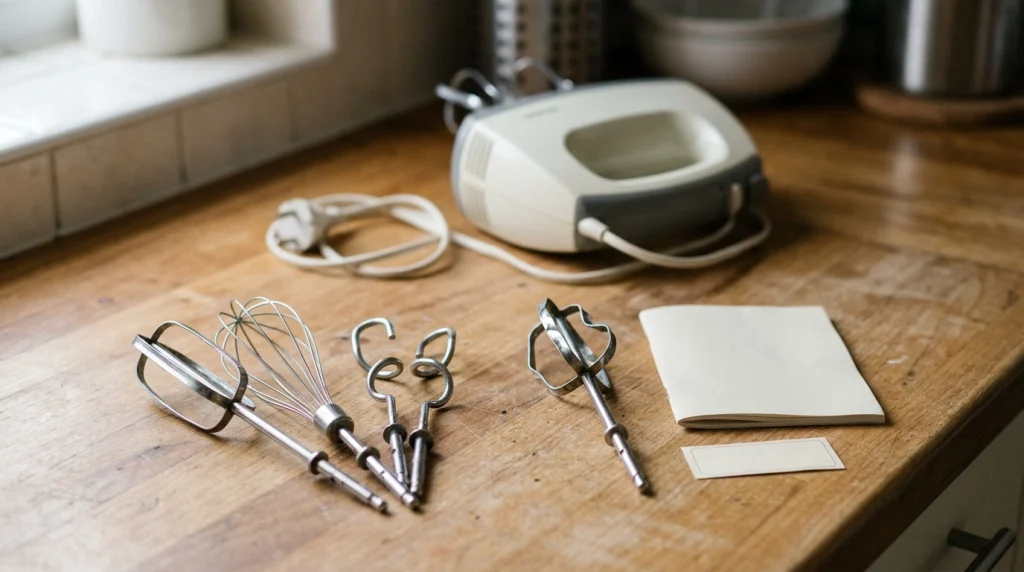
You do not need to replace an entire hand mixer just because one tool is missing. In many cases, a compatible replacement attachment is enough.
Replace a beater, whisk, or hook if it is bent, cracked, badly rusted, or no longer locks in place. Stop using any tool that sheds coating or has a damaged surface that could contact food.
If the maker no longer sells the part, compare the cost of a suitable replacement with the cost of a new mixer. Do not use a tool that only partly fits to save money.
If the mixer itself has a damaged cord, a persistent burning smell, or a motor that repeatedly overheats, the issue goes beyond the attachments. Have it checked before using it again.
My Personal Experience
When comparing the common attachment types, I found that the easiest way to choose is to start with the food you want to make. Standard beaters cover many daily tasks, so they are often enough for simple home baking.
For light mixtures, a whisk is the tool to look for. Dough hooks are more specialized, and I would not use them for thick dough unless the mixer manual says they are suitable.
I would also check the fitting before every use, especially after washing the tools. It takes only a moment and helps prevent loose attachments from moving out of place.
The main lesson is simple: more attachments do not always mean a better mixer for your needs. The best set is the one that suits your recipes and works safely with your model.
Final Thoughts
Most hand mixers come with standard beaters, while some include a whisk, dough hooks, or extra tools. Each attachment has a different purpose, so check its shape and your recipe before using it.
If you need a replacement, use the exact model number to find a compatible part. Clean removable tools after use, keep the motor housing dry, and stop if an attachment is damaged or the mixer shows signs of trouble.
With the right tools and a little care, a hand mixer can handle many everyday kitchen tasks without the need for extra equipment.