
Yes, egg cookers do make hard boiled eggs. Most models steam eggs until the whites and yolks are fully set.
My first batch came out softer than I wanted because I used too little water. I soon learned that water level, egg size, and tray position matter.
If your eggs are soft, cracked, rubbery, or uneven, the cooker may not be broken. Here is the routine I use.
Common Signs of the Problem

A hard-boiled egg should have a firm white and a fully set yolk. If the middle is wet or jammy, the egg did not cook long enough for a hard result.
| Symptom | Likely Cause | Quick Fix |
|---|---|---|
| Soft yolk | Too little water or wrong mode | Use hard-boil water level |
| Uneven eggs | Mixed sizes or poor tray fit | Match sizes and reseat tray |
| Cracked shells | Damaged shell or heat stress | Use intact eggs |
| Cooker stops early | Low water, scale, or power issue | Check water and plate |
| Rubbery eggs | Too much cooking | Cool eggs after the cycle |
If the cooker never heats, leaks into the base, or smells burnt, I stop using it until I know why.
If the measuring cup is missing or its marks are worn, a correct replacement measuring cup can help. Many steam cookers depend on small water changes to control cooking time.
Possible Causes
The most common cause is the wrong water amount. In many models, water creates steam and helps control cooking time.
A soft or medium mode also will not give the same result as the hard-boiled setting.
Other likely causes include:
- Eggs that are very different in size.
- An egg tray that is not sitting flat.
- A lid that is out of position.
- A blocked steam vent.
- Mineral buildup on the heating plate.
- A cycle stopped too soon.
- A loose plug or faulty outlet.
- A heating element that is no longer working well.
I get the most even results when eggs in one batch are close in size and temperature.
Do Egg Cookers Make Hard Boiled Eggs Properly? How to Fix Problems
If the cooker turns on and heats, I start with the easy checks. I never open the base or touch internal electrical parts.
Check the Hard-Boiled Setting
First, I confirm the cooker is set for hard-boiled eggs. Some models use a button, while others rely mainly on the water amount.
I follow the hard-boiled line on the cup or the amount in the manual, including any egg-count marks.
Measure the Water Carefully
Too little water was why my eggs came out soft. I now place the cup on a level surface and read the mark carefully instead of guessing.
Correct water measurement matters because many compact egg cookers use the amount of water to help control how long they produce steam.
Inspect the Tray, Lid, and Vent
I make sure the egg tray sits flat. I also place the lid in its normal position and confirm that the steam vent is open.
I never cover the vent or lean over it. Hot steam can cause a fast burn.
Check the Heating Plate
If the heating plate has white or brown mineral marks, I unplug the cooker and let it cool. Then I follow the maker’s directions for cleaning and descaling.
Some manuals allow diluted white vinegar for light scale. I only use it when the instructions permit it, and I wipe with a soft cloth or non-abrasive sponge.
Run One Full Test Cycle
After checking the water, tray, lid, and plate, I run one full hard-boiled cycle without lifting the lid.
When it ends, I move the eggs into cold or ice water. This stops extra cooking and makes the texture easier to judge.
| Problem | Recommended Solution | Difficulty |
| Soft center | Correct the hard-boil water level | Easy |
| Uneven eggs | Match egg sizes and reseat tray | Easy |
| Scale | Descale as directed | Easy |
| No heat | Check outlet and visible cord | Easy |
| Still no heat | Stop use and service or replace | Moderate |
Check Power Only if the Cooker Does Not Heat
If the cooker stays cold, I check the plug and test the outlet with another safe appliance. I also inspect the visible cord for damage and stop using it if I find any.
Some models use auto shut-off or overheat protection. If the unit stops too soon again and again, I never bypass those safety features.
Mistakes to Avoid
My biggest mistake was treating the water marks as rough suggestions. On a small cooker, they can be the main control for egg doneness.
I also avoid these errors:
- Mixing very small and extra-large eggs.
- Adding far too much water to make eggs “harder.”
- Blocking the steam vent.
- Lifting the hot lid toward my face.
- Touching the heating plate right after cooking.
- Scraping scale with metal tools.
- Opening the base to repair wiring or the heater.
- Bypassing an auto shut-off or safety switch.
If your cooker has an egg-piercing pin, handle it carefully. It is sharp, and not every cooker requires piercing, so I follow the model instructions.
When to Replace the Egg Cooker
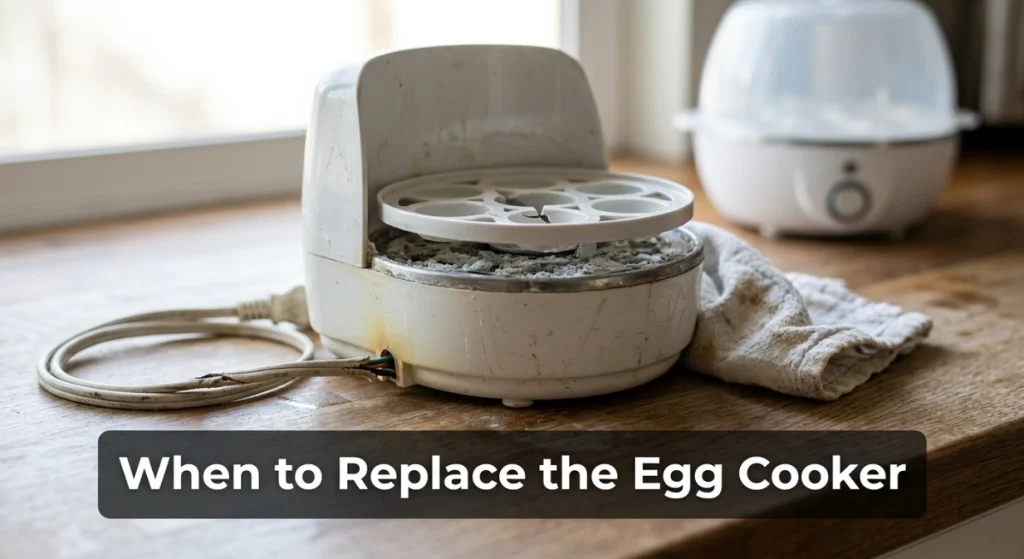
I would replace the cooker if it no longer heats after I have checked the outlet and plug. Internal heater repairs are not a good beginner repair on a sealed appliance.
I also stop using a cooker with melted plastic, sparks, repeated burning smells, severe leaks into the base, or serious cord damage.
| Repair Issue | Best Action | Replace? |
| Missing measuring cup | Get the correct cup | Usually no |
| Cracked egg tray | Replace tray if available | Usually no |
| Mineral buildup | Descale first | Usually no |
| Failed heater | Service or replace | Often yes |
| Burning smell or melted base | Stop use | Yes |
A replacement lid or tray can make sense if the cooker still works well. I only use parts that fit correctly and do not block vents.
My Personal Experience
What worked best for me was simple. I used similar-size eggs, measured water for the hard setting, seated the tray flat, and let the cycle finish.
My soft-center problem went away when I stopped guessing the water amount. Cooling the eggs right after cooking also gave me a firmer, more even result.
I learned to check the heating plate too. A thin layer of mineral scale is easy to ignore, but regular care helps the cooker heat as intended.
Final Thoughts
So, do egg cookers make hard boiled eggs? Yes. A working egg cooker can make firm, fully cooked eggs when the water, setting, tray, and lid are correct.
If your eggs stay soft, start with the water level. Then check the tray, lid, vent, heating plate, and power source.
Most problems are simple. But if you see electrical damage, severe leaking, a burning smell, or a failed heater, stop using the cooker rather than opening the base or bypassing safety parts.