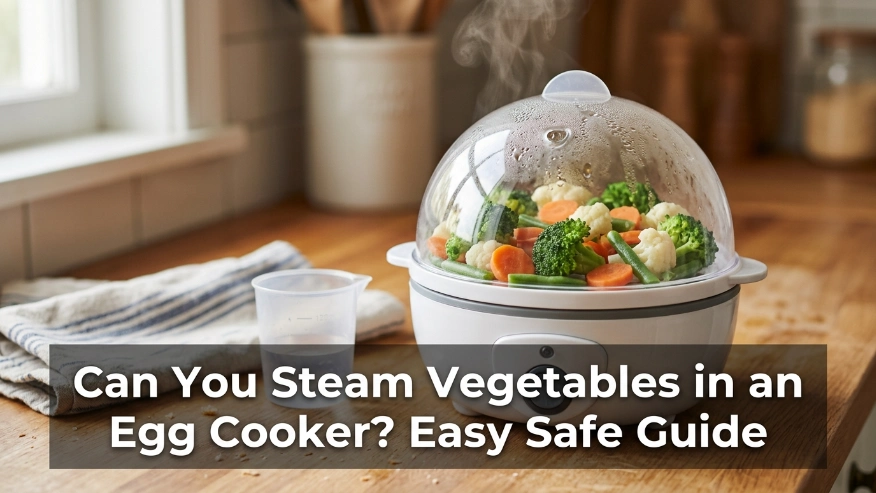
Yes, you can steam vegetables in many egg cookers, but the model matters. I only do it when the cooker has a poaching, omelet, or steaming tray that the maker says is safe for food.
I learned this after packing too much broccoli into one tray. The bottom went soft while the top stayed firm. Once I used smaller pieces, less food, and the right water level, the result was much better.
Here is how I now steam vegetables safely and what I check when the cooker shuts off too soon or does not make enough steam.
Common Signs of the Problem: Can You Steam Vegetables in an Egg Cooker?

The most common sign is uneven cooking. Some pieces turn soft while others stay hard, even when they started at the same time.
You may also see water left in the base, weak steam, or an early shut-off. Heavy steam around the lid edge can also mean the lid is not seated well or too much water was added.
| Symptom | Likely Cause | Quick Fix |
|---|---|---|
| Vegetables stay hard | Too little water or large pieces | Add correct water and cut smaller |
| Food cooks unevenly | Tray is overloaded | Use a loose layer |
| Cooker stops early | Low water or scale buildup | Recheck water and descale |
| Steam leaks at lid | Lid fit is poor | Refit lid and clear vent |
If the original water cup is missing, a matching replacement measuring cup is useful. Small egg cookers often depend on small water amounts, so guessing can make results less consistent.
I also use a soft cloth or non-abrasive sponge on the tray and heating plate. These are simple items, but they help prevent scratches and residue.
Possible Causes
The first cause is using the wrong tray. Some egg cookers include a food tray, while others only include an egg rack.
The next cause is water. Too little may end the cycle early. Too much may leave vegetables soggy and send extra steam around the lid.
Other common causes are:
- Vegetable pieces that are too large.
- Too much food packed into the tray.
- A lid that is not seated correctly.
- A steam vent blocked by food or residue.
- Mineral buildup on the heating plate.
- Normal auto shut-off when the water is gone.
That last point matters. Many egg cookers stop when the water boils away, so the water amount acts like a rough timer.
How to Fix “Can You Steam Vegetables in an Egg Cooker” Problems
Check That Your Tray Is Safe for Vegetables
I check the manual first. If the model only has an egg rack and no food-safe tray, I do not try to balance vegetables over the heating plate.
Never put vegetables straight on the heating plate. It is made to heat water, not food.
Cut Vegetables Into Small, Even Pieces
Small pieces steam faster and more evenly. I use small broccoli florets, thin carrot slices, short green beans, or small cauliflower pieces.
I keep the pieces close in size. A thick piece can stay hard while a thin one turns soft.
Use the Right Amount of Water
Water amount made the biggest difference in my tests. I start with the amount the manual gives for steaming or poaching, if one is listed.
If there is no vegetable guide, I stay within the cooker’s stated water limit. I never fill it by guess just to make a longer cycle.
| Problem | Recommended Solution | Difficulty |
|---|---|---|
| Food too firm | Use a little more approved water next cycle | Easy |
| Food too soft | Use less water or a shorter cycle | Easy |
| Uneven texture | Cut smaller and avoid crowding | Easy |
| Weak steam | Descale the heating plate | Easy |
Do Not Overload the Tray
My worst batch came from piling broccoli too high. Steam could not move around the pieces, so the bottom cooked first.
A loose layer works better. For a larger amount, I run two small batches.
Check the Lid and Steam Vent
The lid should sit in its normal position. I also make sure the steam vent is open and not covered by food.
I never put my face or hand over the vent. Hot steam can burn skin very fast.
Remove Mineral Buildup
A chalky white or brown film on the heating plate can reduce heat transfer. This is where regular cleaning helps.
I unplug the cooker, let it cool, and follow the maker’s descaling method. If the manual allows it, white vinegar can help loosen limescale.
I keep liquid away from electrical parts and use a soft cloth or non-abrasive sponge. I do not use steel wool.
Let Auto Shut-Off Work Normally
If the cooker stops when the water is gone, I do not bypass the shut-off. That feature helps protect the unit from dry heating.
If the vegetables need more time, I let the cooker cool as directed. Then I add only a safe amount of water and run another short cycle if the model allows it.
Mistakes to Avoid
Do not assume every egg cooker can steam vegetables. Check the manual because trays, water limits, and shut-off systems differ.
Do not pack the tray too full or block the steam vent. Steam needs room to move and a safe path out.
When opening the lid, tilt it away from your face. This keeps the first burst of hot steam away from your skin.
Never open the heating base, bypass a safety switch, or change internal wiring. Small appliances are not worth a risky electrical repair.
When to Replace the Egg Cooker

I would replace the cooker if it has a burning smell, melted plastic, a damaged power cord, repeated overheating, or a heating plate that no longer works.
I would also stop using it if the auto shut-off fails. A cooker that keeps heating after the water is gone can be unsafe.
| Repair Issue | What I Would Do | Replace Instead? |
|---|---|---|
| Missing measuring cup | Use a correct replacement cup | No |
| Cracked tray or lid | Replace the matching part | Usually no |
| Heavy limescale | Descale first | No |
| Burnt cord or melting | Stop use at once | Yes |
| Shut-off fails | Stop use at once | Yes |
A cracked lid or tray may be worth replacing if the maker sells the exact part. I avoid random lids or gaskets that do not match the model.
My Personal Experience
The method that worked best for me was simple. I used small broccoli florets in a shallow layer, added the correct water amount, fitted the lid fully, and kept the vent clear.
My first batch failed because the pieces were too large and packed too tightly. The cooker stopped as designed, but the vegetables were still firm inside.
On the next try, I cut them smaller and used less food. Steam moved around the tray better, and the texture was far more even.
I also found that mineral film made the cooker slower over time. After descaling the plate, steam formed faster and the cycle became more consistent.
The main lesson was clear. An egg cooker can handle small vegetable portions well, but it is not the same as a large food steamer.
Final Thoughts
So, can you steam vegetables in an egg cooker? Yes, in many models, as long as the cooker has a food-safe tray and the manual does not warn against it.
For the best result, cut vegetables into small pieces, avoid crowding, use the correct water amount, keep the vent open, and descale the heating plate when needed.
If the cooker smells burnt, overheats, has a damaged cord, or fails to shut off, stop using it. Do not open the base or bypass a safety feature.
For small servings, an egg cooker can be a handy vegetable steamer. The key is to stay within the model’s limits and adjust water or piece size when the first batch is too firm or too soft.