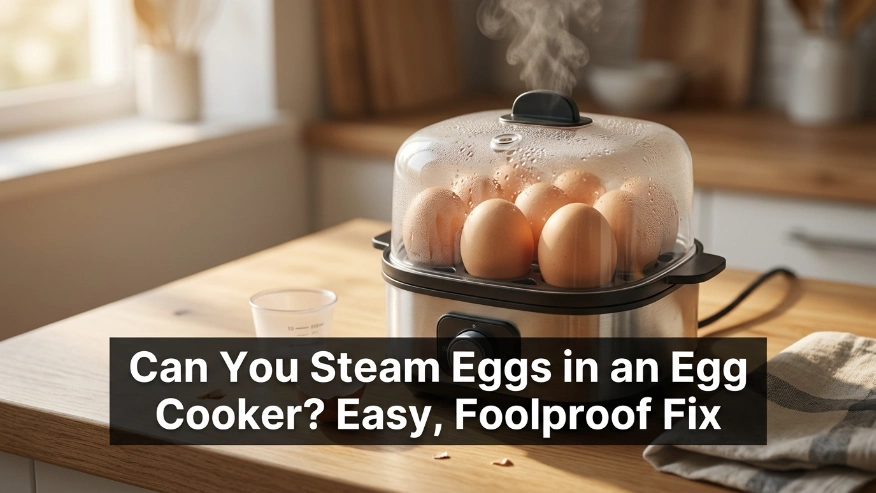
Yes, you can steam eggs in an egg cooker. In fact, steaming is how most electric egg cookers actually cook eggs.
I did not realize this at first. I thought an egg cooker worked more like a small pot that boiled eggs in water. After using one, I learned that the heating plate turns a small amount of water into steam.
That steam cooks the eggs sitting in the egg tray.
The process is simple, but a few small mistakes can cause undercooked eggs, cracked shells, water leaks, or eggs that come out much harder than expected.
Below, I will explain what I found most useful when setting up the tray, measuring the water, checking the lid, and getting better results.
Common Signs of the Problem

If you are asking, “can you steam eggs in an egg cooker,” you may already have tried it and noticed something went wrong.
These were the most common problems I ran into or looked for during testing.
| Symptom | Likely Cause | Quick Fix |
|---|---|---|
| Eggs are too soft | Too little water | Add the correct water amount |
| Eggs are too hard | Too much water | Use less water next time |
| Eggs cook unevenly | Tray or lid is not seated well | Refit the tray and lid |
| Water leaks out | Too much water or poor lid fit | Reduce water and inspect lid |
| Cooker stops early | Low water or safety shut-off | Let it cool and retry |
You may also hear a beep when the water is gone. On many models, that simply means the cooking cycle is done.
Some cookers shut off on their own instead.
Neither result is usually a problem unless the cooker shuts down before enough steam has formed.
I also check whether steam is escaping from the vent normally. A little steam is expected. Heavy leaking around the sides of the lid is not.
If the tray, measuring cup, or lid is damaged, I would rather replace that simple part than keep guessing with water levels. A replacement measuring cup can be especially useful because the markings help control cooking time.
Possible Causes
An egg cooker needs only a few things to steam eggs correctly: water, heat, a stable egg tray, and space for steam to move.
If one of those is wrong, the results can change fast.
Common causes include:
- Using too little water
- Adding too much water
- Placing the egg tray incorrectly
- Leaving the lid loose
- Blocking the steam vent
- Using the wrong water mark on the measuring cup
- Mineral buildup on the heating plate
- Starting another cycle while the cooker is still very hot
- Using a cracked or warped egg tray
- A heating plate that no longer heats evenly
The water amount matters more than I expected.
Most egg cookers do not use a timer in the same way an oven does. Instead, the water slowly turns into steam. When the water is gone, the cooking cycle ends or the cooker alerts you.
That means more water usually gives the eggs more cooking time.
Less water gives them less.
How to Fix Can You Steam Eggs in an Egg Cooker Problems
If your eggs are not steaming correctly, I would start with the simple checks below.
There is usually no reason to open the appliance or touch its internal electrical parts.
Check the Power Source
First, I make sure the egg cooker is sitting on a dry, flat counter.
Then I push the plug fully into the wall outlet.
If the cooker does not turn on, I test the outlet with another small appliance. This helps me rule out a bad outlet before blaming the egg cooker.
I also look over the power cord.
If I see exposed wire, melted plastic, deep cuts, or a loose connection near the cooker, I stop using it.
A damaged power cord is not something I try to repair at home.
Add Water to the Heating Plate
The cooker needs water to create steam.
I use the supplied measuring cup whenever possible. Most cups have marks for soft, medium, or hard eggs.
The exact amount can vary by egg cooker.
That is why I do not recommend using one universal number of tablespoons for every model.
Pour the measured water onto the heating plate or into the water area described in your cooker instructions.
Do not fill the whole cooker with water.
Set the Egg Tray Correctly
Next, I place the egg tray firmly over the heating area.
The tray should sit flat.
If it rocks, tilts, or does not drop into position, I remove it and try again.
Then I place the eggs into the tray.
Some egg cookers include a small piercing pin on the measuring cup. The manual may tell you to make a tiny hole in one end of each egg.
I only do this when the cooker instructions call for it.
Fit the Lid and Check the Steam Vent
The lid helps keep enough steam around the eggs.
I place it on the cooker without forcing it.
The steam vent must stay open.
I never cover the vent with a towel, plate, foil, or another object. Hot steam needs a safe way to escape.
If steam pours heavily from the edge instead of the vent, I check whether the lid is warped or sitting incorrectly.
A damaged lid may be worth replacing.
Adjust the Water Amount
Water level is the main way I control the result.
| Egg Result | Water Approach | What I Check |
|---|---|---|
| Soft | Lower marked amount | Yolk stays soft |
| Medium | Middle marked amount | Yolk is partly set |
| Hard | Higher marked amount | Yolk cooks through |
I found that changing the water a little at a time works better than making a large change.
Egg size, starting temperature, and even room temperature can affect the final result slightly.
For that reason, I keep notes when I find a water level that works well.
Check for Mineral Buildup
After several uses, I may see a white, gray, or brown film on the heating plate.
That is often mineral buildup from water.
A dirty heating surface can reduce heat transfer and may cause uneven steaming.
This is where regular cleaning makes a noticeable difference.
I unplug the cooker and let it cool fully first.
For light deposits, I wipe the surface with a soft damp cloth or a non-abrasive sponge.
For harder mineral deposits, diluted white vinegar can help on many models. I always check the appliance instructions before using any cleaner.
I never pour water over the electrical base.
Let the Safety Shut-Off Reset
Some egg cookers have overheat protection or an automatic shut-off.
If the cooker gets too hot, it may stop.
When this happens, I unplug it and let it cool fully.
I do not keep pressing the power button over and over.
Once the unit is cool, I add the proper amount of water and test it again.
If it repeatedly shuts off with the correct amount of water, the heating system may have a fault.
Watch the End of the Cooking Cycle
Once the cooker starts making steam, I keep my hands away from the vent.
Steam can burn skin very quickly.
When the cooker beeps or shuts off, I turn it off if needed and unplug it.
I lift the lid away from my face so the steam moves in the other direction.
For hard-cooked eggs, I usually move them into cold water right away.
This can stop further cooking and make them easier to handle.
Mistakes to Avoid
The biggest mistake I made at first was thinking more water would always be better.
It is not.
Too much water can make soft eggs turn hard because the cooker keeps producing steam for longer.
Another mistake is guessing the water amount instead of using the measuring cup.
A small difference can change the cooking time.
I also avoid these common errors:
- Blocking the steam vent
- Overfilling the water area
- Running the cooker dry
- Touching the hot heating plate
- Removing the lid toward my face
- Washing the electrical base under running water
- Using abrasive pads on the heating surface
- Using a badly cracked egg tray
- Opening the cooker housing for DIY electrical repairs
- Bypassing an automatic shut-off or safety switch
I never try to defeat a safety feature just to make the cooker run.
If an electrical safety system keeps shutting the unit down, I treat that as a warning.
When to Replace the Egg Cooker
Most steaming problems are simple.
Water level, mineral buildup, or a poorly fitted tray can often explain the problem.
There are times, though, when I would replace the cooker instead of trying another fix.
| Repair Issue | What I Would Do | Replace? |
|---|---|---|
| Missing measuring cup | Get a compatible cup | Usually no |
| Cracked egg tray | Replace the tray | Usually no |
| Warped lid | Replace lid if available | Maybe |
| Heavy mineral buildup | Descale carefully | Usually no |
| Damaged power cord | Stop using cooker | Often yes |
| Burning smell | Unplug immediately | Often yes |
| Heating plate fails | Stop using cooker | Usually yes |
A burning smell is one sign I take seriously.
I unplug the cooker if I smell burning plastic or notice smoke, sparks, melted parts, or unusual electrical sounds.
I also replace the unit if it repeatedly overheats or fails to shut off correctly.
Opening a sealed heating base is not worth the risk for a small kitchen appliance.
My Personal Experience
What helped me most was treating the egg cooker as a small steam appliance instead of a tiny boiling pot.
Once I understood that, the water markings made much more sense.
My first step was to measure the water carefully. Then I made sure the egg tray sat flat and the lid vent stayed clear.
When an egg came out too soft, I added a little more water on the next cycle.
When it came out harder than I wanted, I reduced the water.
That simple adjustment worked better than trying to guess cooking times with a phone timer.
I also noticed that keeping the heating plate free from mineral deposits helped the cooker work more consistently.
The other lesson I learned was not to rush when opening the lid.
The steam inside is much hotter than it looks.
I now unplug the cooker, give it a moment, and lift the lid so the steam moves away from my hands and face.
Final Thoughts
So, can you steam eggs in an egg cooker?
Yes. That is exactly how most electric egg cookers prepare eggs.
The heating plate turns measured water into steam. The steam surrounds the eggs until the water is used up or the cooker ends the cycle.
For the best result, focus on the water amount first.
Then check that the egg tray sits flat, the lid fits correctly, and the steam vent is open.
If results become uneven, inspect the heating plate for mineral buildup and clean it according to the maker’s instructions.
Most problems do not require repairs.
A small change in water level or tray position is often enough to get soft, medium, or hard eggs the way you want them.
If you notice a damaged power cord, burning smell, smoke, repeated overheating, or a failed safety shut-off, stop using the cooker.
For everyday steaming problems, though, careful measuring and a clean heating plate are usually the simplest fixes.
1 thought on “Can You Steam Eggs in an Egg Cooker? Easy, Foolproof Fix”