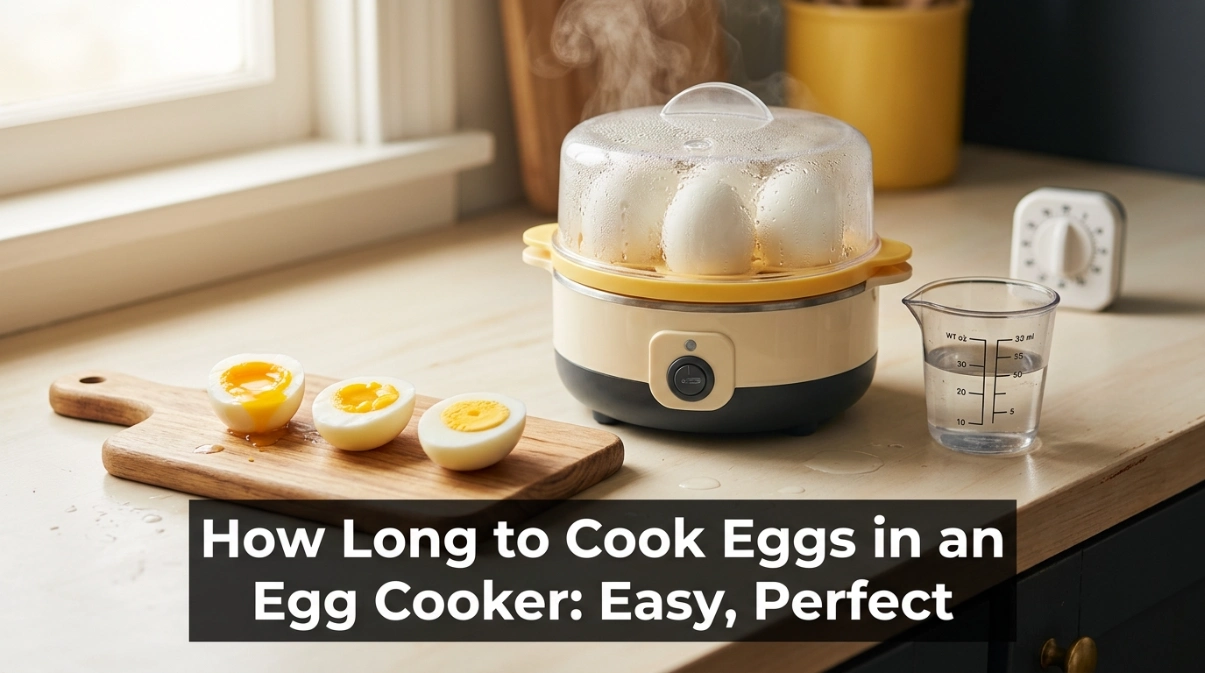
If you want to know how long to cook eggs in an egg cooker, the short answer is 6 to 16 minutes. Soft eggs often take 6 to 8 minutes. Hard eggs may need 12 to 16 minutes.
However, many egg cookers do not use a normal timer. They cook until the water is gone. The amount of water controls how long the heating plate stays hot.
I learned this after making a very soft batch by mistake. I had used the hard-boiled mark on the cup, but I did not fill it on a flat surface. That small error changed the result.
This guide will help you choose the right time and water level. It also explains what to check if your eggs are too soft, too firm, cracked, or uneven.
Common Signs of an Egg Cooking-Time Problem
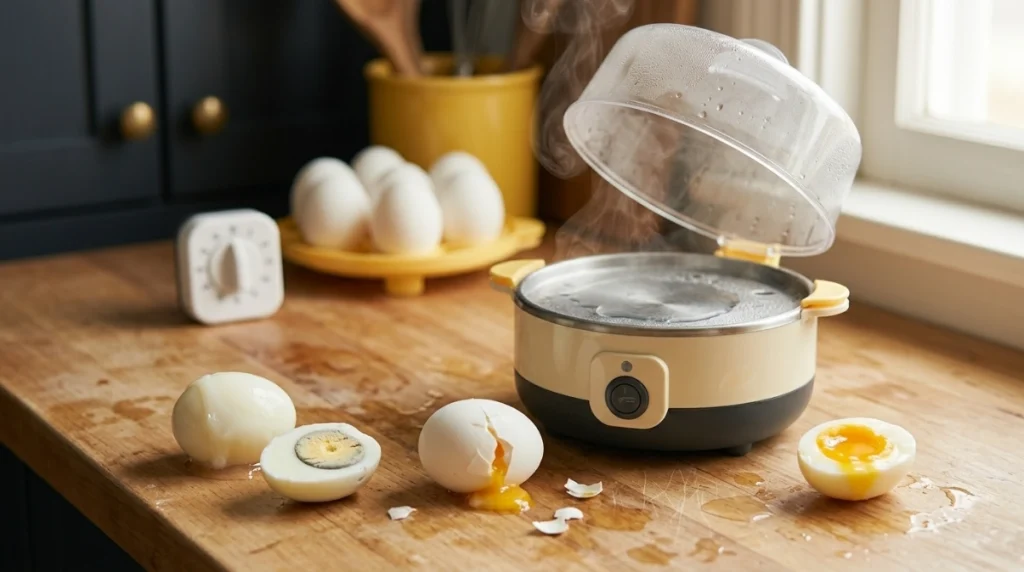
A timing problem is easy to spot. The eggs may look ready outside but remain too soft in the middle.
You may also notice these signs:
- The egg white is wet or clear.
- The yolk is firmer than you wanted.
- Some eggs are cooked while others are not.
- The shells crack during cooking.
- The cooker shuts off too soon.
- The cooker keeps heating for too long.
- Water remains on the heating plate.
- The cooker beeps before the eggs seem ready.
Here is a quick guide based on my tests. These times are estimates, since models work in different ways.
| Egg result | Usual cooking time | Yolk texture |
|---|---|---|
| Soft-boiled | 6–8 minutes | Warm and runny |
| Medium-boiled | 9–11 minutes | Soft and creamy |
| Hard-boiled | 12–16 minutes | Fully firm |
Always check the instructions for your model. A six-egg cooker may heat faster than a large cooker holding 12 or 14 eggs.
Around this stage, I found that the original water measuring cup was worth keeping. Its marks matched my cooker better than a kitchen spoon. A replacement measuring cup can help if yours is lost or hard to read.
Possible Causes of Poor Cooking Results
The most common cause is the wrong amount of water. In most basic egg cookers, more water means a longer cooking cycle.
The cooker heats the water and makes steam. Once the water is gone, the unit may beep or shut off. That is why a small change in water can make a large change in the yolk.
Other likely causes include:
- Eggs are much larger or smaller than usual.
- The eggs are very cold from the fridge.
- Too many eggs are packed into the tray.
- The egg tray is not sitting flat.
- The lid is loose or placed the wrong way.
- A blocked steam vent holds too much heat.
- Limescale covers the heating plate.
- The wall outlet gives an uneven power supply.
- The auto shut-off ends the cycle too early.
- The wrong setting was chosen on a digital model.
Room temperature can also affect the result. In my kitchen, cold eggs took about one or two minutes longer than eggs that had rested on the counter for a short time.
Do not leave raw eggs at room temperature for long. I only take them out while I prepare the cooker and measure the water.
| Symptom | Likely cause | Quick fix |
|---|---|---|
| Runny white | Too little water | Add a small amount next time |
| Dry or gray yolk | Too much water or time | Use less water |
| Uneven eggs | Crowded or tilted tray | Seat the tray correctly |
| Cracked shells | Eggs too cold or pierced too deep | Warm briefly and pierce gently |
| Early shut-off | Scale or poor outlet | Descale and test another outlet |
How Long to Cook Eggs in an Egg Cooker for the Best Results
Start with the marks on the water cup rather than a stopwatch. Those marks are often designed for the heating plate and tray in that exact cooker.
If your model has a digital timer, use the maker’s time chart first. You can then adjust the next batch by one minute at a time.
Choose the Egg Texture
Decide whether you want soft, medium, or hard eggs before adding water. Changing the goal halfway through the cycle can give uneven results.
For soft eggs, I begin checking at about six minutes. For medium eggs, I allow about nine to eleven minutes. Hard eggs usually need at least twelve minutes.
Measure the Water Carefully
Place the measuring cup on a flat counter. Fill it to the line for the number of eggs and the result you want.
Read the mark at eye level. I once held the cup in my hand while filling it. The cup tilted, and I added less water than I thought.
If the first batch is too soft, add a little more water next time. Make small changes. Adding a large amount may make the yolks dry and give them a gray edge.
Arrange the Eggs Correctly
Set the egg tray firmly over the heating plate. Place one egg in each slot and keep the tray level.
Some models tell you to pierce the wide end of each shell. Use only the pin supplied with the cooker. A deep hole can crack the shell and leak egg white.
Keep the lid in its proper position. Steam escaping around a loose lid can slow cooking and make the results less even.
Check the Lid and Steam Vent
The steam vent must stay open. Never cover it with a towel, plate, or kitchen tool.
A blocked vent may trap too much heat or pressure. It can also send hot water out around the edge of the lid.
Check the lid for damage. If it is badly warped or cracked, use a correct replacement lid made for that model.
Clean Mineral Buildup
White or brown marks on the heating plate are often mineral deposits. They can reduce heat transfer and affect the shut-off point.
I improved my cooker’s timing after a simple cleaning cycle. I unplugged the unit, let it cool, and wiped the plate with diluted white vinegar.
Follow your manual’s descaling steps. Use a soft cloth or non-abrasive sponge. Never soak the base or let water enter the control panel or power cord area.
Test One Batch and Record the Result
Cook one full batch with the maker’s suggested water level. Note the egg size, number of eggs, water mark, and final texture.
Cool one egg in ice water and open it. If it is too soft, raise the water level a little. If it is too firm, reduce the water slightly.
This simple test is more useful than copying an exact time from another model. Heating power, tray size, and shut-off design can all differ.
Check the Power and Controls
Push the power cord fully into the unit and wall outlet. If the cooker stops at random, test a safe outlet that you know works.
On digital models, confirm that you chose the boil setting. Some control panels also have separate poach, omelet, or steam modes.
Stop using the cooker if the cord feels hot or damaged. Do not try to bypass a safety switch or auto shut-off.
Mistakes to Avoid
The biggest mistake is treating every egg cooker like a pot on the stove. Many models judge the cycle by water loss, not by a fixed number of minutes.
Avoid these common errors:
- Guessing the water amount
- Using the wrong mark on the cup
- Mixing very small and extra-large eggs
- Lifting the lid during cooking
- Blocking the steam vent
- Pouring water into a hot, plugged-in base
- Touching the lid or vent with bare hands
- Scraping the heating plate with metal
- Opening the sealed heating unit
Steam can burn skin very fast. Lift the lid away from your face and hands. Use the lid handle and wait until the cooker has stopped.
If you smell burning plastic, see smoke, or hear harsh electrical buzzing, unplug the cooker if it is safe to do so. Let it cool and stop using it.
When to Replace the Egg Cooker
A wrong egg texture does not always mean the cooker is broken. Water level, egg size, and mineral buildup are more common causes.
Replacement makes sense when the unit has an electrical fault or no longer heats in a safe way. A damaged cord, melted base, repeated burning smell, or failed shut-off should not be ignored.
| Repair issue | Likely action | Replace instead? |
|---|---|---|
| Lost measuring cup | Buy the correct cup | No |
| Cracked tray or lid | Replace the matching part | Usually no |
| Heavy limescale | Descale the plate | No |
| Damaged power cord | Stop using the unit | Usually yes |
| Failed auto shut-off | Stop using the unit | Yes |
| Melted base or burning smell | Unplug and retire it | Yes |
Do not open a sealed base to repair its wires or heating element. A new basic egg cooker is often safer than an unsafe home repair.
My Personal Experience
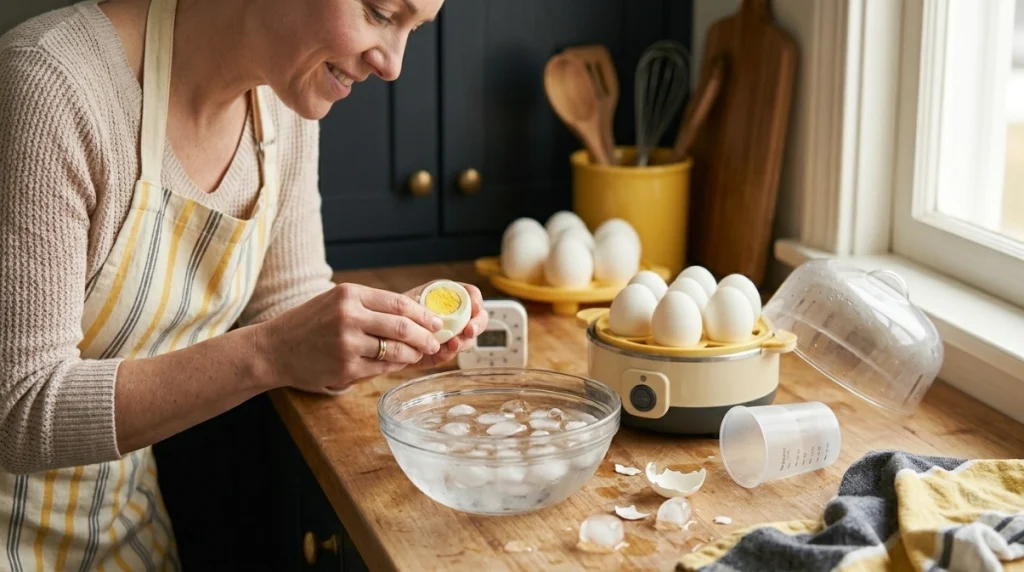
My first bad batch had firm whites near the shell but a very soft center. I first blamed the cooker. The real problem was my water measurement.
I tested it again with six large, cold eggs. I set the cup on the counter, filled it to the hard-boiled line, and made sure the tray sat flat.
That batch took just under 15 minutes. I moved the eggs into ice water as soon as the alarm sounded. The yolks were firm but still bright yellow.
I then tested a soft batch with less water. It took about seven minutes and gave me a warm, runny center.
The most useful lesson was to adjust water in small steps. Adding one full spoon at once made the next batch too firm. A much smaller change gave me better control.
I also learned to write down the result. My best setting now depends on the egg size and whether I start with cold eggs.
Final Thoughts
So, how long to cook eggs in an egg cooker? Plan on about 6 to 8 minutes for soft eggs, 9 to 11 minutes for medium eggs, and 12 to 16 minutes for hard eggs.
Treat those times as a starting point. Use the marked measuring cup and follow the guide for your model. In many cookers, the water level controls the cycle more than the clock does.
If your eggs are not right, change the water by a small amount. Check the tray, lid, vent, and heating plate too.
With one or two test batches, you can find a setting that works every time. Keep a short note of the egg size and water line, and the next batch should be far easier.
1 thought on “How Long to Cook Eggs in an Egg Cooker: Easy, Perfect”