
Work Sharp Precision Adjust Elite Review: The Easiest Precise Sharpener?
KitchAdvisor is reader-supported. As an Amazon Associate we earn from qualifying purchases, at no extra cost to you.
The Work Sharp Precision Adjust Elite is worth it if you want whetstone-level control without the learning curve. You clamp the knife, set any angle from 15 to 30 degrees, and sweep the abrasive along a guide that keeps the angle consistent from heel to tip.
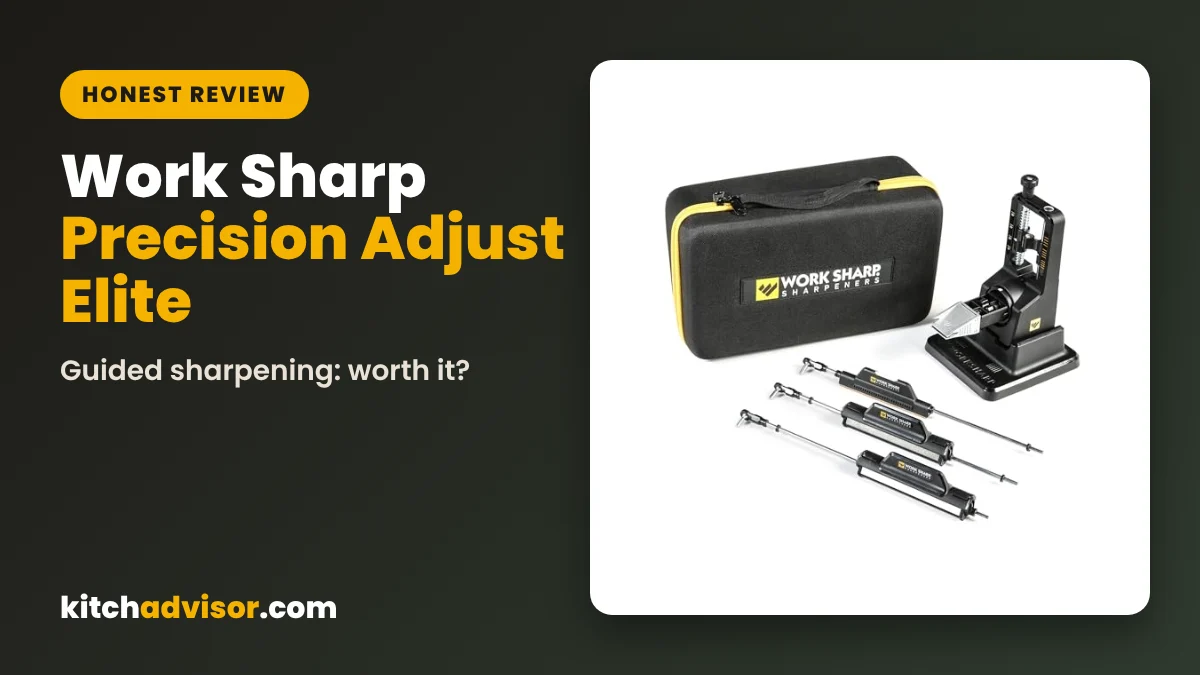
The Elite kit adds coarse and fine diamond plates, a ceramic finishing rod, a serrated blade rod, a tri-brasive attachment for curved blades and a leather strop. It is slower to set up than a pull-through or electric sharpener and bulkier to store. Below we explain how it works, who it suits and how it compares with simpler sharpeners.

Reviewed Product
Work Sharp Precision Adjust Elite Knife Sharpener

Rating: ★★★★½ 4.6/5
Research-based editorial score from verified specs, materials, design and buyer-use factors.
Best For: Home cooks and knife owners who want precise, repeatable edges on kitchen, pocket and hunting knives.
Key Specs
Guided bench sharpener with knife clamp • Adjustable angle 15° to 30° • 320-grit coarse diamond plate • 600-grit fine diamond plate • Ceramic finishing rod • Conical ceramic serrated rod • Tri-brasive attachment for curved blades • Leather strop • About 3 lb
Key Advantage
Any angle from 15 to 30 degrees, held perfectly steady, with a full set of abrasives.
Main Trade-off
Slower than electric or pull-through sharpeners and takes up more storage space.
Quick Verdict
Work Sharp is known for guided sharpening systems, and the Precision Adjust Elite is its most complete manual bench unit. A V-shaped clamp holds the knife in place, and a pivoting arm carries the abrasive at the angle you choose. Because the knife does not move and the arm follows a fixed path, the angle stays consistent along the whole edge.
The angle adjusts from 15 to 30 degrees. Work Sharp suggests 15 degrees for Japanese-style knives, 20 for Western kitchen knives, 25 for hunting blades and 30 for cleavers. That flexibility makes it a good choice if you own both Japanese and German knives, or if you sharpen pocket and outdoor knives too.
The Elite kit includes a 320-grit diamond plate to repair dull or chipped edges, a 600-grit diamond plate to refine, a ceramic rod to finish, a conical ceramic rod for serrated knives, a tri-brasive attachment for curved blades and a leather strop to polish the final edge. Diamond abrasives work well on hard modern steels.
Pros
- Adjustable 15° to 30° angles
- Consistent, repeatable results
- Sharpens serrated and curved blades
- Complete abrasive kit with strop
- Beginner friendly yet precise
Cons
- Slower than electric sharpeners
- Bulkier to store
- Very small knives can be awkward to clamp
How It Compares
| Sharpener | Type | Angles | Serrated | Best For |
|---|---|---|---|---|
| Work Sharp Precision Adjust Elite | Guided manual | 15°-30° | Yes | Precision and flexibility |
| Chef’sChoice 15XV | Electric, 3-stage | 15° | Yes (stage 3) | Speed |
| Tumbler Rolling | Rolling, diamond | 15° / 20° | No | Simple, gentle sharpening |
| Sharp Pebble Orange Ninja | Pull-through, 4-slot | Fixed | Yes | Quick and cheap |
| AccuSharp | Handheld carbide | Fixed | Yes | Touch-ups |
Key Features
Clamp and guide system
The knife is held still in a clamp while the abrasive moves on a guided arm. This removes the hardest part of freehand sharpening, which is holding a steady angle.
Adjustable angle
Set any angle from 15 to 30 degrees. You can match the factory edge of each knife or sharpen a thinner edge on a Japanese blade.
Diamond plates
The 320-grit plate reshapes dull or damaged edges quickly. The 600-grit plate refines the edge for everyday sharpness.
Ceramic and serrated rods
A ceramic rod gives a finer finish, and a conical ceramic rod sharpens each scallop on bread and steak knives.
Leather strop
Stropping removes the tiny burr left by sharpening and polishes the edge for very clean cuts.
How to Use It
- Check your knife’s current angle or choose 15° for Japanese knives and 20° for most Western knives.
- Clamp the knife so the edge is centered and the blade is secure.
- Start with the coarse diamond plate only if the knife is very dull or chipped. Sweep from heel to tip until you feel a small burr on the opposite side.
- Flip the arm to the other side and repeat to match the bevel.
- Move to the fine diamond plate, then the ceramic rod, using lighter strokes.
- Finish with a few passes on the leather strop, then wash and dry the knife.
Sharpening Angles Explained
The angle is measured on each side of the blade. A 15-degree edge has a total included angle of about 30 degrees, while a 20-degree edge is about 40 degrees. Smaller angles cut with less resistance but are thinner and more delicate; larger angles are tougher and last longer under heavy use.
Most German and American kitchen knives come from the factory at around 20 degrees. Many Japanese knives use 15 or 16 degrees. If you are not sure, match the existing bevel: color the edge with a marker, make one light pass and see where the ink is removed. Adjust until the abrasive removes ink evenly across the bevel.
What It Sharpens Well
- Western chef knives and santokus, at around 20 degrees.
- Japanese gyutos and thin slicers, at 15 degrees.
- Bread and steak knives with the serrated rod.
- Curved fillet and boning knives with the tri-brasive attachment.
- Pocket knives and hunting knives at 20 to 25 degrees.
- Cleavers at 30 degrees.
Who Should Buy It (and Who Should Skip It)
Buy it if you own good knives, want consistently sharp edges, have a mix of Japanese and Western knives, or also sharpen outdoor and pocket knives. It is a great gift for knife enthusiasts.
Skip it if you want the fastest possible sharpening (the Chef’sChoice 15XV electric is quicker) or you only have a few inexpensive knives, in which case a simple rolling or pull-through sharpener from our best knife sharpener guide is enough.
Precision Adjust Elite vs. Electric Sharpeners
Electric sharpeners like the Chef’sChoice 15XV are faster, especially for a whole block of knives, but they use fixed angles and can remove more metal. The Work Sharp takes a few more minutes per knife, but gives you full control over angle and finish and removes only as much metal as you choose.
For cooks with expensive Japanese knives, that control matters. For a busy family that just wants sharp knives quickly, an electric unit may be more practical.
Is It Worth the Price?
Yes, if you care about your knives. It costs more than pull-through sharpeners but less than many electric models and professional sharpening over a few years. The included abrasives cover everything from repair to polishing.
Sharp knives are safer and more enjoyable to use. Paired with a good chef knife like the Shun Classic or Victorinox Fibrox Pro, it keeps your edges performing like new.
Caring for the Sharpener
- Wipe the diamond plates and ceramic rods with a damp cloth after each use to remove metal particles.
- Let everything dry fully before storing.
- Clean ceramic rods occasionally with a mild abrasive cleanser to remove dark metal streaks.
- Keep the leather strop clean and dry, and do not get it wet.
- Store the unit and abrasives together in a drawer or box so small parts are not lost.
Tips and Common Mistakes
Do not press hard; let the abrasive do the work. Too much pressure creates a large burr and can scratch the blade face. Do not skip grits when going from coarse to fine, and do not start on the coarse plate for a knife that only needs a touch-up.
Wipe metal dust off the abrasives after use and keep them dry. For more on how sharpening works, see the sharpening article on Wikipedia, and read our knife and cut safety guide before handling freshly sharpened blades.
Frequently Asked Questions
What angles does the Work Sharp Precision Adjust Elite support?
Any angle from 15 to 30 degrees.
Can it sharpen serrated knives?
Yes, it includes a conical ceramic rod for serrated blades.
Is it good for Japanese knives?
Yes. Set it to 15 degrees to match most Japanese-style knives.
What grits are included?
A 320-grit diamond plate, a 600-grit diamond plate, a ceramic finishing rod and a leather strop, plus serrated and curved-blade attachments.
Is it hard to use for beginners?
No. The clamp and guide hold the angle for you, which makes it one of the easiest precise sharpeners to learn.
How long does it take to sharpen a knife?
A touch-up takes a few minutes. A very dull knife takes longer on the coarse plate.
Does the Work Sharp Precision Adjust Elite remove a lot of metal?
No. Because you choose the grit and pressure, it removes only as much metal as needed. Start on the fine plate for touch-ups and use the coarse plate only for damaged edges.
Final Verdict
The Work Sharp Precision Adjust Elite is one of the best ways to get precise, repeatable edges at home without learning freehand sharpening.
It is slower than electric sharpeners, but its adjustable angles and complete abrasive kit make it ideal for anyone with good knives or a mixed collection.
Related reading:
One Comment