
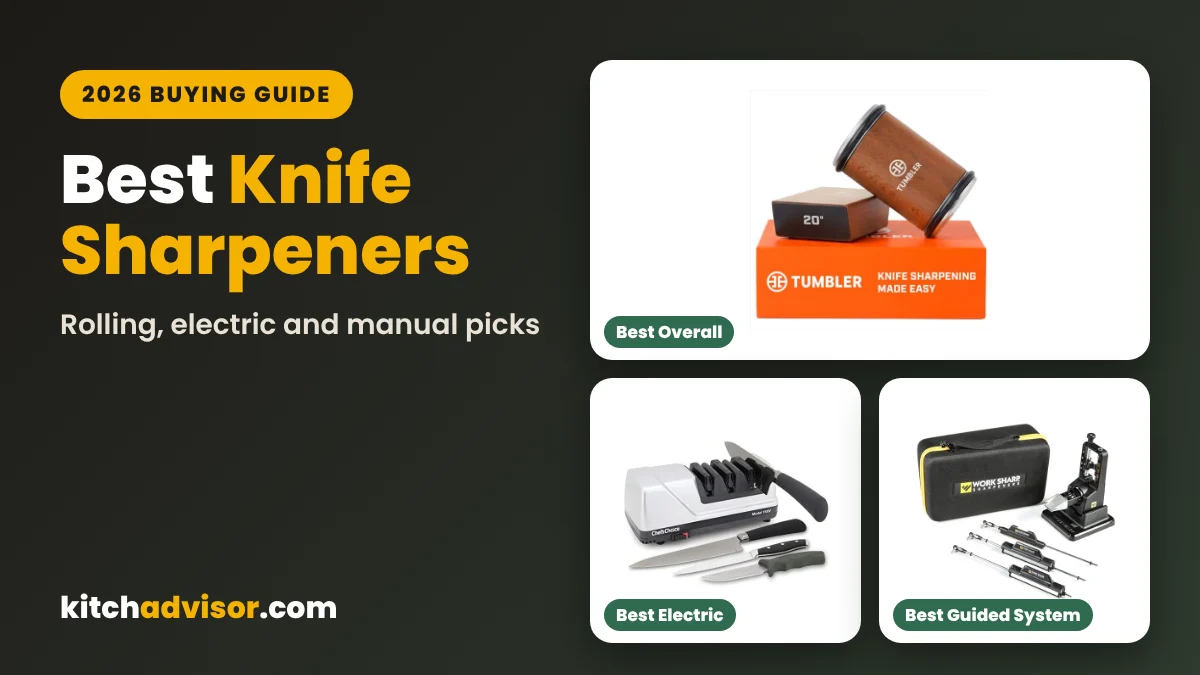
6 Best Knife Sharpeners (2026): Rolling, Electric and Manual
KitchAdvisor is reader-supported. As an Amazon Associate we earn from qualifying purchases, at no extra cost to you.
The best knife sharpener for most home cooks is the Tumbler Rolling Knife Sharpener. A magnetic angle block holds your knife at a fixed 15 or 20 degrees while you roll a diamond disc along the edge, then a stainless helix disc hones it. It is easier to learn than a whetstone and gentler on blades than most pull-through sharpeners.
Dull knives are slower and more dangerous because they need extra force and slip more easily. The right sharpener depends on how many knives you own, how sharp you want them and how much effort you want to spend. Below we compare six sharpeners, from a quick electric model to a precise guided system and a pocket-size budget tool.
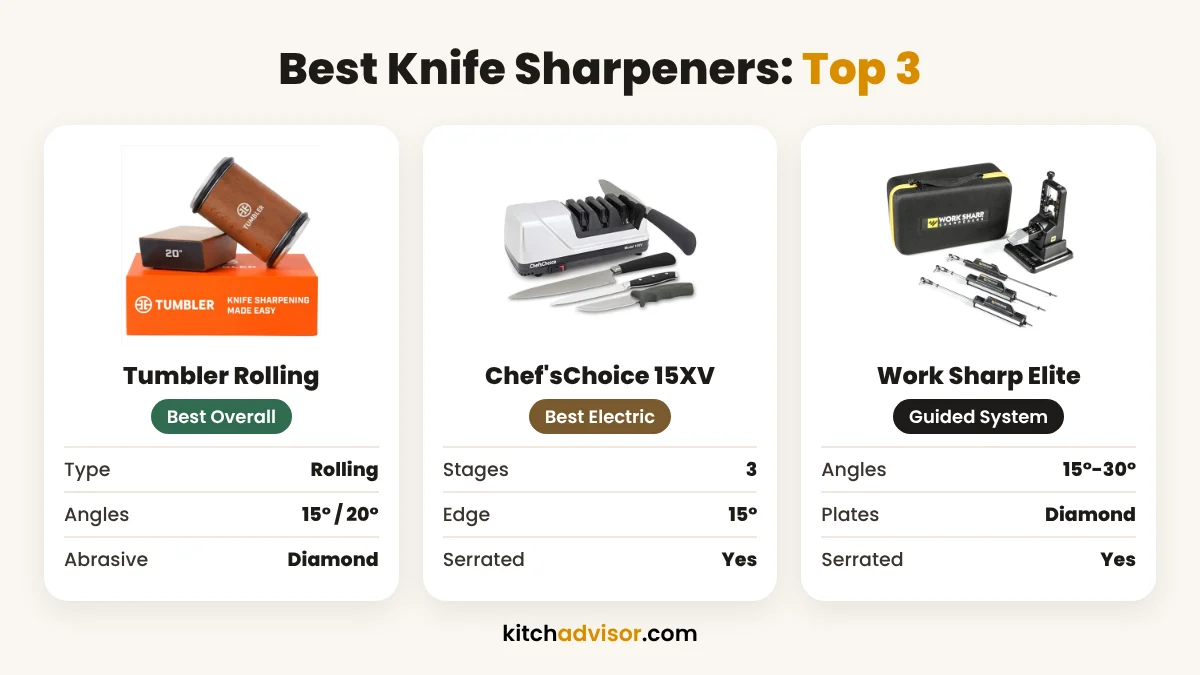
Our Top Picks at a Glance
| Award | Product | Our Score |
|---|---|---|
| Best Overall | The Original Tumbler Rolling Knife Sharpener (Wood) | 4.6/5 |
| Best Electric | Chef'sChoice 15XV EdgeSelect Professional Electric Knife Sharpener | 4.6/5 |
| Best Guided System | Work Sharp Precision Adjust Elite Knife Sharpener | 4.5/5 |
| Best Budget Pull-Through | Kitchellence 3-Stage Knife Sharpener with Cut-Resistant Glove | 4.3/5 |
| Best for Serrated Knives | Sharp Pebble Orange Ninja 4-Stage Knife Sharpener | 4.3/5 |
| Most Compact | AccuSharp Knife Sharpener | 4.2/5 |
The 6 Best Picks Reviewed
1. The Original Tumbler Rolling Knife Sharpener (Wood) – Best Overall
Best Overall
The Original Tumbler Rolling Knife Sharpener (Wood)

Rating: ★★★★½ 4.6/5
Research-based editorial score from verified specs, materials, design and buyer-use factors.
Best For: Home cooks who want consistent, blade-friendly sharpening without learning a whetstone.
Key Specs
Rolling sharpener with diamond-plated disc and stainless steel helix honing disc • Magnetic angle support with fixed 15° and 20° sides • Wood finish • About 1.4 lb
Key Advantage
Fixed angles and a rolling diamond disc make even, controlled sharpening easy.
Main Trade-off
Not for serrated knives, and slower than an electric sharpener for a whole block.
Rolling sharpeners have become popular because they combine the gentleness of a whetstone with the ease of a guided tool. You stick the knife to the magnetic block, choose the 15-degree side for Japanese-style knives or the 20-degree side for most Western knives, and roll the diamond disc back and forth along the edge.
Because the angle is fixed by the block, you avoid the most common whetstone mistake, which is wobbling the angle. The second disc is a stainless steel helix that hones and refines the edge after sharpening.
Tumbler says the design helps preserve blade life compared with basic pull-through sharpeners, which can remove more metal. It is a good fit for cooks with a few good knives they want to keep in top shape.
Pros
- Easy, consistent angles
- Gentle on blades
- 15° and 20° options
- No water or mess
Cons
- Does not sharpen serrated knives
- Slower than electric for many knives
2. Chef'sChoice 15XV EdgeSelect Professional Electric Knife Sharpener – Best Electric
Best Electric
Chef'sChoice 15XV EdgeSelect Professional Electric Knife Sharpener

Rating: ★★★★½ 4.6/5
Research-based editorial score from verified specs, materials, design and buyer-use factors.
Best For: Busy kitchens with many knives that need fast, very sharp results.
Key Specs
3-stage electric sharpener • 100% diamond abrasives in stages 1 and 2 • Stropping stage 3 • Converts 20° edges to 15° Trizor XV edges • Flexible spring angle guides • Straight and serrated blades • About 4.2 lb
Key Advantage
Fast, repeatable 15-degree edges on a whole block of knives.
Main Trade-off
Removes more metal than manual methods and costs more.
The Chef’sChoice 15XV is a three-stage electric sharpener. Stages 1 and 2 use 100 percent diamond abrasives to shape and sharpen, and stage 3 strops the edge to a polished finish. Spring-loaded guides hold the blade at a consistent angle without any guesswork.
It is designed to convert standard 20-degree factory edges into sharper 15-degree Trizor XV edges. Chef’sChoice says sharpening takes about a minute the first time, with touch-ups much faster after that. Stage 3 can also be used to refresh serrated knives.
It is the quickest way to sharpen a whole block of knives. Use the coarse stage sparingly, since it removes metal quickly.
Pros
- Fast and consistent
- Very sharp 15-degree edges
- Handles straight and serrated blades
- Simple on/off operation
Cons
- Higher price
- Coarse stage removes metal quickly
3. Work Sharp Precision Adjust Elite Knife Sharpener – Best Guided System
Best Guided System
Work Sharp Precision Adjust Elite Knife Sharpener

Rating: ★★★★½ 4.5/5
Research-based editorial score from verified specs, materials, design and buyer-use factors.
Best For: Knife enthusiasts who want precise angle control for kitchen, pocket and hunting knives.
Key Specs
Adjustable angle 15° to 30° • Clamp-and-guide system • 320-grit and 600-grit diamond plates • Ceramic finishing rod • Serrated blade rod • Tri-brasive for curved blades • Leather strop • About 3 lb
Key Advantage
Any angle from 15 to 30 degrees, with abrasives from coarse diamond to leather strop.
Main Trade-off
Takes more time to set up than a rolling or pull-through sharpener.
The Precision Adjust Elite clamps your knife in place and guides the abrasive at the exact angle you set, from 15 degrees for Japanese knives to 20 for Western kitchen knives, 25 for hunting blades and 30 for cleavers.
The kit includes coarse and fine diamond plates, a ceramic finishing rod, a dedicated rod for serrated knives, a curved-blade attachment and a leather strop. That makes it one of the most complete manual systems for home use.
Pros
- Adjustable 15° to 30° angles
- Sharpens serrated knives
- Complete abrasive kit
- Very consistent results
Cons
- Slower setup
- Bulkier to store
4. Kitchellence 3-Stage Knife Sharpener with Cut-Resistant Glove – Best Budget Pull-Through
Best Budget Pull-Through
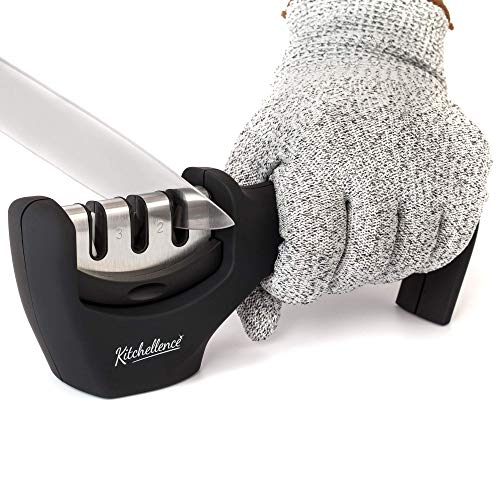
Kitchellence 3-Stage Knife Sharpener with Cut-Resistant Glove
Rating: ★★★★☆ 4.3/5
Research-based editorial score from verified specs, materials, design and buyer-use factors.
Best For: Beginners who want a quick, inexpensive sharpener and a safety glove.
Key Specs
3-stage pull-through (diamond repair, sharpen, polish) • Ergonomic handle for right or left hand • Non-slip base • Cut-resistant glove included • ABS plastic body
Key Advantage
Low price, quick results and a cut-resistant glove in the box.
Main Trade-off
Pull-through slots remove more metal and are less precise.
Kitchellence’s sharpener has three slots: a diamond stage to repair damaged edges, a sharpening stage and a fine polishing stage. You simply pull the knife through each slot a few times.
The non-slip base and included cut-resistant glove make it a sensible first sharpener. Use the coarse slot only when a knife is truly dull.
Pros
- Very low cost
- Quick and simple
- Safety glove included
Cons
- Less precise than guided systems
- Not ideal for premium Japanese knives
5. Sharp Pebble Orange Ninja 4-Stage Knife Sharpener – Best for Serrated Knives
Best for Serrated Knives
Sharp Pebble Orange Ninja 4-Stage Knife Sharpener

Rating: ★★★★☆ 4.3/5
Research-based editorial score from verified specs, materials, design and buyer-use factors.
Best For: Kitchens with bread and steak knives that need a simple sharpener for both edge types.
Key Specs
4-slot manual sharpener • Coarse carbide, medium diamond, fine ceramic and serrated slot • Ergonomic non-slip grip • Left or right-handed use • ABS body • About 0.7 lb
Key Advantage
A dedicated slot for serrated knives plus three stages for straight edges.
Main Trade-off
The carbide slot is aggressive and should be used sparingly.
The Orange Ninja adds a fourth slot for serrated blades, so you can touch up bread knives and steak knives as well as chef knives. The three straight-edge stages run from coarse carbide to medium diamond and fine ceramic.
It is compact, easy to store and works for both right and left-handed users.
Pros
- Handles serrated blades
- Three stages for straight edges
- Compact and inexpensive
Cons
- Aggressive carbide stage
- Fixed angle only
6. AccuSharp Knife Sharpener – Most Compact
Most Compact
AccuSharp Knife Sharpener

Rating: ★★★★☆ 4.2/5
Research-based editorial score from verified specs, materials, design and buyer-use factors.
Best For: Quick touch-ups, small kitchens, camping and RVs.
Key Specs
Handheld sharpener • Diamond-honed tungsten carbide blades • Works on straight and serrated knives • Full-length finger guard • Ambidextrous ergonomic handle • Replaceable sharpening blades • About 0.1 lb
Key Advantage
Tiny, cheap and fast, with a full-length finger guard.
Main Trade-off
Carbide sharpeners remove metal and leave a coarser edge.
AccuSharp has been around for decades. You hold the knife on the counter and draw the small sharpener along the edge. Its diamond-honed tungsten carbide blades restore a working edge in about ten seconds, according to the maker.
The full-length guard protects your fingers, and the sharpening blades can be flipped or replaced. It is not for fine Japanese knives, but it is a useful backup.
Pros
- Extremely compact
- Very fast
- Finger guard
- Replaceable blades
Cons
- Coarse, aggressive edge
- Not for premium knives
Side-by-Side Comparison
| Sharpener | Type | Angles | Serrated | Best For |
|---|---|---|---|---|
| Tumbler | Rolling, diamond | 15° / 20° | No | Easy, gentle sharpening |
| Chef’sChoice 15XV | Electric, 3-stage | 15° | Yes (stage 3) | Speed, many knives |
| Work Sharp Precision Adjust Elite | Guided manual | 15°-30° | Yes | Precision, enthusiasts |
| Kitchellence | Pull-through, 3-stage | Fixed | No | Budget beginners |
| Sharp Pebble Orange Ninja | Pull-through, 4-slot | Fixed | Yes | Bread and steak knives |
| AccuSharp | Handheld carbide | Fixed | Yes | Quick touch-ups |
How to Choose a Knife Sharpener
Type of sharpener
Pull-through sharpeners are fast and cheap but less precise. Rolling sharpeners and guided systems hold a fixed angle for better, gentler results. Electric sharpeners are fastest for many knives. Whetstones give the most control but take practice.
Edge angle
Western knives are usually sharpened to about 20 degrees per side, Japanese knives to about 15. Choose a sharpener that matches your knives, or one with adjustable angles if you own both.
Abrasive
Diamond cuts fastest and works on very hard steels. Ceramic is finer and good for finishing. Carbide is aggressive and removes metal quickly, so it is best for quick fixes on inexpensive knives.
Serrated knives
Most serrated knives need a tapered rod or a dedicated slot. If you own a good bread knife, check that your sharpener supports serrations.
Safety
Look for a non-slip base, finger guards or an included cut-resistant glove, especially with handheld and pull-through models.
Sharpening vs. Honing
Sharpening removes a small amount of metal to create a new edge. Honing realigns an edge that has rolled or bent during use, without removing much metal. Most home cooks should hone every few uses and sharpen a few times a year.
If your knife slides off a tomato skin or crushes herbs instead of slicing them, try honing first. If honing no longer helps, it is time to sharpen.
Signs Your Knife Needs Sharpening
- It slips on tomato or pepper skins instead of biting in.
- Onions crush and make your eyes water more than usual.
- It will not slice a sheet of paper cleanly.
- You have to push down hard to cut through carrots or squash.
- You can see a shiny line along the edge when you look straight down at it.
Tips for Sharpening Safely
- Work on a stable surface and keep the sharpener’s base dry and non-slip.
- Wear a cut-resistant glove on the hand holding the sharpener or knife.
- Use light, even pressure. Let the abrasive do the work.
- Wipe metal filings off the blade and wash the knife before using it on food.
- Start with the finest stage that works and use coarse stages only for damaged edges.
Keep Your Knives Sharp Longer
Cut on wood or plastic boards, never glass, stone or ceramic plates. Hand wash and dry knives instead of using the dishwasher, and store them in a block, on a magnetic strip or with a blade guard.
A sharp knife is a safer knife, as our knife and cut safety guide explains. If your knives are worn out, see our best chef knife and best kitchen knife set picks. You can read more about abrasives and angles in the sharpening article on Wikipedia.
Frequently Asked Questions
What type of knife sharpener is best for home use?
A rolling or guided sharpener gives the best balance of ease and edge quality. Electric models are fastest; pull-through models are cheapest.
Do pull-through sharpeners ruin knives?
They do not ruin knives, but they remove more metal and leave a coarser edge. Use the coarse slot sparingly.
How often should I sharpen kitchen knives?
For most home cooks, a few times a year, with regular honing in between.
Can I sharpen Japanese knives with these?
Yes, with sharpeners that support 15 degrees, such as the Tumbler, Chef’sChoice 15XV and Work Sharp. Avoid aggressive carbide slots on hard Japanese steel.
Can serrated knives be sharpened?
Yes. Use a tapered rod, a dedicated serrated slot or the Chef’sChoice stage 3.
Is a honing steel the same as a sharpener?
No. A honing steel realigns the edge. A sharpener removes metal to create a new edge.
Final Verdict
The Tumbler Rolling Knife Sharpener is the best knife sharpener for most home cooks, with fixed 15 and 20-degree angles, a diamond disc and gentle, consistent results.
Pick the Chef’sChoice 15XV for speed, the Work Sharp Precision Adjust Elite for full angle control, the Kitchellence on a budget, the Sharp Pebble Orange Ninja for serrated knives, or the AccuSharp for quick touch-ups.
Related reading:
One Comment