Quick Answer
Yes, eggs can cook in a crock pot, but a slow cooker isn’t the best tool for making simple hard-boiled eggs. The low, gradual heat can cook eggs thoroughly, yet timing varies by cooker, egg size, starting temperature, and placement. For reliable results, use a food thermometer and cook egg dishes until they reach 160°F; for shell eggs, cook until both the white and yolk are firm. See the USDA’s slow cooker food-safety guidance.
What to know before cooking eggs in a crock pot
- It can work: A crock pot produces enough heat to cook eggs when used correctly.
- Expect slow cooking: Eggs won’t cook as quickly as they do in boiling water.
- Use a thermometer: Egg dishes should reach at least 160°F for safe cooking.
- Watch the texture: Long cooking can make whites rubbery and yolks dry.
- Don’t use warm: The keep-warm setting isn’t intended to cook raw eggs.
- Cool leftovers promptly: Refrigerate cooked eggs within two hours and use them within the recommended storage period.
Best approach
- For plain hard-cooked eggs, boiling or steaming is faster and easier to control.
I’ve cooked plenty of eggs using different kitchen appliances, and the crock pot is one method I treat as a workaround rather than my first choice. It can cook eggs, but the slow, gentle heating changes both the timing and the final texture.
If you’re wondering whether your crock pot can handle the job, this guide explains what happens, how to do it more safely, and when another egg-cooking method makes more sense.
In This Guide
Can eggs cook in a crock pot?
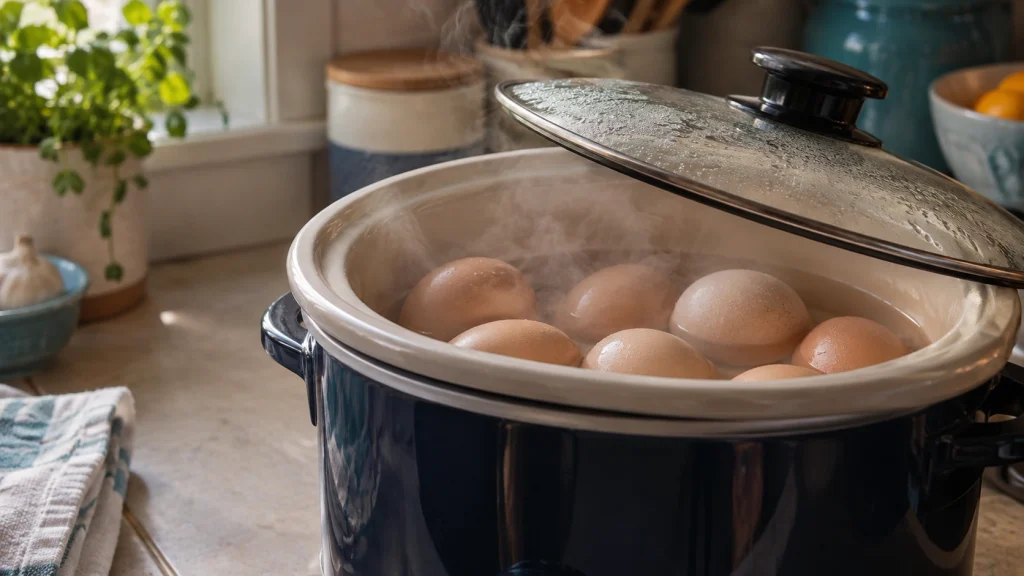
Yes, eggs can cook in a crock pot because a slow cooker heats food gradually and maintains a relatively low cooking temperature. USDA guidance says slow cookers generally operate between about 170°F and 280°F, depending on the appliance and setting. :contentReference[oaicite:0]{index=0}
That doesn’t mean a crock pot behaves like a saucepan of boiling water. The heat reaches the eggs more gradually, so the cooking process can take longer and produce different textures.
What happens to an egg inside a slow cooker?
An egg contains proteins in both the white and yolk that change structure as they heat. As the temperature rises, those proteins set and turn the liquid egg into a firm cooked food.
In a crock pot, that transformation happens gradually. The surrounding heat, moisture, lid design, cooker size, and egg position all influence how quickly the egg heats.
For that reason, I wouldn’t treat one cooking time as universal. Two crock pots with different wattages, shapes, and heating patterns can produce noticeably different results.
- Whole shell eggs: These can be slow-cooked until the whites and yolks become firm.
- Cracked eggs: These can be cooked as part of dishes such as breakfast casseroles.
- Egg mixtures: Scrambled or casserole-style mixtures need careful temperature checking.
For egg-containing dishes, USDA recommends reaching a minimum internal temperature of 160°F. Shell eggs should be cooked until both the white and yolk are firm. :contentReference[oaicite:1]{index=1}
Section Takeaway: A crock pot can cook eggs, but it does so differently from boiling, steaming, or frying. The slow heat makes timing less predictable.
How do you cook eggs in a crock pot?
The simplest approach is to place clean, refrigerated eggs into the crock pot and cook them with enough moisture to create a gentle, even heating environment. Your particular slow cooker’s manual should take priority if it gives specific instructions.
Basic method for whole eggs
- Start with intact eggs: Don’t use eggs with cracked or damaged shells.
- Clean the cooker: Begin with a clean crock and clean utensils.
- Add the eggs: Arrange them so they aren’t tightly stacked or crushed together.
- Add water if appropriate: A moist cooking environment can help transfer heat around the eggs.
- Cover the cooker: Keep the lid in place while cooking.
- Use the cooking setting: Follow your appliance manual rather than assuming every slow cooker heats identically.
- Check doneness: Confirm that the eggs are fully cooked before eating.
- Cool promptly: Move cooked eggs to appropriate cooling and refrigeration once finished.
I prefer not to give a single guaranteed number of hours for every crock pot because that can create a false sense of safety. Older cookers and newer digital models can behave differently.
Should you cook eggs on LOW or HIGH?
Don’t assume LOW is automatically better just because eggs are delicate. USDA notes that slow cookers commonly have different settings and that foods cook faster on HIGH than LOW. :contentReference[oaicite:2]{index=2}
The important point is that the cooker must actually bring the food to a safe cooking temperature. The keep-warm setting is different because it is intended to hold already-cooked food rather than cook raw ingredients.
If your goal is simply hard-cooked eggs, I still recommend boiling or steaming. Those methods give you much more direct control over the cooking environment.
Section Takeaway: Use your crock pot according to its manual, keep the lid closed, and verify doneness rather than relying on a universal cooking time.
How long do eggs take to cook in a crock pot?
There isn’t one dependable cooking time for every crock pot. Cooking speed depends on the cooker, temperature setting, number of eggs, egg temperature, moisture, and how efficiently the appliance transfers heat.
That’s why I would avoid recipes that promise an exact result without accounting for the specific slow cooker. A timing estimate can be a starting point, not proof that the eggs are safe to eat.
Why timing varies so much
- Cooker design: Heating elements and crock shapes differ between models.
- Egg quantity: A larger batch changes how heat moves through the food.
- Starting temperature: Refrigerated eggs require more heating than eggs already at room temperature.
- Water and moisture: Moisture affects how efficiently heat transfers.
- Lid position: Removing the lid releases heat and extends cooking.
- Altitude: Cooking behavior can change at higher elevations.
USDA recommends keeping the slow cooker covered during cooking and notes that slow cookers can take several hours to reach temperatures high enough to destroy harmful bacteria. :contentReference[oaicite:3]{index=3}
Colorado State University Extension also advises against unnecessary lid lifting because the temperature can drop substantially when the lid is removed. :contentReference[oaicite:4]{index=4}
How do you know the eggs are done?
For a cracked egg dish, use a food thermometer and verify that the egg mixture reaches at least 160°F. For shell eggs, the white and yolk should be firm rather than runny. :contentReference[oaicite:5]{index=5}
Don’t judge safety by appearance alone when you’re cooking a large batch or experimenting with an unfamiliar appliance. A thermometer gives you much better information.
Section Takeaway: Cooking time is cooker-specific, so temperature and doneness matter more than an arbitrary number of hours.
How does a crock pot compare with other egg-cooking methods?
A crock pot works, but it isn’t the most efficient option for ordinary hard-cooked eggs. Boiling and steaming usually give you faster feedback and simpler temperature control.
| Method | Best For | Heat Control | Main Advantage |
|---|---|---|---|
| Crock pot | Slow-cooked egg dishes | Low and gradual | Hands-off cooking |
| Boiling | Hard-cooked eggs | Direct | Simple and predictable |
| Steaming | Hard-cooked eggs | Direct | Easy batch cooking |
| Egg cooker | Regular egg preparation | Purpose-built | Designed for eggs |
| Skillet | Fried and scrambled eggs | Direct | Fast visual control |
When does a crock pot make sense?
A slow cooker makes more sense when eggs are one part of a larger recipe. Breakfast casseroles, egg bakes, and other mixed dishes can take advantage of the appliance’s steady heat.
For one or two hard-cooked eggs, however, the crock pot adds little benefit. A saucepan or dedicated egg cooker is usually easier to manage.
As of 2026, I still see the crock pot as a useful secondary egg-cooking method rather than a replacement for a purpose-built egg appliance.
Section Takeaway: Choose the crock pot when eggs belong in a slow-cooked dish. Choose boiling, steaming, or an egg cooker when plain hard-cooked eggs are the goal.
Why can crock-pot eggs become rubbery?
Rubbery eggs usually come from overcooking rather than from the crock pot being incapable of cooking eggs. Egg proteins become firmer as they continue heating, and excessive cooking can produce a tougher texture.
Common causes of tough eggs
- Too much cooking: Leaving eggs in the heat long after they are fully cooked can make them firm and dry.
- Excessive heat: A higher setting can cook delicate egg proteins more aggressively.
- Uneven heating: Eggs positioned near a hotter area may cook differently from those in the center.
- Repeated lid opening: Temperature changes can extend cooking and make timing harder to judge.
- Improper cooling: Eggs can continue to heat after cooking if they’re left in the hot crock.
I’ve found that appliance cooking becomes much easier when I stop treating the timer as the only signal. Temperature, texture, and the behavior of the particular cooker all tell you something useful.
Can eggs crack in a crock pot?
They can. Rapid temperature changes, pressure from crowded eggs, or accidental contact with the crock can damage shells.
A cracked shell isn’t automatically a sign that the egg is unsafe if it cracks during cooking, but starting with damaged eggs is different. USDA advises consumers not to purchase cracked eggs. :contentReference[oaicite:6]{index=6}
Section Takeaway: Protect the texture by avoiding unnecessary overcooking and protect food safety by starting with intact eggs and checking doneness.
What are the food-safety rules for crock-pot eggs?
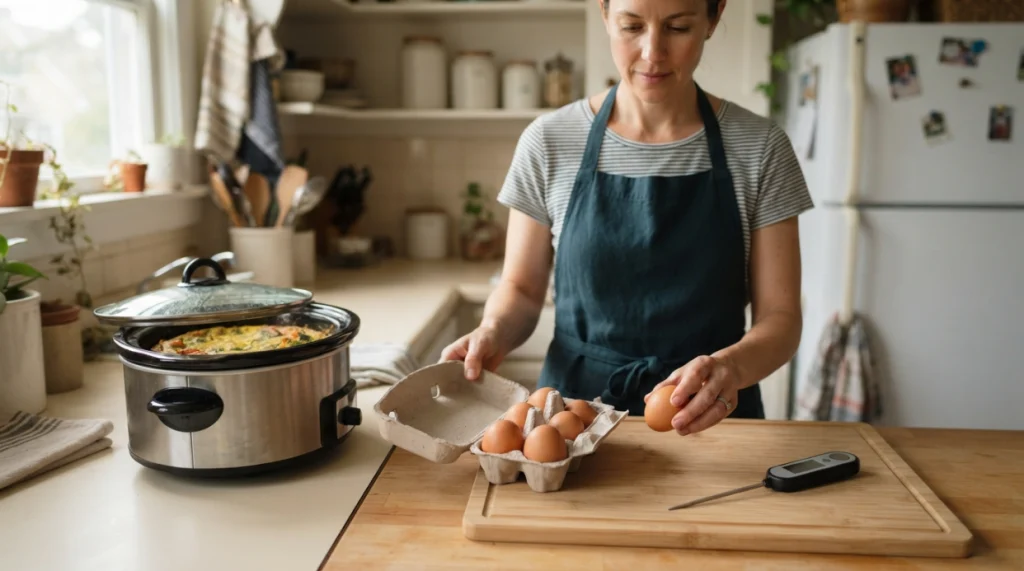
Egg safety matters more than convenience. Raw eggs can carry harmful bacteria, so cooking them thoroughly and handling them correctly is essential.
The FDA recommends keeping eggs refrigerated, cooking them until the yolks are firm, and cooking egg-containing dishes thoroughly. :contentReference[oaicite:7]{index=7}
Follow these basic safety rules
- Use refrigerated eggs: Keep eggs cold until you’re ready to prepare them.
- Check shells: Avoid eggs that are cracked before cooking.
- Clean equipment: Wash hands, utensils, and food-contact surfaces before and after handling raw eggs.
- Cook thoroughly: Egg dishes should reach at least 160°F.
- Avoid keep-warm cooking: Don’t rely on a warming setting to cook raw eggs.
- Refrigerate promptly: Don’t leave cooked eggs sitting at room temperature for extended periods.
- Watch power interruptions: If a slow cooker loses power during cooking, follow USDA guidance rather than assuming the food is safe because it looks cooked.
USDA identifies 40°F to 140°F as the food-safety danger zone, where bacteria can multiply quickly. :contentReference[oaicite:8]{index=8}
For broader slow-cooker safety practices, the Colorado State University Extension crock-pot guidance is also useful, especially when you’re using an older appliance.
What if your crock pot is old?
An older slow cooker deserves extra attention because you may not know how accurately it maintains its intended temperature. CSU Extension recommends testing older slow cookers with water and checking temperature behavior rather than assuming the appliance still performs normally. :contentReference[oaicite:9]{index=9}
If the cooker doesn’t heat properly, has a damaged cord, or behaves unpredictably, don’t attempt to bypass a safety feature or repair a sealed electrical component yourself.
Pro tip: If an electrical slow cooker has a damaged cord, faulty controls, overheating symptoms, or other electrical problems, stop using it and consult the manufacturer’s manual or a qualified appliance repair technician.
Section Takeaway: Treat crock-pot eggs like any other perishable food. Cook them thoroughly, verify temperature when needed, and refrigerate leftovers promptly.
Frequently Asked Questions
Can you hard boil eggs in a crock pot?
Yes, you can cook whole eggs in a crock pot until the whites and yolks are firm. However, slow cookers aren’t the most predictable method for plain hard-cooked eggs. Boiling, steaming, or using a dedicated egg cooker usually gives you easier control over the cooking process.
How long does it take to cook eggs in a crock pot?
There is no single reliable cooking time for every crock pot. Cooking speed varies with the model, setting, egg quantity, starting temperature, moisture, and heat distribution. Use your manufacturer’s instructions as the starting point and verify that the eggs are thoroughly cooked.
Can you put raw eggs directly in a slow cooker?
Yes, raw eggs can be used in a slow cooker as part of an appropriate recipe, such as an egg casserole. Keep the eggs refrigerated before preparation and cook the finished egg dish to at least 160°F, using a food thermometer to verify the temperature.
Can you cook scrambled eggs in a crock pot?
Yes, scrambled eggs can be prepared in a crock pot, especially as part of a larger breakfast casserole. The slow-cooking environment can produce a softer texture, but overcooking can make the eggs dry or rubbery, so monitor doneness carefully.
Is it safe to cook eggs on the warm setting?
No. A slow cooker’s warm or keep-warm setting is intended to hold food after it has already been cooked safely, not to cook raw eggs from the beginning. Use an appropriate cooking setting and verify that egg dishes reach a safe internal temperature.
Are crock-pot eggs better than boiled eggs?
Not usually for plain hard-cooked eggs. A crock pot can work, but boiling or steaming offers more direct control and is generally more practical. A slow cooker becomes more useful when eggs are part of a casserole, breakfast bake, or another slow-cooked recipe.
Final Takeaway: Will eggs cook in a crock pot?
Yes, eggs will cook in a crock pot when the appliance reaches appropriate cooking temperatures and you give the eggs enough time to become fully cooked. The bigger question is whether a crock pot is the best tool for the job.
For plain hard-cooked eggs, I’d choose boiling, steaming, or an egg cooker. For breakfast casseroles and other mixed recipes, the slow cooker can be a convenient option.
Whatever method you choose, don’t rely on a timer alone. Cook egg dishes to at least 160°F, make sure shell eggs have firm whites and yolks, and handle the finished eggs safely.
If you’re using a slow cooker because you don’t have an egg cooker, that’s perfectly workable. Just remember that convenience shouldn’t come at the expense of predictable cooking and food safety.
Ready for the next test? Compare the cooking method, temperature control, cleanup, and capacity before choosing the appliance that fits your kitchen routine.