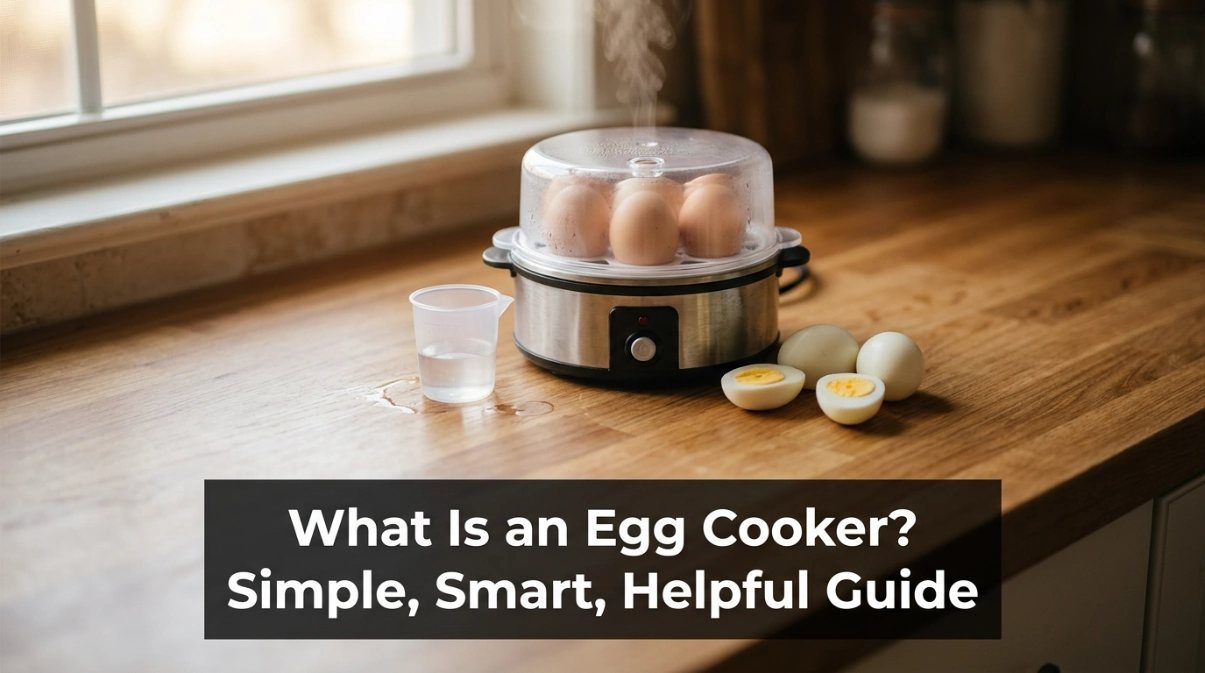
If you are asking what is an egg cooker, the simple answer is this: it is a small kitchen appliance that uses water and heat to cook eggs.
Most models can make soft, medium, or hard-boiled eggs. Some can also make poached eggs or small omelets.
The first time I used this type of cooker, I expected it to work like a tiny pot. It was much simpler than that, but the water level mattered far more than I expected.
Once I understood the heating plate, egg tray, measuring cup, and lid, the whole process made sense. I also learned why a cooker may beep, shut off early, or leave eggs softer than planned.
What Is an Egg Cooker and How Does It Work?
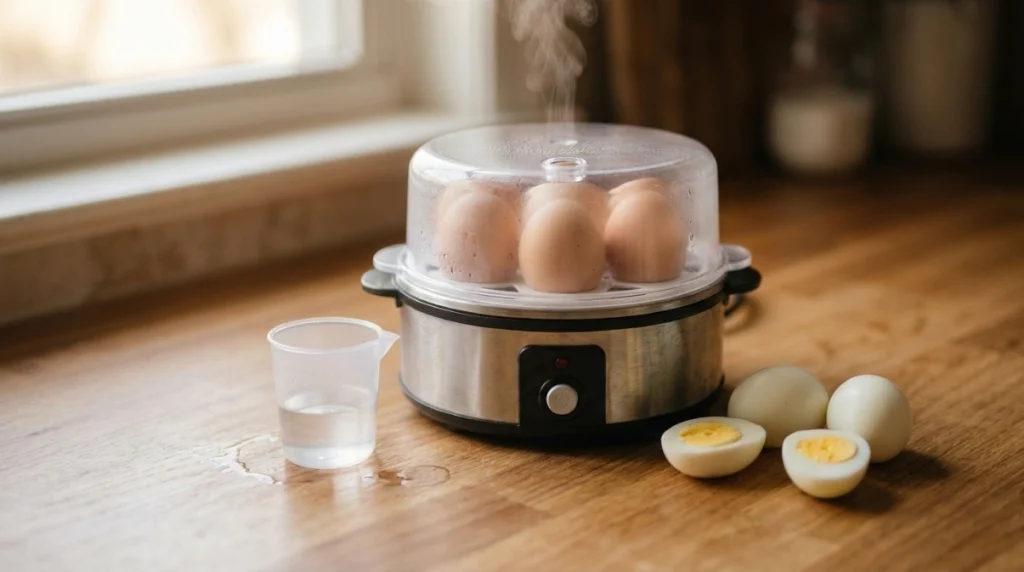
An egg cooker has a heated base. You add a small amount of water to the heating plate or water area, depending on the design.
The egg tray sits above it. A lid covers the eggs and keeps much of the steam inside while still allowing excess steam to leave through a vent.
When you switch the cooker on, the heating element warms the water. The water turns into steam, and that steam cooks the eggs.
In many basic models, the amount of water controls how long the eggs cook. More water often means a longer cooking time.
Some models have buttons for soft, medium, or hard eggs. Others use only one power button and depend on the measuring cup.
The parts are usually simple:
- Heating plate or heating base
- Removable egg tray
- Water measuring cup
- Clear or solid lid
- Steam vent
- Power button or control panel
- Auto shut-off or buzzer on some models
I like to keep the original measuring cup with the cooker. A replacement measuring cup, egg tray, or lid can also be useful if the original part is lost or damaged.
The cup matters more than it looks. Using a random cup can change the amount of water and give very different results.
Common Signs of Egg Cooker Problems
Most egg cooker problems are easy to spot. They often happen during the first few uses because the appliance works differently from boiling eggs in a pot.
Here are the signs I would check first.
| Symptom | Likely Cause | Quick Fix |
|---|---|---|
| Eggs are too soft | Too little water | Add the correct measured amount |
| Eggs are too hard | Too much water | Reduce water for the next batch |
| Cooker will not start | Power or assembly issue | Check outlet, cord, tray, and switch |
| Water spits from lid | Too much water or blocked vent | Reduce water and check vent |
| White marks on plate | Mineral buildup | Descale the heating plate |
| Cooker stops by itself | Normal shut-off or heat protection | Check the manual before restarting |
A beep is not always a fault. On many models, it simply tells you that the cooking cycle has ended.
The same is true for auto shut-off. The cooker may turn itself off when the water is gone or when the cycle is complete.
Possible Causes
When an egg cooker does not work as expected, I start with the simplest causes. Most issues do not need repair tools.
Wrong Water Amount
This is one of the most common problems. The cooker needs a specific amount of water for the egg quantity and doneness level.
Too little water can leave the eggs undercooked. Too much can make them firmer than you wanted or extend the cooking cycle.
Egg Tray or Lid Is Not Seated Correctly
The egg tray should sit flat. The lid should also rest in its normal position.
A tilted tray can make the eggs sit unevenly. A badly placed lid may let too much steam escape.
Mineral Buildup on the Heating Plate
Tap water leaves minerals behind as it evaporates. After several uses, I often expect to see pale white or brown marks on a heating plate.
This does not always mean the plate is damaged. It may simply need descaling.
Power Supply Trouble
If there is no light, heat, or sound, check the wall outlet first. Then inspect the visible power cord for damage.
Never keep using a cooker with a cracked plug, exposed wire, or damaged electrical base.
Blocked Steam Vent
Steam must be able to leave through the lid vent. Food residue or mineral deposits can partly block that opening.
Do not cover the vent while the appliance is running. Pressure and very hot steam can build up around the lid.
How to Fix Common Egg Cooker Problems
An egg cooker is simple enough that I can rule out most common problems in a few safe steps.
Check the Power Source
I start by plugging another small appliance into the same wall outlet. This tells me whether the outlet itself works.
Next, I look at the cord and plug. I do not open the base or try to repair internal electrical parts.
If the cord is damaged, I stop using the cooker.
Measure the Water Carefully
I use the measuring cup supplied with the cooker whenever possible. The marks may change based on egg count and desired doneness.
I also check the model instructions because different cookers use different water amounts.
Guessing the water level was one of the easiest ways for me to get poor results. Small changes can make a noticeable difference.
Inspect the Egg Tray and Lid
Before switching the cooker on, I make sure the egg tray is seated in the right direction. I then place the lid on without forcing it.
If a tray or lid is warped or cracked, replacement is often safer than trying to bend it back into shape.
Check the Steam Vent
I inspect the steam hole while the cooker is cool and unplugged. It should not have dried egg or scale blocking it.
I never put my face or hand over the vent while cooking. The steam can burn skin very fast.
Descale the Heating Plate
Mineral scale can slow heat transfer and leave dark or chalky marks.
For cleaning, I unplug the cooker and let it cool first. I then follow the maker’s care instructions.
Many basic heating plates can be treated with a small amount of white vinegar and water. I let it sit briefly, wipe the plate with a soft cloth or non-abrasive sponge, then remove the residue.
I never pour water into electrical openings or place the powered base in a sink.
| Problem | Recommended Solution | Difficulty |
|---|---|---|
| Wrong egg doneness | Adjust measured water | Easy |
| Dirty heating plate | Descale after cooling | Easy |
| Steam escaping oddly | Check lid and vent | Easy |
| No power | Test outlet and inspect cord | Easy |
| Broken internal part | Stop using the unit | Professional service |
Let Overheat Protection Reset
Some cookers have heat protection. The unit may stop if it gets too hot or runs without enough water.
I unplug it and let it cool fully. I do not try to bypass the safety system.
If it repeatedly overheats even with the correct water amount, I stop using it.
Mistakes to Avoid
The biggest mistake is treating every unusual sound as a fault. A click, beep, or shut-off may be part of normal operation.
Another mistake is adding water without measuring it. The cooker may still work, but the egg texture becomes hard to predict.
I also avoid these habits:
- Touching the heating plate while it is hot
- Opening the lid with my face above it
- Blocking the steam vent
- Using a damaged power cord
- Putting the electrical base under running water
- Scraping the plate with metal tools
- Running the cooker dry unless the instructions allow it
- Opening the sealed heating unit
- Bypassing an auto shut-off or safety switch
When removing the lid, I tilt it away from my body. That sends hot steam away from my hands and face.
When to Replace the Egg Cooker
Many cooking problems are caused by water, scale, or incorrect setup. Those issues do not usually mean you need a new cooker.
Electrical problems are different. A damaged cord, burning smell, melting plastic, repeated overheating, or failure of the safety system deserves more caution.
| Repair Issue | Typical Action | Replace Instead? |
|---|---|---|
| Lost measuring cup | Replace the cup | No |
| Cracked removable lid | Replace compatible lid | Usually no |
| Heavy mineral scale | Descale first | No |
| Damaged power cord | Stop using cooker | Often yes |
| Burning smell from base | Unplug immediately | Usually yes |
| Repeated electrical failure | Stop using unit | Yes |
For a low-cost egg cooker, internal electrical repair may cost more than replacement. I would not open a sealed base just to save the appliance.
My Personal Experience
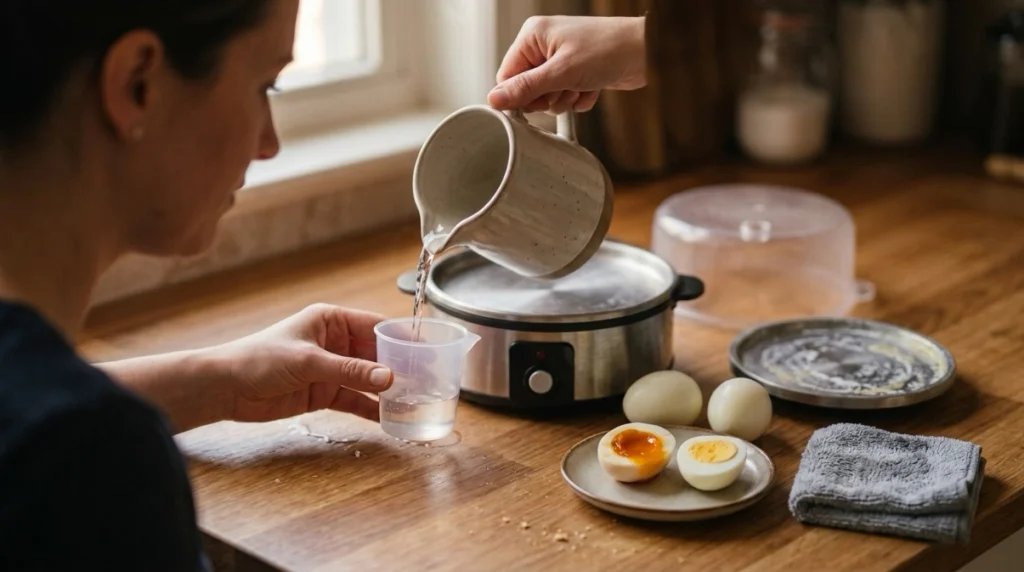
The biggest lesson I learned was that an egg cooker is more about water control than complicated settings.
When eggs came out too soft, my first thought was that the heating plate was weak. The simpler explanation was the water amount.
I checked the measuring marks, used the right level, and made another batch. The result was much more consistent.
I also noticed that mineral marks can make a heating plate look damaged even when it still works. Gentle descaling was far better than scraping the surface.
My basic test order is now simple. I check the outlet, water amount, tray, lid, steam vent, and heating plate before assuming there is a serious fault.
That order saves time and keeps me away from unsafe electrical repairs.
Final Thoughts
So, what is an egg cooker? It is a compact appliance that uses measured water, heat, and steam to cook eggs with very little attention.
The key parts are the heating plate, egg tray, measuring cup, lid, and steam vent. Some models also add timers, buzzers, buttons, and automatic shut-off.
If the eggs are too soft or hard, check the water first. If steam acts strangely, check the lid and vent.
If the cooker becomes slow or develops mineral marks, descale it after unplugging and cooling it. If you notice cord damage, a strong burning smell, melting parts, or repeated overheating, stop using it.
Once I understood those few points, an egg cooker became much easier to use. Most everyday problems come down to correct water, good placement, safe cleaning, and knowing what the cooker is designed to do.
10 thoughts on “What Is an Egg Cooker? Simple, Smart, Helpful Guide”