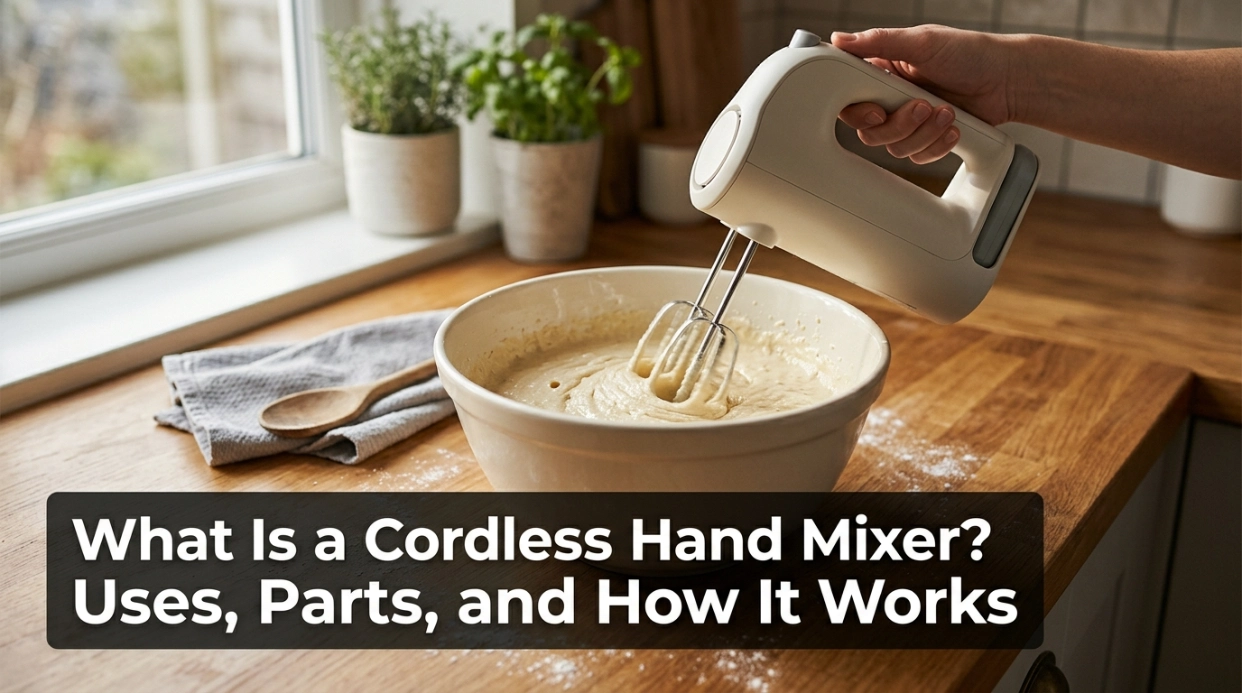
Quick Answer
A cordless hand mixer is a handheld electric mixer powered by a rechargeable battery instead of a wall outlet. The battery supplies electricity to a motor, which turns removable beaters or other compatible attachments for mixing, beating, and whipping. Because rechargeable appliances depend on batteries and charging systems, it is also worth following CPSC battery-safety guidance.
What to know at a glance
- Power source: A rechargeable battery replaces the power cord during mixing.
- Main job: It mixes, beats, stirs, and whips many everyday ingredients.
- Main advantage: You can work without keeping the bowl beside an electrical outlet.
- Main limitation: Operating time depends on battery charge, battery condition, and mixing load.
- Best use: Quick small-to-medium mixing jobs where portability matters.
Simple rule to remember
- A cordless hand mixer works much like a corded electric hand mixer, but stored battery energy powers the motor.
If you are asking, “What is a cordless hand mixer?” the word cordless describes its power source, not a completely different type of mixer. It is still a handheld electric mixer with powered rotating attachments.
The difference becomes important in daily use. You can position your bowl where it feels comfortable instead of planning around a nearby outlet or a cord crossing the counter.
In This Guide
What Is a Cordless Hand Mixer?
A cordless hand mixer is a portable electric kitchen appliance with a built-in or removable rechargeable battery. That stored electrical energy powers a motor that rotates the mixer attachments.
Definition: A cordless hand mixer is a battery-powered handheld mixer that turns removable beaters or similar attachments without needing a wall outlet while it is operating.
You still hold the appliance over a separate mixing bowl. You also guide the spinning beaters through the ingredients yourself.
The cordless design only changes where the mixer gets its electrical energy. A corded mixer draws power continuously from an outlet, while a cordless model draws stored power from its battery.
What parts does a cordless hand mixer have?
Exact designs vary by manufacturer, but most models use the same basic groups of parts.
- Rechargeable battery: Stores the electrical energy needed for operation.
- Electric motor: Converts electrical energy into rotating mechanical motion.
- Gear system: Transfers and controls that rotation before it reaches the attachments.
- Speed controls: Let you change how quickly the attachments rotate.
- Attachment sockets: Hold the beaters or other compatible accessories.
- Eject control: Releases removable attachments after use on many models.
- Charging system: Recharges the battery through the manufacturer’s specified charger, dock, cable, or power adapter.
As of 2026, cordless systems differ considerably between brands. Some batteries stay inside the mixer, while others are removable and can work with several appliances from the same product family.
For example, the current KitchenAid Go Cordless Hand Mixer uses a removable 12V MAX battery and provides seven speed settings. KitchenAid lists the battery’s nominal voltage as 10.8 volts.
Section Takeaway: A cordless hand mixer is an electric hand mixer with rechargeable battery power. The battery changes how you power the appliance, but the fundamental mixing mechanism stays familiar.
How Does a Cordless Hand Mixer Work?
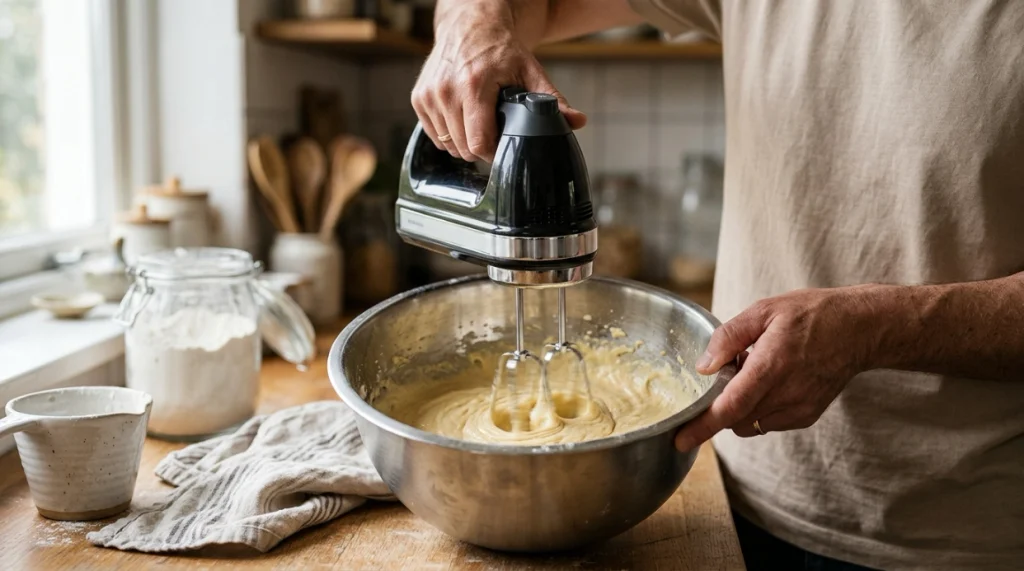
A cordless hand mixer works by converting energy stored in its battery into rotating motion. The motor and drivetrain then transfer that motion to the beaters.
The process is easier to understand as a short chain.
- The battery stores energy. You charge it using the system specified by the manufacturer.
- You select a speed. The controls regulate how the mixer delivers power to the motor.
- The motor begins turning. It converts electrical energy into mechanical rotation.
- The gears transfer motion. Internal gears and drive components send rotation toward the attachment sockets.
- The attachments rotate. Beaters or another approved attachment move through the ingredients.
- You guide the mixer. Moving it around the bowl helps the attachments reach the entire mixture.
Does a cordless hand mixer have enough power?
Battery operation does not automatically mean a mixer is weak. Performance depends on motor design, gearing, battery output, attachment design, speed control, and the food being mixed.
It is also difficult to judge a hand mixer from one number alone. Voltage or wattage should not be treated as a complete measurement of real mixing ability.
A manufacturer may publish battery voltage and runtime. Those numbers still need context because thicker mixtures generally place a different load on a mixer than cream or egg whites.
KitchenAid, for example, currently advertises up to 60 minutes of continuous runtime for its Go cordless hand mixer. The company also states that actual runtime varies with recipe, attachments, battery age, and use.
What happens as the battery runs down?
The exact behavior depends on the model’s electronics and battery-management system. You should follow the owner’s manual rather than assuming every rechargeable mixer behaves the same way.
Charging practices matter as well. CPSC notes that battery-powered products should be designed and tested as systems that include the cells, battery pack, charger, and finished product.
Section Takeaway: Battery energy powers the motor, the motor drives the gears, and the gears rotate the attachments. Battery condition and recipe load can affect how long that process continues between charges.
What Can You Use a Cordless Hand Mixer For?
A cordless hand mixer suits many of the same everyday jobs as a conventional hand mixer. Light and moderate mixtures are usually the most natural fit.
- Cake and muffin batter: Combine wet and dry ingredients without prolonged hand stirring.
- Pancake and waffle batter: Mix ingredients quickly while controlling lumps and overmixing.
- Whipped cream: Use suitable beaters or a whisk attachment when supplied by the manufacturer.
- Egg whites: Beat air into egg whites for recipes requiring foam or peaks.
- Butter and sugar: Cream softened butter and sugar for many cakes and cookies.
- Frosting: Mix softened butter, sugar, and other ingredients until the desired consistency develops.
- Mashed foods: Some soft cooked foods can be mixed when the manufacturer’s instructions allow it.
What should you avoid?
A cordless hand mixer should not automatically be treated like a stand mixer. Dense mixtures can demand far more torque and continuous workload than light batter or cream.
Be especially cautious with recipes such as these:
- Large batches of stiff cookie dough
- Heavy bread dough
- Very cold or hard mixtures
- Recipes exceeding the manufacturer’s recommended batch size
- Jobs requiring long periods of continuous operation beyond the manual’s guidance
Some hand mixers include dough hooks, but an included hook does not mean the machine can knead every dough. Check the manufacturer’s limits for batch size, speed, and operating time.
I find the easiest way to think about the category is to separate convenience from heavy-duty mixing. Cordless models can remove a frustrating cord without turning a handheld appliance into a countertop stand mixer.
Why is the cordless design useful?
The clearest benefit is freedom of bowl placement. You are not limited by outlet location or cord length while the mixer is running.
- Kitchen islands: Mix on an island even when no outlet sits beside the bowl.
- Small kitchens: Work on whichever counter section is clear.
- Shared kitchens: Move the mixer between work areas without unplugging it.
- Cleaner setup: There is no operating cord to drape beside bowls or ingredients.
- Easy storage: Many hand mixers remain more compact than a full stand mixer.
The tradeoff is simple. Freedom from the outlet means you now have a battery to charge and maintain.
Section Takeaway: Cordless hand mixers are best suited to common light-to-moderate mixing jobs. Their main advantage is convenient movement, not unlimited heavy-duty mixing.
Cordless vs. Corded vs. Manual Hand Mixer: What’s the Difference?
A cordless and corded hand mixer both use electric motors. A manual hand mixer relies on your own physical effort instead.
| Feature | Cordless Hand Mixer | Corded Hand Mixer | Manual Hand Mixer |
|---|---|---|---|
| Power source | Rechargeable battery | Household outlet | Human effort |
| Electric motor | Yes | Yes | No |
| Outlet needed during mixing | No | Yes | No |
| Needs charging | Yes | No | No |
| Runtime consideration | Limited by available charge and manufacturer guidance | No battery runtime limit | Limited mainly by your effort and tool capability |
| Movement | Not restricted by a power cord | Restricted by cord and outlet position | Not restricted by a power cord |
| Good fit | Portable electric mixing | Frequent powered mixing near an outlet | Simple light mixing without electricity |
When does cordless make more sense?
Consider cordless when outlet placement regularly gets in your way. It also makes sense if you often move between different kitchen work surfaces.
When does a corded mixer make more sense?
A corded model avoids battery charging and battery aging. That can be useful if you regularly complete several recipes in one long baking session.
What about a manual mixer?
A manual mixer needs no electricity at all. However, your hand provides the energy, so repetitive or thicker mixing can demand more effort.
Section Takeaway: Choose cordless for movement, corded for continuous outlet-powered convenience, and manual for simple mixing without electricity.
What Should You Look for in a Cordless Hand Mixer?
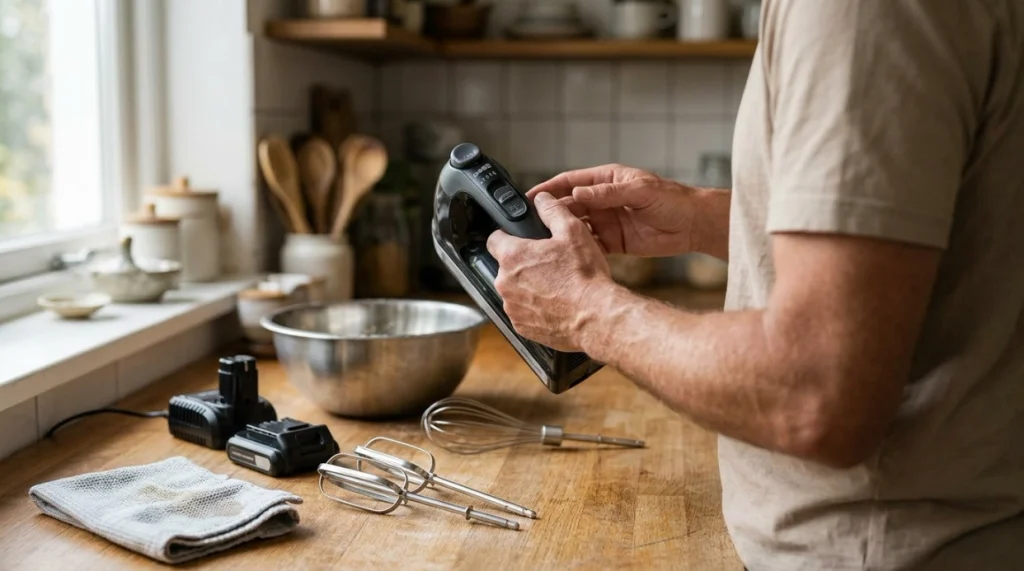
Start with the jobs you expect the mixer to do. Battery numbers matter, but usability and control often matter just as much in an everyday kitchen.
1. Battery system
Check whether the battery is built in or removable. A removable battery may be more convenient if the manufacturer uses the same battery across several compatible appliances.
Also check whether the battery and charger come in the package. Some product versions are sold without a battery.
2. Runtime information
Look for a manufacturer-stated runtime and read its conditions. Avoid assuming that maximum advertised runtime will apply to every recipe.
Thicker mixtures, attachment choice, battery age, and usage pattern can change runtime. Manufacturers may state these limitations directly in the product documentation.
3. Speed control
Multiple speeds give you more control over different ingredients. Low-speed starting is useful when dry flour or powdered sugar could otherwise scatter from the bowl.
As one current example, KitchenAid’s KHMR762 cordless mixer provides seven speeds plus a gradual-start feature. That illustrates why the controls deserve attention alongside battery capacity.
4. Attachments
Check exactly what comes with the mixer. Standard beaters are common, while whisks, dough hooks, storage accessories, and other tools vary by model.
Never assume attachments from another hand mixer will fit. Locking mechanisms, shaft lengths, and connection shapes can differ.
5. Weight and balance
You support a hand mixer throughout the job. Battery weight can change how a cordless model feels compared with a lightweight corded design.
Look for a handle shape and overall balance you can control comfortably. This becomes more important during longer whipping or creaming jobs.
6. Cleaning
Removable attachments simplify cleanup, but dishwasher compatibility varies. Follow the manufacturer’s care instructions for the attachments, mixer body, battery, and charging components.
The motor housing and electrical parts should not be submerged unless the manufacturer specifically says otherwise. Wipe the appliance as directed in its manual.
7. Battery and electrical safety
Rechargeable kitchen appliances should be treated as complete electrical systems. The battery, charging equipment, appliance electronics, and protective features all matter.
The CPSC discusses hazards associated with batteries and chargers, including overheating, fire, burns, and electrical shock. It recommends suitable chargers and properly designed battery-management protections.
UL Solutions’ battery standards overview also explains that safety standards cover batteries used across consumer products and small appliances. Its broader appliance safety information describes testing and certification work for household appliances.
- Use the specified charger: Follow the mixer’s manual and manufacturer instructions.
- Inspect for damage: Stop using a battery or appliance showing swelling, cracking, unusual heat, or other damage.
- Keep electrical parts dry: Do not immerse the mixer body, battery, or charging equipment.
- Store it properly: Follow manufacturer guidance on storage temperature and long-term battery care.
- Respect operating limits: Stop if the manual requires cooling periods or limits certain mixtures.
Pro tip: Do not open a sealed mixer, modify its battery, bypass a protective feature, or attempt improvised electrical repairs. Follow the manufacturer’s manual or contact a qualified appliance repair professional.
Section Takeaway: Look beyond the word “cordless.” Compare the battery system, controls, attachments, balance, cleaning instructions, charging equipment, and manufacturer’s operating limits.
Cordless Hand Mixer FAQ
Does a cordless hand mixer need electricity?
Yes. A cordless hand mixer is still an electric appliance, but it stores electricity in a rechargeable battery before use. It does not need to remain connected to a wall outlet while you are mixing.
Is a cordless hand mixer the same as a manual hand mixer?
No. A cordless hand mixer uses a battery-powered electric motor. A manual hand mixer relies on your hand to turn a crank, push mechanism, whisk, or other mechanical system.
Can a cordless hand mixer make cake batter?
Yes, cake batter is a common hand-mixer task when the recipe and batch size fall within the manufacturer’s instructions. Start at an appropriate low speed, then increase speed only as needed.
Can a cordless hand mixer knead bread dough?
Only some models support dough hooks or dough mixing, and their limits vary. Heavy bread dough can create a demanding load, so check the owner’s manual before using a cordless hand mixer for kneading.
How long does a cordless hand mixer battery last?
There is no universal runtime. It depends on battery capacity, motor load, recipe, attachment, battery age, and design. For example, KitchenAid currently advertises up to 60 minutes of continuous runtime for its Go cordless hand mixer, with stated conditions and limitations.
Is a cordless hand mixer better than a corded mixer?
Neither power system is better for every kitchen. Cordless models remove outlet and cord restrictions, while corded mixers avoid charging and battery-runtime concerns. The better fit depends on how and where you normally mix.
Do cordless hand mixer batteries wear out?
Rechargeable batteries age through time and use, so their available capacity can eventually decline. Follow the manufacturer’s charging, storage, and replacement instructions rather than substituting an unapproved battery or charger.
If counter freedom is your main frustration with a traditional mixer, a cordless model can solve that problem neatly. You still get powered beaters and speed control, but your bowl no longer has to stay within reach of a wall socket.
Before buying, check the battery arrangement, included accessories, charging equipment, speed settings, and recipe limits. Those details tell you far more than the word “cordless” on the box.