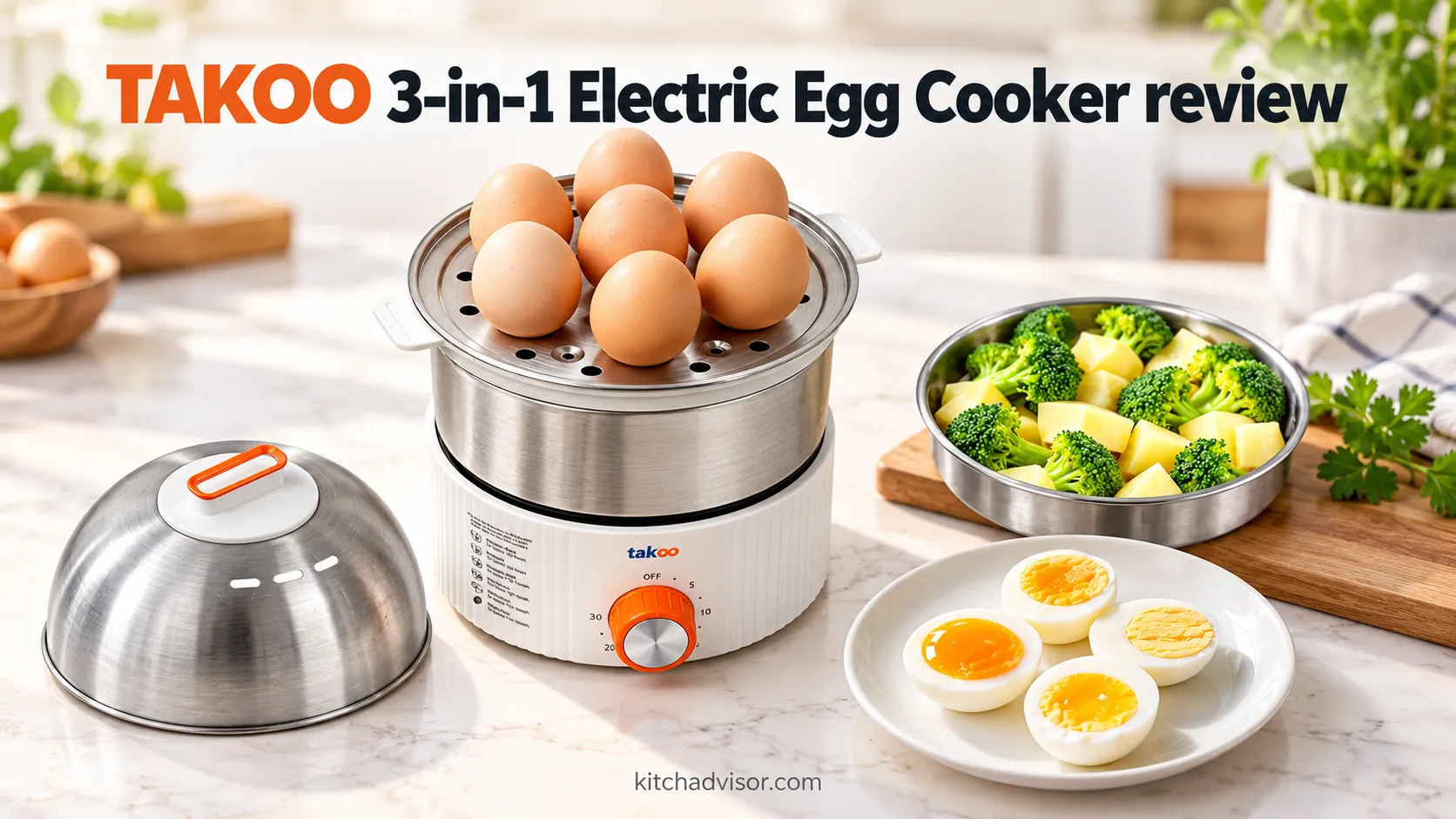
The TAKOO 3-in-1 Electric Egg Cooker is a countertop steam cooker designed for boiled eggs, poached eggs, omelets, and basic vegetable steaming. Its main appeal is capacity: the ES-350W model can handle up to 14 eggs, making it more suitable for families and meal-prep users than many smaller single-layer cookers.
This TAKOO 3-in-1 Electric Egg Cooker review focuses on verified specifications, everyday usability, cooking flexibility, maintenance, and the limitations buyers should understand before choosing it.
Quick Verdict
Reviewed Product
TAKOO 3-in-1 Electric Egg Cooker
A high-capacity steam egg cooker aimed at households that want boiled eggs plus poaching, omelet, and vegetable-steaming functions in one appliance.
Rating: ★★★★☆4.0/5
Best For: Families and meal-prep users who regularly cook several eggs at once.
Key Specs
14-egg capacity • ES-350W model • 8.7 × 8.4 × 9.8 in • egg tray, steaming cup and measuring cup included
Key Advantage
Large capacity with multiple steam-cooking functions.
Main Trade-off
Accurate results still depend on measuring water and selecting cooking time correctly.
Bottom Line
The TAKOO is a sensible option when 14-egg capacity matters and you want more flexibility than a basic egg boiler. Buyers wanting stronger brand documentation or a simpler one-button design may prefer an established alternative.

At a Glance
- Holds up to 14 eggs for higher-volume batches.
- Supports boiled eggs, poached eggs, omelets, and vegetable steaming.
- Uses a measuring cup to control water for different cooking needs.
- Includes automatic shut-off and an audible completion alert.
- Removable cooking components are documented as dishwasher-safe.
- Its countertop dimensions are approximately 8.7 × 8.4 × 9.8 inches.
Verified Specifications & Buyer Implications
| Attribute | Verified Detail | Why It Matters |
|---|---|---|
| Model | ES-350W | Identifying the exact model helps separate this cooker from similar generic 14-egg designs. |
| Egg Capacity | Up to 14 eggs | This capacity favors larger batches, meal preparation, or households that cook eggs for several people at once. |
| Dimensions | 8.7 × 8.4 × 9.8 inches | The footprint remains countertop-friendly, though its double-layer capacity requires more vertical space than some compact models. |
| Functions | Boiling, poaching, omelets, vegetable steaming | Multiple cooking formats give the appliance more usefulness than a dedicated hard-boiled-egg cooker. |
| Included Accessories | Egg tray, steaming cup, measuring cup | These components cover its documented cooking modes without requiring separate specialty trays immediately. |
| Controls | Timer dial with automatic shut-off and alert | The timer adds control, but buyers still need to measure water and choose an appropriate cooking duration. |
Design & Build Quality
The TAKOO uses a vertically stacked design to achieve its 14-egg capacity without requiring an especially wide base. Its documentation identifies stainless-steel construction and a stainless-steel lid, while the removable trays organize the cooking space above the heated base.
That design is useful when countertop width is limited, but the 9.8-inch height should still be considered if the cooker will live under low cabinets. Stainless-steel construction identifies the stated material; it should not be interpreted as proof of indefinite durability.
Setup & Ease of Use
- Wash and dry the removable parts before first use.
- Measure cold water using the supplied cup.
- Place the appropriate egg tray or steaming cup on the base.
- Add the food and fit the lid correctly.
- Turn the timer dial to begin the cooking cycle.
- Use caution when opening the lid because escaping steam is hot.
For a broader explanation of this cooking method, KitchAdvisor’s guide to how an egg cooker works explains why the water level and steam cycle influence the final result.
How This Review Was Researched
This review evaluates the TAKOO ES-350W using available product documentation, current product information, documented operating instructions, specifications, maintenance guidance, and relevant competing egg cookers. No personal hands-on testing is claimed.
Category-Specific Performance
Batch Capacity
The 14-egg capacity is the TAKOO’s clearest practical advantage. A larger batch can reduce repeat cooking cycles for meal prep, gatherings, or households that regularly prepare several hard-boiled eggs.
Capacity does not automatically mean every cooking mode handles 14 portions. The maximum figure primarily describes the egg-holding configuration rather than omelet or poaching volume.
Doneness Control
The cooker uses measured water plus a timer setting to manage soft-, medium-, or hard-cooked eggs. This offers more control than watching a saucepan manually, but correct water measurement remains important.
Egg temperature, water quantity, and cooking time can affect the finished yolk. The documentation specifically recommends adjusting water or timing when eggs come out undercooked or overcooked.
Cooking Versatility
The steaming cup extends the appliance beyond shell eggs. It can be used for omelets, poached eggs, and vegetables, giving occasional users more reasons to keep the cooker accessible rather than storing it after breakfast.
It remains a small steam appliance, not a replacement for a skillet, saucepan, or full-size vegetable steamer. KitchAdvisor’s guide to what you can cook in an egg cooker explains why the included trays determine its practical limits.
Automatic Cooking Control
The automatic shut-off and audible alert reduce the need to monitor the cooker continuously. That convenience matters most during breakfast routines or meal prep when several other tasks are happening at once.
Automatic shut-off should not be confused with completely automatic doneness selection. Users still control important variables before the cooking cycle starts.
Expert Insight
For steam-based egg cookers, repeatable measuring habits are often more important than having numerous controls. Keeping the supplied measuring cup nearby can make the TAKOO easier to use consistently.
Key Features Explained
14-Egg Double-Layer Capacity
The cooker is designed to hold up to 14 eggs, giving it more batch capacity than many compact egg cookers. This makes the most sense for buyers who routinely cook more than a few eggs rather than occasional single-person use.
Measuring Cup and Timer Control
The supplied measuring cup helps match water quantity to the desired cooking result, while the timer dial controls the operating period. The combination provides flexibility but introduces more user input than a fully preset system.
Multi-Purpose Steaming Cup
The steaming cup supports poached eggs, omelets, and vegetables. That versatility improves the appliance’s value for buyers who want more than hard-boiled eggs without moving to a larger multi-cooker.
Real-World Usability & Maintenance
Routine cleanup is straightforward on paper. The documented removable parts can be washed separately, while the powered base should be wiped rather than immersed.
Mineral scale can form on the heating plate, particularly with hard water. The care instructions recommend a diluted white-vinegar solution for deposits, followed by wiping with a damp cloth and thorough drying.
Because water measurement is central to operation, losing the measuring cup could make consistent results less convenient. Buyers new to these appliances may find KitchAdvisor’s egg cooker usage guide helpful for understanding the basic process.
Pros & Cons
Pros
- Large 14-egg batch capacity
- Multiple egg and steaming functions
- Automatic shut-off and completion alert
- Dishwasher-safe removable components
Cons
- Water measurement affects consistency
- Requires more vertical space than compact cookers
- Warranty details are not clearly verified
Common Issues & Fixes
Eggs Come Out Undercooked
Cause: Too little water, insufficient cooking time, very cold eggs, or altitude can affect the result.
Fix: Recheck the measuring-cup level and increase the cooking time slightly when necessary.
Eggs Become Overcooked
Cause: Excess water or an unnecessarily long cooking period can extend steam exposure.
Fix: Reduce water or time and move finished eggs to an ice bath promptly.
Mineral Deposits on the Heating Plate
Cause: Hard-water minerals can remain after repeated heating cycles.
Fix: Use the documented vinegar-and-water cleaning method and wipe the plate with a non-abrasive material.
What to Know Before You Buy
The TAKOO makes the most sense when its 14-egg capacity will actually be used. A household preparing only one or two eggs occasionally may find a smaller cooker easier to store.
Also consider the control style. The measuring-cup-and-timer approach gives you flexibility, but it rewards consistent preparation rather than eliminating every variable automatically.
The available documentation does not provide enough verified information for a confident warranty-duration claim. Buyers who prioritize clearly documented long-term manufacturer support should check current seller and manufacturer terms before purchasing.
Who Should Consider It / Who Should Look Elsewhere
Who Should Consider It
- Families cooking several eggs together
- Meal-prep users needing larger batches
- Buyers wanting egg and vegetable steaming
Who Should Look Elsewhere
- Buyers needing only one or two eggs
- Users wanting minimal manual adjustment
- Shoppers prioritizing established-brand support
Alternatives to Consider
Reviewed Product
TAKOO ES-350W
Best For: High-capacity home egg preparation
Key Specs: 14 eggs • timer • steaming cup
Advantage: Large batch capacity
Trade-off: Less established support documentation
Alternative A
Hamilton Beach 25508
Best For: Buyers wanting established manufacturer support
Key Specs: 14 hard-boiled eggs • 2 poached eggs • omelet/steaming tray
Advantage: Extensive official documentation
Trade-off: Simpler one-button control
Alternative B
DASH Deluxe Rapid Egg Cooker
Best For: Buyers wanting a slightly smaller high-capacity cooker
Key Specs: 12-egg capacity • auto shut-off • multi-purpose trays
Advantage: Broad cooking versatility
Trade-off: Lower egg capacity than TAKOO
Is It Worth It?
The TAKOO is worth considering primarily for buyers who will benefit from its larger capacity. Preparing up to 14 eggs in one appliance can be more convenient than repeating smaller batches, while the steaming cup gives the cooker additional usefulness.
The main compromise is that repeatable results still depend on following the water and timing guidance. If you value established manufacturer documentation more than timer control, the Hamilton Beach alternative may be the more comfortable purchase.
Final Verdict
The TAKOO ES-350W is best suited to families, frequent egg eaters, and meal-prep users who want a relatively compact appliance with substantial egg capacity. Its strongest advantage is the combination of 14-egg cooking and multi-purpose steaming functions.
Its biggest limitation is not capacity but confidence around the broader ownership experience, because warranty information is less clearly documented than with some established competitors. Buyers who value capacity and versatility should consider it; those prioritizing brand support may prefer Hamilton Beach or DASH.
Frequently Asked Questions
How many eggs can the TAKOO egg cooker hold?
It can hold up to 14 eggs. That capacity makes it especially relevant for families and batch meal preparation.
Can the TAKOO make soft-, medium-, and hard-boiled eggs?
Yes. Its instructions provide water-measurement guidance for different doneness levels, with the timer used to manage the cooking cycle.
Can it make poached eggs and omelets?
Yes. The included steaming cup is documented for poached eggs and omelets in addition to vegetable steaming.
Does the TAKOO shut off automatically?
Yes. The documented operation includes automatic shut-off and an audible alert when the cooking cycle finishes.
Are the removable parts dishwasher-safe?
The documented egg tray, steaming cup, and lid are listed as dishwasher-safe. The powered base should not be immersed in water.
How do you remove mineral buildup from the heating plate?
The documented method uses one part white vinegar to two parts water. Let the solution sit briefly, clean gently with a non-abrasive sponge, then wipe the plate with a damp cloth.
Affiliate disclosure: KitchAdvisor earns a small commission when you purchase through links on this page — at no extra cost to you. Our editorial process is independent: affiliate relationships never influence which products we recommend or how we rank them.