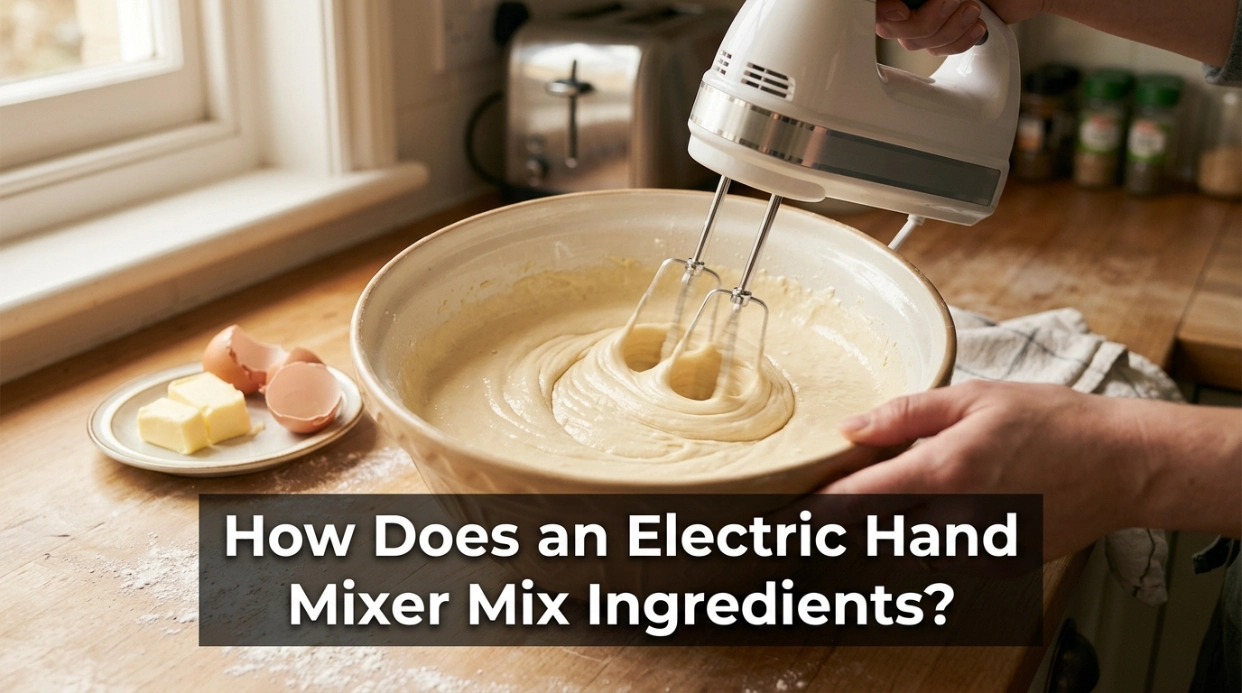
Quick Answer
An electric hand mixer mixes ingredients by using an electric motor to rapidly rotate removable beaters, whisks, or other attachments. Their movement creates circulation, shear, and sometimes aeration inside the bowl, pulling separate ingredients together until the mixture becomes more uniform. Choosing the right attachment and gradually increasing speed, as explained in this hand mixer usage guide, helps control how quickly ingredients combine.
What happens while the mixer runs?
- Motor rotation: The electric motor provides the mechanical force that spins the attachments.
- Ingredient circulation: Rotating beaters move batter or dough continuously around the bowl.
- Shearing action: Moving beater surfaces break apart lumps and distribute ingredients.
- Air incorporation: Faster whipping can pull air into cream, egg whites, butter, and similar mixtures.
- Texture development: Continued mixing changes consistency as ingredients hydrate, disperse, aerate, or emulsify.
Best practice
- Start slowly, then increase speed only after loose ingredients are incorporated and the recipe calls for more vigorous mixing.
I’m often asked what a hand mixer is doing beyond simply “spinning the beaters.” The useful answer involves both the mixer’s mechanical parts and what that movement does to food.
As of 2026, the basic principle remains straightforward. A motor turns an attachment, while the attachment transfers that movement into batter, cream, eggs, potatoes, dough, or another mixture.
In This Guide
- What Happens Inside an Electric Hand Mixer?
- How Do the Beaters Actually Mix Ingredients?
- How Does Mixer Speed Change the Result?
- What Happens to Different Ingredients During Mixing?
- How Do Different Hand Mixer Attachments Change Mixing?
- How Do You Use a Hand Mixer Effectively and Safely?
- Frequently Asked Questions
What Happens Inside an Electric Hand Mixer?
An electric hand mixer converts electrical energy into rotating mechanical movement. The motor inside the housing drives the shafts connected to the beaters or other attachments.
Pressing the speed control changes how quickly that drive system turns. You then guide the moving attachments through the ingredients by hand.
Definition: An electric hand mixer is a portable motor-driven kitchen appliance that rotates removable mixing attachments to combine, beat, whip, cream, or knead ingredients.
Most conventional hand mixers use two beater positions. The paired attachments create overlapping areas of movement rather than stirring only one small point in the bowl.
This matters because efficient mixing requires bulk movement. Ingredients from the edges must repeatedly travel toward the active mixing area.
- The motor produces rotational force.
- The drive mechanism transfers that force to the attachment sockets.
- The beaters transfer movement into the food.
- Your hand moves the mixer around the bowl so untouched ingredients enter the mixing zone.
The result is faster and more consistent than mixing many recipes with a spoon alone. However, the machine still depends on correct speed, bowl movement, and attachment choice.
How Do the Beaters Actually Mix Ingredients?
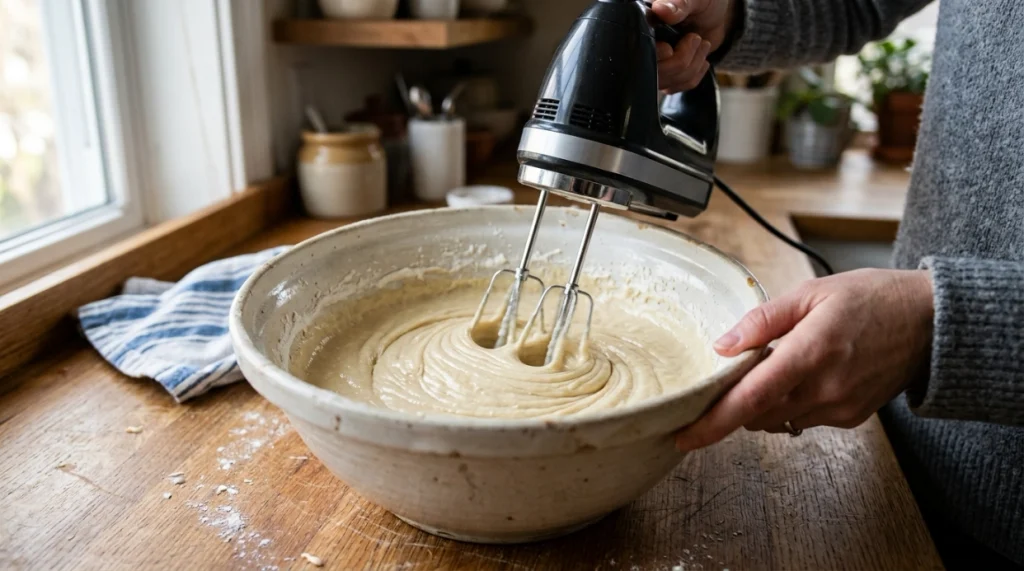
Beaters mix through several actions happening at the same time. They circulate ingredients, create shear, break up soft lumps, and repeatedly bring different parts of the mixture into contact.
I find it easier to understand a hand mixer when I separate those jobs instead of treating “mixing” as one process.
Circulation moves ingredients through the bowl
The rotating beaters push nearby material away and pull fresh material into their path. Moving the mixer slowly around the bowl expands that circulation.
That is why holding a mixer perfectly still can leave flour, butter, or batter near the bowl wall. The attachment cannot effectively work on ingredients it never reaches.
Shear breaks apart and disperses ingredients
Shear occurs when adjacent portions of a mixture move at different speeds. The rotating metal surfaces create these speed differences continuously.
This action helps disperse flour pockets, break soft butter into a mixture, smooth mashed ingredients, and distribute liquids through thicker batters.
- Thin mixtures: Flow easily around the beaters and combine quickly.
- Thick batters: Resist movement more strongly and place a greater load on the motor.
- Dense dough: May require dough hooks or a more suitable mixer rather than standard beaters.
Fast movement can incorporate air
Whipping is different from simple blending. A whisk or fast-moving beater can drag air into a mixture and divide larger air pockets into smaller bubbles.
Those bubbles matter in whipped cream, egg whites, frosting, and creamed butter mixtures because they contribute to volume and texture.
How Does Mixer Speed Change the Result?
Speed determines how aggressively the attachments move ingredients. Low speed favors control, while higher speed increases circulation and air incorporation.
KitchenAid’s current hand mixer buying guide notes that hand mixers commonly offer roughly three to nine speed settings, depending on the model.
| Relative Speed | What It Does | Good Uses | Main Risk |
|---|---|---|---|
| Low | Gentle circulation and blending | Adding flour, folding in chips, starting wet ingredients | May be too slow for aeration |
| Medium | Faster blending with moderate aeration | Cake batter, frosting, creaming softened butter | Overmixing some batters |
| High | Rapid whipping and strong air incorporation | Egg whites, whipped cream, light mixtures | Splatter or overwhipping |
Starting on high speed is rarely helpful with loose flour or powdered sugar. The beaters can throw dry particles outward before they become wet enough to stay in the bowl.
A low start also reduces sudden torque against thick ingredients. Increase the setting after the mixture begins moving smoothly.
Does higher speed always mix better?
No. Higher speed means more intense mechanical action, not automatically better results.
Recipes often depend on controlled mixing. Once flour enters cake or muffin batter, excessive agitation can change the finished texture.
What Happens to Different Ingredients During Mixing?
Different foods respond differently because mixing can do more than distribute ingredients. It can aerate fat, unfold proteins, disperse droplets, hydrate flour, or break down soft solids.
Butter and sugar
Creaming butter and sugar is a classic example of mechanical aeration. Sugar crystals help create tiny spaces in softened fat while the mixer repeatedly beats the ingredients together.
King Arthur Baking’s creaming guidance explains that these air pockets help support lighter textures in baked goods.
Egg whites
Whipping egg whites introduces air while mechanical movement changes how egg proteins arrange themselves. The proteins help form a network around the bubbles.
That is why egg whites can move from a clear liquid to foam and eventually form soft or stiff peaks.
Heavy cream
Whipped cream also depends on air incorporation. As the whisk moves rapidly, bubbles become distributed through the cold cream and the structure thickens.
Continuing too long can push the mixture beyond whipped cream. The fat structure can begin separating toward butter.
Flour-based batter
Once flour becomes wet, proteins and starches hydrate. Mechanical mixing distributes that water while also encouraging gluten development in wheat-flour recipes.
That can be useful for bread but undesirable when a tender muffin or cake needs only limited mixing.
- Cookies: Often need creaming followed by controlled flour incorporation.
- Cakes: Usually benefit from even mixing without excessive beating after flour is added.
- Whipped toppings: Depend more heavily on air incorporation.
- Mashed potatoes: Need caution because aggressive mixing can produce a gluey texture.
How Do Different Hand Mixer Attachments Change Mixing?
The attachment determines how the mixer transfers energy into the ingredients. A thin-wire whisk interacts with food differently from a standard beater or dough hook.
| Attachment | Primary Action | Best Suited To |
|---|---|---|
| Standard beaters | Blending, beating, moderate aeration | Batters, frosting, softened butter, mashed foods |
| Wire whisk | Rapid air incorporation | Cream, egg whites, light foams |
| Dough hooks | Pulling and working dense dough | Small yeast-dough batches when the mixer supports them |
A whisk exposes more thin wires to the mixture and leaves open spaces between them. That design makes it effective when your goal is trapping air rather than simply pushing a dense batter around.
Standard beaters provide more substantial mixing surfaces. They are usually the most versatile option for everyday batter and frosting.
Dough hooks require more torque because bread dough resists movement strongly. Check your mixer’s manual before assuming it can handle a heavy dough.
How Do You Use a Hand Mixer Effectively and Safely?
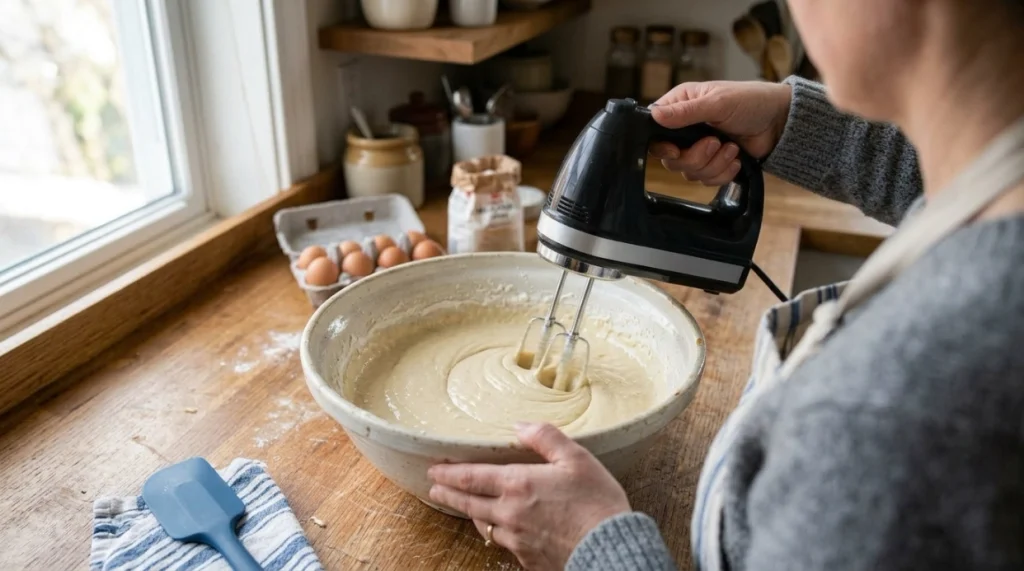
The best mixing technique starts with control. Attach the correct accessories while the appliance is switched off and unplugged, then place them in the ingredients before starting.
- Choose the right bowl. Use a bowl large enough to contain movement and splatter.
- Insert attachments securely. Confirm each attachment is locked into its correct socket.
- Start at low speed. Let dry and wet ingredients begin combining before increasing speed.
- Move around the bowl. Guide the mixer gradually so ingredients near the edges enter the active zone.
- Watch the mixture. Stop when the recipe’s desired texture is reached rather than mixing automatically for longer.
- Switch off before removing beaters. Wait for moving parts to stop before lifting or ejecting attachments.
Keep fingers, spatulas, loose clothing, and other objects away from moving attachments. Never try to scrape the beaters while the motor is running.
For broader household-appliance safety context, UL Solutions explains IEC 60335-1, which covers general safety requirements for household electrical appliances.
If a mixer develops damaged wiring, unusual burning smells, sparking, or obvious internal mechanical problems, stop using it. Electrical repairs are not a normal food-preparation task.
Pro tip: Don’t open a sealed mixer housing or bypass a safety feature unless you are qualified to repair electrical appliances. Follow the manufacturer’s manual or use a qualified appliance technician instead.
It is also worth checking the U.S. Consumer Product Safety Commission search database if you suspect a model has been recalled or has a documented safety issue.
Section Takeaway: Good hand-mixer technique is mostly about control. Start slowly, use the correct attachment, keep the beaters moving through the bowl, and stop as soon as the mixture reaches the required texture.
Frequently Asked Questions
Do hand mixer beaters spin in the same direction?
Many traditional two-beater hand mixers use paired drive mechanisms that make the beaters work together through overlapping mixing paths. Exact mechanical arrangements can vary by model, so the manufacturer’s manual is the best reference for a specific mixer.
Why does a hand mixer mix faster than a spoon?
An electric motor rotates the attachments far faster and more consistently than typical hand stirring. That creates stronger circulation and shear, allowing ingredients to repeatedly pass through the active mixing area in less time.
Why should I start a hand mixer on low speed?
Low speed gives you more control while loose ingredients begin combining. It reduces flour and powdered-sugar clouds, limits splashing, and makes it easier to judge whether a thick mixture is placing excessive load on the mixer.
Does a hand mixer add air to batter?
It can. Beaters and whisks can draw air into ingredients, especially at medium or high speeds. The amount depends on the attachment, speed, ingredient viscosity, mixing time, and whether the mixture can hold the bubbles that form.
Can a hand mixer knead bread dough?
Some models include dough hooks and are designed for limited dough mixing. Others are not suitable for dense bread dough. Check the manual because heavy dough can overload a hand mixer that was designed mainly for batters, creams, and lighter mixtures.
Why does batter climb up the beaters?
Thick mixtures can cling to rotating metal surfaces and move upward along an attachment. Reducing speed, changing the mixer angle slightly, or checking whether the mixture is too dense for that attachment can help.
Can you overmix ingredients with a hand mixer?
Yes. More mixing is not always better. Cake and muffin batters can become less tender after excessive flour mixing, while whipped cream and egg whites can also pass their ideal stage if beating continues too long.
Final takeaway: An electric hand mixer works by converting motor power into rapid attachment movement, then using circulation, shear, and aeration to change ingredients into a more uniform mixture.
For the best results, match the speed and attachment to the job rather than simply running the mixer faster. Watch the food itself, because texture is usually the clearest signal that mixing is finished.
