Quick Answer
Yes, hand mixers are good for baking, especially for cakes, cupcakes, frosting, whipped cream, meringue, brownies, and many cookie recipes. They provide powered mixing without taking up the space of a stand mixer, although thick dough and large batches can exceed their practical limits. Current hand mixer buying guidance also shows that speed control, attachments, and motor design matter more than wattage alone.
Where a hand mixer works best
- Cake batter: Excellent for creaming butter, mixing batter, and beating eggs.
- Frosting: Handles buttercream and cream cheese frosting efficiently.
- Whipped mixtures: Higher speeds work well for cream, egg whites, and meringue.
- Cookie dough: Suitable for many softer doughs, but dense batches may strain lighter mixers.
- Bread dough: Only appropriate when the mixer and its dough hooks are specifically designed for the job.
The simple rule
- Choose a hand mixer for light-to-medium baking jobs and a stand mixer for frequent heavy dough, oversized batches, or long hands-free mixing.
If you’re wondering, “Are hand mixers good for baking?” the practical answer is yes for most everyday home baking. A good electric hand mixer sits comfortably between a manual whisk and a large stand mixer.
I consider it especially useful when a recipe needs serious beating or whipping but doesn’t justify pulling out a heavy countertop machine. The important part is knowing where the hand mixer’s strengths end.
In This Guide
Are Hand Mixers Good for Baking?
Yes. A hand mixer is well suited to the beating, creaming, whipping, and moderate mixing required by many common baked goods.
It won’t replace every function of a stand mixer. For cakes, frosting, cream, eggs, brownies, and smaller batches, however, it can cover an impressive amount of baking work.
Definition: A hand mixer is a portable electric appliance that spins removable beaters, whisks, or compatible attachments while you guide the mixer through ingredients in a separate bowl.
The biggest advantage is convenience. You don’t need to dedicate permanent counter space or lift a large appliance whenever you want cupcakes.
- Compact storage: Most hand mixers fit inside a cabinet or deep drawer.
- Fast setup: Insert the beaters, choose a suitable bowl, and you’re ready.
- Bowl flexibility: You aren’t restricted to one dedicated mixer bowl.
- Speed control: Low speeds combine ingredients while higher settings support whipping and aeration.
- Simple cleanup: The removable attachments are usually the main mixer parts contacting food.
A hand mixer also gives you direct control over where the beaters travel. That can be useful when ingredients collect along the sides or bottom of a bowl.
There is a tradeoff. You must hold and guide the appliance throughout mixing, which becomes tiring during long recipes.
Section Takeaway: For everyday cakes, frosting, whipped ingredients, and many cookies, a hand mixer provides enough capability without the size and setup of a stand mixer.
What Can You Bake With a Hand Mixer?
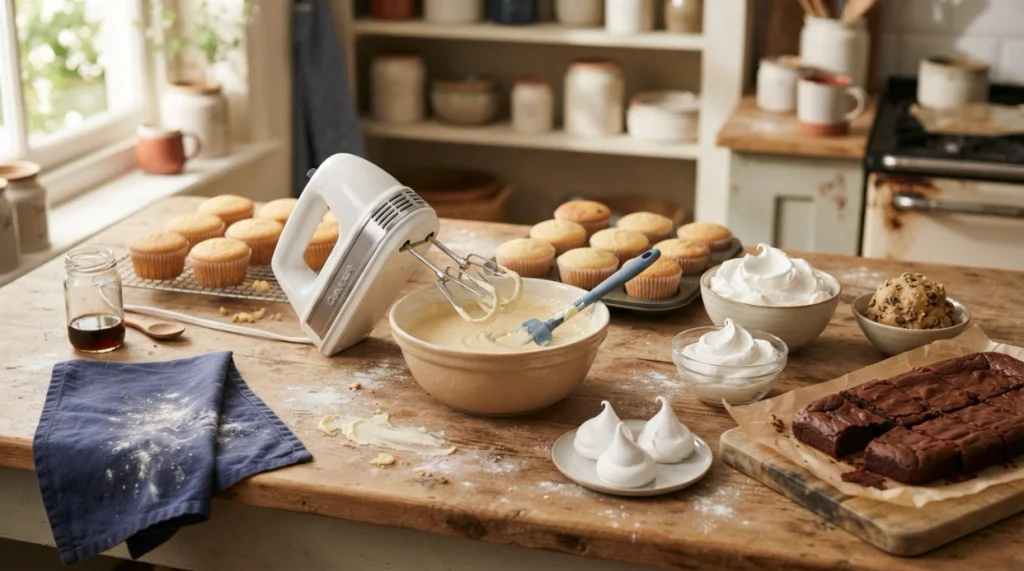
A hand mixer can handle most recipes based on beating, whipping, creaming, or mixing a pourable-to-moderately-thick batter. That covers far more baking than many beginners expect.
Cakes and cupcakes
Traditional butter cakes often begin by creaming butter and sugar. The beating action creates and holds small air pockets that influence the finished cake’s texture.
King Arthur Baking’s creaming guidance explains why butter temperature and proper mixing matter during this process. A hand mixer is a practical tool for carrying out the same basic creaming technique in a separate bowl.
- Butter cakes
- Cupcakes
- Sponge-style mixtures
- Boxed cake mixes
- Cheesecake filling
- Many quick breads
Frosting and whipped toppings
This is one of the jobs where a hand mixer makes the most sense. Beaters or an approved whisk attachment can quickly aerate soft ingredients.
- Buttercream: Beat softened butter before gradually combining it with sugar and liquid.
- Cream cheese frosting: Blend softened ingredients until smooth without prolonged hand stirring.
- Whipped cream: Higher speed introduces air as cold cream thickens.
- Meringue: A suitable whisk or beater can whip egg whites into foam.
Cookies and brownies
Many cookie recipes begin with creamed fat and sugar, which suits a hand mixer. Softer cookie doughs can often be mixed further with the beaters.
Once a dough becomes stiff or heavily loaded with chocolate chips, nuts, or other additions, I prefer switching to a sturdy spatula. That reduces unnecessary strain on the appliance.
Muffins and pancakes
A hand mixer can mix these batters, but more power isn’t always better. Muffins and pancakes often need limited mixing after flour is added.
Use low speed only as long as necessary. Overworking flour-based batter can develop more gluten and change the finished texture.
Section Takeaway: Hand mixers are strongest with batters, aerated mixtures, frostings, eggs, cream, and softer doughs rather than dense kneading jobs.
Hand Mixer vs. Stand Mixer: Which Is Better for Baking?
Neither mixer is automatically better for every baker. A hand mixer favors convenience, while a stand mixer favors capacity, stability, and hands-free operation.
| Baking factor | Hand mixer | Stand mixer |
|---|---|---|
| Operation | Held and guided by hand | Fixed and hands-free |
| Best batch size | Small to medium | Medium to large |
| Cake batter | Very well suited | Very well suited |
| Whipped cream or egg whites | Well suited | Well suited |
| Dense bread dough | Model-dependent and often limited | Generally better suited |
| Long mixing sessions | Requires continuous holding | Runs without being held |
| Storage | Compact | Needs more space |
If I were choosing a tool mainly for occasional cakes, brownies, frosting, and whipped cream, the hand mixer format would cover those requirements without much storage commitment. Frequent bread baking changes the equation.
A stand mixer becomes more practical when the recipe needs extended kneading or when the mixture is heavy enough to make a handheld machine uncomfortable. It also lets you prepare another ingredient while the mixer runs.
The deciding factors are therefore mixture density, batch size, mixing duration, and available kitchen space. Price alone doesn’t tell you which format suits your baking routine.
Section Takeaway: Choose a hand mixer for quick everyday baking and a stand mixer when heavy dough, large batches, or long hands-free mixing are regular requirements.
What Features Matter in a Hand Mixer for Baking?
Speed control matters more than simply choosing the mixer with the biggest number printed on its box. A useful baking mixer should start gently and increase power predictably.
Look for a genuinely useful low speed
Dry flour and powdered sugar can fly out of a bowl when the beaters start too aggressively. A controlled low setting helps bring ingredients together before you increase speed.
As of 2026, current KitchenAid ranges include models with several different speed counts. Current Cuisinart hand mixers likewise include 5-, 7-, and 9-speed options.
Don’t judge performance by wattage alone
Wattage describes electrical power consumption, but it doesn’t provide a universal measure of mixing ability. Motor type, gearing, beater design, cooling, and speed control also affect how a mixer behaves.
For context, one current Cuisinart 9-speed model is rated at 220 watts, while manufacturer guidance shows the wider hand-mixer category can span substantially different power ratings. Comparing wattage across brands without considering design can therefore mislead you.
Check the included attachments
- Traditional beaters: The everyday choice for cake batter, frosting, and creaming.
- Whisk attachment: Useful for cream, egg whites, and aerated mixtures.
- Dough hooks: Intended only for dough loads permitted by the manufacturer’s instructions.
- Storage case: Helps keep attachments together between baking sessions.
Consider comfort and build quality
A hand mixer stays in your hand throughout use. Weight balance, grip shape, control placement, cord position, and vibration can therefore matter during longer baking sessions.
I also look for clearly marked controls and an attachment-eject system that isn’t easy to trigger accidentally. Removable parts should lock securely before the machine is powered.
For electrical appliances, recognized third-party safety evaluation can add useful context. UL Solutions describes its small-appliance testing and certification services for electrical household products.
Section Takeaway: Prioritize controllable low speed, suitable attachments, comfortable handling, secure attachment locking, and sensible motor design rather than chasing wattage alone.
When Should You Not Use a Hand Mixer?
A hand mixer becomes the wrong tool when the mixture requires more torque, stability, or continuous run time than the appliance was designed to provide. Forcing it doesn’t improve the recipe.
Dense bread dough
Some hand mixers come with dough hooks. That doesn’t mean every model is suitable for every bread dough.
Low-hydration dough, large batches, and heavy whole-grain mixtures can create substantial resistance. Follow the manufacturer’s batch and attachment guidance rather than assuming the hooks make the mixer heavy-duty.
Oversized cookie batches
A small quantity of soft cookie dough may be manageable. Double or triple batches can become difficult as flour and mix-ins increase resistance.
If the mixer starts twisting strongly in your hand, slowing dramatically, or sounding strained, stop. Finish manually or move the mixture to equipment intended for heavier work.
Recipes needing long hands-free mixing
A hand mixer has no stationary base. You must hold it for the entire mixing period.
For recipes requiring prolonged kneading or beating, that becomes uncomfortable. A stand mixer can be more practical even when both machines could technically complete the task.
Mixing methods that need almost no agitation
Not every baking recipe benefits from electric mixing. Muffins, quick breads, and similar batters may only need gentle combining once flour enters the bowl.
A spatula or whisk gives you more control when the recipe warns against overmixing. The fastest appliance isn’t always the best baking tool.
Section Takeaway: Don’t force a hand mixer through dense dough, oversized batches, or recipes that need long unattended mixing; match the appliance to the load.
How Do You Get Better Baking Results With a Hand Mixer?
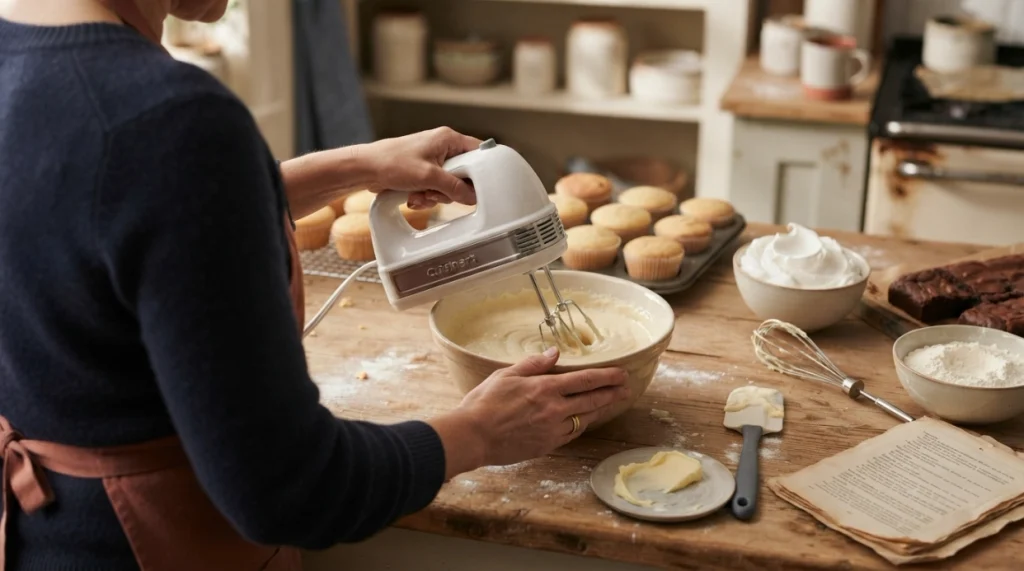
Good results come from technique as much as appliance power. The simplest improvements involve ingredient temperature, bowl size, speed, and knowing when to stop.
- Use the correct attachment. Standard beaters work for most batters, while whipping jobs may benefit from an approved whisk.
- Choose a roomy bowl. Extra space helps keep flour and liquids inside when the beaters begin moving.
- Start at low speed. Let dry and wet ingredients begin combining before increasing speed.
- Move through the bowl steadily. Guide the beaters so ingredients from different areas reach the active mixing zone.
- Scrape when needed. Stop the mixer before using a spatula around the sides and bottom.
- Stop when the recipe says. More mixing isn’t automatically better, particularly after flour has been added.
Use softened butter correctly
Butter that is too cold resists creaming, while melted or excessively warm butter can’t hold air in the same way. Follow the recipe’s temperature guidance rather than softening butter until it becomes greasy.
Increase speed gradually
High speed makes sense for some whipping tasks, not for every stage. Starting slowly reduces splatter and lets you see how the mixture changes.
Keep electrical safety simple
Inspect the cord before using the mixer and keep electrical equipment away from standing water. The Consumer Product Safety Commission’s electrical-safety guidance provides broader advice for household electrical products.
- Unplug the mixer before inserting or removing attachments.
- Keep the cord away from hot burners and other heat sources.
- Don’t handle the appliance with wet hands.
- Switch the mixer off before lifting spinning beaters from the bowl.
- Don’t use a mixer with a damaged cord, plug, housing, or attachment socket.
Pro tip: If the mixer overheats, sparks, gives an electrical shock, or develops an abnormal mechanical noise, unplug it and consult the manufacturer’s manual or a qualified appliance repair technician.
Section Takeaway: Start slowly, use the right attachment, watch ingredient texture, and stop mixing when the recipe reaches the intended consistency.
Hand Mixer Baking FAQ
Can you make a cake with a hand mixer?
Yes. Hand mixers are well suited to many cake recipes because they can cream butter and sugar, beat eggs, and combine batter. Use the speed instructed by the recipe and avoid prolonged mixing once the flour has been incorporated unless the method specifically requires it.
Can a hand mixer make cookie dough?
Yes, particularly with softer cookie dough and moderate batches. Once the dough becomes stiff or contains lots of nuts, chocolate, or other mix-ins, switching to a strong spatula can reduce strain on the mixer.
Can you use a hand mixer for bread dough?
Only when the manufacturer supplies or approves dough hooks and permits that type and quantity of dough. Dense bread dough can demand much more torque than cake batter, so a stand mixer or manual kneading is often more appropriate.
Is a hand mixer powerful enough for buttercream?
Yes. Buttercream is one of the most practical uses for a hand mixer. Start with properly softened butter, beat it until smooth, then add sugar and other ingredients gradually according to the recipe.
How many speeds should a good baking hand mixer have?
There isn’t one required number. A controllable low speed and useful progression toward faster whipping speeds matter more than chasing the highest speed count. Current mainstream models commonly offer several settings, with examples ranging from roughly 3 to 9 speeds.
Is a hand mixer worth buying if I already own a stand mixer?
It can be. A hand mixer is quicker to retrieve for small jobs such as whipped cream, frosting, eggs, or a single cake batter. Many bakers therefore use a hand mixer for convenience and reserve the stand mixer for larger or heavier recipes.
Can a hand mixer replace a stand mixer completely?
For some home bakers, yes. If you mainly make cakes, brownies, cream, frosting, and moderate cookie batches, a hand mixer may cover most needs. Frequent bread, large batches, and extended mixing make a stand mixer more useful.
Final takeaway: Hand mixers are good for baking when you match them to the right jobs. For cakes, frosting, cream, eggs, brownies, and everyday batches, their compact size and quick setup make them especially practical.
If most of your baking involves dense bread dough or large batches, consider moving up to a stand mixer. Otherwise, a capable hand mixer can easily become one of the most frequently used tools in a home baker’s cabinet.
