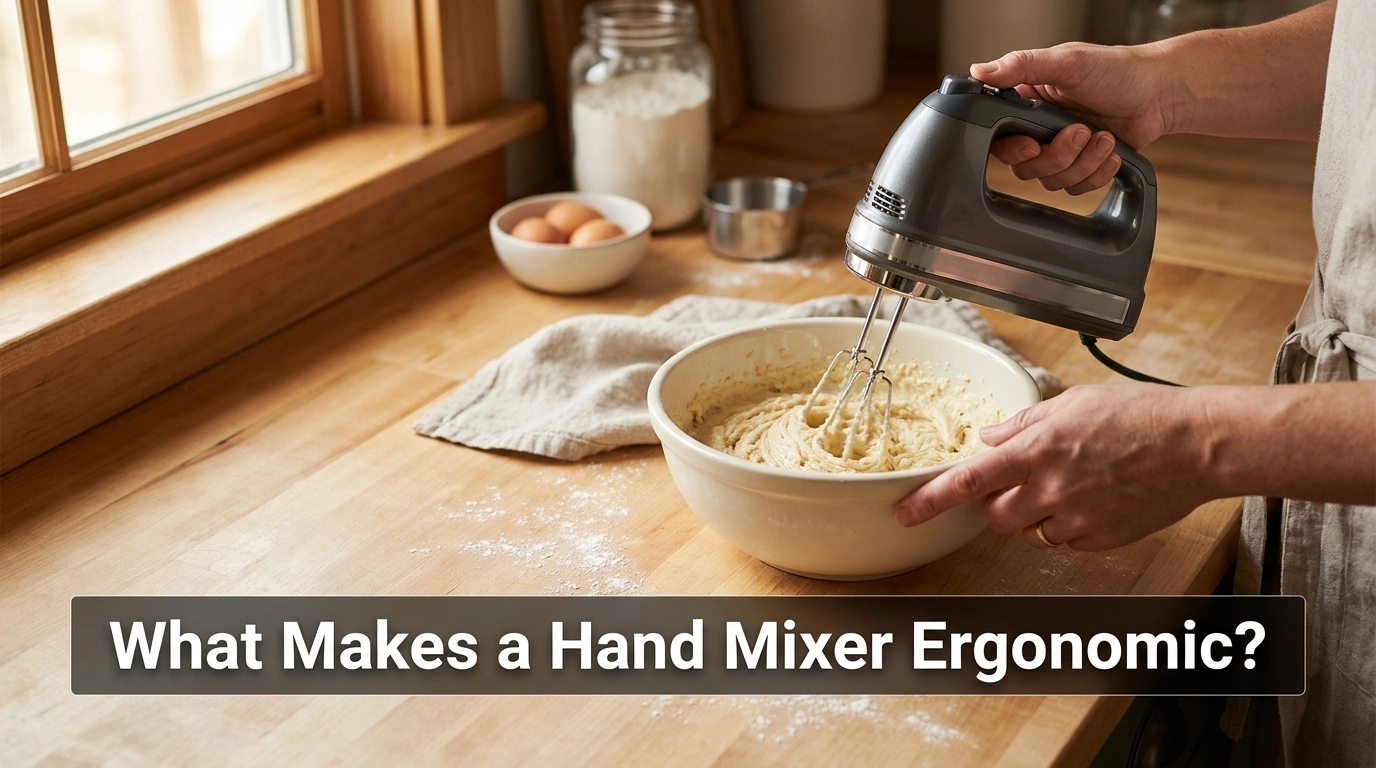
Quick Answer
An ergonomic hand mixer combines a comfortable, secure handle with balanced weight, accessible controls, and attachments that are easy to install and remove. These features help reduce unnecessary wrist strain and improve control while mixing. The best design feels natural in your hand, whether you’re whipping cream, beating eggs, or preparing cookie batter.
What to look for
- Comfortable grip: Choose a handle that fits your palm without forcing your fingers into an awkward position.
- Balanced weight: Look for a mixer that feels stable without pulling your wrist forward or sideways.
- Easy controls: Speed settings and the power switch should be accessible while you maintain a secure grip.
- Manageable vibration: A well-designed mixer should feel controllable rather than excessively buzzy or difficult to steady.
- Useful attachments: Beaters should fit securely and release easily without awkward finger movements.
- Practical cleaning: Smooth surfaces and removable, washable attachments make routine cleanup easier.
A simple comfort check
- Hold the unplugged mixer in your usual working position, reach each control, and check whether your wrist stays close to neutral rather than bending sharply.
- If possible, try the mixer at a safe low speed with a suitable bowl and ingredients before deciding whether its grip and balance suit you.
When choosing a hand mixer, comfort matters just as much as speed settings or motor power. In this guide, I’ll explain what makes a hand mixer ergonomic, how handle design and weight distribution affect everyday use, and which features deserve your attention before buying.
I’ll also distinguish meaningful comfort features from marketing language, so you can judge a mixer by how it fits your cooking routine rather than by the word “ergonomic” on its packaging.
In This Guide
- What does an ergonomic hand mixer mean?
- How should a hand mixer handle fit your hand?
- How do weight and balance affect comfort?
- Which controls, vibration, and attachment features matter?
- Which ergonomic features should you compare?
- How can you test a hand mixer for comfort?
- Frequently asked questions
What Does an Ergonomic Hand Mixer Mean?
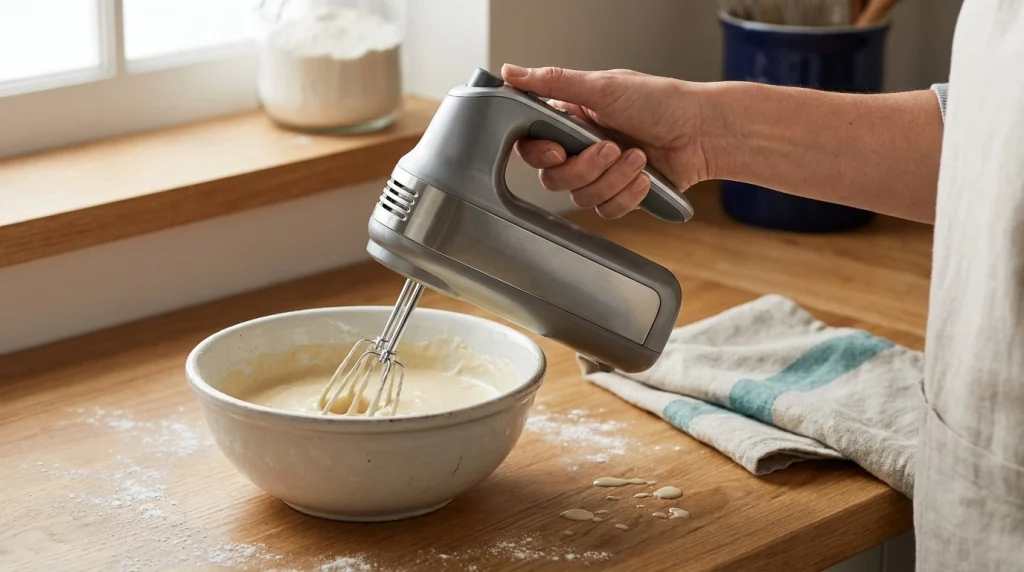
An ergonomic hand mixer is designed to fit the user’s hand, remain controllable during mixing, and reduce unnecessary physical effort. Its handle, weight distribution, controls, and attachment system work together to make common kitchen tasks more comfortable.
Ergonomics is more than a comfortable handle
Ergonomics means designing a product around the people who use it, including their body size, grip, movements, and physical needs. For a hand mixer, that means considering what happens from the moment you pick it up until you finish mixing and clean the attachments.
A soft handle can feel pleasant initially, but it won’t solve every comfort problem. A mixer with awkward balance, stiff controls, or excessive vibration can still become tiring during a longer recipe.
Look at the complete experience rather than one advertised feature:
- Grip: Does the handle fit your palm and allow a secure hold?
- Posture: Can you keep your wrist reasonably straight while reaching the bowl?
- Control: Can you change speeds without shifting your grip dangerously?
- Movement: Can you guide the beaters around the bowl without fighting the appliance?
- Recovery: Can you put the mixer down safely when you need a break?
Why ergonomics matters during everyday baking
Hand mixers require you to support the motor, guide moving beaters, and keep the appliance positioned over the ingredients. Your wrist and forearm help control those movements throughout the task.
That matters when you prepare several batches of cookies, whip cream for a dessert, or beat a mixture that needs sustained attention. A comfortable design can make these tasks easier to manage, although it cannot eliminate fatigue or guarantee that every user will experience the same comfort.
For broader guidance on handheld-tool design, the Canadian Centre for Occupational Health and Safety’s ergonomics guidance discusses grip, tool weight, and balance. These principles provide a useful starting point when evaluating a kitchen appliance.
Section takeaway: An ergonomic hand mixer should fit your hand, feel balanced, and let you control the appliance without unnecessary strain.
How Should a Hand Mixer Handle Fit Your Hand?
The handle should let you hold the mixer securely without squeezing excessively, bending your wrist sharply, or stretching your fingers to reach the controls. Its shape and surface should suit your hand size and preferred grip.
Choose a grip shape that feels natural
Handle shape influences where pressure falls across your palm and fingers. A handle that’s too thick may be difficult to wrap your fingers around, while a narrow or sharply edged handle may create uncomfortable pressure points.
When comparing designs, pay attention to these details:
- Rounded edges: Smooth contours can feel more comfortable than sharp corners that press into your palm.
- Suitable thickness: Your fingers should close around the grip without excessive effort.
- Adequate length: Your hand should feel supported rather than cramped against the handle’s ends.
- Natural orientation: The handle should allow you to guide the beaters without twisting your wrist into an awkward angle.
No single handle shape suits everyone. People with smaller hands may prefer a slimmer grip, while others may find a broader handle easier to hold securely.
Does a rubberized or soft-touch grip help?
A textured or rubberized grip can improve confidence when handling a mixer, especially if the housing feels slippery. However, a soft-touch finish isn’t automatically more ergonomic than firm, well-shaped plastic.
Compare the actual feel rather than the material label. A smooth, rounded plastic handle may suit you better than a bulky rubberized one if the latter forces your fingers apart.
Also consider cleaning. Flour, butter, and other kitchen residue can collect around seams or textured surfaces, so a grip should remain practical to wipe down according to the manufacturer’s instructions.
Can the handle reduce wrist strain?
A well-positioned handle can make it easier to keep your wrist aligned with your forearm. That position may help you guide the mixer with less awkward bending, particularly when moving between the center and edges of a mixing bowl.
Try to avoid a design that makes you cock your wrist backward to keep the beaters level. You should also be able to hold the appliance without constantly adjusting your fingers to maintain control.
For people who experience hand discomfort, the best choice depends on individual needs. Persistent pain, numbness, or tingling deserves medical advice rather than relying on a different handle alone.
Section takeaway: Prioritize a handle that fits your palm, offers dependable grip, and supports a natural wrist position over a particular material or finish.
How Do Weight and Balance Affect Hand Mixer Comfort?
A hand mixer should feel manageable to hold and easy to guide, with its weight distributed so the appliance doesn’t constantly pull your hand in one direction. The lightest model isn’t necessarily the most comfortable, because balance and grip geometry also affect control.
Is a lighter hand mixer always better?
Not necessarily. A lighter mixer can be easier to lift and hold during whipping, but an extremely light design may feel less steady to some users.
A heavier model may feel solid initially but become tiring when you support it for several minutes. The important question is whether you can comfortably control its weight throughout the recipes you prepare most often.
When comparing models, check the manufacturer’s stated weight and consider the complete appliance, including the attachments you expect to use. If a specification doesn’t clarify whether attachments are included, don’t assume the listed figure represents the full working weight.
What is weight distribution, and why does it matter?
Weight distribution describes how an appliance’s mass is spread across its body. A hand mixer may feel nose-heavy, tail-heavy, or relatively balanced even when two models weigh the same.
For example, imagine holding a mixer whose motor housing pulls forward while the beaters sit deep inside a bowl. You may need to apply extra force through your wrist to keep the appliance positioned correctly.
A more balanced design can make that movement feel more natural. Your hand still needs to support the mixer, but you shouldn’t feel as though you’re continually correcting its position.
How do motor power and mixing resistance affect comfort?
Motor wattage describes electrical power, not ergonomic quality. A higher wattage figure alone cannot tell you whether a mixer feels balanced, runs smoothly, or is comfortable to hold.
Ingredient resistance matters, too. Thick cookie dough can place more demand on the motor and make the appliance harder to guide than a bowl of lightly beaten eggs.
Choose a mixer designed for the work you intend to do. Follow the manufacturer’s limits for heavy mixtures, recommended attachments, and continuous operating time rather than forcing a handheld appliance through unsuitable tasks.
For longer or particularly heavy mixing jobs, a stand mixer may be a better fit because its base supports the motor during operation. A hand mixer remains useful when portability, flexible bowl choice, and easy storage matter more.
Section takeaway: Judge weight together with balance, intended workload, and handling comfort. Motor wattage alone doesn’t establish ergonomic quality.
Which Controls, Vibration, and Attachment Features Matter?
Comfort also depends on how easily you operate the mixer. Accessible speed controls, manageable vibration, convenient beater release, and a practical resting position can make routine mixing less awkward.
Are speed controls easy to reach?
The speed selector should be accessible without forcing you to loosen your grip or move your fingers into the beaters’ path. Controls positioned on top of the handle can work well, provided they suit your hand and remain easy to operate.
Look for a clear, predictable control layout:
- Easy speed adjustment: You should be able to select a suitable setting without fumbling.
- Clearly identified settings: Markings should be easy to understand at a glance.
- Accessible power switch: You should be able to stop the appliance promptly without an awkward hand movement.
- Useful low speed: A gentle starting setting helps you begin mixing without immediately scattering flour or splashing liquid.
A turbo or boost button can be useful for a short increase in speed, but it isn’t essential to ergonomic design. What matters more is whether the controls are intuitive and easy to manage safely.
How important are vibration and noise?
Excessive vibration can make a mixer feel less comfortable and harder to steady. Unpleasant noise can also make longer kitchen sessions less enjoyable, although noise level and ergonomic quality are separate considerations.
Vibration may depend on the motor, attachment condition, ingredient load, and how the appliance operates. A damaged or bent beater can affect smooth operation, so don’t assume that every unusual vibration is simply a design characteristic.
If you can inspect a working demonstration, notice whether the handle feels steady at low and moderate speeds. Avoid comparing models based on sound alone, because the bowl, ingredients, and surrounding room can change how loud a mixer seems.
Stop using a mixer that develops unusual vibration, sparking, smoke, or a burning smell. Unplug it safely and consult the manufacturer’s support service before using it again.
Do beater release and attachment storage matter?
Yes. Ergonomics extends beyond active mixing to the small actions involved in setup, storage, and cleanup.
- Beater release: A clearly positioned release button reduces the need for awkward finger movements.
- Secure attachment fitting: Beaters should fit correctly and lock into their intended positions.
- Practical storage: A storage case or cord-management feature can make the mixer easier to put away.
- Stable resting design: A model designed to rest securely between mixing steps can reduce unnecessary handling.
Never press the release button while the motor is running unless the manufacturer’s instructions explicitly provide for that operation. Switch off and unplug the appliance before removing attachments for cleaning or inspection.
For practical electrical safety advice, Electrical Safety First’s hand and stand mixer guidance explains safe handling, cleaning, and what to do when an appliance shows signs of damage.
Section takeaway: Comfortable controls and convenient attachments reduce avoidable effort. Smooth, predictable operation matters more than a long list of extra buttons.
Which Ergonomic Features Should You Compare?
The most useful comparison focuses on how each design supports your hand, wrist, and typical mixing tasks. Compare published specifications where available, then assess subjective features such as grip comfort and balance in person whenever possible.
Ergonomic hand mixer versus standard hand mixer
The word “ergonomic” isn’t a universal guarantee of comfort. A standard-looking model may fit your hand beautifully, while a mixer marketed as ergonomic may still feel bulky or awkward.
| Feature | What to look for | Why it matters |
|---|---|---|
| Handle shape | Rounded contours and a comfortable fit | Helps avoid pressure points and awkward gripping |
| Grip surface | Secure, easy-to-clean material | Supports control without excessive squeezing |
| Weight | Manageable for your typical mixing duration | Helps limit unnecessary holding effort |
| Balance | Minimal tendency to tip or pull your hand | Makes the appliance easier to guide |
| Speed controls | Accessible, clear, predictable operation | Reduces awkward grip changes |
| Vibration | Steady operation under suitable loads | Helps maintain comfortable control |
| Attachments | Secure fitting and convenient release | Makes setup and cleanup less awkward |
| Resting position | Stable placement between tasks | Reduces the risk of tipping or spills |
This is a practical evaluation framework, not a laboratory ranking of specific mixers. There is no single handle shape, weight, or control arrangement that guarantees a comfortable experience for every user.
Which features matter most for different users?
- Occasional bakers: Prioritize a comfortable grip, simple speed controls, and easy cleanup.
- Frequent bakers: Pay closer attention to weight distribution, vibration, and how the mixer feels during repeated use.
- People with smaller hands: Check handle thickness, finger reach, and the effort needed to operate controls.
- People with limited grip strength: Look for a secure, comfortable handle and controls that require little force.
- People who prepare dense mixtures: Confirm the manufacturer’s guidance on dough hooks, suitable ingredients, and operating limits.
These are starting points, not medical recommendations. If a hand condition affects your grip or movement, consider getting individualized advice from an appropriate healthcare professional or occupational therapist.
As of 2026, the most useful buying approach remains straightforward: evaluate the actual shape, balance, controls, and handling experience rather than treating an “ergonomic” label as proof of superior comfort.
Section takeaway: Compare features against your own needs, and treat ergonomic claims as prompts to investigate rather than guarantees.
How Can You Test a Hand Mixer for Comfort?
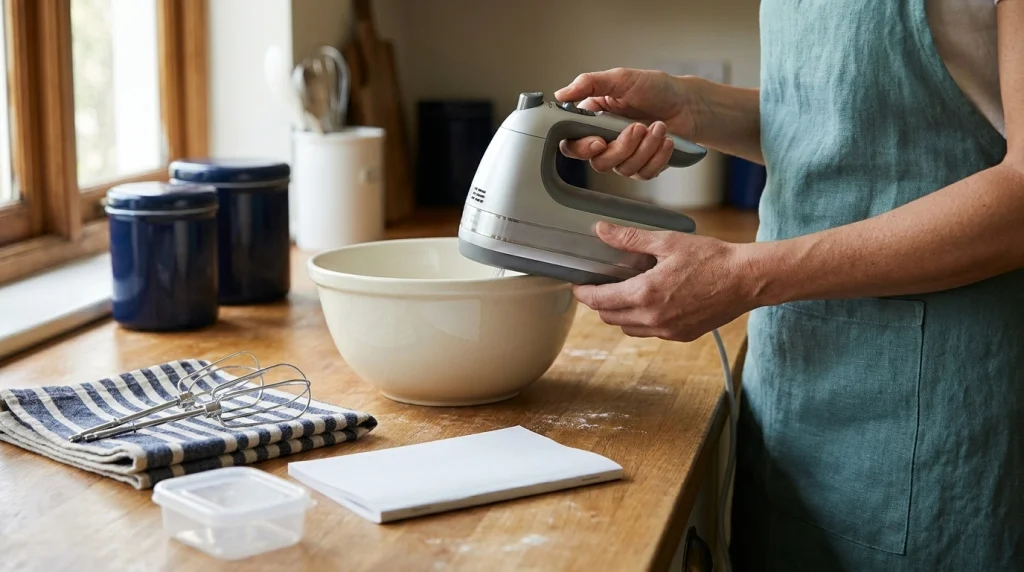
The best way to evaluate a hand mixer is to assess its grip, balance, controls, and handling together. If you can’t try it before purchasing, use manufacturer specifications, clear product photographs, instruction manuals, and detailed reviews to identify potential drawbacks.
Use this five-step comfort checklist
- Check the grip. Hold the unplugged mixer as you would during normal use. Your fingers should wrap around the handle comfortably without excessive squeezing.
- Assess the balance. Notice whether the motor housing feels as though it pulls your hand forward, backward, or sideways.
- Reach the controls. Check whether you can operate the speed selector and power switch without substantially changing your grip.
- Consider your bowl position. Imagine moving the beaters around a bowl on your usual countertop. The handle should allow a reasonably natural wrist position.
- Review cleaning and storage. Check how the beaters release, which parts are washable, and whether the appliance has a practical place to rest.
If the retailer permits a demonstration, follow its instructions and use an appropriate bowl and ingredients. Don’t operate a mixer without properly installed attachments or attempt to test its balance while the beaters are spinning outside a bowl.
What if you can’t try the mixer in person?
Product descriptions often emphasize motor power, speed settings, and included accessories. Those details can help you understand functionality, but they don’t establish whether a particular handle will feel comfortable in your hand.
Before buying, look for these details in the product listing or manufacturer’s documentation:
- The appliance’s weight and, if available, dimensions.
- Photographs showing the handle from different angles.
- The location and operation of the speed controls.
- Descriptions of grip materials and attachment-release mechanisms.
- Instructions covering suitable ingredients, cleaning, and operating time.
- Warranty coverage and the retailer’s return policy.
Check whether user reviews repeatedly mention the same handling problem, such as an awkward grip or tiring weight. Treat individual opinions as subjective experiences rather than verified measurements.
How can you use a hand mixer more comfortably?
Even a well-designed mixer can become uncomfortable when used in an awkward position or for a task beyond its intended capabilities. A few simple habits can improve handling.
- Keep the mixing bowl at a comfortable working height on a stable surface.
- Hold the mixer securely without gripping harder than necessary.
- Start at a low speed when appropriate, then increase gradually.
- Move the beaters around the bowl smoothly rather than forcing them through thick ingredients.
- Put the mixer down safely when you need a break, and follow the manual’s operating-time limits.
- Unplug the appliance before removing attachments or cleaning it.
Pro tip: If the mixer repeatedly causes discomfort, stop and reassess your grip, posture, and the task you’re performing. Persistent pain or tingling shouldn’t be ignored, and switching to a different appliance may be more appropriate for demanding mixing jobs.
Section takeaway: A short, structured comfort check can reveal problems that a product description won’t. Choose a mixer that fits your hands and your actual cooking habits.
Frequently Asked Questions
1. What is the most important ergonomic feature of a hand mixer?
The most important feature is a comfortable, secure handle that allows you to control the mixer without excessive squeezing or awkward wrist positioning. Weight distribution, accessible controls, and manageable vibration also influence comfort, so evaluate the complete design rather than focusing on one feature.
2. Is a lightweight hand mixer more ergonomic?
Not always. A lightweight mixer can reduce the effort needed to support it, but balance and grip design also matter. Compare the weight with how the appliance feels in your hand and how long you typically mix, rather than choosing the lightest model automatically.
3. Does an ergonomic handle reduce wrist pain?
A well-designed handle may help reduce awkward wrist positioning and unnecessary gripping effort, but it cannot guarantee pain prevention or relief. If you experience persistent pain, numbness, or tingling while mixing, stop the activity and seek appropriate medical advice.
4. Are rubberized handles better than plastic handles?
Rubberized handles can offer a secure, comfortable grip, but well-shaped plastic handles can work just as well for some users. Handle thickness, contour, surface texture, and ease of cleaning are more useful comparison points than material alone.
5. How much should an ergonomic hand mixer weigh?
There is no universal ideal weight for every user. The right choice depends on your hand strength, the appliance’s balance, and your typical mixing duration. Check the manufacturer’s weight specification and, if possible, hold the mixer before deciding whether it feels manageable.
6. Are more speed settings a sign of better ergonomics?
No. Additional speed settings may offer more control over different mixtures, but they don’t automatically make a mixer more comfortable. Clear markings, predictable adjustments, and easy access to the controls are more directly related to everyday handling.
7. Can an ergonomic hand mixer handle thick cookie dough?
Ergonomics doesn’t determine mixing capacity. Thick cookie dough places greater demands on the motor and attachments, so check the manufacturer’s instructions for approved ingredients, dough hooks, and operating limits. A stand mixer may be more suitable for frequent heavy mixing.
Final Takeaway: Choose Comfort You Can Feel
What makes a hand mixer ergonomic comes down to how well its design supports comfortable, controlled use. A suitable handle, balanced weight, accessible controls, manageable vibration, and convenient attachments all contribute to the experience.
My main recommendation is to judge the mixer as a complete tool, not by its advertised wattage or an ergonomic label alone. If possible, hold it before purchasing and consider how it will feel during the recipes you make most often.
For everyday baking, the best hand mixer is one you can hold securely, guide naturally, and clean without unnecessary effort. Comfort is personal, so choose the design that works for your hands and your kitchen.
Before you buy: Compare handle fit, weight, balance, control placement, attachment handling, and the manufacturer’s operating guidance. These practical checks will tell you more about likely comfort than marketing claims alone.