Quick Answer
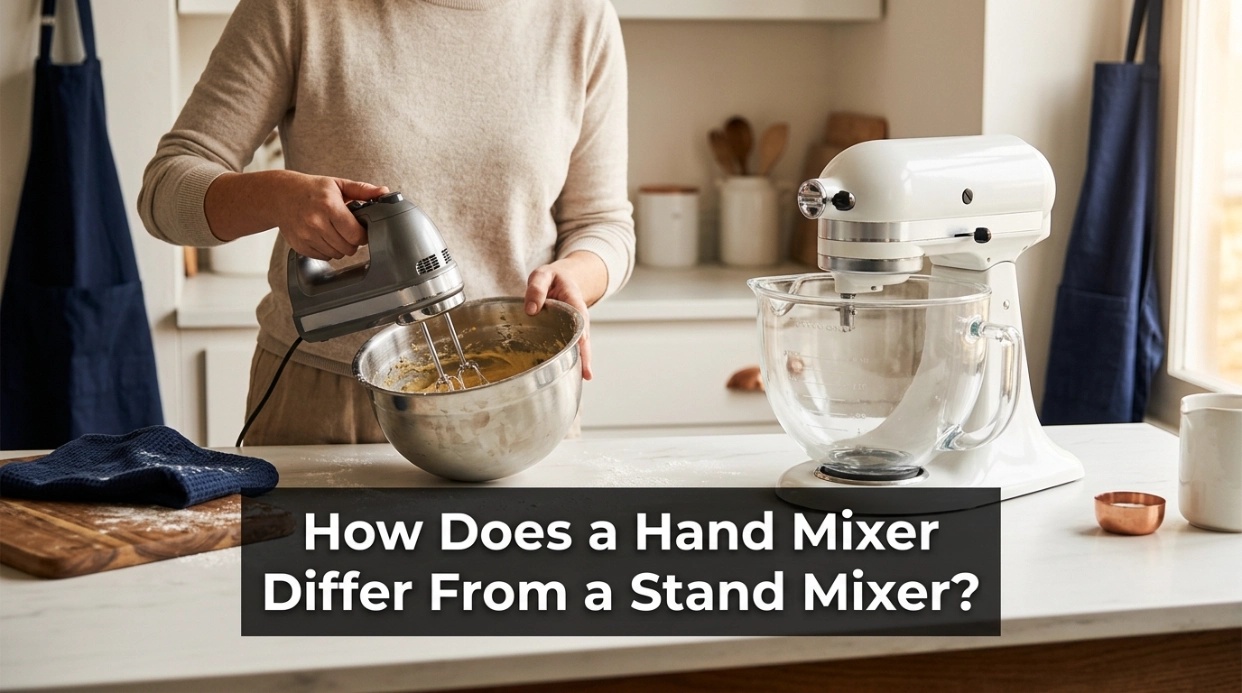
A hand mixer is a lightweight electric mixer you hold and move through a bowl, while a stand mixer is a stationary countertop appliance that mixes in its own bowl. Hand mixers suit quick, light jobs and small kitchens, while stand mixers are better for heavy dough, bigger batches, longer mixing sessions, and hands-free work. This basic distinction also matches KitchenAid’s hand mixer and stand mixer comparison.
The biggest differences
- Design: You hold a hand mixer, while a stand mixer stays on the counter.
- Batch size: Hand mixers favor small or medium batches; stand mixers handle larger batches more comfortably.
- Heavy mixtures: Stand mixers generally cope better with bread dough and stiff cookie dough.
- Convenience: A stand mixer can work hands-free, while a hand mixer needs continuous control.
- Storage: Hand mixers need much less cabinet and countertop space.
- Versatility: Many stand mixers accept optional attachments for tasks beyond basic mixing.
If you’re deciding between these two appliances, power alone doesn’t tell the whole story. Bowl size, recipe type, storage space, mixing time, and how often you bake matter just as much.
As of 2026, I still view them as complementary tools rather than simple substitutes. This guide explains where each one works best and when paying for a stand mixer makes sense.
In This Guide
What Is the Main Difference Between a Hand Mixer and a Stand Mixer?
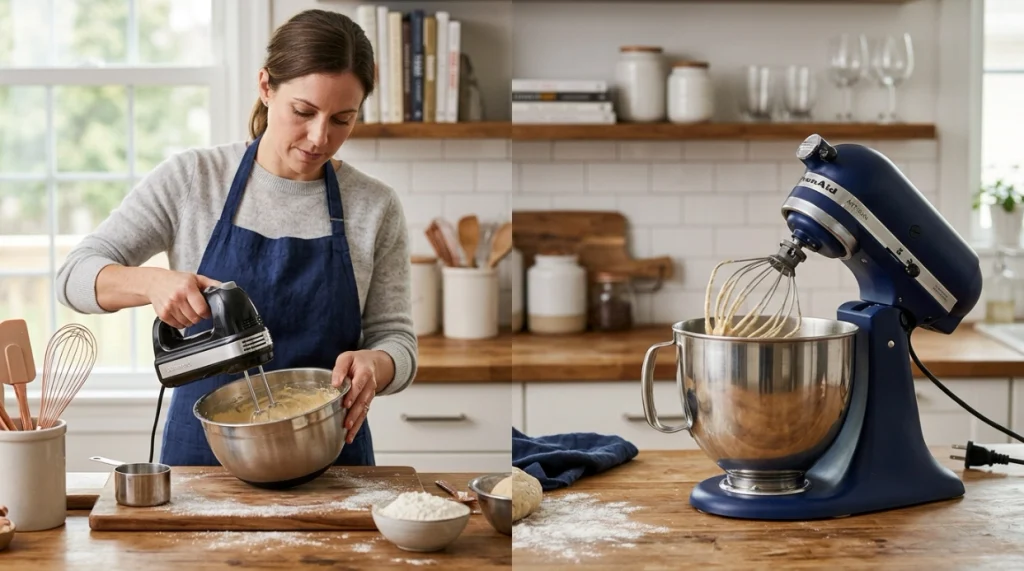
The main difference is how the appliance is supported and controlled. You guide a hand mixer around a bowl, while a stand mixer supports its motor and mixing tool on a fixed frame.
That design difference affects almost everything else. It changes capacity, comfort, storage needs, recipe suitability, and the amount of attention you must give the appliance.
What is a hand mixer?
A hand mixer is a portable electric appliance with removable beaters or similar attachments that you hold while mixing ingredients in a separate bowl.
You can move the beaters around the bowl yourself. That control works well for whipped cream, cake batter, frosting, eggs, mashed potatoes, and many cookie recipes.
- Portable design: Easy to carry between work areas.
- Separate bowl: You can choose a bowl suited to the recipe.
- Compact storage: Most models fit inside a cabinet or deep drawer.
- Quick setup: Insert the beaters, plug in the mixer, and start.
- Manual control: You decide exactly where the beaters move.
Modern hand mixers commonly offer several speed settings and interchangeable accessories. Some models include whisks, dough hooks, storage cases, or cordless operation.
Wattage varies widely, so I wouldn’t compare models on watts alone. Motor design, gearing, beater shape, and speed control also affect how a mixer behaves under load.
What is a stand mixer?
A stand mixer is a stationary electric mixer with a motor head or drive assembly mounted above a dedicated mixing bowl. The appliance supports both the mixing mechanism and bowl during operation.
Most household models use a flat beater, wire whisk, and dough hook. Some also accept optional attachments for food preparation beyond mixing.
- Hands-free mixing: The machine holds and drives the mixing tool.
- Fixed bowl: The bowl locks or mounts to the mixer.
- Higher workload: The design suits longer and heavier mixing jobs.
- Large footprint: The appliance needs significant counter or cabinet space.
- Extra attachments: Some models can power grinders, pasta rollers, and other accessories.
Stand mixers also come in different configurations. Tilt-head models hinge upward, while bowl-lift machines raise the bowl toward the mixing attachment.
KitchenAid, for example, offers household stand mixer bowls from compact 3.5-quart models through larger-capacity machines. Its stand mixer buying guide explains common configurations and attachment options.
| Feature | Hand Mixer | Stand Mixer |
|---|---|---|
| Operation | Held and guided by hand | Stationary, hands-free mixing |
| Bowl | Uses a separate bowl | Uses its fitted bowl |
| Typical workload | Light to moderate | Light through heavy |
| Storage space | Low | High |
| Long mixing jobs | Can become tiring | More convenient |
| Heavy dough | Model-dependent and limited | Usually better suited |
Section Takeaway: A hand mixer puts you in control of a portable mixing tool. A stand mixer supports the bowl and mixing mechanism for heavier, longer, and more hands-free jobs.
Which Mixer Performs Better for Different Recipes?
Neither mixer wins every recipe. A hand mixer excels at quick, flexible work, while a stand mixer earns its space when mixtures become heavy or mixing times increase.
Tasks that suit a hand mixer
I usually think of a hand mixer first when the mixture stays relatively loose and the job doesn’t require extended kneading. It is particularly practical when you only need the appliance for a few minutes.
- Whipped cream: A hand mixer gives you close visual control as the cream thickens.
- Egg whites: The whisk or beaters can build foam without requiring a large mixer bowl.
- Cake batter: Many standard cake batters need mixing rather than heavy mechanical kneading.
- Frosting: Buttercream and similar mixtures often work well in manageable batches.
- Mashed potatoes: You can mix directly in a suitable pot or bowl when the recipe permits.
- Small cookie batches: Softer doughs may not justify setting up a full stand mixer.
KitchenAid’s current hand mixer guide likewise describes these appliances as useful for batters, doughs, whipping, and other everyday jobs.
Tasks that favor a stand mixer
A stand mixer becomes more useful as resistance increases. Dense bread dough is the clearest example because kneading can demand both sustained power and physical control.
- Bread dough: A dough hook can knead while the bowl remains secured.
- Pizza dough: Stiffer dough is easier to manage without holding the motor yourself.
- Large cookie batches: The bowl and frame provide stability as dough thickens.
- Repeated batches: Hands-free operation reduces physical effort during longer baking sessions.
- Attachment-driven jobs: Compatible stand mixers may support pasta rollers, grinders, or other accessories.
A stand mixer also gives you two free hands for certain steps. You can measure another ingredient or prepare a pan while the machine mixes.
That doesn’t mean you should walk away. You still need to watch the mixture and follow the appliance manufacturer’s operating instructions.
Can a hand mixer knead bread?
Some hand mixers include dough hooks, but that doesn’t make every hand mixer suitable for every bread dough. Dense dough places far more load on the motor than whipped cream or cake batter.
Check the manual before kneading. Pay attention to recommended batch size, speed, duty cycle, and any warnings about heavy mixtures.
If the mixer slows sharply, becomes unusually hot, or struggles to turn the dough, stop rather than forcing it. The recipe may be better suited to a stand mixer or hand kneading.
Section Takeaway: Choose by recipe resistance and mixing duration, not simply by which appliance has the higher advertised wattage.
How Do Power, Capacity, and Mixing Time Compare?
A stand mixer generally has the advantage when you combine large batches, dense mixtures, and longer operating times. A hand mixer prioritizes portability instead.
Does a stand mixer always have more power?
Stand mixers are commonly designed for heavier workloads, but motor wattage alone isn’t a reliable cross-brand performance score. Electrical input and useful mixing performance aren’t the same measurement.
Two mixers with different wattage ratings can behave differently because of motor type, gearing, efficiency, electronic control, attachment design, and mechanical losses.
- Don’t shop by watts alone: Look at the manufacturer’s intended uses.
- Check dough limits: Heavy-dough capacity matters if you bake bread often.
- Read duty guidance: Some appliances specify operating or cooling limits.
- Match bowl size: A huge bowl isn’t automatically better for tiny batches.
How does capacity differ?
A hand mixer has no fixed bowl capacity because you supply the bowl. That gives it useful flexibility for small recipes and awkward containers.
A stand mixer has a defined bowl capacity. Household options may range from compact bowls around 3.5 quarts to substantially larger bowls, depending on the manufacturer and product line.
Bowl capacity still doesn’t equal usable capacity for every recipe. Flour quantity, dough stiffness, liquid volume, and attachment clearance can change the practical limit.
What about long mixing times?
This is where the physical difference becomes obvious. Holding a mixer for several minutes can fatigue your hand, wrist, and forearm.
A stand mixer transfers that burden to its frame. You still supervise the appliance, but you aren’t supporting the motor’s weight throughout the process.
That advantage matters when whipping large quantities, creaming ingredients for multiple batches, or developing dough. Frequent bakers often value reduced effort as much as increased capacity.
For electrical appliances, I also look beyond performance claims and check the product’s safety documentation. UL Solutions explains that household electrical appliances fall under safety requirements addressing electrical, mechanical, thermal, and related hazards through standards such as IEC 60335-1.
Pro tip: If a mixer overheats repeatedly, sparks, smells electrically burnt, or develops an internal fault, don’t open or bypass its safety features. Follow the manufacturer’s manual or use a qualified appliance repair technician.
Section Takeaway: Stand mixers gain their biggest performance advantage when workload, batch size, and mixing duration increase together.
Which Is Easier to Use, Clean, and Store?
A hand mixer usually wins for setup and storage. A stand mixer usually wins for physical comfort during demanding recipes.
Setup and everyday use
A hand mixer has a simple routine. Choose a bowl, attach the beaters, connect power if required, and mix.
Moving it around the bowl also lets you target dry pockets near the sides. That can feel more intuitive when you’re making a small batch.
A stand mixer needs a little more preparation. You secure its bowl, fit the correct attachment, set the bowl or head position, and choose an appropriate speed.
Once running, though, it demands less physical effort. That’s a major difference during recipes with lengthy mixing stages.
Cleaning
A hand mixer often leaves you with the bowl and one pair of beaters to wash. The mixer body normally only needs exterior cleaning according to its manual.
A stand mixer may involve a bowl, beater, whisk, dough hook, pouring shield, or other parts. Whether those pieces are dishwasher-safe depends on the specific manufacturer and finish.
- Unplug first: Disconnect corded mixers before cleaning or changing attachments.
- Keep the motor dry: Never immerse a motor housing unless the manual explicitly says otherwise.
- Check attachment instructions: Coated, polished, and specialty parts may have different care requirements.
- Dry before storage: Moisture left on metal components can create staining or corrosion on susceptible finishes.
Storage and counter space
A compact hand mixer is much easier to accommodate in a small apartment kitchen. Many units can share a drawer or cabinet shelf with their accessories.
A full-size stand mixer is another matter. Its weight and height often make permanent countertop storage more practical than lifting it from a low cabinet each time.
Measure your available height if you plan to place one beneath upper cabinets. Tilt-head models need additional clearance when the head is raised.
Electrical safety
Mixers combine moving parts, electricity, and kitchens where water is nearby. Sensible placement matters even during routine baking.
The U.S. Consumer Product Safety Commission’s home electrical safety checklist advises keeping countertop appliance cords away from hot surfaces and keeping electrical appliances away from sinks.
- Inspect the cord: Stop using an appliance with damaged insulation or exposed wiring.
- Avoid wet areas: Keep the mixer and plug away from splashes and standing water.
- Unplug safely: Disconnect power before fitting or removing beaters when directed by the manual.
- Keep tools clear: Don’t insert utensils into moving beaters or attachments.
- Follow the manual: Speed limits and maximum batch guidance vary by model.
Section Takeaway: Hand mixers minimize setup and storage demands, while stand mixers reduce the physical work of longer mixing jobs.
Should You Buy a Hand Mixer or a Stand Mixer?
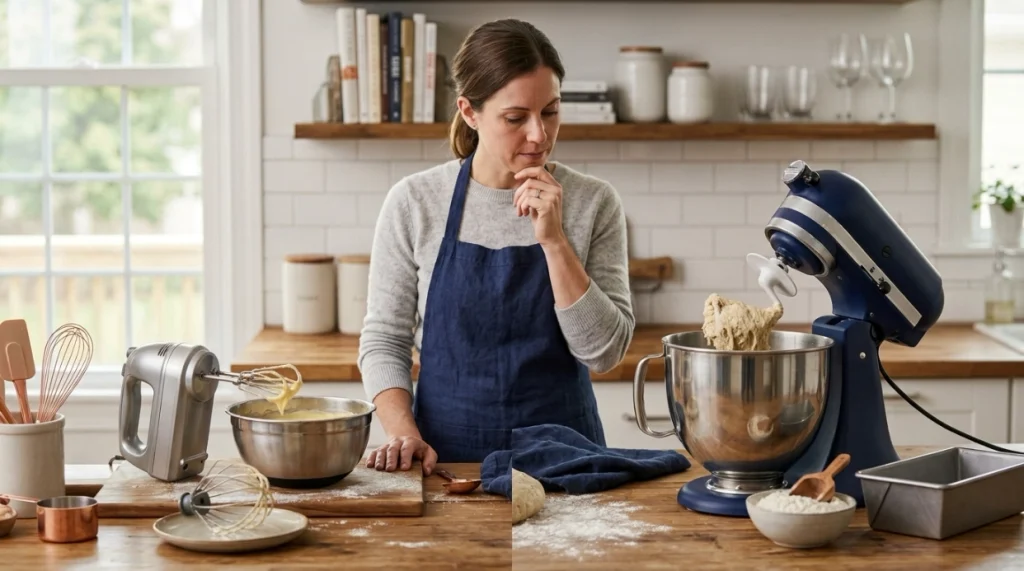
Buy according to what you make most often. The best choice for an occasional cake baker can be completely different from the best choice for someone making bread every weekend.
Choose a hand mixer if…
- You bake occasionally rather than several times each week.
- You mainly make cakes, frosting, whipped cream, eggs, or other lighter mixtures.
- Your kitchen has limited counter and cabinet space.
- You prefer an appliance that’s easy to carry and store.
- You usually make small or moderate batches.
- You don’t need specialty stand mixer attachments.
A hand mixer also makes sense as a second mixer. Even households with a stand mixer may prefer the smaller appliance for one bowl of whipped cream or a quick frosting.
Choose a stand mixer if…
- You frequently make bread, pizza, or other heavy dough.
- You prepare large batches of cookies or batter.
- You want hands-free operation during longer mixing stages.
- You bake often enough to justify dedicated countertop space.
- You want compatible food-preparation attachments.
- Holding a hand mixer for extended periods is uncomfortable.
A stand mixer is particularly useful when baking is part of your weekly routine. Its size becomes easier to justify when you use it often.
What if you can only own one?
For lighter everyday baking in a small kitchen, a hand mixer covers a surprising amount of ground. It costs less in many product ranges and is easier to store.
For bread, thick dough, large batches, and frequent baking, a stand mixer offers capabilities that a hand mixer may not comfortably replace.
Don’t overlook ergonomics. Someone with limited grip strength may value hands-free mixing even if they rarely make huge batches.
On the other hand, a heavy stand mixer can itself be difficult to lift. Keeping it permanently on the counter may be necessary if moving it is uncomfortable.
| Your Priority | Usually the Better Fit | Why |
|---|---|---|
| Small kitchen | Hand mixer | Minimal storage footprint |
| Bread baking | Stand mixer | Better suited to sustained heavy mixing |
| Quick cakes and frosting | Hand mixer | Fast setup and cleanup |
| Large batches | Stand mixer | Stable bowl and larger-capacity options |
| Maximum portability | Hand mixer | Easy to move and store |
| Hands-free operation | Stand mixer | Frame supports the mixer and bowl |
When I compare the two categories, I focus first on the toughest recipe someone regularly makes. That question is often more useful than comparing feature counts.
If your toughest normal job is cake batter, a hand mixer may be enough. If it’s two loaves of bread dough, the case for a stand mixer becomes much stronger.
Section Takeaway: Match the mixer to your hardest frequent recipe, available space, and preferred working style rather than buying the appliance with the longest specification sheet.
Frequently Asked Questions
Can I use a hand mixer instead of a stand mixer?
Yes, for many lighter recipes. Hand mixers can handle tasks such as cake batter, whipped cream, frosting, eggs, and some cookie dough, but heavy bread dough and large batches may be better suited to a stand mixer.
Is a stand mixer better than a hand mixer?
A stand mixer is better suited to heavy dough, larger batches, long mixing periods, and hands-free operation. A hand mixer can be more practical for light recipes, small kitchens, fast setup, and easy storage.
Can a hand mixer make cake batter?
Yes. Cake batter is one of the most common jobs for a hand mixer, provided you follow the recipe and appliance instructions and use a bowl large enough to prevent ingredients from splashing out.
Can a hand mixer make cookie dough?
A hand mixer can make many soft or moderate cookie doughs. Once dough becomes dense enough to strain the mixer, stop and check the manufacturer’s instructions rather than forcing the motor through a mixture beyond its intended workload.
Do I need a stand mixer for bread?
No. Bread dough can also be kneaded by hand, and some hand mixers include dough hooks. A stand mixer is simply more convenient for many frequent bakers because its fixed frame can handle sustained kneading without requiring you to hold the motor.
Does a higher-watt mixer always mix better?
No. Wattage describes electrical power consumption and isn’t a complete measurement of mixing ability. Motor design, gearing, efficiency, attachment shape, electronic controls, and the manufacturer’s recommended workload also affect real-world performance.
Is it worth owning both a hand mixer and a stand mixer?
It can be. A stand mixer can take care of demanding dough and large batches, while a hand mixer remains convenient for small, quick tasks that don’t justify setting up the larger appliance.
The simplest takeaway is this: a hand mixer emphasizes portability and convenience, while a stand mixer emphasizes capacity, stability, and sustained mixing.
Before buying either one, list the recipes you make most often and identify the heaviest mixture on that list. That will tell you far more than choosing on wattage or appearance alone.
