
If you are wondering what to do with eggs after egg cooker finishes, the best first step is simple. Remove the eggs from the heat and cool them in cold water.
I use the same routine each time because leaving the eggs sitting in the hot cooker can keep them cooking. That can make the yolks dry and can even cause a gray-green ring.
You also need to watch out for hot steam. The lid, egg tray, water, and heating plate may stay very hot for several minutes.
In this guide, I will show you how to cool the eggs, check them, peel them, store them, and fix common problems.
Common Signs of the Problem
Most people searching this question do not have a broken egg cooker. The real problem is knowing what should happen when the cooking cycle ends.
Here are some common signs I look for.
| Symptom | Likely Cause | Quick Fix |
|---|---|---|
| Eggs are very hot | Normal after steaming | Move them into cold water |
| Shells are hard to peel | Eggs stayed hot too long | Cool them well before peeling |
| Yolks look dry | Eggs continued cooking | Remove them sooner |
| Egg white looks runny | Not enough cooking time | Cook again briefly |
| Shells cracked | Heat, pressure, or handling | Cool gently and check the egg |
A beep or auto shut-off normally means the heating cycle has ended. It does not always mean the eggs are cool enough to touch.
I wait a moment for the strongest steam to escape before I handle the lid.
If the egg tray is cracked or hard to lift, I would replace it rather than keep struggling with hot eggs. A replacement egg tray can make removal safer.
The same goes for the water measuring cup. If its markings have worn away, a replacement measuring cup can help you get more consistent results next time.
Possible Causes
The main problems after an egg cooker finishes usually come from heat, water amount, or timing.
The cooker may have stopped heating, but the eggs and metal heating plate still hold a lot of heat. This is called carryover cooking.
Common causes include:
- Leaving eggs inside the closed cooker after the beep.
- Using too much or too little water.
- Opening the lid directly toward your face.
- Peeling eggs before they have cooled.
- Leaving cooked eggs at room temperature too long.
- Using a damaged egg tray.
- Cooking eggs longer than needed for the desired texture.
The amount of water matters because many electric egg cookers use water to control cooking time. More water can mean a longer steaming cycle.
That is why I do not guess the water level when consistent results matter. I use the marks on the measuring cup that match soft, medium, or hard eggs.
What to Do With Eggs After Egg Cooker: Step-by-Step
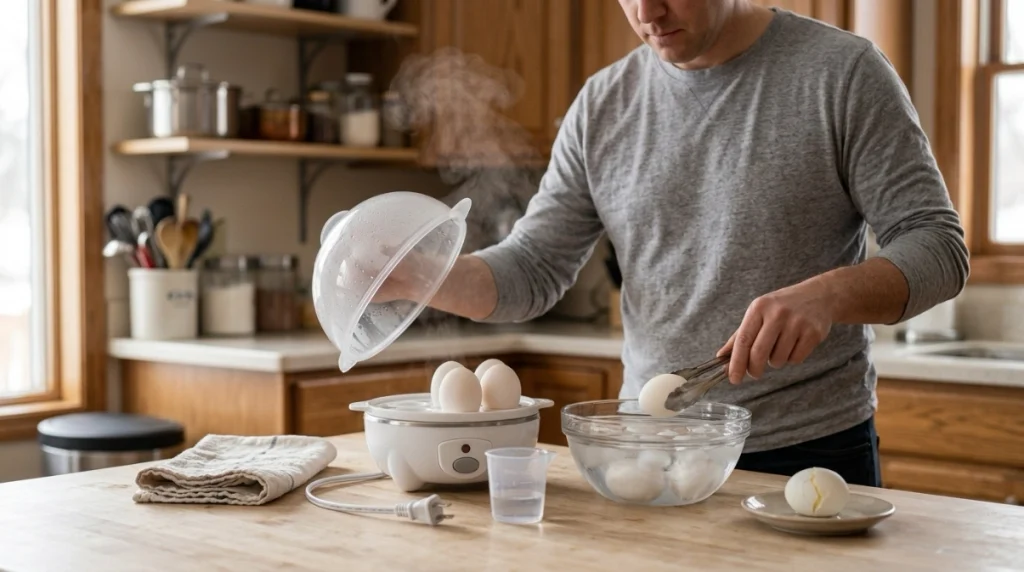
Once the cooker stops, I follow a simple routine. It keeps the eggs from overcooking and makes them easier to handle.
1. Turn Off or Unplug the Egg Cooker
If the cooker does not switch itself fully off, turn it off and unplug it.
Do not touch the heating plate. It can stay hot even when the light has gone out.
I also keep the power cord away from any spilled water. Water and electrical parts should never mix.
2. Let the Steam Escape Safely
Steam can burn skin very fast. I never put my face or hands directly above the steam vent.
Lift the lid from the side or by its handle. Open it so the steam moves away from you.
Do not grab the eggs at once if steam is still pouring out.
A short pause makes the next step much safer.
3. Move the Eggs Into Cold Water
This is the step that makes the biggest difference for me.
Put the cooked eggs into a bowl of very cold water. Ice water also works well.
Cooling stops most of the extra cooking from stored heat. It can also make hard-cooked eggs easier to peel.
Let the eggs sit until they feel cool enough to handle. For very hot hard-cooked eggs, I usually give them several minutes.
| Problem | Recommended Solution | Difficulty |
|---|---|---|
| Eggs keep cooking | Use cold or ice water | Easy |
| Eggs are hard to handle | Cool before touching | Easy |
| Shell sticks badly | Cool fully before peeling | Easy |
| Egg seems undercooked | Check and cook a little longer | Easy |
4. Check the Egg Before Eating
If I am not sure about doneness, I open one egg first.
For a hard-cooked egg, the white should be firm. The yolk should be set to the level I wanted.
If the white is still too loose, the egg may need more cooking. Put it back only if your egg cooker’s instructions allow another short cycle.
Do not keep adding random amounts of water. Use the measuring guide when possible.
5. Peel the Eggs or Leave the Shell On
If I plan to eat an egg right away, I often peel it after it cools.
I tap the shell gently and roll the egg on a flat surface. Then I peel from the wider end, where there is often a small air pocket.
Running a little water over the egg can help loosen small shell pieces.
If I plan to store the eggs, I usually leave the shells on. The shell gives the cooked egg some protection in the refrigerator.
6. Store Cooked Eggs Safely
Do not leave cooked eggs sitting on the counter for hours.
As a general food-safety rule, refrigerate perishable cooked food within two hours. If the room is above about 90°F or 32°C, use one hour instead.
Hard-cooked eggs are generally best used within about one week when kept refrigerated.
Keep them in a covered container so they do not pick up smells from other foods.
7. Clean the Cooker After It Cools
Wait until the appliance has cooled and is unplugged before you clean it.
I wipe the heating plate with a soft damp cloth. I do not pour water over the electrical base or place it under running water unless the manufacturer clearly says it is safe.
The removable egg tray and lid can often be washed separately. Always check the care instructions for your model.
If the heating plate develops white mineral marks, gentle cleaning with a small amount of white vinegar may help. Do not use rough metal scrubbers because they can scratch the plate.
What If the Eggs Are Undercooked?
An undercooked egg often happens when too little water was used or the cooking cycle ended early.
First, check one egg. If the white or yolk is softer than you wanted, you may be able to run another short cooking cycle.
Use only the amount of water recommended for your cooker. Adding a large amount can make the eggs overcook.
If the cooker repeatedly stops before the eggs are done, check that the egg tray is sitting correctly and that the lid fits as intended.
A blocked steam vent can also affect normal operation. Make sure the vent is clear after the unit is cool.
What If the Eggs Are Overcooked?
Overcooked eggs often have firm, rubbery whites and dry yolks.
You may also see a gray or green ring around the yolk. This is usually harmless, but it often means the egg stayed hot for too long.
The fix is mostly about timing.
Remove the eggs soon after the cooking cycle ends and place them in cold water. Next time, also check that you are using the correct water level.
Mistakes to Avoid
One mistake I try to avoid is leaving the lid closed after the cooker finishes. The trapped heat can keep cooking the eggs.
Another mistake is opening the lid toward my face. Hot steam can escape suddenly and cause a painful burn.
Do not:
- Touch the heating plate while it is hot.
- Pour cold water directly onto a hot electrical base.
- Open the sealed heating unit.
- Bypass an auto shut-off or safety switch.
- Use a damaged power cord.
- Leave cooked eggs unrefrigerated for long periods.
- Keep using a badly cracked egg tray or lid.
If you smell burning plastic or see smoke, unplug the cooker if it is safe to do so and stop using it.
That is not a normal egg-cooking issue.
When to Replace the Egg Cooker

Most post-cooking problems do not mean you need a new appliance.
Hard-to-peel eggs, overcooked yolks, or hot shells are usually solved by changing the cooling method or water amount.
Replacement makes more sense when the electrical parts show signs of damage.
| Repair Issue | Best Action | Replace Instead? |
|---|---|---|
| Cracked removable tray | Replace tray | Usually no |
| Lost measuring cup | Replace cup | No |
| Damaged lid | Replace if available | Usually no |
| Frayed power cord | Stop using cooker | Often yes |
| Burning smell from base | Stop using cooker | Yes |
| Cooker fails to shut off | Stop using cooker | Often yes |
I would not open the heating base to repair wiring myself.
For a low-cost kitchen appliance, replacement is often safer than attempting an electrical repair.
My Personal Routine
The simplest routine I follow is remove, cool, check, and store.
The biggest improvement comes from moving the eggs out of the hot cooker soon after the beep. Letting them sit in the trapped steam tends to make hard-cooked eggs firmer than needed.
Cold water is the next key step. It makes the eggs comfortable to handle and stops much of the extra cooking.
I also check one egg before assuming the whole batch is perfect. If that egg is too soft or too firm, I know what to change the next time.
The water measuring cup is more important than it looks. Using the correct mark gives me more repeatable results than guessing.
Final Thoughts
If you are unsure what to do with eggs after egg cooker finishes, keep the process simple.
Turn the cooker off, avoid the hot steam, remove the eggs, and put them in cold or ice water. Then check their doneness and either peel them or refrigerate them.
For most people, that solves the problem.
If the eggs keep coming out too soft or too firm, adjust the water amount and remove them sooner after the cooking cycle.
And if the cooker shows electrical damage, a burning smell, smoke, or a failed safety shut-off, stop using it rather than trying to open or repair the heating unit yourself.