How much electricity does an egg cooker use? Most small models use about 250 to 500 watts while heating. A normal 10-minute batch uses about 0.04 to 0.08 kilowatt-hours (kWh).
That is a small amount of power. In most homes, one batch costs only a few cents or less. The exact cost depends on the cooker’s wattage, cook time, and your local power rate.
When I first checked an egg cooker, I made the mistake of looking only at its watt rating. I soon learned that watts tell only half the story. Cook time matters just as much.
This guide shows you how to estimate the real cost. It also explains why a cooker may run too long and how to fix common causes safely.
Common Signs of the Problem
A small egg cooker should heat fast and stop when its water is gone. Most batches take about 6 to 16 minutes, based on the model and egg setting.
A power problem may be present if the cooker takes far longer than normal. You may also see water left on the heating plate after the usual cook time.
Other warning signs include:
- The cooker keeps heating after the eggs are done.
- Steam escapes from the edge of the lid.
- The heating plate has thick white scale.
- The cooker turns off and then starts again.
- The plug, cord, or wall outlet becomes hot.
- You notice a burning smell or melted plastic.
- The unit fails to beep or shut off.
The measuring cup is more important than it looks. When I tested different water amounts, a small extra pour added several minutes to the cycle. If the original cup is lost, a marked replacement measuring cup can help keep each batch consistent.
| Sign | Likely Cause | Quick Check |
|---|---|---|
| Cook cycle is too long | Too much water | Use the marked water level |
| Steam leaks near the lid | Lid is loose or damaged | Seat the lid correctly |
| Plate heats slowly | Mineral buildup | Descale the plate |
| Cooker does not stop | Shut-off fault | Unplug and stop using it |
| Plug feels hot | Cord or outlet problem | Try no further tests |
How Much Electricity Does an Egg Cooker Use?
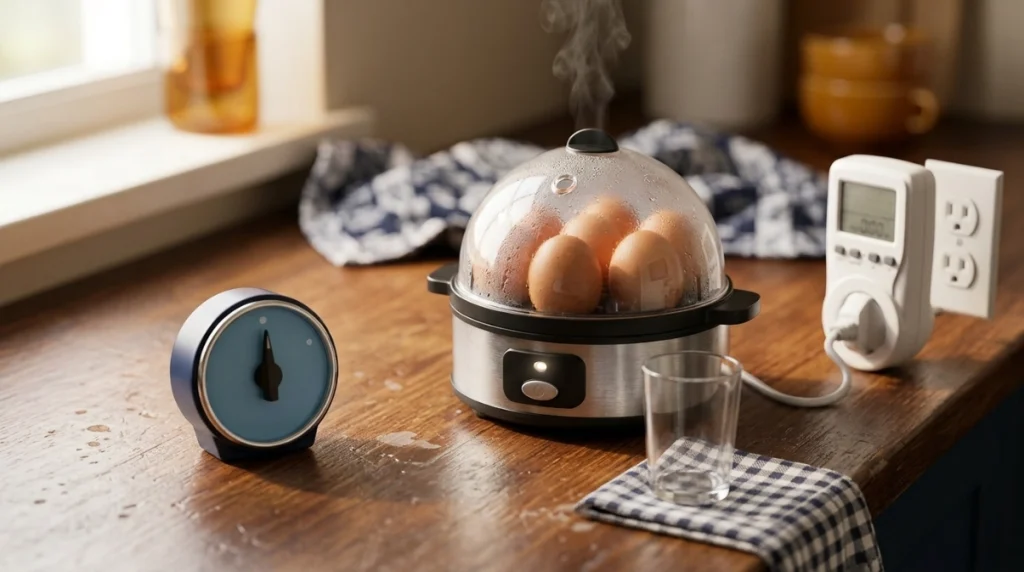
Most home egg cookers draw between 250 and 500 watts. Large models with several trays may use 600 watts or more. Always check the rating label under the base.
A watt is the rate at which a device uses power. Your electricity bill, however, is based on kilowatt-hours. This includes both power and time.
Use this simple formula:
Energy used in kWh = watts ÷ 1,000 × hours used
For example, a 400-watt egg cooker running for 10 minutes uses:
400 ÷ 1,000 × 0.167 = about 0.067 kWh
To find the cost, multiply that result by your electricity price:
Cost per batch = kWh used × price per kWh
If electricity costs $0.16 per kWh, that 400-watt cooker costs about one cent per batch. Local rates vary, so use the rate shown on your own bill.
| Cooker Power | 10-Minute Energy Use | 30 Batches per Month |
|---|---|---|
| 250 watts | 0.042 kWh | 1.25 kWh |
| 350 watts | 0.058 kWh | 1.75 kWh |
| 400 watts | 0.067 kWh | 2.00 kWh |
| 500 watts | 0.083 kWh | 2.50 kWh |
| 600 watts | 0.100 kWh | 3.00 kWh |
These figures assume the heating element draws its full rated power for the whole cycle. Real use can vary because some models cycle the heat on and off.
Possible Causes of Higher Electricity Use
An egg cooker rarely causes a large jump in a power bill by itself. Yet a fault or poor setup can make each cycle longer than it should be.
Too much water
The cooker must heat and boil all the water you add. More water means a longer cycle and more electricity.
The cup markings may seem odd because some cookers need less water for more eggs. Follow the markings made for your model rather than guessing.
Mineral buildup on the heating plate
Hard water leaves a white or brown layer on the metal plate. This layer can slow heat transfer and cause uneven cooking.
A thin film may have little effect. Thick scale can make the cooker run longer and leave the eggs softer than expected.
A poor lid fit
A loose lid lets heat and steam escape. The cooker may then need more time to boil away the water.
Check that the egg tray is flat and the lid sits in its proper position. Never block the steam vent to hold heat inside.
A failing heating element
A weak or damaged heater may warm slowly. A short cook cycle can become much longer, even with the correct water level.
A heater fault can also cause odd smells, noise, or repeated shut-offs. This is not a safe home repair inside a sealed base.
Auto shut-off trouble
Many egg cookers stop heating when the plate becomes dry and its temperature rises. A sensor or switch then cuts the power.
If that system fails, the cooker may stay hot after the water is gone. Unplug it at once and do not keep testing it.
How to Fix High Egg Cooker Electricity Use
You cannot lower the cooker’s rated watts. You can, however, stop it from running longer than needed.
Check the wattage label
Unplug the cooker and turn the cool base over. Look for a label showing watts, such as 350W or 400W.
If the label lists only volts and amps, multiply them to estimate watts:
Volts × amps = watts
This is the highest likely draw. It does not mean the cooker uses that much energy all day.
Time one normal batch
Add the correct water amount and use eggs of a similar size. Start a timer when you switch on the cooker.
Write down when it beeps or shuts off. Repeat the test once more after the unit has cooled.
A large change between similar batches may point to a loose lid, scale, or a faulty control. Stop testing if the unit smells hot or behaves in an unsafe way.
Use the correct water amount
Use the cup and chart supplied with the cooker. Select the mark for soft, medium, or hard eggs.
Do not fill by sight. In my checks, this was the easiest mistake to make and the simplest one to correct.
Inspect the tray, lid, and steam vent
Set the egg tray into its proper slots. Make sure the lid is level and the steam vent is open.
Replace a cracked lid or warped tray with a compatible part. A poor fit can release too much steam, while a blocked vent can cause unsafe pressure and hot-water spray.
Remove mineral buildup
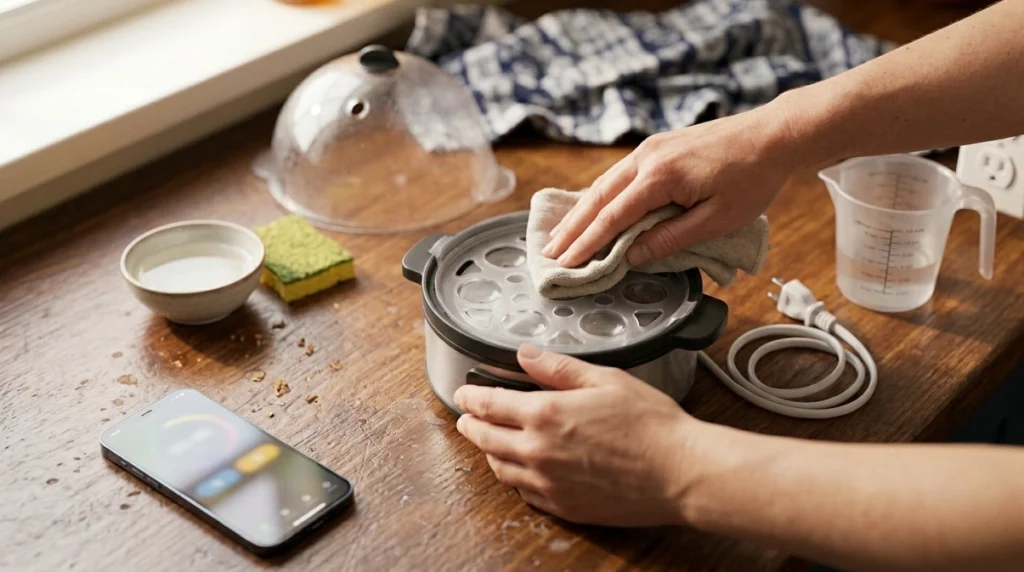
Let the cooker cool and unplug it. Wipe the heating plate with a soft cloth and a small amount of white vinegar, if the manual permits it.
Good cleaning helps the plate pass heat into the water. For thick scale, let the approved solution sit for the time stated in the manual, then wipe it away with a non-abrasive sponge.
Do not place the powered base in water. Do not scrape the plate with a knife, steel wool, or another sharp tool.
Test the wall outlet safely
Plug the cooker straight into a sound wall outlet. Avoid a loose adapter or a damaged extension cord.
If the outlet, plug, or cord becomes hot, unplug the cooker. Have the outlet checked by a qualified electrician if other devices also have the same problem.
Check the auto shut-off
Stay near the cooker during the test. It should beep, switch off, or change to a safe mode at the end of the cycle.
If it keeps heating on a dry plate, unplug it. Never bypass the safety switch or try to repair the sealed heating unit.
| Problem | Safe Solution | Difficulty |
|---|---|---|
| Excess water | Follow the cup markings | Easy |
| Light scale | Wipe with vinegar | Easy |
| Loose lid | Refit or replace it | Easy |
| Damaged cord | Replace the cooker | Do not repair |
| Failed shut-off | Stop using the cooker | Do not repair |
Mistakes to Avoid
Do not judge energy use from watts alone. A 500-watt cooker used for eight minutes may consume less energy than a 350-watt model used for 15 minutes.
Do not add extra water just to be safe. It makes the cycle longer and may overcook the eggs.
Never cover the steam vent. Steam burns can be severe, so lift the lid away from your face and hands.
Do not run the cooker without water unless its manual clearly allows it. Dry heating may harm the plate or trigger overheat protection.
Never open the base, bypass a switch, or join a damaged cord with tape. These actions can cause shock, fire, or loss of safety protection.
When to Replace the Egg Cooker
Replace the cooker if its cord is split, the plug is scorched, or the base leaks. A burning smell is also a clear reason to stop.
Replacement is usually safer than internal repair for a low-cost sealed appliance. This is especially true when the heater, thermostat, or auto shut-off has failed.
A longer cook time alone does not always mean the unit is bad. First check the water level, lid fit, and scale. Those problems are cheap and easy to correct.
My Personal Experience
I compared wattage, cycle time, and water use instead of trusting the number on the label alone. That gave me a much clearer view of actual energy use.
My first test ran too long because I had poured extra water into the plate. The cooker worked as designed; it simply had more water to boil.
I then used the correct cup mark and removed a light film of scale. The next cycle ended sooner and produced more even eggs.
The key lesson was simple: the egg cooker’s watt rating did not change. The shorter cycle reduced the total electricity used.
Final Thoughts
So, how much electricity does an egg cooker use? A typical 250-to-500-watt model uses about 0.04 to 0.08 kWh during a 10-minute batch.
That is a very small amount for most households. Correct water, a clear steam vent, a fitted lid, and a scale-free plate help keep it low.
If the cooker runs on after the water is gone, smells burnt, or has a hot cord, unplug it. Safe replacement is better than opening or modifying the heating base.
1 thought on “How Much Electricity Does an Egg Cooker Use? Easy Truth”