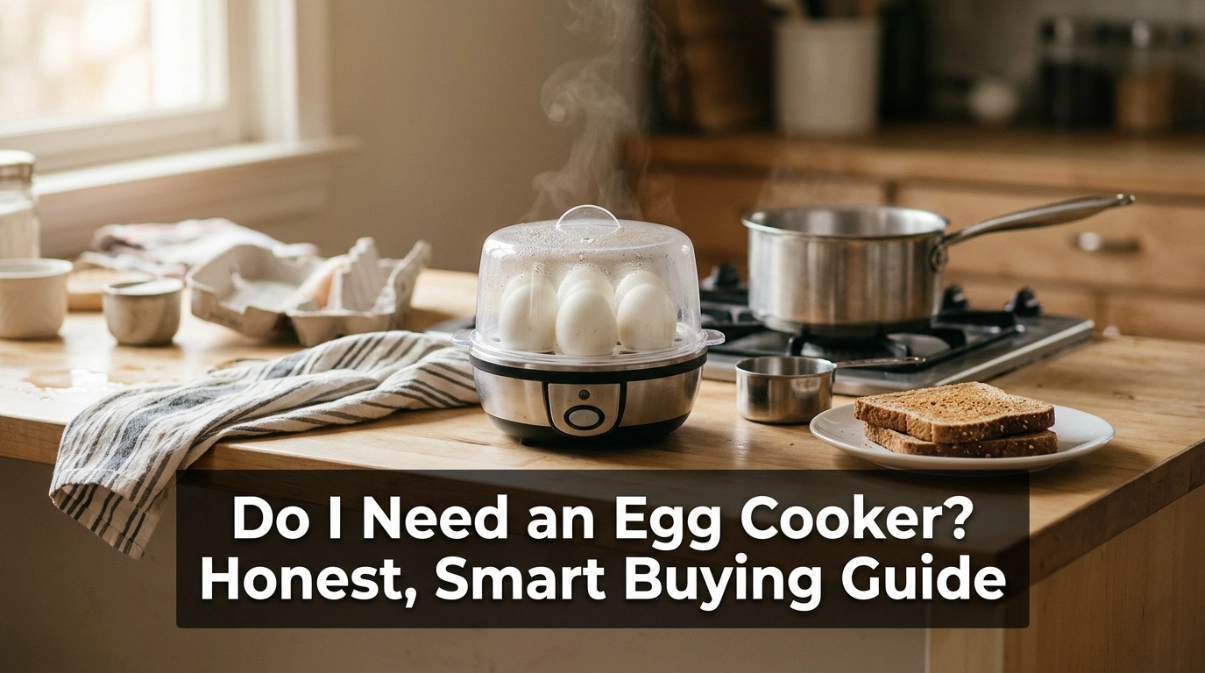
Do I need an egg cooker? I asked myself this after ruining another batch of soft-boiled eggs. Some were firm. Others were almost raw.
I tested an electric egg cooker beside my usual saucepan. I wanted to know if it saved time or just took up space. The answer was not the same for every kitchen.
You may need one if you cook eggs often and want steady results. You may not need one if you cook eggs once a week or already get good results with a pot.
This guide will help you decide. I will also cover common egg cooker problems, safe checks, cleaning, and signs that an old unit needs to go.
Common Signs of the Problem
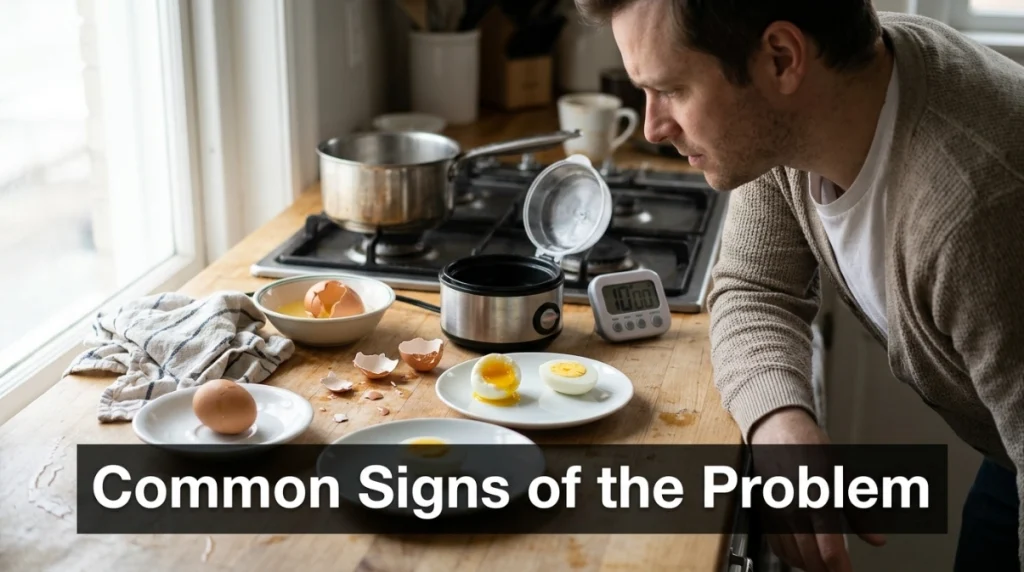
The main “problem” here is often doubt. You may like the idea of easy eggs but worry that the cooker will become another unused tool.
I had the same concern. My kitchen had little counter space, so the cooker had to earn its place.
An egg cooker may help if you notice these signs:
- You often overcook or undercook eggs.
- You forget eggs while they boil.
- Eggshells crack in the pan.
- You want eggs ready while you do other tasks.
- You make several eggs at one time.
- You want soft, medium, or hard eggs with less guesswork.
- You do not want to watch a boiling pot.
The cooker may not help much if you rarely eat eggs. It also may not suit you if you need to cook very large batches.
| Your situation | What it may mean | Quick answer |
|---|---|---|
| You cook eggs most days | A cooker may save effort | Likely useful |
| Results vary each time | Measured steam may help | Worth considering |
| You cook one egg a week | A pot is often enough | Probably not needed |
| Counter space is tight | Storage may be a problem | Choose a small unit |
| You need 12 or more eggs | Small trays may be limiting | Use a large pot |
Before buying, check what comes in the box. Most units include an egg tray, lid, and water measuring cup.
Those parts matter more than I first thought. If you lose the cup, the cooking times may change. Replacement measuring cups, egg trays, and lids can be useful if the maker sells them.
I would check part availability before buying. A small cooker is less useful when a cracked plastic lid cannot be replaced.
Possible Causes
Several common issues can make someone wonder, “Do I need an egg cooker?” The real cause may be time, poor cooking results, or an old cooker that no longer works well.
Your saucepan results are not consistent
Boiling eggs looks simple, but many small things change the result. Egg size, starting temperature, water depth, and stove heat all matter.
An egg cooker controls part of that process. It uses a set amount of water to create steam. When the water is gone, many models beep or shut off.
You want a faster morning routine
I did not find the cooker much faster than boiling water in every test. Its main benefit was that I did not need to watch it.
I could make toast and coffee while the eggs cooked. That made breakfast feel easier, even when the total cook time was similar.
Your current egg cooker gives poor results
If you already own one, uneven eggs do not always mean it is broken. Too much water, blocked steam vents, mineral buildup, or a tray placed the wrong way can cause trouble.
A loose wall outlet or damaged power cord can also stop the heating plate from working. These issues need safe checks before replacement.
You expect it to do too much
An egg cooker is a small steam appliance. Basic models cook eggs in the shell. Some also include trays for poached eggs or omelets.
Not all models make true pan-style scrambled eggs. A shallow omelet tray can cook beaten eggs, but the texture may be firm rather than soft and creamy.
How to Fix “Do I Need an Egg Cooker” Doubts
The best fix is to compare your needs with what the appliance can really do. I used the following checks before deciding.
Count how often you cook eggs
Write down how many times you cook eggs in one week. Do not base your choice on what you hope to do.
If you cook eggs three or more times each week, the cooker may be handy. If you cook them once or twice a month, a pot is more practical.
Compare effort, not just cooking time
A saucepan needs water, heat control, and a timer. You may also need to move the eggs into cold water at the right time.
An egg cooker needs measured water and the correct tray. It still requires some setup, but the process is easier to repeat.
| Task or problem | Recommended solution | Difficulty |
|---|---|---|
| One or two eggs at times | Use a saucepan | Easy |
| Frequent mixed results | Try an egg cooker | Easy |
| Large family batch | Use a large pot or large cooker | Easy |
| Cooker will not heat | Check outlet and cord | Easy |
| White marks on plate | Descale the heating plate | Easy |
| Burning smell or damaged cord | Stop using the unit | Do not repair at home |
Check your available space
Measure the shelf or counter where the cooker will stay. I once bought a small appliance without checking its lid height.
The base fit under my cabinet, but I could not lift the lid fully. A compact cooker still needs room for steam and safe lid removal.
Store it only after it has cooled and dried. An anti-scratch storage pouch is optional, but a dry cupboard is often enough.
Test your saucepan method first
Before buying anything, try one careful batch in a pot. Use eggs of the same size, set a timer, and cool them in cold water.
If that method gives you good results, you may not need another appliance. If you still forget the timer or dislike watching the stove, the cooker may solve a real problem.
Check the power source
If you already have a cooker that will not start, unplug it first. Inspect the cord and plug for cuts, dark marks, or bent parts.
Test the wall outlet with another small appliance. Do not use an extension cord unless the cooker manual allows it.
Never open the sealed heating base. It holds electrical parts close to water, which creates a shock risk.
Inspect the tray, lid, and steam vent
Set the egg insert flat on the base. Fit the lid as the manual shows. A tilted tray can cause uneven cooking.
Make sure the steam vent is open. Do not place your face or hand above it while the unit runs. Hot steam can burn skin very fast.
Some cookers use a lid seal or silicone gasket. If yours has one, check for cracks, stretching, or poor fit. Replace it only with a part made for that model.
Measure the water carefully
The water amount often controls the egg texture. More or less water does not always work the way a new user expects.
Use the marks on the supplied measuring cup. Egg size, room temperature, and your preferred yolk can still require a small change.
I adjust water in tiny steps. Large changes gave me rubbery whites or loose yolks.
Remove mineral buildup
White or brown marks on the heating plate are often minerals left by water. They can slow heating and cause uneven results.
Unplug the cooker and let it cool. For safe cleaning, follow the maker’s instructions. Many models can be descaled with diluted white vinegar.
Use a soft cloth or non-abrasive sponge. Do not scrape the plate with a knife or metal pad, as this can damage its surface.
Keep the base out of water. Wipe it only as directed in the manual, then let every part dry before the next use.
Reset the overheat protection
Some cookers stop when they get too hot or run without water. Unplug the unit and allow it to cool fully.
Add the right amount of water before trying again. If it keeps shutting off early, stop using it and contact the maker.
Never bypass an auto shut-off, safety switch, or overheat device. Those parts reduce fire and burn risks.
Test the controls
Check that each button moves normally. Flashing lights or repeated beeps may point to a bad setting, poor lid fit, or an internal fault.
Read the model manual because signals differ by brand. If the control panel gets hot, smells burnt, or behaves at random, unplug the unit.
Mistakes to Avoid
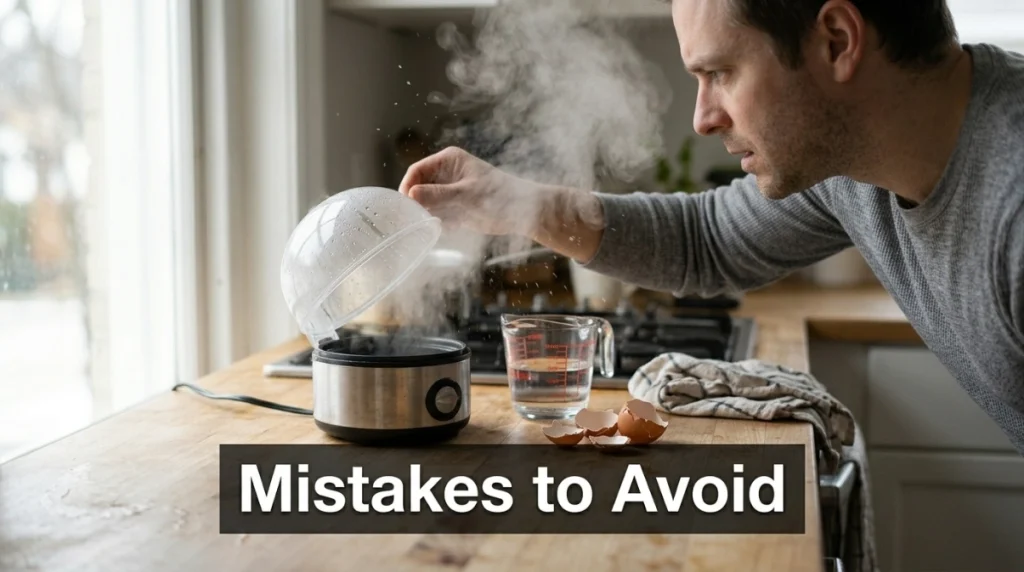
My first mistake was adding water by eye. The eggs cooked, but the yolks were never the same from one batch to the next.
I also lifted the lid toward my face. A burst of steam reached my hand. Since then, I tilt the lid away from me and wait a moment before touching the tray.
Avoid these common errors:
- Running the cooker without water
- Blocking the steam vent
- Filling above the maker’s limit
- Using a cracked lid or egg tray
- Placing the hot base in water
- Touching the heating plate before it cools
- Piercing an egg while holding it in your hand
- Leaving cooked eggs in a hot unit for too long
- Repairing wires or opening the heating unit at home
- Bypassing a lid switch or auto shut-off
Place the cooker on a dry, level, heat-safe surface. Keep it away from the counter edge and out of a child’s reach.
When to Replace the Egg Cooker
A worn measuring cup or tray does not always mean the whole cooker must go. Replace the removable part if an exact, food-safe match is available.
Replace the full unit when the base has a serious electrical fault. Safety matters more than the low cost of a small appliance.
| Repair issue | Likely cost level | Replace the cooker? |
|---|---|---|
| Lost measuring cup | Low | Usually no |
| Cracked removable tray | Low to medium | Only if no part is sold |
| Damaged lid | Low to medium | Stop use until replaced |
| Frayed power cord | High safety risk | Yes |
| Burning smell from base | High safety risk | Yes |
| Heat cuts out each time | Internal fault possible | Usually yes |
| Rust or deep plate damage | Poor heat and hygiene | Often yes |
Unplug the cooker at once if you see sparks, smoke, melted plastic, or water entering the base. Do not test it again.
Replacement is also sensible when the unit leaks, overheats, or fails to shut off. A home repair is rarely worth the risk.
My Personal Experience
I tested the cooker with cold eggs, room-temperature eggs, and three water levels. The most steady results came from using similar egg sizes and the marked cup.
My worst results came from guessing the water amount. I also got poor results when mineral spots had formed on the heating plate.
After descaling the plate and using the correct water line, the cooker became much more reliable. The eggs were not perfect every time, but the results were easy to adjust.
The cooker helped most on busy mornings. I could start it, make the rest of breakfast, and listen for the beep.
Still, I kept my saucepan. It works better for large batches and does not need another place in my cupboard.
My main lesson was simple: an egg cooker is about ease and steady results. It is not a must-have tool, and it does not replace every way of cooking eggs.
Final Thoughts
So, do I need an egg cooker? You may benefit from one if you eat eggs often, forget boiling pots, or want repeatable soft, medium, and hard eggs.
You probably do not need one if you rarely cook eggs, have little storage space, or already trust your saucepan method.
If you own a cooker that performs poorly, check the water amount, tray, lid, vent, outlet, and mineral buildup first. Stop using it if you notice leaks, cord damage, overheating, or a burning smell.
For me, the cooker earned its space because it made busy mornings easier. That is the best test: buy it only if it solves a real problem in your daily routine.
1 thought on “Do I Need an Egg Cooker? Honest, Smart Buying Guide”