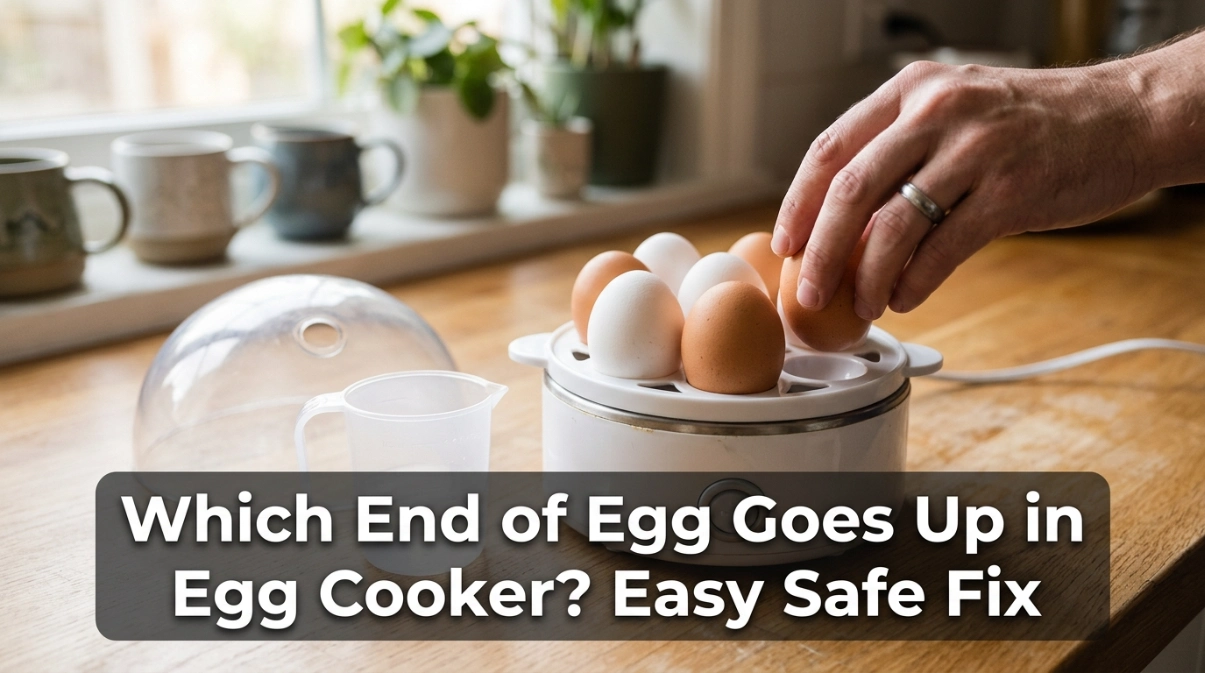
If you are wondering which end of egg goes up in egg cooker, the usual answer is simple. Place the larger, rounded end of the egg facing up and the narrower, pointed end facing down.
That is the position I check first when setting up an egg cooker. The wide end holds the egg’s air pocket, so keeping it at the top is a sensible way to position the egg in most upright egg trays.
There is one important exception. Some egg cookers tell you to pierce an egg before cooking. In that case, always follow the maker’s directions about which end to pierce and how the egg should sit.
In this guide, I will show you how to place the eggs, check the tray, use the right amount of water, and avoid the small mistakes that can lead to cracks or uneven eggs.
Common Signs of the Problem
Putting an egg in the tray the wrong way will not always ruin it. In fact, many eggs still cook.
But I look for a few signs that the setup is not quite right.
| Symptom | Likely Cause | Quick Fix |
|---|---|---|
| Egg sits at an angle | Egg is upside down or tray hole is small | Put the pointed end down |
| Shell cracks while cooking | Egg was pierced wrong or hit the lid | Check egg position and lid clearance |
| Eggs cook unevenly | Poor tray fit or wrong water amount | Seat eggs well and measure water |
| Egg rocks in the tray | Egg is too large for the insert | Reposition it or use a suitable tray |
A properly placed egg should sit securely in the egg insert. It should not lean hard against the lid or another egg.
I also make sure every egg is resting in its own opening. If one egg is tilted, it may bump the lid as steam builds inside the cooker.
Around this point, it is worth checking your accessories too. A cracked egg tray or missing water measuring cup can make setup harder than it needs to be.
If the original cup is lost, a replacement measuring cup with clear markings can help. If the egg tray is warped or broken, replacing that tray may also give the eggs a more stable position.
Possible Causes
This issue is usually not caused by an electrical fault. It is more often a simple setup question.
The most common causes are:
- The pointed and rounded ends look similar.
- The egg is too large for the tray opening.
- The egg tray is not sitting flat.
- Too much or too little water was added.
- The egg was pierced on the wrong end.
- The lid is not seated correctly.
- An egg is touching the lid.
- The cooker has a brand-specific placement rule.
The rounded end can be easy to miss on some eggs. I find it helps to place the egg on its side for a moment and compare both ends.
One side is normally more narrow and pointed. The other side looks wider and more rounded.
That wide side normally faces upward.
How to Fix Which End of Egg Goes Up in Egg Cooker
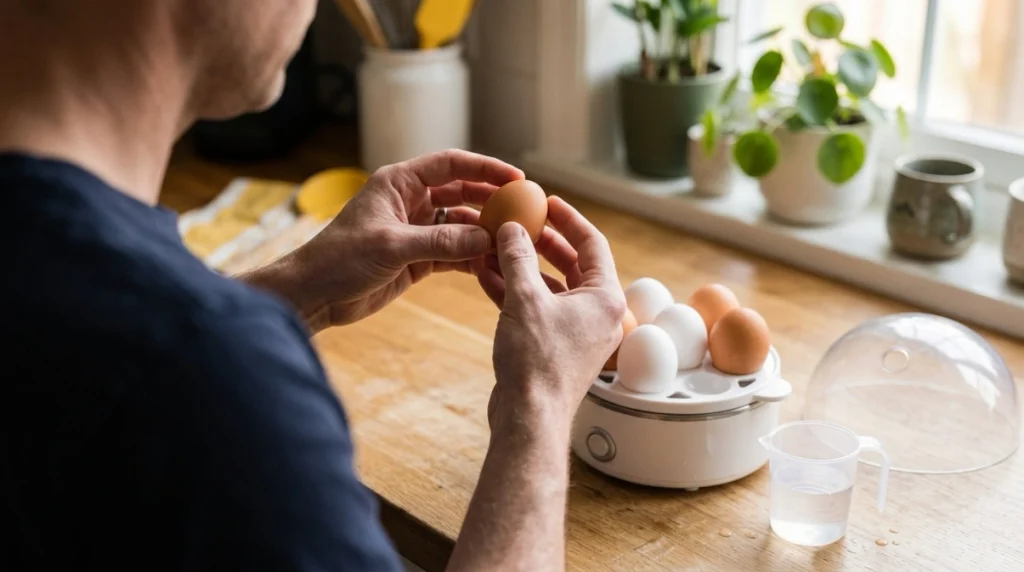
For most upright electric egg cookers, the basic setup is:
Pointed end down. Rounded end up.
Here is how I would check the whole setup before turning the cooker on.
Identify the Rounded End
Pick up one egg and look at both ends.
One end should have a slightly wider curve. That is the rounded end and normally contains the air cell.
The other side will look narrower.
Put the narrow end into the hole in the egg tray. The rounded end should remain at the top.
Do not force the egg down into the opening. It only needs to sit securely.
Check the Egg Tray
Next, I check whether the tray itself is installed the right way.
The egg insert should sit flat on the cooker. It should not rock, tilt, or rest on the edge of the heating plate.
Place each egg into a separate opening.
If an egg leans badly, lift it out and reseat it. Large or oddly shaped eggs may need a little more care.
| Problem | Recommended Solution | Difficulty |
|---|---|---|
| Egg points upward | Turn it so the narrow end faces down | Easy |
| Egg tilts sideways | Reseat it in the tray | Easy |
| Tray moves around | Remove and reinstall the tray | Easy |
| Egg touches lid | Use a smaller egg or check tray fit | Easy |
Check Whether Your Cooker Uses an Egg Piercer
Many egg cooker measuring cups have a small piercing pin on the bottom.
This pin can make people unsure about egg direction. More important, piercing instructions vary between models.
Some manufacturers tell users to pierce the wide end because that is where the air pocket sits. Others may give different setup directions.
That is why I would check the manual before piercing any shell.
Never hold an egg in your palm and push hard against a sharp piercing pin. Put the cup or piercer on a firm surface if the instructions allow it, and use light pressure.
Measure the Water Correctly
Egg position matters, but water amount often has a bigger effect on how soft or firm the egg becomes.
Use the amount shown for your preferred result.
A cooker may have marks for:
- Soft eggs
- Medium eggs
- Hard eggs
- Different numbers of eggs
Do not assume that more water always means a better-cooked egg. Egg cookers are often designed to stop or alert you after a set amount of water has turned to steam.
If you lost the original measuring cup, check the cooker manual for the required volume before using another cup.
Check the Lid and Steam Vent
Once the eggs are in place, lower the lid gently.
I would look through the lid, if it is clear, and make sure no egg is pressing against the top.
The steam vent must also stay open.
Do not cover it with a towel, plate, or other object. Hot steam needs a safe way to escape.
A blocked vent can create excess heat and pressure inside the cooker.
Keep the Heating Area Clean
Egg orientation is easy to blame when cooking results change, but mineral buildup can also affect heating.
At about the halfway point in my troubleshooting, I would clean the heating plate if I could see white or chalky marks.
Always unplug the cooker first and let it cool.
For routine cleaning, wipe removable parts with a soft cloth or non-abrasive sponge. Do not immerse the powered base unless the manufacturer specifically says it is safe.
If the heating plate has limescale, the manual may allow diluted white vinegar or a suitable descaling method.
Never scrape the heating plate with a knife or metal tool. Scratches can damage its surface.
Mistakes to Avoid
The biggest mistake is assuming every egg cooker works exactly the same way.
Most upright trays work well with the pointed end down and the rounded end up, but the manual should always take priority.
I would also avoid these common errors:
- Forcing oversized eggs into the tray
- Piercing eggs without checking the manual
- Using a damaged egg before cooking
- Filling the base above the recommended water level
- Blocking the steam vent
- Opening the lid while steam is hitting your hands
- Touching the heating plate while it is hot
- Running the cooker without the required water
- Using a cracked or warped egg tray
Be careful when lifting the lid after cooking.
Tilt the lid away from your face and hands. Steam burns can happen very fast.
I would never open the electrical base, bypass an auto shut-off system, or alter a safety switch to solve an egg-placement problem.
Those parts are not related to which end of the egg faces up.
When to Replace the Egg Cooker
Putting an egg in the wrong direction is not a reason to replace the cooker.
Replacement only starts to make sense when the cooker has a real fault.
| Repair Issue | What I Would Do | Replace Instead? |
|---|---|---|
| Broken removable egg tray | Replace the tray | Usually no |
| Lost measuring cup | Replace the cup | No |
| Cracked lid | Look for an exact replacement | Maybe |
| Heating plate does not heat | Stop using and check warranty | Often yes |
| Burning electrical smell | Unplug immediately | Usually yes |
| Damaged power cord | Stop using the unit | Often yes |
A burning smell, melted plug, damaged cord, or repeated electrical failure is very different from incorrect egg placement.
If you notice any of those problems, unplug the appliance and stop using it.
Do not try to open a sealed heating unit or repair internal mains wiring yourself.
For a low-cost egg cooker, replacement is often safer than attempting an electrical repair.
My Personal Troubleshooting Approach
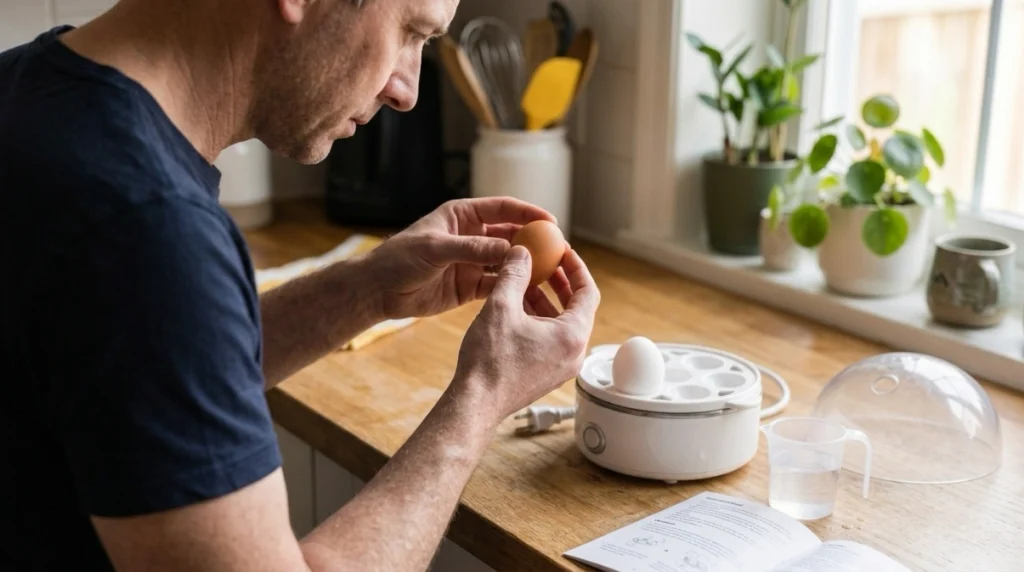
The first thing I check is the shape of the egg.
The narrow tip goes into the tray. The wider end stays at the top.
Then I check how the egg sits.
If it rocks, leans, or touches the lid, I do not start the cooker yet. I reseat the egg and make sure the tray is flat.
Next comes the water.
This is where many cooking problems actually begin. A perfectly placed egg can still come out too soft or too firm if the water amount does not match the cooker instructions.
I also pay close attention to piercing directions.
It is easy to see a little pin on the measuring cup and assume every shell needs to be pierced in the same place. I would always verify that step first because different designs can use different instructions.
The main lesson is simple: egg direction is only one part of the setup.
Tray position, water level, lid clearance, and steam flow all matter too.
Final Thoughts
So, which end of egg goes up in egg cooker?
For most egg cookers with an upright egg tray, place the rounded, wider end up and the pointed, narrow end down.
Make sure the egg sits securely. Use the correct water amount and keep the steam vent clear.
If your cooker includes an egg-piercing tool, check its manual before making a hole in the shell. Brand instructions should always come before a general rule.
Once the eggs are seated correctly, there is usually nothing else to fix. It is a small setup detail, but getting it right can make the cooker easier and safer to use.