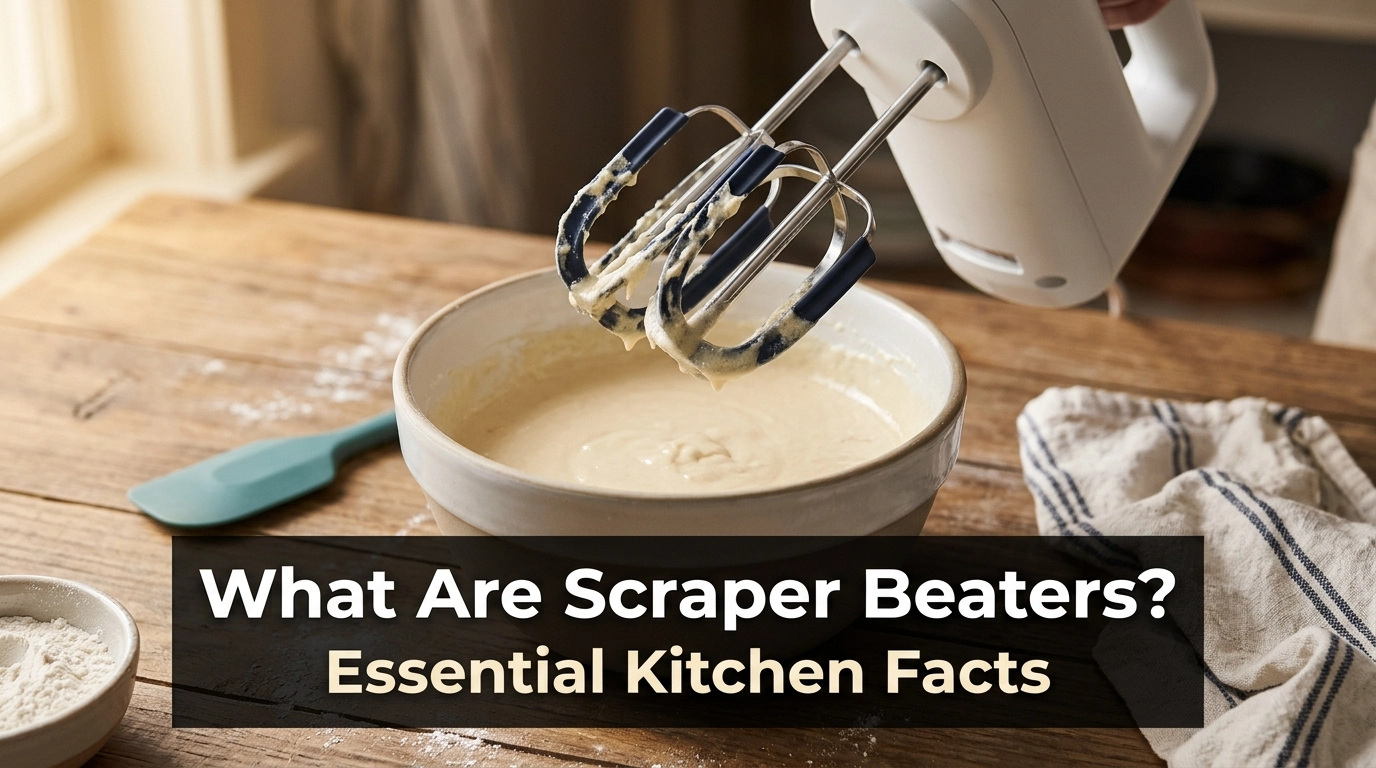
What are scraper beaters? They are mixer attachments with flexible edges that help mix food and scrape the sides of a bowl at the same time. They can reduce the need to stop and scrape the bowl by hand.
I find them most useful when mixing cake batter, soft dough, butter, and other thick mixtures. They help keep more of the mix in motion, though they do not replace every job done by a spatula.
In this guide, I will explain how scraper beaters work, what they are used for, how they differ from standard beaters, and how to care for them. I will also cover a few common mistakes that can affect mixing results.
Common Signs You May Need Scraper Beaters
If you often mix food with a hand mixer or stand mixer, you may notice that some ingredients stick to the bowl. Flour, butter, and thick batter can collect along the sides while the beaters keep turning.
Scraper beaters are made to help with this problem. Their flexible edges move close to the bowl wall and guide more food back into the mixing area.
Here are a few signs that they may help:
- Batter stays stuck to the sides of the bowl.
- You need to stop often to scrape the bowl with a spatula.
- Soft butter collects around the bowl’s edge.
- Some ingredients mix unevenly unless you pause and stir by hand.
- You want to reduce the number of times you stop the mixer.
These signs do not mean your mixer is broken. They may simply show that your current attachments are not suited to the mixture or bowl shape.
What Are Scraper Beaters, and How Do They Work?
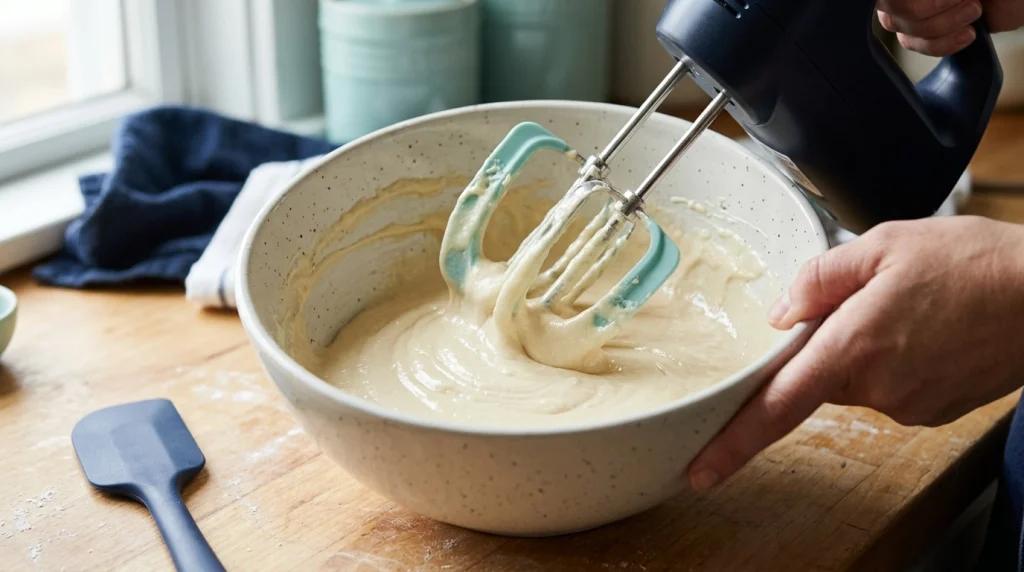
Scraper beaters are mixer attachments that combine a mixing surface with a flexible scraping edge. The edge is often made from silicone or another food-safe flexible material.
As the mixer runs, the attachment moves ingredients away from the bowl wall. This helps bring more of the mixture back toward the beaters, where it can be mixed more evenly.
Some models use a flexible coating over a metal beater. Others have a different design made for a particular mixer. The exact shape and material depend on the brand and model.
Scraper beaters are not the same as a flat spatula. A spatula lets you scrape the bowl by hand, while scraper beaters do part of that work during mixing.
Common Uses for Scraper Beaters
Scraper beaters work well for many soft and medium-thick mixtures. They are often useful for:
- Cake and muffin batter.
- Cookie dough, when the mixer is rated for the task.
- Soft butter and sugar mixtures.
- Frosting and buttercream.
- Cream cheese mixtures.
- Some soft spreads and fillings.
They are less suitable for very stiff dough unless the mixer and attachment are designed for it. A dough hook is usually the better choice for bread dough.
Possible Reasons Scraper Beaters May Not Work Well
Scraper beaters can help with mixing, but they are not perfect. If they leave food behind or make unusual noises, check the attachment and bowl before assuming something is wrong.
Common causes include:
- Wrong attachment: The beaters may not fit your mixer model.
- Poor bowl fit: The scraper edge may sit too far from the bowl wall.
- Incorrect installation: An attachment may not be fully locked into place.
- Overfilled bowl: Too much food can stop the mixture from moving freely.
- Very thick mixture: Heavy dough can put too much strain on a mixer.
- Worn scraper edges: Damaged or misshapen edges may not contact the bowl as intended.
Some scraper beaters are made for specific bowl sizes and mixer designs. A model that fits one mixer may not work safely or correctly in another.
How to Use Scraper Beaters Properly
A few simple checks can help you get better results and avoid damaging the attachments.
1. Check Compatibility
Start by checking your mixer’s manual or the attachment maker’s compatibility list. Match the model number rather than relying only on the brand name.
If you need a replacement, look for scraper beaters designed for your exact mixer. Replacement beaters, flexible scraper edges, and the correct bowl can all matter, depending on the design.
Do not force an attachment into a fitting that does not match. A loose or poorly fitted beater may wobble or fail to mix correctly.
2. Fit the Beaters Correctly
Turn the mixer off and unplug it before fitting or removing attachments. Insert each beater as directed by the manufacturer.
Check that each one is secure before switching the mixer on. If the beaters look uneven or strike the bowl, stop and check the fit.
3. Start at a Low Speed
Add your ingredients to the bowl, then start at a low speed. This helps prevent flour and other dry ingredients from flying out.
Increase the speed gradually as the ingredients come together. Use the speed recommended for your recipe and mixer.
4. Avoid Overfilling the Bowl
Leave enough room for ingredients to move around the bowl. An overloaded bowl can cause splashes, uneven mixing, and extra strain on the motor.
For a large batch, it may work better to mix in smaller portions. This is especially helpful with thick cookie dough or a large amount of frosting.
5. Check the Bowl and Scraper Edge
With the mixer unplugged, inspect the flexible edge for cracks, tears, or signs of wear. Make sure the bowl is the correct shape and size for the attachment.
Do not bend or trim the scraper edge to make it fit. If the attachment rubs too hard against the bowl, check the model instructions or contact the manufacturer.
6. Clean the Beaters After Use
Remove the attachments before washing them. Follow the manufacturer’s cleaning instructions, as not all coatings and scraper materials can handle the same temperatures or cleaning methods.
Cleaning the beaters soon after use helps stop dried batter and grease from building up around the flexible edge. Use a soft sponge or cloth if hand washing is required.
Dry the attachments fully before storing them. Avoid abrasive pads that may scratch the surface or damage the scraper material.
Quick Troubleshooting Table
| Problem | Likely Cause | Quick Fix |
|---|---|---|
| Food stays on bowl sides | Poor fit or thick mixture | Check compatibility and reduce batch size |
| Beater rubs the bowl | Wrong attachment or bowl | Stop and check the model |
| Mixing is uneven | Overfilled bowl or poor technique | Use smaller batches and start slowly |
| Attachment wobbles | Beater not fitted correctly | Unplug and reinstall |
| Scraper edge is cracked | Wear or damage | Replace the attachment |
Mistakes to Avoid
Scraper beaters are simple tools, but a few mistakes can reduce their usefulness or damage your mixer.
- Do not use an attachment that is not approved for your mixer.
- Do not force beaters into the attachment slots.
- Do not run the mixer at high speed as soon as you add flour.
- Do not use scraper beaters for stiff dough unless the maker allows it.
- Do not keep using a cracked or loose attachment.
- Do not wash parts in a dishwasher unless the instructions say they are dishwasher-safe.
Always switch off and unplug the mixer before touching the beaters or checking the bowl. Never put your fingers or a spatula near moving attachments.
If the motor smells burnt, sparks, or makes a new grinding noise, stop using the mixer. Do not open the motor housing or try to repair its electrical parts yourself.
When to Replace Scraper Beaters
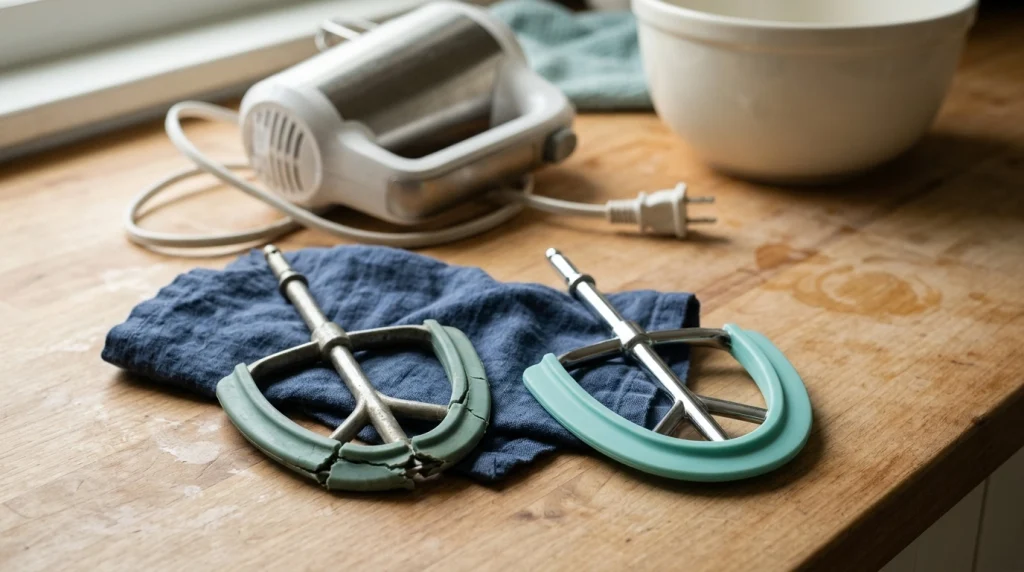
Replacement may be the best choice if the scraper edge is split, badly worn, or coming loose. A damaged edge may leave food behind or break away during use.
You should also replace a beater if its shaft is bent or its fitting no longer holds securely. Do not try to fix a bent shaft by hand.
| Repair Issue | Recommended Action | Replace Instead? |
|---|---|---|
| Worn flexible edge | Check whether the edge is replaceable | Yes, if damaged |
| Bent metal shaft | Stop using the attachment | Usually |
| Wrong attachment size | Find the correct model | No repair needed |
| Loose fitting | Check installation and compatibility | If it remains loose |
| Minor dried food | Wash as directed | No |
If the mixer itself has a motor or electrical fault, replacing the beaters will not solve it. Have the mixer assessed by a qualified repair service if the fault continues.
My Practical Experience With Scraper Beaters
When comparing how different mixer attachments handle soft mixtures, I would start with a simple cake batter or softened butter and sugar. These mixtures make it easier to see whether food collects around the bowl’s edge.
I would use the correct bowl, begin at a low speed, and pause the mixer before checking any leftover mixture. I would also compare the result with standard beaters under similar conditions.
The key point is that scraper beaters can reduce the need for manual scraping, but results depend on the bowl, attachment shape, and thickness of the food. A scraper edge that fits one bowl well may not work as well with another.
I would not claim that scraper beaters eliminate all unmixed spots. For some recipes, a quick pause and a spatula check are still useful.
Final Thoughts
Scraper beaters are mixer attachments designed to mix ingredients while scraping food from the sides of a bowl. They can save time when making cake batter, frosting, cookie mixtures, and other soft foods.
For the best results, choose an attachment that matches your mixer, fit it correctly, and avoid overloading the bowl. Clean and inspect the flexible edges after use.
If your current beaters leave too much food around the bowl, scraper beaters may be a useful option. If they rub, wobble, or show damage, stop and check the fit before using them again.