
Nama J2 Review: The Hands-Free Cold Press Juicer, Explained
KitchAdvisor is reader-supported. As an Amazon Associate we earn from qualifying purchases, at no extra cost to you.
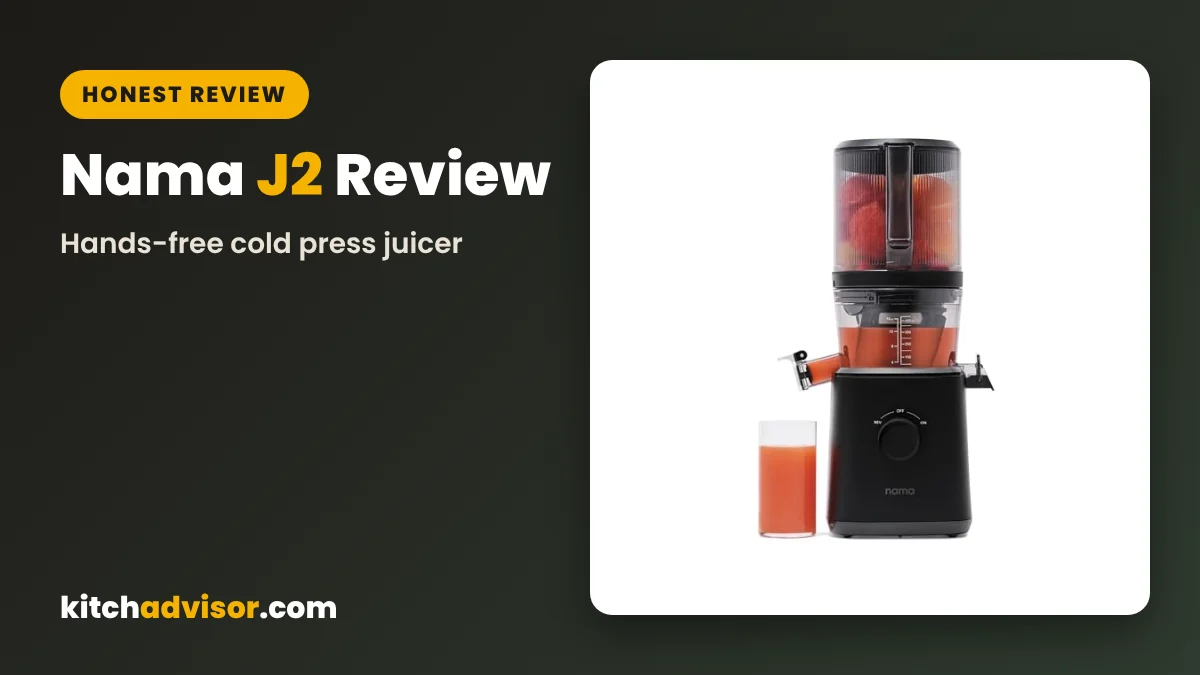
The Nama J2 is a cold press juicer built around one big idea: you should not have to stand at the machine feeding it piece by piece. Instead, you load a whole recipe of chopped fruit and vegetables into its wide hopper, close the lid, and let it work through the batch by itself.
Under the hood is a 200-watt motor that turns a slow auger at 50 RPM, squeezing produce rather than shredding it at high speed. That slow pressing is what cold press fans like, because it is quiet and suits leafy greens.
In this review we explain how the J2 works, what it does well, where it falls short, how hard it is to clean and who will get the most from it. We also compare it with other juicers so you can decide whether it is worth the higher cost.
Reviewed Product
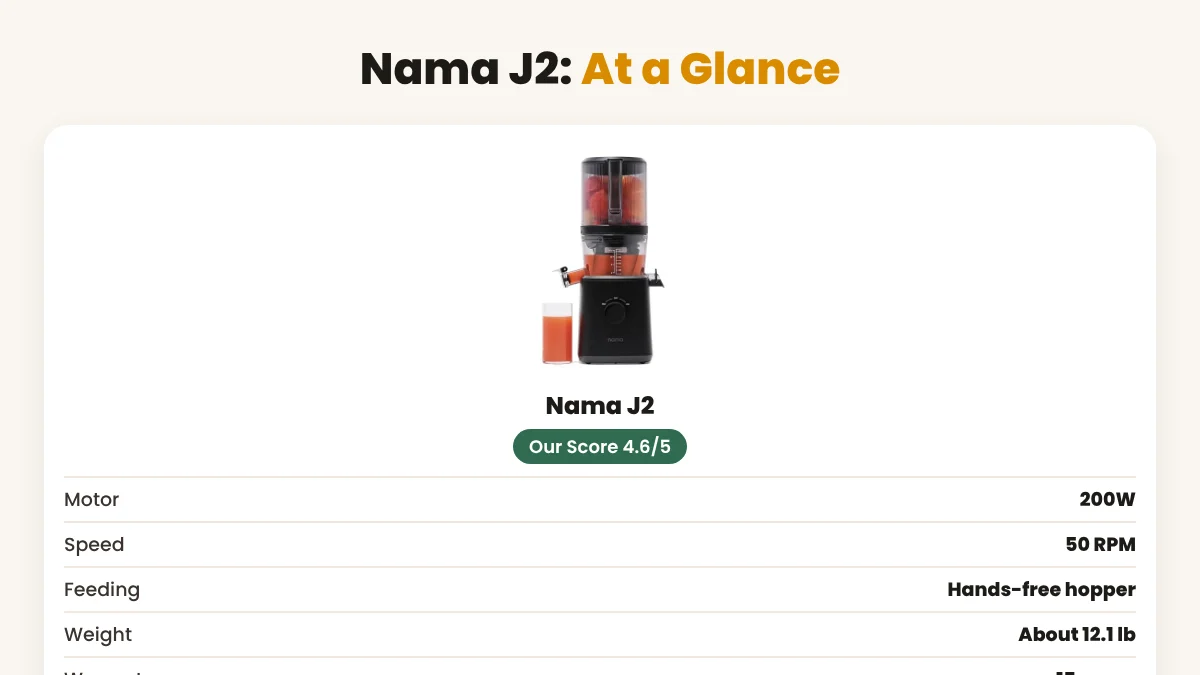
Nama J2 Cold Press Juicer

Rating: ★★★★½ 4.6/5
Research-based editorial score from verified specs, materials, design and buyer-use factors.
Best For: Daily juicers who make green juice or big batches and want to walk away while it runs.
Key Specs
Hands-free, self-feeding wide hopper fits a whole recipe • 200-watt motor • Slow 50 RPM auger (masticating) • Quick-release parts • Cleaning brush, juice containers and strainers included • About 12.1 lb • About 17.7 in tall • 15-year warranty
Key Advantage
Load once and walk away: the hopper feeds itself through a full batch.
Main Trade-off
Costs much more than most juicers and is tall for under-cabinet counters.
Quick Verdict
The Nama J2 changes how juicing feels. With most juicers, you stand and push produce down a chute one handful at a time. With the J2, you fill the large hopper with your whole recipe, close it, and the machine cuts and presses its way through on its own.
A 200-watt motor turns the auger at a slow 50 RPM. Nama says this design extracts more juice with less waste and handles leafy greens efficiently, which is where fast centrifugal juicers struggle.
Cleanup is helped by quick-release parts and an included brush. Nama backs the J2 with a 15-year warranty, one of the longest in the category.
Pros
- Truly hands-free batches
- Slow, quiet 50 RPM pressing
- Good with leafy greens
- 15-year warranty
- Quick-release parts
Cons
- High price
- Tall, about 17.7 in
- Chopping still needed for large produce
- Slower than a centrifugal juicer
How It Compares
| Juicer | Type | Power / Speed | Feeding | Best For |
|---|---|---|---|---|
| Nama J2 | Cold press | 200W, 50 RPM | Hands-free hopper | Big batches, greens |
| Hurom H-AA | Cold press (vertical) | Slow auger | Standard chute | Quiet everyday juice |
| Ninja NeverClog JC151 | Cold press | 150W auger | Standard chute | Budget cold press |
| Breville JE98XL | Centrifugal | 850W, 2 speeds | 3-inch chute | Fast juice, beginners |
Key Features
- Hands-free self-feeding hopper that holds a whole recipe.
- 200-watt motor driving a slow 50 RPM auger.
- Masticating cold press design for high yield and less pulp.
- Handles leafy greens as well as fruit and vegetables.
- Quick-release parts and a cleaning brush for easier cleanup.
- Juice containers and strainers included.
- 15-year warranty.
How the Hands-Free Hopper Works
The hopper is the reason most people look at the J2. It is a wide, deep chamber that sits above the auger. Inside, the produce is guided down toward the auger, which pulls it in, cuts it and presses it against a strainer.
Because the machine feeds itself, you can load apples, cucumbers, celery, spinach and lemon in one go, close the lid and walk away to make breakfast or pack lunch. That is a big change from vertical juicers that need you to drop in pieces slowly and push them down.
For best results, chop large or very hard items into chunks, and alternate soft and leafy items with firmer ones so the hopper keeps moving.
Juice Quality and Yield
Slow juicers like the J2 press produce rather than spin it, so they tend to make juice with less foam and a smoother texture. Nama says the J2 is designed to maximize output and leave less waste in the pulp.
Leafy greens are a strong point. Spinach, kale and herbs are hard for fast centrifugal juicers, which often fling them around and send them into the pulp bin. A slow auger grips and squeezes them instead.
Very soft fruit such as ripe bananas or mango does not juice well in any juicer, and the J2 is no exception. Blend those into smoothies instead.
Noise and Speed
At 50 RPM, the J2 is far quieter than a centrifugal juicer, which spins thousands of times faster. You can usually juice early in the morning without waking the house.
The trade-off is time. A centrifugal juicer can make a glass in under a minute, while a slow juicer takes longer to press through a batch. With the J2 that matters less, because you are not standing there feeding it.
Design and Size
The J2 is a tall, upright machine at about 17.7 inches high and around 12.1 pounds. Measure the space under your upper cabinets before buying, since you need room to open the hopper lid.
The footprint is compact for its capacity, about 9 by 9.8 inches, so it does not take much counter width. A machine this tall works best on a counter without low cabinets above, or on an island.
Cleaning the Nama J2
Cleaning is the part of juicing that makes people quit, so it matters. The J2 uses quick-release parts that come off without fiddly twisting, and it ships with a cleaning brush for the strainer.
The best habit is to rinse the parts right after juicing, before pulp dries onto the strainer mesh. Scrub the strainer with the brush under running water, rinse the auger and chamber, and let everything air dry. Check the manual for which parts can go in the dishwasher.
Who Should Buy the Nama J2
- People who juice most days and want the least hands-on time.
- Green juice fans who juice a lot of spinach, kale and celery.
- Families who make several glasses at once.
- Anyone who values a long 15-year warranty.
Who Should Skip It
- Occasional juicers who make juice once or twice a month.
- Shoppers on a tight budget; a basic cold press or centrifugal juicer costs far less.
- Kitchens with low upper cabinets and little vertical space.
- People who only want orange juice; a citrus press is cheaper and easier.
Nama J2 vs Other Juicers
Compared with a vertical slow juicer such as the Hurom H-AA, the J2’s main advantage is the hands-free hopper. Both press produce slowly, but with a standard vertical juicer you feed pieces in as it runs.
Compared with a budget cold press juicer like the Ninja NeverClog, the J2 costs more but adds batch loading and a much longer warranty. Compared with a centrifugal model like the Breville JE98XL, the J2 is slower and pricier but quieter and better with greens. Read our Eanoruus vs Nama J2 comparison for a budget alternative.
Tips for Best Results
- Cut large or hard produce into chunks so the hopper feeds smoothly.
- Layer leafy greens between firmer items like apple or cucumber.
- Peel thick, bitter skins such as oranges and grapefruit.
- Remove large pits and hard seeds from stone fruit.
- Do not overfill past the hopper’s fill line.
- Rinse parts right away while the pulp is still wet.
Is the Nama J2 Worth It?
If you juice often and the main thing stopping you is the time spent feeding and cleaning, the J2 is worth considering. The hands-free hopper saves real effort every day, and the 15-year warranty spreads the cost over many years.
If you juice only now and then, a simpler slow juicer will give you similar juice for much less. The J2 makes the most sense for people who have already built a juicing habit. To learn more about the different types of machines, see Wikipedia’s juicer page.
What We Like Less
The price is the biggest hurdle. The J2 sits at the top end of home juicers, and you are paying mostly for the convenience of the hopper.
Its height can be a problem in kitchens with low upper cabinets. And while the hopper is hands-free, you still need to wash and chop produce first, so it is not a zero-prep machine.
Frequently Asked Questions
Is the Nama J2 worth it?
For daily juicers, yes. The hands-free hopper and 15-year warranty make it worth the cost for people who juice often. Occasional juicers can save money with a simpler model.
Is the Nama J2 a cold press juicer?
Yes. It is a masticating cold press juicer that uses a slow auger turning at 50 RPM to press produce.
How powerful is the Nama J2 motor?
The Nama J2 has a 200-watt motor.
Can the Nama J2 juice leafy greens?
Yes. Nama says it processes leafy greens efficiently. Layer greens between firmer produce for the smoothest feeding.
Do I need to chop produce for the Nama J2?
Usually yes for large or hard items. Cutting produce into chunks helps the hopper feed smoothly.
How do you clean the Nama J2?
Remove the quick-release parts, rinse them right after juicing, and scrub the strainer with the included brush. Check the manual for dishwasher guidance.
What warranty does the Nama J2 have?
Nama backs the J2 with a 15-year warranty.
How tall is the Nama J2?
It is about 17.7 inches tall, so check the space under your cabinets before buying.
Final Verdict
The Nama J2 is a well-designed cold press juicer that solves the most tiring part of juicing: standing at the machine feeding it. Its slow 200-watt, 50 RPM auger suits greens, it runs quietly, and the 15-year warranty is excellent.
It is expensive and tall, so it is best for people who already juice often. If that is you, the hands-free hopper is a real everyday upgrade.
Related reading:
One Comment