Quick Answer
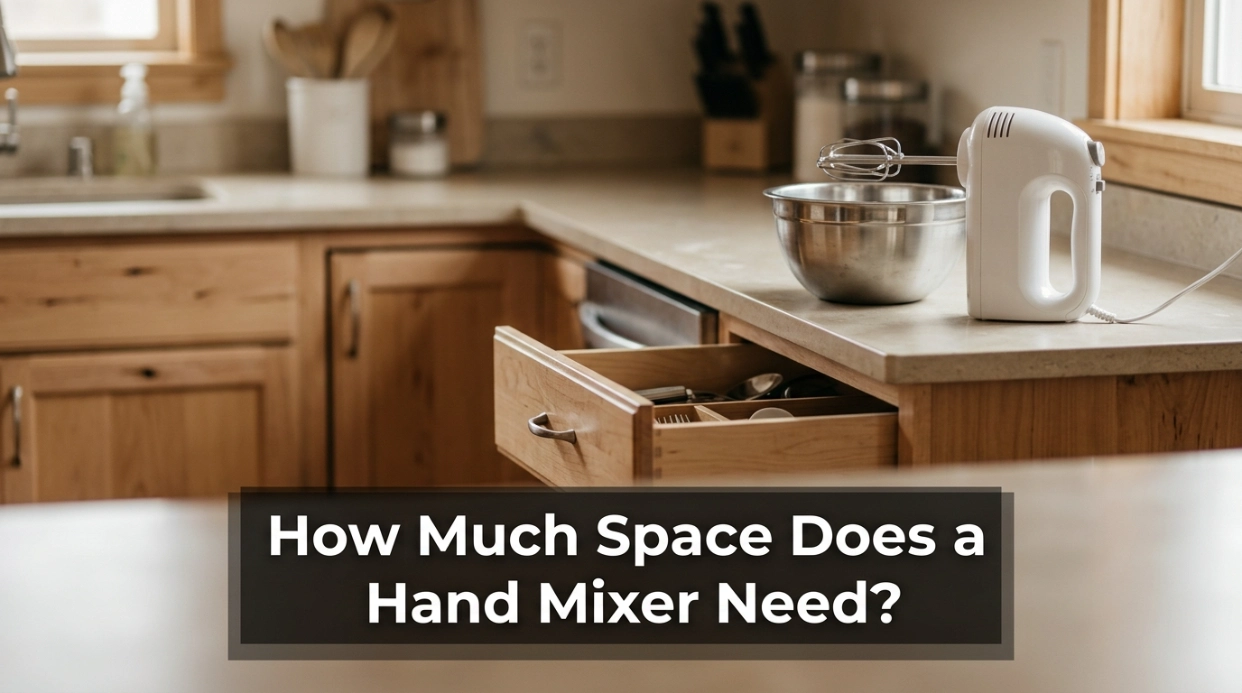
A hand mixer needs surprisingly little storage space. For planning purposes, a cabinet area of roughly 12 × 9 × 4 inches can accommodate many compact corded hand mixers or storage-case designs, although every model is different. Current Hamilton Beach hand mixer dimensions show why measuring your exact model matters.
Space to plan for
- Mixer body: Many compact models have one narrow dimension close to 3.5–4 inches.
- Storage case: A snap-on case can make the appliance wider while keeping attachments together.
- Power cord: Leave room so the cord is not sharply bent or crushed.
- Attachments: Beaters, whisks, and dough hooks need their own space unless the mixer includes storage.
- Working area: Your mixing bowl and hand movement require considerably more room than the stored appliance.
Simple planning rule
- Measure the complete mixer, case, cord, and attachments before choosing a drawer or cabinet shelf.
A hand mixer is one of the easier electric kitchen appliances to fit into a small kitchen. Unlike a stand mixer, it doesn’t need a permanent section of countertop.
The confusing part is that product dimensions are listed in different orientations. In this guide, I’ll separate storage footprint, working space, attachment storage, and cabinet clearance so you can plan accurately.
In This Guide
How Much Storage Space Does a Hand Mixer Need?
Most hand mixers need only a small section of a drawer, cabinet, or pantry shelf. A practical planning allowance for many conventional models is roughly 12 inches × 9 inches × 4 inches.
That is a planning guideline rather than a universal appliance specification. Some models are considerably smaller.
Definition: A hand mixer’s storage footprint is the total three-dimensional space occupied by the mixer body, cord, attachments, and any storage case when the appliance is put away.
For example, KitchenAid lists its KHM9212 9-Speed Hand Mixer at 7.5 inches deep, 3.5 inches wide, and 6 7/16 inches high. Those dimensions make the mixer body easy to fit on many shelves.
You can check the manufacturer’s specifications on the KitchenAid 9-Speed Hand Mixer product page. :contentReference[oaicite:0]{index=0}
Why can two hand mixers need different amounts of space?
Body design is only part of the equation. Included accessories can change the total storage requirement more than you might expect.
- Basic models: Usually include two beaters and take relatively little space.
- Whisk-equipped models: Need extra room for the longer whisk attachment.
- Dough-hook models: May include several separate metal accessories.
- Storage-case models: Keep everything organized but create a wider package.
- Cordless models: May require space for a charger or battery system.
I prefer to measure the appliance as one complete storage package. Measuring only the motor body often leads to a drawer that fits the mixer but not everything that comes with it.
Section Takeaway: Allow around 12 × 9 × 4 inches as a conservative starting point, then confirm the dimensions of your exact mixer and accessories.
How Much Counter Space Do You Need While Mixing?
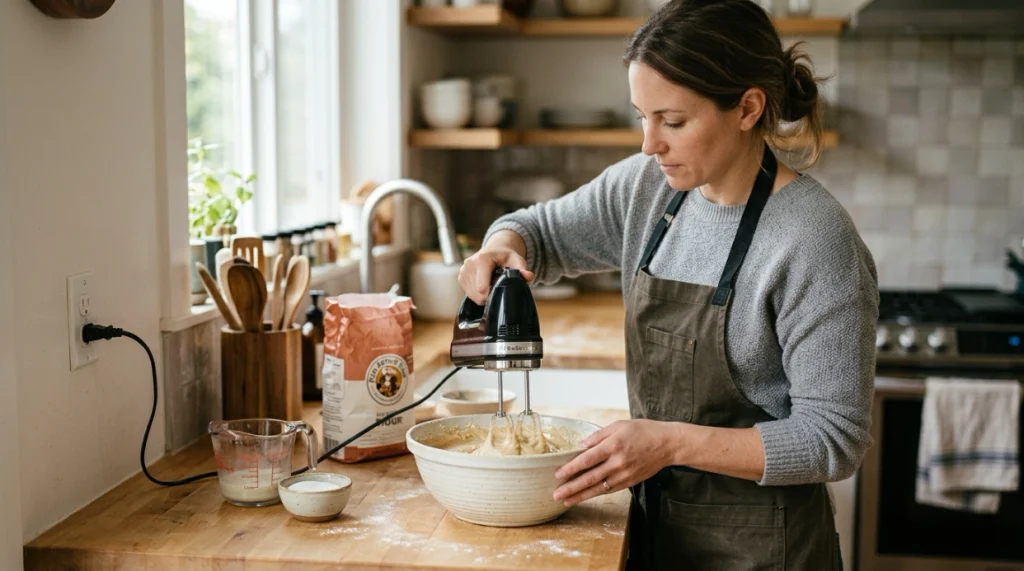
A hand mixer needs much more room during use than it does during storage. The mixer itself may be compact, but you also need space for the bowl and your hand movement.
Unlike a stand mixer, a hand mixer travels around the bowl. Your working zone therefore needs to remain clear.
Plan around the mixing bowl
Start with your bowl diameter rather than the mixer dimensions. Then leave open space around the bowl so you can move the beaters without hitting containers, walls, or other appliances.
For an ordinary home mixing bowl around 10–12 inches across, I would prefer approximately 18–24 inches of uncluttered counter width. That figure is a practical workspace recommendation, not a manufacturer requirement.
- Bowl area: The bowl must sit flat and remain stable.
- Hand movement: You need room to guide the mixer around the bowl.
- Cord routing: A corded model needs a clear route to an outlet.
- Ingredient space: Flour, sugar, eggs, and other ingredients should not crowd the mixing area.
Keep the working area away from water and heat
Counter location matters as much as size. The U.S. Consumer Product Safety Commission recommends keeping countertop appliances away from sinks and keeping appliance cords away from hot surfaces.
The CPSC also recommends unplugging countertop appliances when they are not in use. Its Home Electrical Safety Checklist explains these kitchen precautions. :contentReference[oaicite:1]{index=1}
A narrow counter beside a sink may technically fit the mixer. I would still choose a slightly larger, dry working area whenever possible.
Section Takeaway: Storage space may be tiny, but comfortable mixing usually requires a clear area large enough for the bowl, mixer movement, ingredients, and safe cord placement.
How Much Extra Space Do Attachments and the Cord Need?
Attachments are easy to overlook when measuring a hand mixer. Two beaters take little room, but a complete accessory set can become awkward in a shallow drawer.
Some mixers solve this with a snap-on case. Others use a separate storage bag.
Storage cases can change the appliance footprint
Hamilton Beach lists one current 6-Speed Hand Mixer at 11 inches high, 8.6 inches wide, and 3.8 inches deep. The company also lists a storage configuration for another model at about 8.6 × 8.6 × 4 inches.
You can compare current models on the Hamilton Beach hand mixer page. :contentReference[oaicite:2]{index=2}
Don’t force the cord into a tight compartment
A power cord should fit without being crushed against the appliance. I also avoid tightly wrapping a cord around the mixer body unless the manufacturer designed the appliance for that method.
Some KitchenAid models use a swivel cord that can lock to either side during use. KitchenAid notes that this arrangement helps keep the cord out of the mixing area. :contentReference[oaicite:3]{index=3}
- Two beaters only: Minimal additional storage needed.
- Whisk: Usually needs more length than standard beaters.
- Dough hooks: Add two more accessories to organize.
- Blending rod: Can require a longer drawer or storage bag.
- Storage case: Usually makes the overall package easier to organize but wider.
Remove the beaters before storing the mixer if the manufacturer’s instructions call for it. This also prevents exposed beaters from snagging other items inside a drawer.
How Should You Measure a Drawer or Cabinet?
Measure the usable interior space, not the outside of your drawer or cabinet. Hinges, drawer slides, lips, and shelf supports can reduce the opening.
I use a simple three-measurement check before deciding where an appliance will live.
- Measure width: Check the narrowest usable part of the drawer or shelf.
- Measure depth: Measure from the front opening to the usable back surface.
- Measure height: Check the actual opening clearance, not just the shelf spacing.
- Add accessories: Include beaters, whisk, dough hooks, cord, bag, or case.
- Add handling room: Leave enough space to lift the mixer out without scraping nearby items.
Should a hand mixer go in a drawer?
Yes, if the drawer is deep enough and doesn’t force the cord or controls against other utensils. A drawer can be especially convenient for a slim mixer without a bulky case.
A shallow utensil drawer may be less suitable. Mixer handles and attachment hubs can create more height than they appear to need.
Is a cabinet shelf better?
A cabinet shelf works well for mixers with snap-on cases or several accessories. You can store the whole package together instead of separating small parts.
If the shelf is high, consider the appliance’s weight and how safely you can retrieve it. Compact appliances are most useful when they’re easy to reach.
What about countertop storage?
You can leave a hand mixer on the counter, but there is usually little reason to sacrifice permanent worktop space. Most models are designed to be portable and easy to put away.
KitchenAid’s hand mixer guidance also describes portability and storage features as important buying considerations. :contentReference[oaicite:4]{index=4}
Section Takeaway: Measure the narrowest real opening and include every accessory. A storage location that technically fits but makes retrieval difficult is still too small.
How Do Real Hand Mixer Sizes Compare?
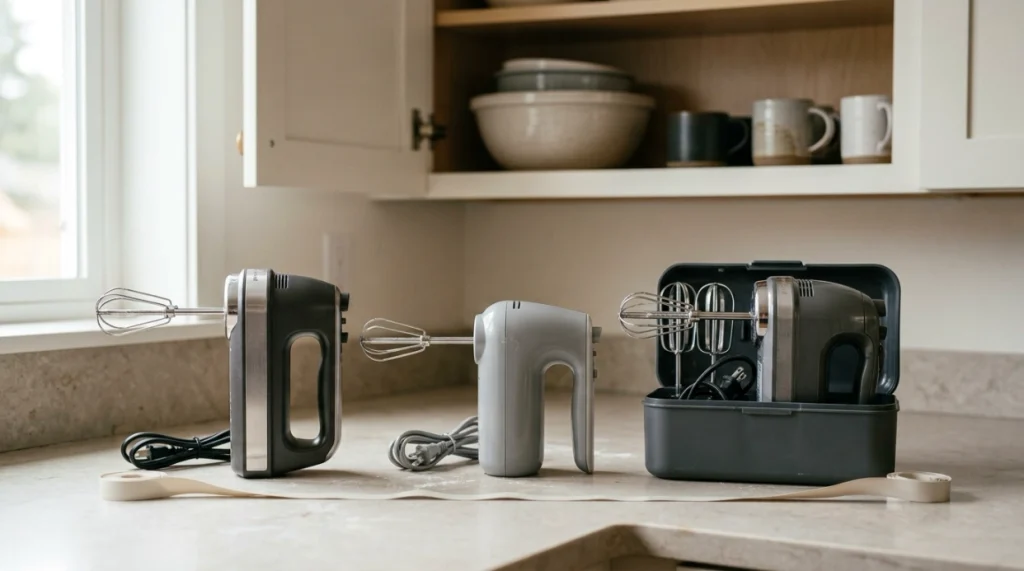
Manufacturer dimensions show why one generic measurement cannot describe every hand mixer. Even models from the same brand can use different body and storage layouts.
| Example | Listed Dimensions | Storage Note |
|---|---|---|
| KitchenAid KHM9212 9-Speed | 7.5 D × 3.5 W × 6 7/16 H in. | Slim mixer body; accessories include a storage bag. |
| Hamilton Beach 62636 | 5.1 H × 8.3 W × 3.5 D in. | Compact body with storage case. |
| Hamilton Beach 62620 | 8.86 H × 3.54 W × 9.06 D in. | Includes six attachments and snap-on storage. |
| Hamilton Beach 62700 with case | 8.6 H × 8.6 W × 4 D in. | Case creates a wider, compact storage package. |
The important number is not just length or height. Look for the complete three-dimensional envelope that must fit inside your chosen storage area.
Also check whether dimensions describe the bare appliance or the mixer with its case. That distinction can change the space you need.
Does motor power determine mixer size?
Not reliably. Two mixers with similar power ratings can have completely different housings, handles, cooling vents, and storage systems.
Choose storage space from the listed dimensions, not wattage. Motor power tells you something different about the appliance.
Household mixers fall within the scope of UL 982, the safety standard covering motor-operated household food-preparing machines. The standard includes mixers and other short-period-use kitchen appliances. UL 982 information is available from UL Standards & Engagement. :contentReference[oaicite:5]{index=5}
Frequently Asked Questions
Can a hand mixer fit in a kitchen drawer?
Yes. Many hand mixers can fit in a medium or deep kitchen drawer, especially models with a narrow body around 3.5–4 inches thick. Measure the drawer’s interior height and include the handle, cord, and attachments before deciding.
How much cabinet space should I allow for a hand mixer?
A useful starting allowance is around 12 × 9 × 4 inches for many compact models. This is not a universal specification, so compare that space with the manufacturer’s dimensions for your exact mixer and storage case.
Does a hand mixer need permanent counter space?
No. A major advantage of a hand mixer is that you can store it between uses. Unlike most stand mixers, it doesn’t normally need a permanent countertop location.
How much room do I need while using a hand mixer?
You need room for the mixing bowl plus enough clearance to guide the mixer around it. For a typical bowl, an uncluttered working zone around 18–24 inches wide is a practical comfort target rather than a manufacturer requirement.
Should I store beaters inside the mixer?
No, unless your model includes a storage system specifically designed for that purpose. Remove attachments after use, clean and dry them, then store them in the supplied case, bag, or another safe location.
Can I store a hand mixer beside the kitchen sink?
A dry cabinet may be near the sink, but don’t use or leave a plugged-in mixer where it can be splashed or knocked into water. CPSC guidance recommends keeping countertop electrical appliances away from sink areas.
Should I clean a hand mixer before storing it?
Yes. Unplug it first, remove the accessories, and follow the manufacturer’s cleaning directions. KitchenAid instructs users to wipe the mixer body with a damp cloth, dry it, and avoid immersing the motor housing in water. :contentReference[oaicite:6]{index=6}
How Much Space Should You Ultimately Reserve?
If you’re planning storage before buying, about 12 × 9 × 4 inches is a useful conservative starting allowance for many compact hand mixers. Models without storage cases may need noticeably less.
The safest approach is still to check the exact width, depth, and height supplied by the manufacturer. Then include the cord and every attachment you intend to store with the mixer.
- For cabinet storage: Check the complete appliance dimensions and leave retrieval clearance.
- For drawer storage: Pay special attention to usable interior height.
- For accessories: Allow room for beaters, whisks, hooks, and storage cases.
- For operation: Give the bowl and your hands much more room than the mixer needs in storage.
- For safety: Keep the working area dry and keep cords away from hot surfaces.
As of 2026, compact hand mixers remain one of the easier powered kitchen appliances to accommodate in a small kitchen. Their biggest space advantage is simple: you can use the counter when you need it, then put the appliance away when you’re finished.