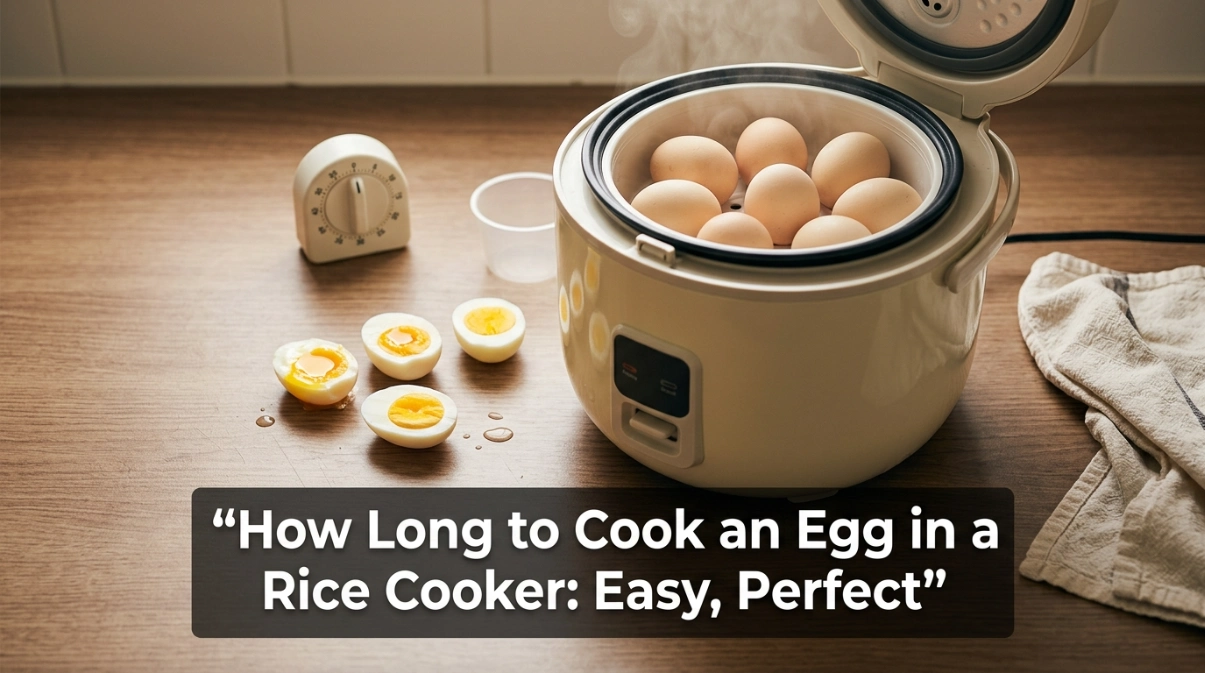
If you want to know how long to cook an egg in a rice cooker, start with 8 to 15 minutes. The exact time depends on how firm you want the yolk.
I learned this after my first batch came out far too soft. I had counted the rice cooker’s warm-up time as part of the cooking time. Once I began timing from when steady steam appeared, my results became much more reliable.
Here is the quick answer:
| Egg result | Steam cooking time | Yolk texture |
|---|---|---|
| Soft-cooked | 7–9 minutes | Runny or very soft |
| Medium-cooked | 10–12 minutes | Jammy and partly firm |
| Hard-cooked | 13–15 minutes | Fully firm |
These times work best when the eggs sit in a steam basket above the water. If you cook them right in the water, the timing may vary by a few minutes.
Common Signs of the Problem
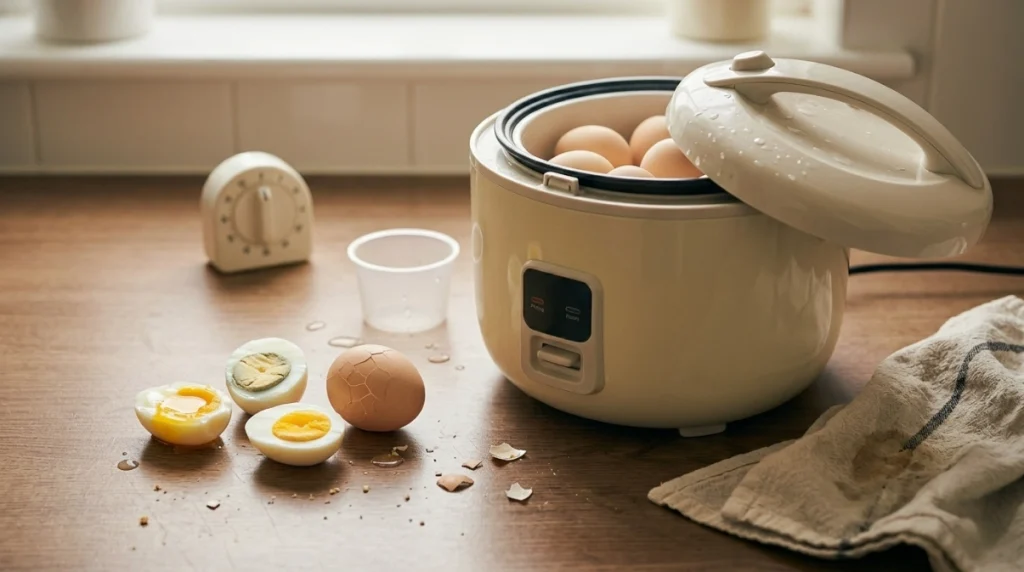
A rice cooker can cook eggs well, but the results may change from one batch to the next. My first clue was a white that looked firm while the yolk was still almost raw.
You may notice one or more of these signs:
- The egg white stays loose.
- The yolk becomes dry or chalky.
- The shell cracks during cooking.
- Water boils away too soon.
- The cooker switches to “warm” early.
- Steam leaks around the lid.
- The eggs cook at different rates.
A basic steam basket is useful because it keeps the eggs away from the heating plate. If your original basket is lost or damaged, a replacement egg tray or small heat-safe steamer basket may help.
A measuring cup can also make each batch more consistent. I found that guessing the water amount caused more problems than the cooking time itself.
| Symptom | Likely cause | Quick fix |
|---|---|---|
| Runny white | Cooking time was too short | Add 2–3 minutes |
| Dry, gray yolk | Egg was overcooked | Reduce time and use an ice bath |
| Cracked shell | Egg heated too fast | Start with cool water |
| Cooker stops early | Too little water | Add enough water for steady steam |
| Uneven eggs | Eggs are different sizes | Use eggs of the same size |
Possible Causes
The cooking time is not the only factor. Rice cookers differ in power, bowl size, settings, and the way they sense heat.
These are the most common causes of poor results:
- The timer starts too early: Steam has not formed yet.
- There is too little water: The cooker switches to warm before the eggs are done.
- There is too much water: Warm-up takes longer than expected.
- The steam vent is blocked: Heat cannot move as designed.
- The lid does not fit well: Steam escapes around the edge.
- The eggs are very cold: Fridge-cold eggs may need another minute.
- Egg sizes are mixed: Large eggs need more time than small eggs.
- The heating plate has residue: Heat may not pass evenly into the bowl.
- The wrong setting is used: Some quick-cook modes heat more strongly.
Altitude can also affect the result. Water boils at a lower temperature in high places, so eggs may need a little more time.
How to Fix How Long to Cook an Egg in a Rice Cooker
The easiest method is to steam the eggs. It keeps them away from the hot base and makes the timing easier to control.
Check the Rice Cooker Manual
Read the manual before you begin. Some models include a steam setting and a maximum water level.
Do not use a basket or tray that blocks the lid. The lid must close as the maker intended, and the steam vent must remain open.
Add the Right Amount of Water
Add about one to two cups of water to the inner pot. You need enough water to make steam for the full cooking time.
The water should stay below the steam basket. If it touches the eggs, you are partly boiling them instead of steaming them.
I use the same cup each time. This small step removes one variable and makes the next batch much easier to adjust.
Arrange the Eggs Carefully
Place the eggs in one layer. Leave a little space between them so steam can move around each shell.
Do not pile eggs on top of one another. Crowding can lead to uneven whites and yolks.
Check that the basket is stable. It should not tip or rest against a bare heating plate.
Start Timing When Steam Appears
Close the lid and turn on the steam or cook setting. Wait until you see steady steam coming from the vent.
Start your timer at that point:
- Cook for 7–9 minutes for a soft yolk.
- Cook for 10–12 minutes for a jammy yolk.
- Cook for 13–15 minutes for a hard yolk.
For a first test, cook only one or two eggs. Cut one open, note the result, and adjust the next batch by one minute.
Use an Ice Bath
Move the cooked eggs into cold ice water at once. Leave them there for about five minutes.
The cold water stops the eggs from cooking after removal. It also helps prevent the gray-green ring that may form around an overcooked yolk.
Use tongs or a spoon. The eggs, basket, lid, and steam will be very hot.
Check the Lid and Steam Vent
A loose lid lets heat escape. This may leave the eggs soft even when the timer seems correct.
Inspect the lid for chips, warping, or a poor fit. Replace a damaged lid only with one made for your cooker.
Let the cooker cool and unplug it before checking the vent. Wipe away food or dry residue with a soft cloth.
Remove Mineral Buildup
White marks on the inner bowl often come from minerals in water. Heavy buildup can slow heat transfer and affect cooking time.
For safe cleaning, follow the care guide for your model. A mild mix of white vinegar and water often helps with a removable metal bowl, but it should not be poured into the electrical base.
Use a non-abrasive sponge. Rough pads can scratch the bowl and damage its finish.
Test the Cooking Setting
Some rice cookers switch to warm when the free water has gone. If that happens too early, add a little more water during the next test.
A steam setting is often easier to control than a standard rice mode. If there is no steam mode, use the normal cook setting and watch the timer.
| Problem | Recommended solution | Difficulty |
|---|---|---|
| Egg is too soft | Add 1–2 minutes | Easy |
| Egg is too hard | Reduce time by 1–2 minutes | Easy |
| Steam escapes | Check lid position and fit | Easy |
| Cooker changes to warm | Add a little more water | Easy |
| Heat is uneven | Clean the bowl and heating plate | Easy |
Mistakes to Avoid
Do not place an egg on the exposed heating plate. Always use the inner bowl and a stable, heat-safe basket if you plan to steam it.
Avoid opening the lid during cooking. Each time you lift it, steam escapes and the cooking temperature falls.
Do not seal or cover the steam vent. Pressure and hot steam must be able to leave the cooker safely.
Never reach over the vent. Open the lid away from your face and hands because trapped steam can cause a fast, painful burn.
Do not pour water into the electrical base. Only the removable inner bowl should hold water.
If the cord is damaged, the base smells burnt, or the cooker trips an outlet, unplug it. Do not open the sealed heating unit or bypass its safety switch.
Poking the shell is not needed for this method. A pin can slip, hurt your hand, or make the shell crack more easily.
When to Replace the Rice Cooker
A timing problem alone does not mean the cooker is bad. Most soft or hard eggs can be fixed by changing the time or water level.
Replacement may be safer when the cooker has a damaged cord, a cracked electrical base, repeated overheating, or a strong burning smell. Stop using it if sparks or smoke appear.
| Cooker issue | Safe action | Replace it? |
|---|---|---|
| Worn steam basket | Replace the basket | Usually no |
| Bent or cracked lid | Find a correct replacement | Maybe |
| Damaged power cord | Stop using the cooker | Usually yes |
| Burning smell from base | Unplug it at once | Yes |
| Unreliable safety switch | Do not bypass it | Yes |
Repair may not be worth the cost for a small, low-priced cooker. A qualified appliance technician can assess a costly model, but home electrical repairs are not a safe choice.
My Personal Experience
My first test used three cold, large eggs. I added too little water and started timing as soon as I pressed the cook button.
After ten minutes, the whites were only partly firm. The cooker had also switched to warm before enough steam had reached the eggs.
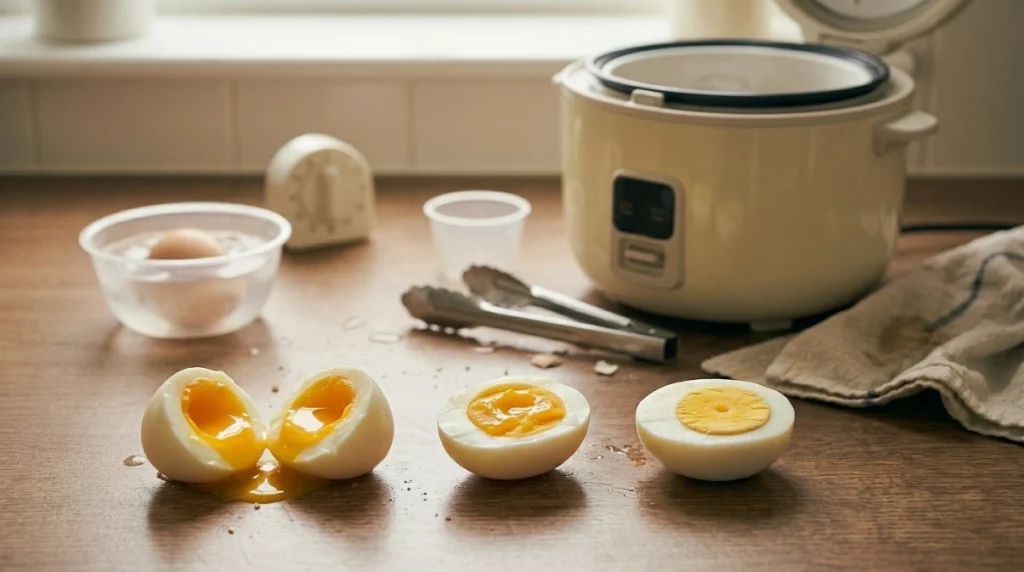
On my next try, I added more water and waited for steady steam. I cooked one egg for eight minutes, one for eleven minutes, and one for fourteen minutes.
The eight-minute egg had a soft yolk. The eleven-minute egg was thick and jammy. The fourteen-minute egg was fully firm without being dry.
The ice bath made a clear difference. When I skipped it, the yolk kept cooking and became firmer than I wanted.
My best lesson was to change only one thing at a time. I kept the egg size, water amount, and basket position the same, then adjusted the time by one minute.
Final Thoughts
So, how long to cook an egg in a rice cooker? Steam it for 7–9 minutes for soft, 10–12 minutes for medium, or 13–15 minutes for hard.
Begin timing when steady steam appears. Use enough water, keep the vent clear, and place the finished eggs in ice water.
Test one egg first because rice cookers do not all heat in the same way. Once you find the best time for your model, write it down and use the same setup for each batch.