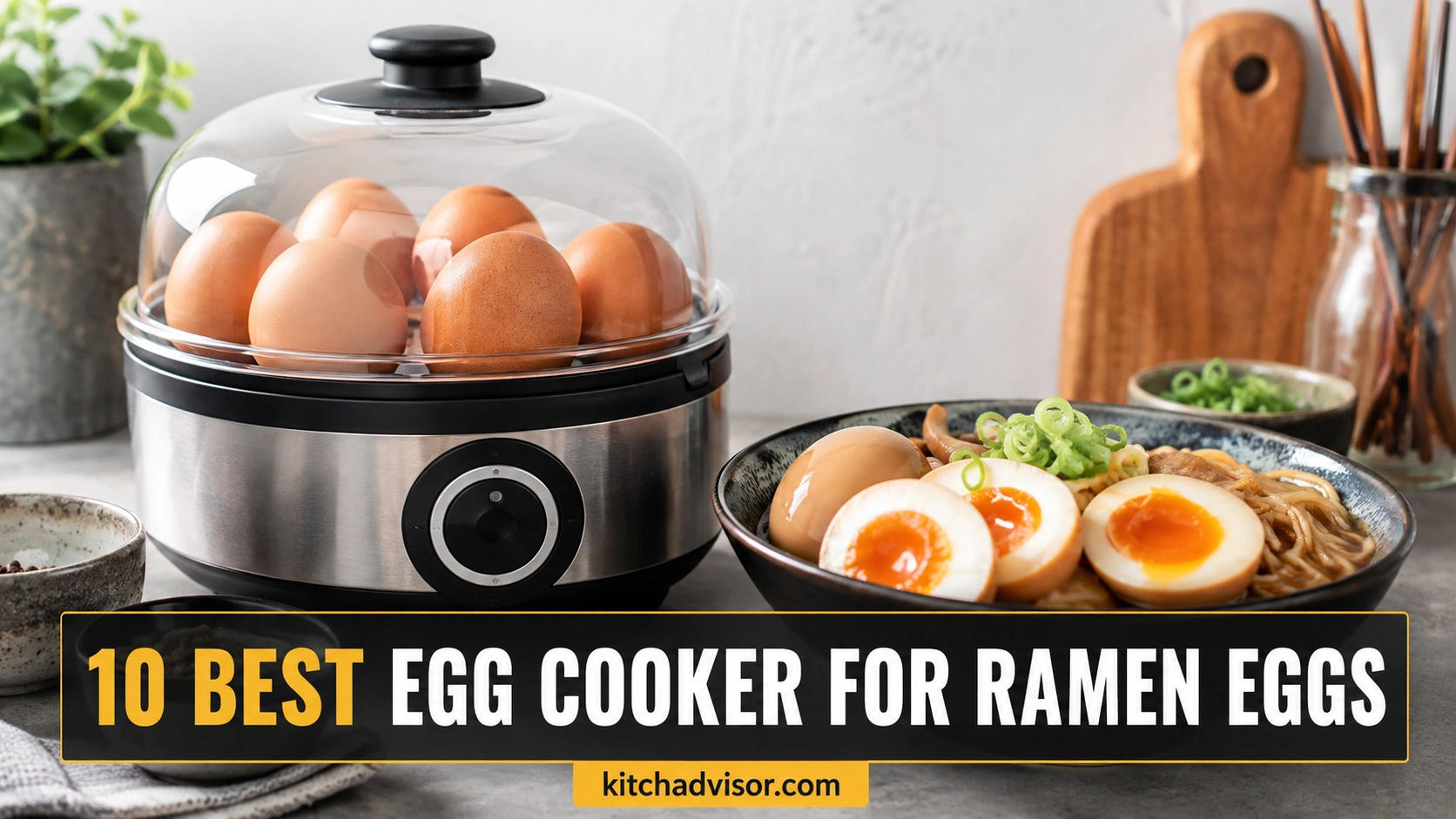
A jammy ramen egg lives or dies on timing. Too short and the yolk stays wet and won’t hold a spoon; too long and it turns chalky and loses that glossy, custard-like center that makes a bowl of ramen worth photographing. Getting there consistently on a stovetop means babysitting a pot, timing to the second, and hoping the water never dips below a rolling boil.
An egg cooker takes that guesswork out of the equation by using steam and a fixed water measurement instead of a simmering pot you have to watch. That consistency is exactly what ramen eggs demand: the same yolk texture batch after batch, whether you’re making two eggs for tonight’s dinner or a dozen for a week of marinated ajitsuke tamago. The right cooker turns ramen eggs from a fussy weekend project into a five-minute weekday habit.
Buying one for this specific job means paying attention to a few things a general “best egg cooker” list might gloss over. Basket capacity matters if batch marinating is the goal, and so does how easy the shells peel, since a ragged peel ruins the presentation of a halved egg floating in broth. Alarm accuracy and water-measuring precision decide whether you land on runny, jammy, or overcooked, and quick cooling is what stops the yolk from carrying over into fully set territory after the cooker shuts off.
Best overall: Dash Rapid Egg Cooker, 7 Eggs
Best large-capacity: Dash Deluxe Egg Cooker, 12 Eggs
Best microwave option: Sistema Easy Eggs Microwave Egg Cooker
Best budget pick: Elite Gourmet 7-Egg Rapid Egg Cooker
Dash Rapid Egg Cooker, 7 Eggs
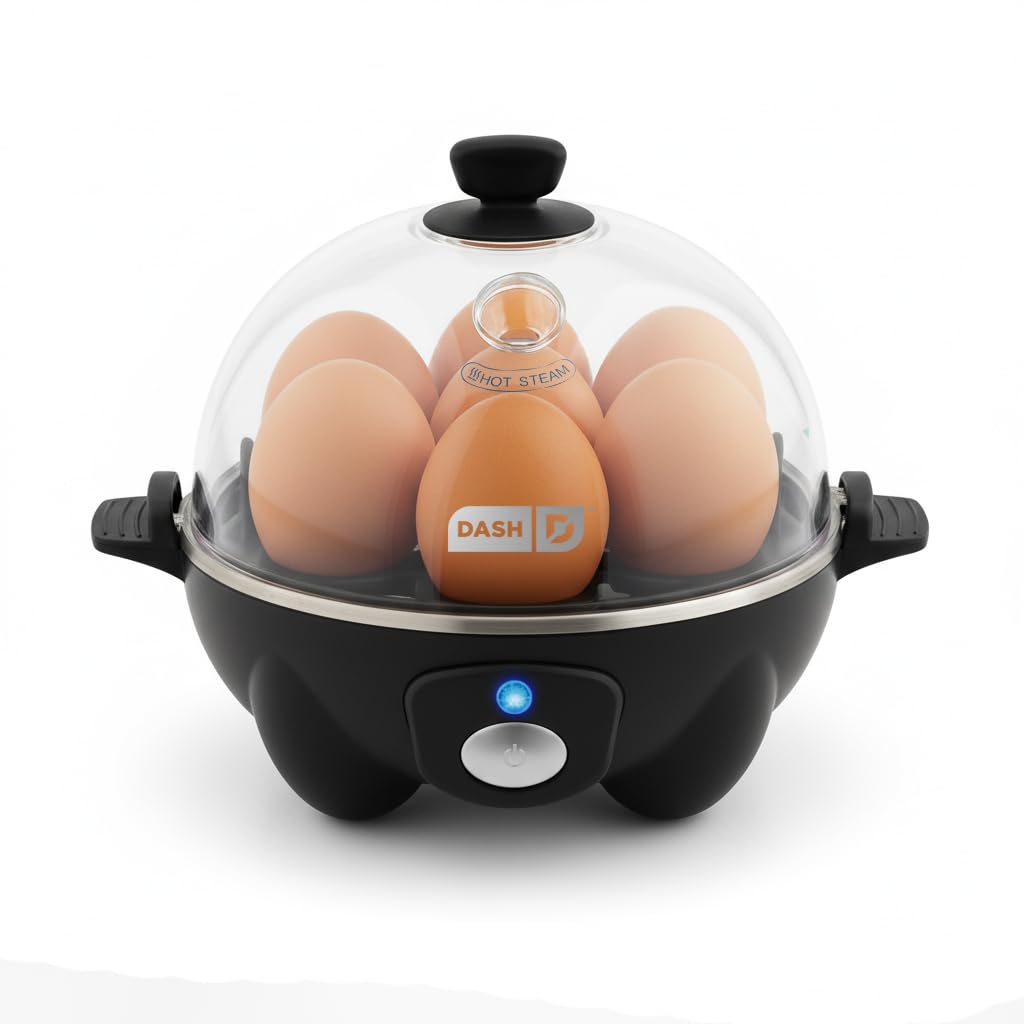
This is the cooker we reach for most often when a ramen craving hits on a weeknight, and it earns that spot through sheer repeatability.
Pros
- Seven-egg capacity fits a full ramen batch plus extras for snacking
- Thermal sensor gives consistent results once water amount is dialed in
- Compact enough to leave on the counter permanently
Cons
- No true auto shut-off, despite marketing language, it just beeps
- Buzzer alone means eggs keep cooking if you’re not nearby
- Basket spacing is tight for jumbo eggs
The trick with this cooker for ramen eggs is treating the beep as a starting gun, not a finish line. Pull the tray the moment it sounds and plunge straight into ice water; wait even a minute and carryover heat pushes a jammy yolk toward fully set. Once we found our water line for a 6.5-minute jammy yolk, results repeated batch after batch. Peeling is clean thanks to the steam method, which matters when you’re halving eggs for presentation in a bowl.
Dash Deluxe Egg Cooker, 12 Eggs
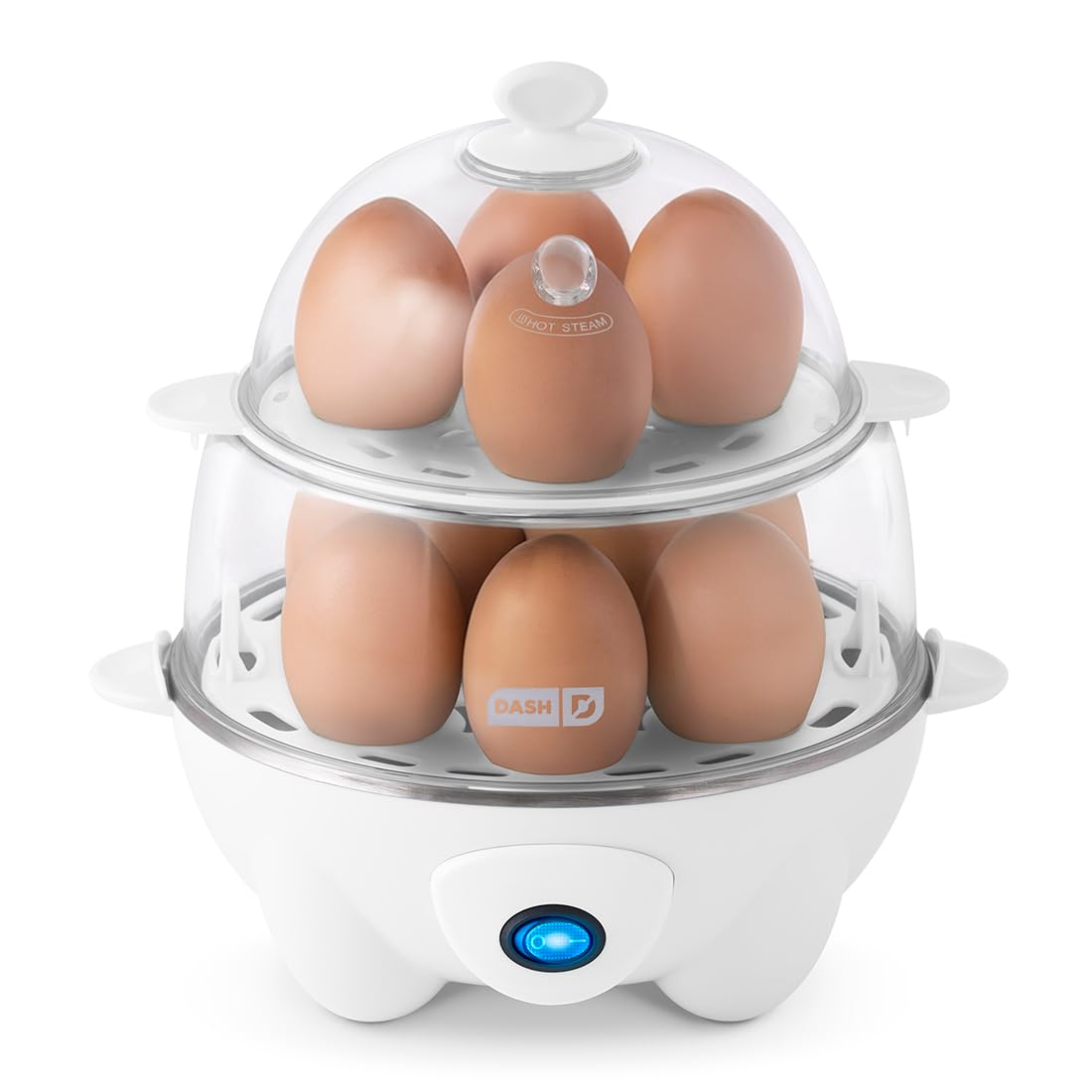
This is the pick for anyone who wants to marinate a full jar of ajitsuke tamago in one go instead of running the cooker twice.
Pros
- Double-decker design cooks 12 eggs at once for serious batch marinating
- Same precision thermal sensor as the smaller Dash model
- Doubles as a steamer for vegetables or dumplings on ramen night
Cons
- Taller footprint takes up more cabinet or counter space
- Two tiers can cook slightly unevenly if water isn’t leveled
- Longer cook cycle than smaller-capacity cookers
Twelve eggs sounds like overkill until you’ve tried keeping a week of ramen toppings stocked in the fridge. The two-tier basket does mean eggs on the bottom tray see slightly more direct steam, so rotating trays halfway through, or accepting a small variance between top and bottom, helps even things out. For anyone building a ramen-egg batching routine, that trade is worth it. Cleanup matches the smaller Dash: rinse the trays, wipe the base.
Hamilton Beach 3-in-1 Egg Cooker (25507)

A solid middle-ground pick that handles seven eggs at a time with an indicator light that’s easier to track at a glance than a beep alone.
Pros
- Indicator light plus alarm makes timing easier to monitor
- Seven-egg tray works well for a standard ramen batch
- Doubles as a steamer for the omelet tray
Cons
- Power must be manually switched off, it doesn’t stop on its own
- Measuring cup markings run a little vague
- Plastic housing feels less substantial than metal-clad models
Shells “slide right off” according to several buyers, and that peeling ease is a genuine advantage for ramen eggs, since a torn peel means a lumpy, uneven surface once halved. The measuring cup takes a test run or two to nail the exact water line for a jammy yolk, but once dialed in, it holds steady. Manual shutoff is a minor annoyance worth remembering.
Elite Gourmet 7-Egg Rapid Egg Cooker

This is the budget-friendly option that still delivers a genuine auto shut-off, a feature many pricier cookers skip.
Pros
- True auto shut-off stops the cooking cycle, not just an alarm
- Built-in piercing pin on the measuring cup speeds up prep
- Seven-egg capacity handles a standard ramen batch
Cons
- Can overheat if left plugged in after the cycle ends
- Housing runs warm to the touch near the base
- Steam vents release more visible moisture than competitors
The piercing pin built into the measuring cup is a small detail that saves real time when prepping a batch for ramen night, since pierced eggs release less sulfur smell and peel more predictably. Buyers report needing to unplug the unit promptly once it shuts off to avoid residual heat buildup. For the price, the timer and auto shut-off combination is hard to match, and it consistently produces the soft-to-medium range that ramen eggs need.
Nordic Ware Microwave Egg Boiler

Buy this if speed and minimal counter space matter more than fine yolk control, since microwave wattage variance makes precise jammy yolks harder to hit.
Pros
- No piercing required before cooking
- Cooks four eggs in ten minutes or less
- Dishwasher-safe and easy to store in a drawer
Cons
- Cooking time varies significantly by microwave wattage
- No built-in cooling step, eggs need a manual ice bath after
- Only handles four eggs per cycle, limiting batch marinating
Microwave egg boilers work by trapping steam inside a sealed shell, and that method cooks fast but leaves less room for fine-tuning a specific yolk stage. Wattage swings between microwaves mean the same six-minute setting can produce a soft yolk in one kitchen and a firmer one in another. For occasional ramen eggs or dorm-style cooking, it gets the job done; for repeatable jammy yolks across many batches, it takes more trial runs than an electric cooker.
Sistema Easy Eggs Microwave Egg Cooker

This compact microwave cooker is better suited to poached or scrambled eggs than shell-on ramen eggs, but it’s the fastest option on this list for a single-serving fix.
Pros
- Steam vent keeps microwave splatter contained
- Dishwasher, fridge, and freezer-safe for easy storage
- Fast cycle time for single or double servings
Cons
- Designed for cracked eggs, not shell-on hard or soft boiling
- Not built for batch marinating multiple ramen eggs at once
- Smaller capacity limits it to one or two servings at a time
For ramen purposes, this cooker fills a different niche: it’s better for a quick poached egg topping than a marinated jammy egg. One reviewer found a single poached egg “spreads out into a thin layer then overcooks” at the recommended time, so shorter test runs help. Anyone set on classic shell-on ramen eggs will get more mileage from an electric cooker or the Nordic Ware boiler instead.
Evoloop Rapid Egg Cooker

A capable six-egg cooker for ramen batches, provided you’re ready to pull the eggs the instant it finishes.
Pros
- Six-egg capacity suits smaller ramen batches well
- Detachable trays make cleanup quick
- Multiple accessories cover poached and omelet styles too
Cons
- Requires prompt attention right when cooking finishes, per user feedback
- Some units reported reliability issues after repeated use
- Not a true hands-off, walk-away appliance
One long-time user summed it up well: it’s “NOT an automatic egg boiler” in the sense of walking away and forgetting about it, since it needs attention the moment it’s done to avoid overcooking. For ramen eggs specifically, that’s manageable if you’re in the kitchen anyway prepping broth and noodles. Reliability complaints exist in a handful of reviews, so this fits best as a secondary or backup cooker rather than a daily-use workhorse.
Hamilton Beach 3-in-1 Egg Cooker, 14-Egg

Choose this one for large households or meal-prep marathons that need 14 eggs in a single cycle.
Pros
- Fourteen-egg capacity is the largest on this list
- Two hard-boiled/poaching trays add flexibility
- Shells reported to peel cleanly and consistently
Cons
- No automatic timer or cutoff, relies on manual monitoring
- Taller unit takes up more vertical cabinet space
- Slower overall cycle given the larger batch size
Fourteen eggs at once means one cycle can stock an entire week of ramen toppings, which is a real advantage for meal preppers. The tradeoff is monitoring: there’s no automatic timer, so this cooker asks for more attention than the smaller Dash or Elite Gourmet models. For batch marinating where exact yolk timing matters less across the whole tray, that’s a fair compromise.
Annie & Mia Design Stainless Steel Egg Cooker

Pick this one if avoiding plastic contact with food matters, since the tray, lid, and bowl are stainless steel rather than the plastic used in most competitors.
Pros
- Nearly all food-contact parts are stainless steel, not plastic
- Genuine auto shut-off with audible alarm
- Seven-egg capacity suits a standard ramen batch
Cons
- Some buyers found the included water-measurement guide inaccurate
- Runs faster than expected, requiring shorter water fills for jammy yolks
- Higher price point than comparable plastic cookers
The stainless steel build is the clear draw here, and it shows in the sturdier feel compared to all-plastic units. Water measurement accuracy is the sticking point: a couple of reviewers found the eggs overcooked at the recommended fill line, so a shorter test run for the first batch is worth doing before committing to a full seven-egg ramen batch.
NESCO EC-10 Egg Cooker
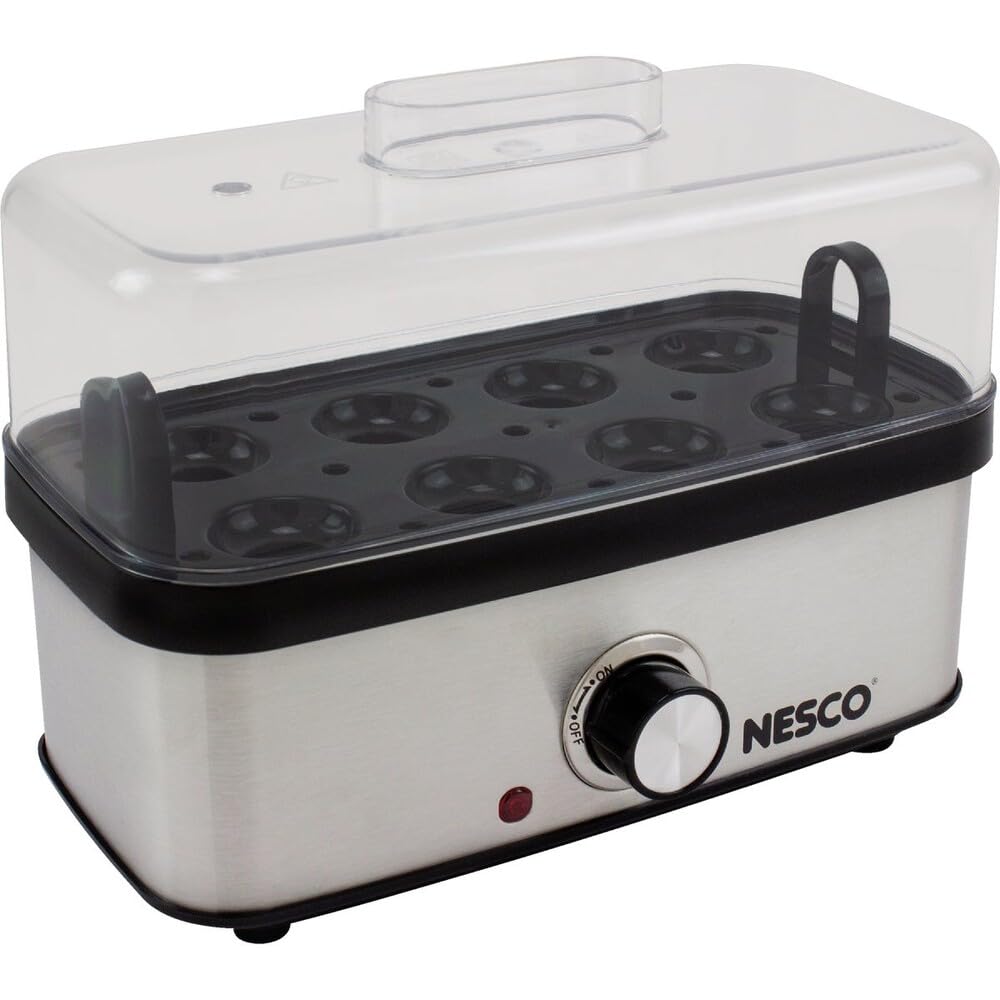
A no-frills eight-egg cooker with a poaching tray, best suited to buyers who don’t mind manually shutting it off.
Pros
- Eight-egg capacity plus a 3-compartment poaching tray
- Slim stainless steel design fits narrow counter spaces
- Buzzer clearly signals when the cycle ends
Cons
- No automatic shut-off, one reviewer specifically flagged this as a missing timer feature
- Smaller company footprint means fewer recent reviews to draw on
- Poaching tray takes priority in design over hard-boil precision
The poaching tray is a nice bonus for anyone who wants a soft poached egg on ramen instead of the classic jammy shell-on version. For straightforward soft- or medium-boiled ramen eggs, the lack of auto shut-off means treating the buzzer the same way as with the Dash and Hamilton Beach models: pull the eggs the second it sounds. Reviewers who’ve owned it for months report consistent results once they’ve dialed in their preferred water line.
Buying Guide
Capacity and Batch Marinating
Match the basket size to how many ramen eggs will realistically be marinated at once. A four- or six-egg capacity works for a single dinner, but batch marinating a jar of ajitsuke tamago for the week calls for a seven-egg tray at minimum, and a double-decker or 12-to-14-egg model saves real time for larger households.
| Capacity | Best For |
|---|---|
| 2-4 eggs | Single servings, microwave cookers |
| 6-7 eggs | Standard ramen batch, weeknight cooking |
| 12-14 eggs | Meal prep, marinating jars, larger households |
Timing Control and Alarm Type
A true auto shut-off stops the heating element the instant the cycle ends, which matters more for ramen eggs than for fully hard-boiled ones. A jammy yolk sits in a narrower window than a hard-boiled egg, so a few extra seconds of carryover heat under a beep-only alarm can push a runny center toward fully set.
Look for one of these two designs:
- Auto shut-off with buzzer: cooking stops on its own; lower risk of overcooking
- Buzzer only, manual power-off: requires standing by to switch off the unit right when it sounds
Water Measurement Precision
Every electric egg cooker relies on a fixed water amount to time the cook, standing in for a thermometer. The included measuring cup should have clear markings for soft, medium, and hard settings, but real-world results vary by egg size and starting temperature. Cold eggs straight from the fridge cook slower than room-temperature ones, and jumbo eggs need a touch more water and time than mediums to land in the same yolk zone.
Run a test batch with any new cooker before committing to a jammy-yolk timing for regular use. Note the water line and time that works, then repeat it.
Cooling and Peeling
Quick cooling stops carryover cooking and makes peeling easier. An ice bath immediately after the buzzer sounds is the single biggest factor in landing a clean jammy yolk instead of one that firms up while the eggs sit warm on the counter.
Peeling ease depends partly on the cooker’s steaming method and partly on egg freshness; very fresh eggs (just days old) tend to peel less cleanly than eggs that are a week or two old, regardless of which cooker did the cooking.
Material and Cleanup
Stainless steel trays and lids resist staining and feel more durable than all-plastic units, though they typically cost more. Dishwasher-safe removable parts matter most for anyone running the cooker several times a week, since hand-washing small trays and poaching cups gets old fast.
Editor’s Choice
The Dash Rapid Egg Cooker, 7 Eggs earns the top spot for ramen eggs specifically. Its seven-egg capacity matches a standard batch, the thermal sensor gives repeatable timing once the water line is dialed in, and cleanup takes minutes. It’s the cooker we’d hand to a friend who just wants consistent jammy yolks without fuss.
For anyone marinating in bulk, the Dash Deluxe Egg Cooker, 12 Eggs is worth the larger footprint. And for a genuinely hands-off cycle at a lower price, the Elite Gourmet 7-Egg Rapid Egg Cooker stands out as the one budget pick that includes a real auto shut-off instead of just a buzzer.
Serious yolk purists chasing one exact stage of doneness, especially a very specific runny-but-set center, may still get more precise control from a saucepan and a kitchen timer, since stovetop water temperature can be adjusted mid-cook in ways a fixed electric cycle can’t match.
Conclusion
Any of these cookers beats standing over a pot guessing at timing, but the right pick depends on how many ramen eggs need marinating at once and how much hands-off convenience matters. Electric cookers with genuine auto shut-off remove the most risk of overcooking a jammy yolk, while microwave boilers suit fast, small batches better than large-scale marinating projects.
Whichever cooker ends up on the counter, the habit that matters most is consistent: same water line, same egg size when possible, and an ice bath the moment the buzzer sounds. Nail that routine once, and ramen night stops being a gamble.
FAQS
What water-to-egg ratio gives a jammy yolk for ramen eggs?
It varies by cooker, since each model’s manual specifies its own fill lines for soft, medium, and hard settings. Start with the manufacturer’s “soft” or “medium” line, then adjust in small increments until a test egg comes out with a glossy, half-set yolk.
Should I pierce the egg before cooking?
Piercing the wide end with a pin (many cookers include one built into the measuring cup) releases trapped air and reduces cracking. It also makes peeling slightly easier since it prevents the internal membrane from sticking as tightly to the shell.
How do I stop carryover cooking after the buzzer sounds?
Transfer the eggs to an ice bath immediately. Even a minute of residual heat sitting in the tray can push a runny yolk toward a firmer, more set texture.
Can I marinate the eggs right after peeling?
Yes, once the eggs are fully cooled and peeled, they can go straight into a marinade of soy sauce, mirin, and water (or a similar ajitsuke tamago blend). Give them at least a few hours, and ideally overnight, for the flavor to penetrate the white and edge of the yolk.
Does altitude affect egg cooker timing?
Higher altitudes lower water’s boiling point, which can extend cooking times slightly in any steam-based cooker. Anyone above 3,000 feet may need to add a minute or two beyond the manufacturer’s stated time and confirm with a test batch.