Quick Answer
A hand mixer’s eject mechanism releases the beaters, dough hooks, or other compatible attachments when you press the eject button. The button moves an internal release component, such as a retaining latch or gear, allowing the attachment shafts to slide out of their sockets. Some models use a spring-assisted arrangement, while others use a different retaining design. For safe removal, follow your model’s instructions, including the guidance in the manufacturer’s product support resources.
Main Parts of the Eject Mechanism
- Eject button: The external control you press to begin releasing an attachment.
- Internal linkage: Transfers movement from the button to the release component.
- Retaining component: Holds the attachment shaft in place during normal use.
- Attachment shaft: Fits into the mixer’s socket and engages with its drive mechanism.
- Return action: Allows the button or release parts to return to their resting position after use.
Before Removing the Beaters
- Switch the mixer off, unplug it, and wait until the beaters have stopped completely.
- Keep your fingers away from the beater sockets and avoid forcing an attachment that will not release.
A hand mixer has a small but useful feature that often goes unnoticed until it’s time to clean up: the eject mechanism. It lets you remove the beaters without pulling hard on the shafts or struggling with sticky batter.
In this guide, I’ll explain how the eject mechanism works, what happens inside the housing when you press the button, and why some attachments refuse to come out. I’ll also cover common design differences and safe troubleshooting steps.
In This Guide
What Is a Hand Mixer Eject Mechanism?
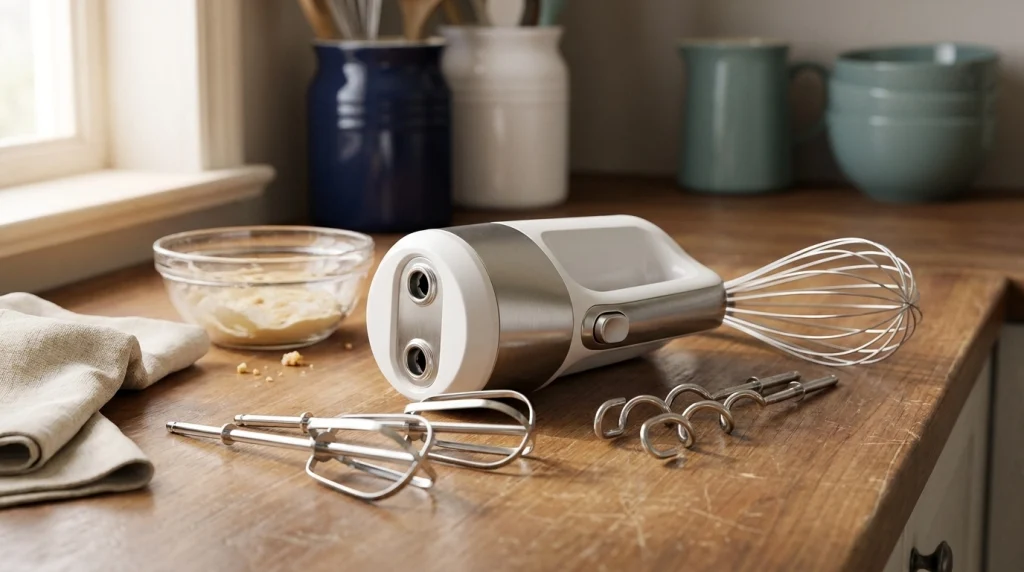
A hand mixer eject mechanism is the internal release system that allows removable attachments to come out of the mixer body. It connects the external eject button to the components that keep the beater shafts securely seated during mixing.
Why does a hand mixer need an eject mechanism?
Beaters must remain securely attached while the motor rotates them through batter, cream, or other ingredients. At the same time, users need a convenient way to remove those beaters for washing and storage.
The eject mechanism solves both problems. It provides a controlled release instead of requiring you to pull forcefully on the attachment shafts.
Depending on the model, the same release system may accommodate several approved attachments, including:
- Standard beaters for mixing cake batter, eggs, and similar ingredients.
- Dough hooks designed for compatible dough-mixing tasks.
- Whisks or other accessories supplied for that particular mixer.
Not every hand mixer accepts every attachment. The shaft shape, collar, and socket arrangement must match the manufacturer’s design.
What holds the beaters in place?
Most designs use a retaining feature that prevents an attachment shaft from sliding out during normal operation. Depending on the model, this may involve a latch, retaining gear, locking surface, or another mechanical arrangement.
For example, KitchenAid’s hand mixer support documentation describes an internal retaining gear that holds the beaters in place until the eject button is pressed. This illustrates the principle, but it shouldn’t be assumed that every brand uses the same parts.
The eject mechanism is separate from the motor’s main mixing function. Its job is to release attachments, not to generate the rotation that mixes ingredients.
Section takeaway: The eject mechanism balances secure attachment during mixing with easy removal afterward. Its exact internal construction varies by manufacturer and model.
How Does the Eject Mechanism Work Step by Step?
The eject mechanism works by transferring pressure from the button to an internal release component. That component disengages the retaining feature so the attachment shaft can slide out of its socket.
Step 1: The attachment locks into its socket
When you insert a compatible beater, its shaft enters the designated opening underneath the mixer. The shaft’s shape, grooves, or collar help it seat correctly and engage with the mixer’s drive and retaining components.
Some models produce an audible click when an attachment locks into place. Others may engage without a distinct clicking sound, so the manufacturer’s instructions are more reliable than sound alone.
Step 2: The retaining component holds the shaft
Once inserted correctly, the attachment remains in position while the mixer operates. The retaining component helps prevent the shaft from slipping out as the beater rotates and encounters resistance from the mixture.
This matters when mixing thick cake batter or other ingredients that put resistance on the beaters. A properly engaged attachment should remain seated instead of gradually working loose.
Step 3: You press the eject button
After switching off and unplugging the mixer, you press its designated release control. The button moves an internal lever, linkage, or release component, depending on the design.
On some hand mixers, the speed control and eject button are combined into one control. These designs generally allow ejection only when the control is in the OFF position, as specified in the product instructions.
Step 4: The retaining feature disengages
Movement inside the housing releases the attachment shaft from its retaining position. The exact movement depends on the mechanism, but the purpose remains the same: free the shaft without dismantling the mixer.
Some systems use spring force to assist release or return moving parts to their resting positions. Others rely on the shape and movement of the retaining components, so a strong outward spring action is not universal.
Step 5: The attachment comes out
Once released, the beater can slide out of the socket. Depending on the model, it may drop into your waiting hand or require you to pull it out gently.
Here’s the important distinction: pressing the eject button releases the attachment; it doesn’t necessarily propel it out with force. A quiet release or the absence of a noticeable click can be normal on certain models.
- Turn the mixer off.
- Unplug it from the outlet.
- Hold the attachment securely, following the manual’s removal instructions.
- Press the eject button and remove the released attachment without twisting or forcing it.
For a model-specific example, consult the KitchenAid hand mixer attachment instructions.
Section takeaway: The button moves the release mechanism, the retaining feature disengages, and the attachment becomes removable. Always disconnect power before handling the beaters.
What Parts Make the Eject Mechanism Work?
A hand mixer eject mechanism depends on several cooperating parts, although their shapes and arrangements differ across models. Understanding these parts helps explain why a button can feel normal while an attachment still refuses to release.
Key components and their functions
| Component | Main function | Possible problem |
|---|---|---|
| Eject button | Receives pressure from your thumb. | Sticks, jams, or fails to move. |
| Linkage or lever | Transfers button movement to the release component. | May become disconnected or damaged. |
| Retaining component | Keeps the attachment seated until release. | May fail to disengage or retain the shaft. |
| Return spring, if fitted | Helps return a moving component to its resting position. | May lose tension or become displaced. |
| Beater shaft and socket | Provide the attachment interface and drive connection. | Debris, damage, or misalignment may prevent removal. |
This table describes common functions rather than a universal parts list. A particular mixer may combine functions into one component or use a different arrangement entirely.
How does the eject mechanism relate to the motor?
The motor drives the beaters through the mixer’s internal transmission. The eject mechanism controls whether those attachments remain locked in their sockets.
Although both systems occupy the same housing, they perform different jobs. A mixer can have a working motor but a faulty eject mechanism, or a working release button but a motor that won’t run.
That distinction helps narrow down the problem. If the beaters rotate normally but won’t release, the attachment-retention system deserves attention before the motor.
For more detail about safe operation, consult the U.S. Consumer Product Safety Commission for general consumer-product safety information and follow your appliance manufacturer’s specific instructions.
Section takeaway: The eject button, linkage, and retaining component form the release path. The motor and transmission perform the separate task of rotating the attachments.
How Do Different Eject Mechanism Designs Compare?
Hand mixers don’t all use the same eject mechanism. Manufacturers may use a dedicated release button, a combined speed-control and eject button, or a design that incorporates spring assistance.
The most useful comparison is how each design operates and what the user should expect, rather than assuming one arrangement is used across all brands.
| Design | How it works | What to know |
|---|---|---|
| Dedicated eject button | A separate button actuates the release component. | Easy to identify, but button placement varies. |
| Combined speed and eject control | The control selects speeds and also releases attachments in its designated OFF position. | Correct control position is essential. |
| Spring-assisted release | A spring helps move or return part of the release system. | Spring behavior depends on the design. |
| Retaining-gear arrangement | A retaining component holds the beater until the release control disengages it. | A damaged retaining component can prevent proper retention or release. |
Does every eject button make a clicking sound?
No. Some eject mechanisms release attachments smoothly without an obvious click, and certain combined speed-control designs are specifically described by their manufacturers as not producing a noticeable click during ejection.
Don’t judge the mechanism by sound alone. Instead, check whether the control moves as expected and whether the attachment releases without excessive force.
Are all hand mixer attachments released the same way?
Many compatible beaters, dough hooks, and whisks use the same release control. However, attachment shafts can differ in shape, collar placement, and socket compatibility.
Never assume that an attachment fits simply because its shaft enters an opening. Check the manufacturer’s diagram to confirm the correct socket and orientation.
Section takeaway: Different designs can accomplish the same release task. Your model’s manual determines the correct button position, attachment arrangement, and removal procedure.
Why Won’t a Hand Mixer Release Its Beaters?
When a hand mixer eject mechanism stops working, the cause may be a simple operating mistake or a damaged internal component. Start with safe external checks before considering professional service.
Common causes and what to check
- The control isn’t in OFF: Some models combine the speed selector and eject button, so the release function may work only in the OFF position.
- The shaft isn’t seated correctly: A misaligned attachment may not engage or disengage as intended.
- Dried batter is obstructing movement: Food residue around the attachment openings can interfere with removal.
- The retaining component is damaged: A broken or worn component may stop the attachment from releasing properly.
- The button or linkage is jammed: A control that won’t move normally may indicate an internal mechanical problem.
- The attachment is damaged: A bent shaft or worn locking surface can prevent smooth removal.
What should you do if the eject button feels stuck?
First, switch the mixer off and unplug it. Never troubleshoot the release mechanism while the motor is running or the appliance remains connected to power.
- Check the manual to confirm the required OFF position and release procedure.
- Inspect the exposed attachment shafts and openings for visible food residue.
- Wipe accessible exterior surfaces with a slightly damp cloth, keeping moisture away from openings.
- Try the prescribed release action without twisting, prying, or applying excessive force.
- If the button remains jammed, stop and contact the manufacturer or an authorized repair service.
Do not pour water or cleaning liquid into the beater sockets. Moisture entering the housing can damage electrical components or create an electrical hazard.
Section takeaway: Check the control position, visible residue, and attachment alignment first. Persistent sticking or a failed retaining mechanism calls for manufacturer guidance rather than force.
How Do You Use and Maintain the Eject Mechanism?
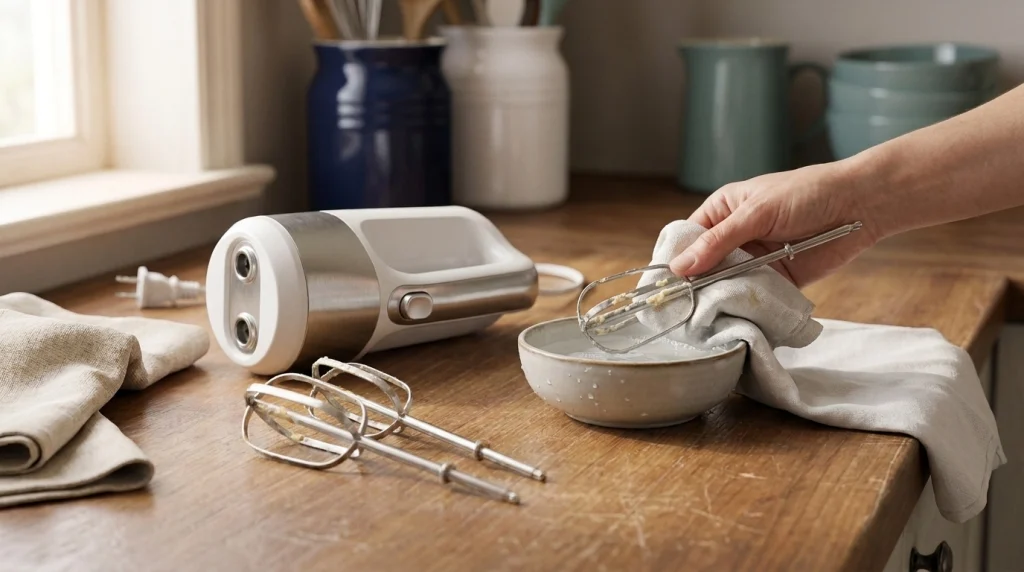
Good handling habits help keep the eject mechanism working as intended. The most important steps are to disconnect power before removal and keep food residue from building up around accessible parts.
Use the release button safely
Follow this routine whenever you finish mixing:
- Move the speed control to OFF.
- Unplug the mixer from the electrical outlet.
- Wait until all moving parts have stopped.
- Position your hand to catch or support the attachments as directed by the manual.
- Press the eject button and remove the released beaters.
- Wash the removable attachments according to their care instructions.
KitchenAid’s official guidance for inserting and removing hand mixer beaters also emphasizes turning the appliance off and unplugging it before handling attachments. Other manufacturers may specify additional steps for their own models.
Keep residue away from the mechanism
After mixing, wipe the exterior around the attachment openings with a damp cloth if necessary. Clean the beaters separately and dry them as instructed before storage.
Never immerse the motor housing unless the manufacturer explicitly states that the particular component is designed for immersion. For most electric hand mixers, the housing must remain dry.
When should you seek repair?
Stop using the mixer if the attachments fall out during operation, the eject button breaks, or the release mechanism behaves unpredictably. An attachment that won’t stay secured can create an injury hazard.
Pro tip: Don’t open a sealed motor housing, stretch a spring, bend a retaining part, or bypass a locking feature to make the eject mechanism work. Check your model’s service instructions and contact a qualified appliance repair technician when internal repairs are needed.
As of 2026, the safest troubleshooting approach remains model-specific: use the correct manual, avoid improvised repairs, and confirm that the attachments lock securely before returning the mixer to service.
Section takeaway: Unplug before removing attachments, clean only accessible areas, and stop using a mixer with a damaged or unreliable retaining system.
Frequently Asked Questions
1. What happens inside a hand mixer when you press the eject button?
Pressing the eject button moves an internal release component that disengages the attachment’s retaining feature. Once the shaft is free, the beater can slide out of its socket. The exact arrangement depends on the manufacturer’s design.
2. Does a hand mixer eject mechanism use a spring?
Some hand mixer designs use a spring to assist movement or return the release components to their resting position. Others use different mechanical arrangements. A spring is therefore common in some designs, but it isn’t a universal requirement.
3. Why do my hand mixer beaters fall out?
Beaters may fall out if they aren’t inserted correctly or if the internal retaining component is damaged. Stop using the mixer until you identify the cause. Consult the manual or manufacturer support if the attachments won’t stay securely locked.
4. Why does my eject button work but the beater won’t come out?
The button may move without fully disengaging the retaining component. Dried residue, shaft misalignment, a damaged attachment, or a faulty internal linkage can contribute. Unplug the mixer, check the manual, and avoid pulling or prying forcefully.
5. Should the eject button click when I press it?
Not necessarily. Some models release beaters without a noticeable click. The expected feel and sound depend on the design, so check the manufacturer’s instructions rather than treating a silent release as evidence of a fault.
6. Can I clean the eject mechanism with water?
Keep water away from the motor housing, internal mechanism, and attachment openings. Clean exposed surfaces with a slightly damp cloth and wash removable accessories separately according to the manufacturer’s instructions. Never immerse the mixer unless its documentation explicitly permits it.
7. Can I repair a broken eject mechanism myself?
Simple external cleaning and correct attachment positioning are reasonable first checks. Internal repairs may involve electrical parts, springs, or retaining components, so consult the manufacturer’s service guidance. If the unit isn’t designed for user repair, contact an authorized technician or ask about replacement options.
Final Takeaway
A hand mixer eject mechanism uses a button and internal release components to disengage the feature that holds each attachment in place. Although the button’s appearance and the internal parts vary, the goal is always controlled attachment removal.
If your mixer releases its beaters smoothly, keep the housing clean and follow the recommended removal procedure. If the button jams or the attachments won’t stay secure, stop using the appliance and seek model-specific support rather than forcing the mechanism.