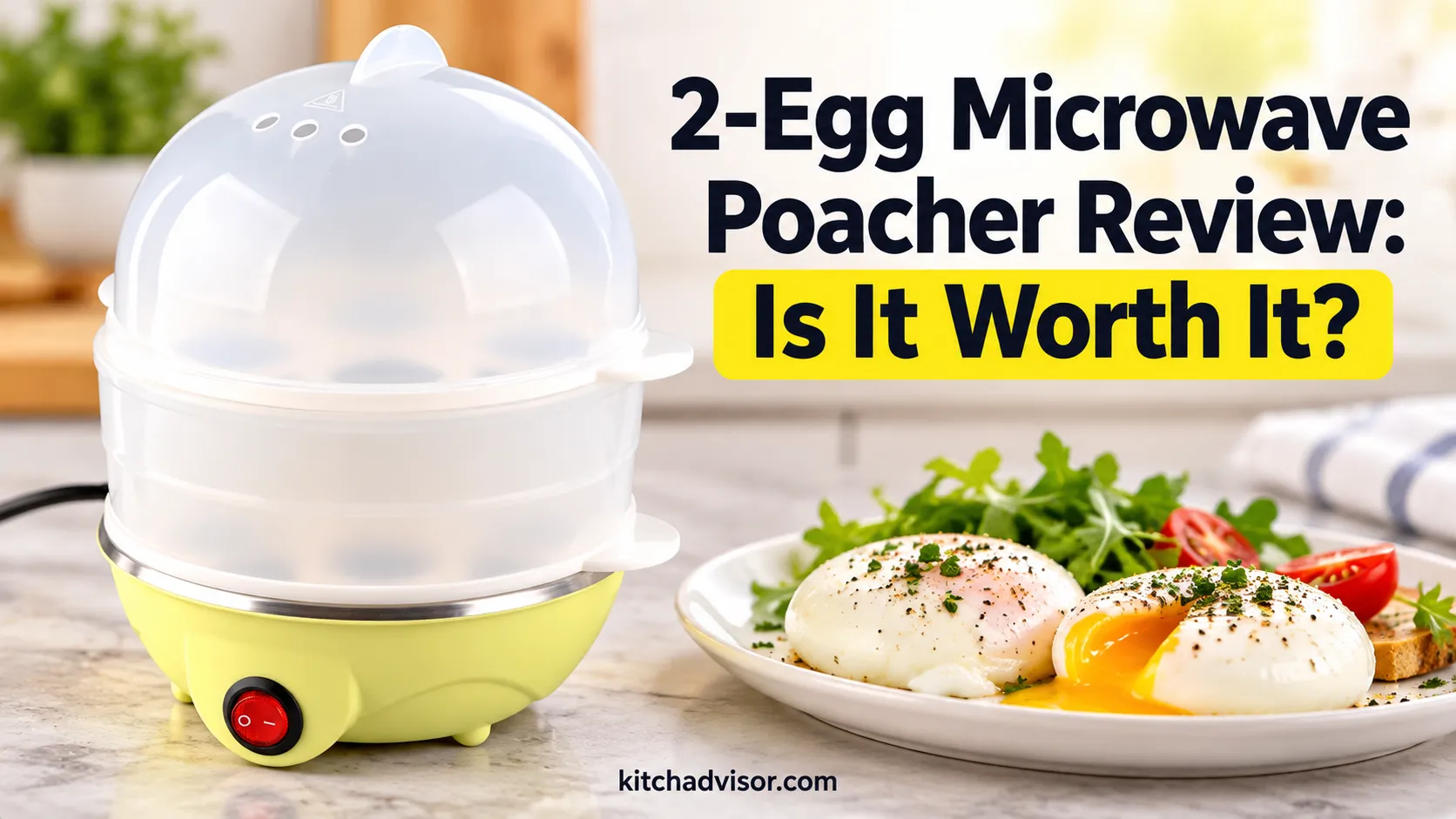
The 2-Egg Microwave Poacher with Lid and Handle is a compact microwave egg cooker designed to prepare up to two cracked eggs at once. Its primary use is making quick poached-style eggs without using a frying pan or dedicated electric egg cooker.
This 2-Egg Microwave Poacher review focuses on its simple dual-cavity design, food-grade polypropylene construction, integrated handle, and everyday practicality. It is positioned as a basic low-complexity option for individuals, students, office kitchens, and anyone who regularly prepares one or two eggs.
🏆 My Quick Verdict
💡 Best For: Single users and couples who want a compact way to microwave one or two eggs for quick meals.
⚡ Key Specs:
Dual egg cavities, capacity for up to two eggs, food-grade polypropylene construction, fitted lid, integrated handle, approximately 6.3 × 4.7 × 1.2 inches.
✅ Bottom Line: This is a straightforward microwave accessory that removes the need for a skillet when preparing a small egg portion. Its biggest strengths are simplicity and compactness, while results still depend on microwave wattage and careful timing.

At a Glance
- The dual-cavity layout prepares up to two cracked eggs in one batch.
- Food-grade polypropylene keeps the cooker lightweight and suitable for repeated kitchen use.
- A fitted lid helps contain the egg while it cooks inside the microwave.
- The integrated handle simplifies moving the cooker after heating.
- Cooking time requires adjustment for microwave wattage, egg size, and preferred yolk texture.
- The compact footprint suits dorm rooms, office kitchens, RVs, and small kitchens.
Specifications
| Specification | Verified Detail |
|---|---|
| Product Type | Microwave egg poacher |
| Capacity | Up to 2 eggs |
| Material | Food-grade polypropylene |
| Layout | Two separate egg cavities |
| Approximate Size | 6.3 × 4.7 × 1.2 inches |
| Design | Lid with integrated handle |
| Cooking Method | Microwave heating |
Design & Build Quality
The design prioritizes simplicity rather than complicated controls or accessories. Two molded cavities separate the eggs, while the lid covers the cooking area and the handle provides a convenient gripping point.
Food-grade polypropylene makes the unit lighter than ceramic microwave cookware. That low weight is useful for storage, although users who prefer glass or ceramic cookware may naturally favor a different construction.
The shallow footprint also makes this easier to store than a countertop electric egg cooker. It can fit into kitchens where cabinet and worktop space are limited.
Setup, Installation & Ease of Use
- Remove the cooker and inspect the lid, handle, and cavities before first use.
- Wash the food-contact surfaces before preparing the first batch.
- Crack one egg into each cavity without exceeding the two-egg capacity.
- Pierce the yolk membrane carefully before microwaving to provide a path for steam to escape.
- Fit the lid and begin with conservative microwave timing rather than immediately using a long cooking cycle.
- Adjust subsequent cooking time according to microwave wattage, egg size, and preferred doneness.
- Open the lid carefully after heating because accumulated steam can be hot.
- Allow the cooker to cool briefly, clean away food residue, and store it dry.
Core Performance & Feature Breakdown
The main performance benefit is preparing two eggs simultaneously in a very small microwave-safe format. The separate cavities keep each egg contained instead of allowing the whites to spread across a large plate.
Cooking consistency depends heavily on timing. Microwave output varies significantly between appliances, so there is no single cooking duration that can guarantee an identical yolk and white texture in every kitchen.
Expert Insight
Treat your first batch as a calibration run. Starting with less cooking time and adding short intervals gives you more control than overheating the eggs and trying to correct them afterward.
The lid is another practical component because microwave egg cooking can create steam and splatter. Users should still treat the cooker as hot cookware and avoid opening the lid toward their face immediately after heating.
This product is therefore better understood as a convenience tool than an automatic egg-making appliance. There is no electronic timer, heating element, or automatic shutoff system doing the decision-making for you.
Key Features Explained
Dual-Cavity Cooking
The molded two-cavity layout allows two eggs to cook in the same microwave cycle. This matters for breakfast sandwiches, toast, rice bowls, and other meals where two portions are more useful than one.
Food-Grade Polypropylene Construction
The cooker uses food-grade polypropylene rather than heavier ceramic or glass. That keeps the accessory light and easy to move, although buyers specifically seeking non-plastic cookware should consider another format.
Lid and Integrated Handle
The lid covers the egg cavities during heating, while the integrated handle provides a designated gripping area. The handle does not eliminate the need for caution because steam and heated surfaces may still cause burns.
Microwave-Based Operation
No separate electrical base is required because the microwave supplies the heat. This makes the cooker especially useful where adding another countertop appliance would be inconvenient.
Real-World Usability & Maintenance
For everyday ownership, the small capacity is both an advantage and a limitation. One or two eggs are quick to prepare, but households cooking larger batches will need repeated cycles.
Cleanup should be easiest when residue is rinsed away soon after the cooker cools. Allowing cooked egg to dry onto the cavities can make routine cleaning less convenient.
For broader guidance on this category, see KitchAdvisor’s microwave egg cooker guide. It explains how microwave cookers differ in design, materials, and intended cooking style.
Pros & Cons
Pros
- Two separate cavities let you prepare up to two eggs in one microwave cycle.
- The compact design occupies little cabinet or countertop space.
- No dedicated electrical base or stovetop pan is required.
- The lid and integrated handle make the format convenient for routine microwave use.
Cons
- Exact doneness requires experimentation with your microwave’s power and timing.
- The two-egg maximum is restrictive for larger households or meal-prep batches.
- Buyers who avoid plastic cooking vessels will prefer glass or ceramic alternatives.
Common Issues & Fixes
Eggs Turn Out Too Firm
Excessive microwave time can make the whites and yolks firmer than intended. Reduce the next cycle and make adjustments in short increments.
Eggs Are Still Undercooked
A short cycle or lower-power microwave can leave the egg below your preferred doneness. Continue heating cautiously in short intervals rather than adding a large block of time.
Steam Builds Up Under the Lid
Microwaved eggs release moisture and can create hot steam inside a covered vessel. Pierce the yolk membrane before heating and open the cooker carefully after the cycle.
What to Know Before You Buy
This cooker makes the most sense when your usual serving is one or two eggs. It does not replace the batch capacity of a six-, seven-, or twelve-egg electric cooker.
You should also expect a small learning curve when determining cooking time. Microwave wattage, starting egg temperature, egg size, and preferred yolk consistency can all change the result.
The manufacturer listing does not provide enough verified information to make a dependable warranty claim. Buyers who consider warranty coverage essential should confirm the current seller terms before ordering.
Who Should Buy It / Who Should Skip It
✅ Who Should Buy It
- Individuals who usually prepare one or two eggs at a time.
- Dorm, office, RV, or small-kitchen users with microwave access.
- People who want to avoid using a skillet for a quick egg portion.
- Buyers prioritizing simple storage and minimal equipment.
✗ Who Should Skip It
- Families regularly preparing several eggs in one batch.
- Anyone wanting automatic timing or automatic shutoff.
- Buyers specifically seeking ceramic, glass, or metal cookware.
- Users expecting identical results without calibrating microwave time.
Alternatives to Consider
Good Cooking Microwave 2-in-1 Omelet Maker and Egg Cup Cooker
Best For: Buyers wanting more versatility than a dedicated two-cavity poacher.
Main Advantage: It supports omelets, scrambled eggs, and individual egg portions.
Trade-off: Its broader design is less focused on simple side-by-side poaching.
Key Spec: Includes a removable egg-cup insert.
Elite Gourmet EGC-508 Rapid Egg Cooker
Best For: Buyers who routinely need larger egg batches.
Main Advantage: It can prepare up to seven shell-on eggs and includes additional egg-cooking accessories.
Trade-off: It occupies more space and requires a dedicated electrical appliance.
Key Spec: Capacity for up to seven shell-on eggs.
Is It Worth It?
The 2-Egg Microwave Poacher is worth considering when convenience and small portions matter more than advanced control. It performs a narrow task without requiring a pan or another powered countertop appliance.
Its value becomes less compelling for large families or users who want automated cooking. In those situations, a multi-egg electric cooker provides greater batch capacity and more specialized accessories.
For a simple one- or two-person breakfast routine, however, the concept is practical. You just need to calibrate the timing for your microwave rather than expecting a universal cooking time.
Final Verdict
The 2-Egg Microwave Poacher with Lid and Handle is a compact, uncomplicated choice for quickly preparing up to two eggs in a microwave. Its strongest fit is small households and space-conscious users who value simplicity, while buyers needing larger batches or automatic controls should consider an electric egg cooker instead.
Frequently Asked Questions
How many eggs can this microwave poacher cook?
It is designed to hold up to two eggs at once. The two separate cavities provide one compartment for each egg.
Is it suitable for every microwave?
Cooking results must be adjusted to the microwave being used. Wattage varies between appliances, so begin conservatively and modify the cooking duration as needed.
Do I need to pierce the yolk before microwaving?
Yes, the supplied usage guidance recommends piercing the yolk membrane before heating. This provides a path for steam to escape and helps reduce the chance of the egg bursting.
What material is the egg poacher made from?
The verified listing describes food-grade polypropylene construction. Buyers specifically wanting ceramic or glass cookware should choose a different type of microwave egg cooker.
How should I clean and maintain it?
Allow it to cool, remove egg residue, rinse or wash the food-contact surfaces, and store it clean and dry. Cleaning soon after use helps prevent cooked egg residue from drying onto the cavities.
Does it come with a warranty?
A specific manufacturer warranty could not be verified from the available product information. Check the current seller and marketplace terms before purchase if warranty coverage is important to you.
Affiliate disclosure: kitchadvisor.com earns a small commission when you purchase through links on this page — at no extra cost to you. Our editorial process is independent: affiliate relationships never influence which products we recommend or how we rank them.