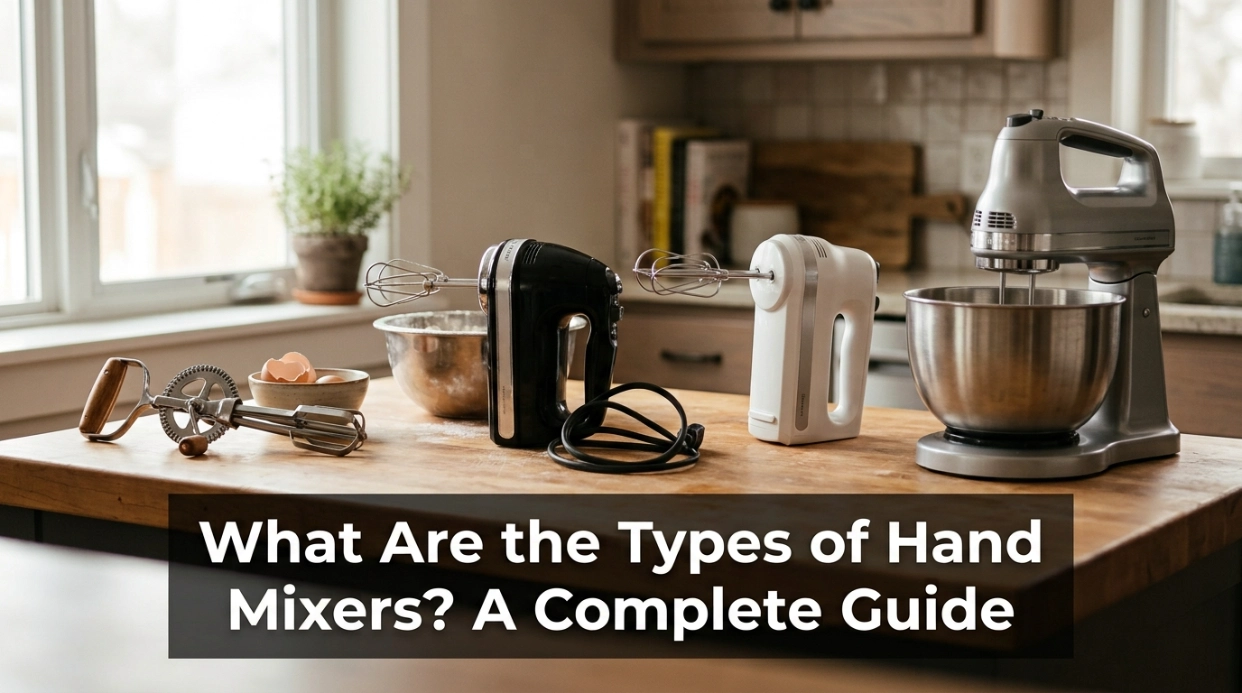
Quick Answer
The main types of hand mixers are manual hand mixers, corded electric hand mixers, and cordless electric hand mixers. Electric models can also be grouped by speed control, attachments, and design, including convertible hand/stand mixers. Current hand mixer buying guidance from KitchenAid also separates models by speed settings and cordless operation.
Main hand mixer types
- Manual hand mixer: Uses a crank, gears, spring, or hand motion instead of electricity.
- Corded electric mixer: Plugs into a wall outlet and offers continuous power without battery charging.
- Cordless hand mixer: Runs from a rechargeable battery and gives you more freedom around the kitchen.
- Multi-speed mixer: Uses several preset speeds for stirring, beating, creaming, and whipping.
- Variable-speed mixer: Provides finer speed adjustment through an electronic control or dial.
- Hand/stand mixer: Can work as a handheld mixer or attach to a stand for some hands-free mixing tasks.
The easiest way to choose
- Choose by power source first, then compare speed control, attachments, weight, storage, and the foods you make most often.
I find the term “hand mixer” confusing because manufacturers don’t always classify these appliances in exactly the same way. One brand may focus on speed count, while another highlights cordless power or included attachments.
As of 2026, the simplest approach is to separate hand mixers by power source, control system, and physical design. That makes it much easier to understand what you’re buying and what each style is meant to do.
In This Guide
- What Are the Main Types of Hand Mixers?
- How Do Corded and Cordless Hand Mixers Differ?
- What Types of Hand Mixers Are There by Speed and Controls?
- Which Hand Mixer Attachments Change What It Can Do?
- Which Type of Hand Mixer Is Best for Different Jobs?
- What Should You Check Before Choosing a Hand Mixer?
- Frequently Asked Questions
What Are the Main Types of Hand Mixers?
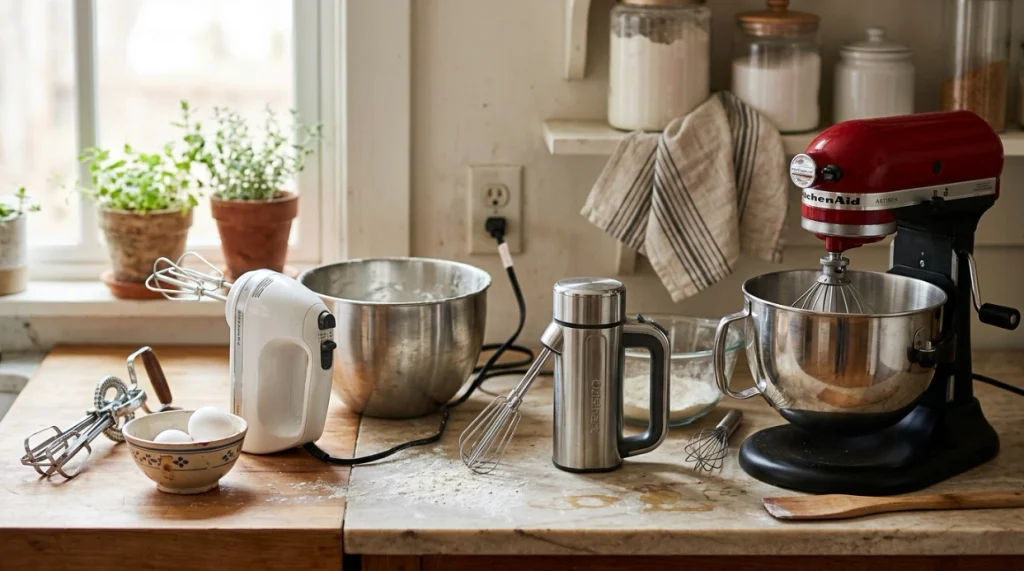
The three clearest categories are manual, corded electric, and cordless electric hand mixers. A fourth useful category is the convertible hand/stand mixer, although it overlaps with corded electric designs.
Definition: A hand mixer is a handheld kitchen tool that rotates beaters, whisks, or similar attachments to combine, beat, cream, or aerate ingredients. Depending on the design, the rotation comes from hand power, an electric cord, or a rechargeable battery.
1. Manual hand mixers
A manual hand mixer has no electric motor. You create the mixing motion yourself through a crank, push mechanism, spring action, or direct whisking movement.
The classic example is the rotary egg beater. Turning its handle drives gears connected to one or two metal beaters.
- Best for: Eggs, light cream, dressings, sauces, and thin batters.
- Main advantage: No outlet, battery, or charging is required.
- Main limitation: Your hand supplies the power, so dense mixtures become tiring.
- Storage: Usually compact and simple.
- Noise: Much quieter than a motorized mixer.
Manual models make sense for occasional light mixing or kitchens where electrical convenience isn’t important. They are not the type I would choose for repeated batches of frosting or stiff cookie dough.
2. Corded electric hand mixers
A corded hand mixer uses an electric motor powered directly from a household outlet. This is the traditional modern hand mixer most people picture.
You insert the beaters, select a speed, and guide the appliance around a separate mixing bowl. The motor and internal drivetrain turn the attachments for you.
- Best for: Cake batter, frosting, whipped cream, eggs, creaming butter and sugar, and many everyday baking jobs.
- Main advantage: No battery runtime or charging schedule to manage.
- Main limitation: The cord can restrict movement or crowd the work area.
- Speed options: Models commonly provide several selectable speeds.
- Attachments: Depending on the model, these can include beaters, whisks, and dough hooks.
For a kitchen with a convenient outlet, a corded model remains a practical all-purpose choice. You can also store it for months without worrying about battery condition.
3. Cordless electric hand mixers
A cordless hand mixer replaces the wall connection with a rechargeable battery. The battery still powers an electric motor, so the mixing principle is similar to a corded model.
The important difference is mobility. You aren’t tied to one outlet or one section of the counter.
- Best for: Kitchens with limited outlets, islands, mobile prep, and cooks who dislike cord clutter.
- Main advantage: Greater freedom of movement around the bowl and kitchen.
- Main limitation: The battery must be charged.
- Buying consideration: Check whether the battery is built in, removable, or sold separately.
- Storage consideration: Remember that the charger or battery system also needs a home.
Current manufacturers offer rechargeable hand mixers alongside their corded lines. That makes cordless operation a genuine product category rather than a novelty.
4. Convertible hand/stand mixers
A convertible model combines two formats. You can detach the mixer for handheld work or place it on a compatible stand for certain hands-free jobs.
Hamilton Beach currently lists hand/stand mixer designs alongside its conventional models. Its mixer range also illustrates how manufacturers may classify products by both design and feature set.
Section Takeaway: The most useful basic classification is manual, corded electric, and cordless electric. Convertible hand/stand mixers form an additional design category for people who want some flexibility between handheld and supported mixing.
How Do Corded and Cordless Hand Mixers Differ?
Corded and cordless hand mixers perform many of the same kitchen jobs. The biggest difference is how electricity reaches the motor.
A corded mixer receives power while it is plugged in. A cordless model stores electrical energy in a rechargeable battery.
| Feature | Corded Hand Mixer | Cordless Hand Mixer |
|---|---|---|
| Power source | Wall outlet | Rechargeable battery |
| Movement | Limited by cord length and outlet location | Free from an outlet while operating |
| Charging | Not required | Required |
| Long sessions | No battery-runtime concern | Runtime depends on battery and workload |
| Counter clutter | Cord remains in the work area | No operating cord |
| Best fit | Frequent home baking near outlets | Flexible prep and outlet-limited kitchens |
When does corded make more sense?
I would start with corded if charging is something you simply don’t want to think about. It is also a straightforward fit when your main mixing area already has an easy-to-reach outlet.
- You bake frequently.
- You often mix several recipes in one session.
- Your counter has convenient electrical outlets.
- You prefer a simpler power system.
- You don’t mind managing a cord during use or storage.
When does cordless make more sense?
Cordless becomes attractive when mobility matters more than continuous connection to an outlet. It can be especially useful on an island or crowded counter.
- You regularly move between prep areas.
- Your outlets are awkwardly placed.
- You dislike cords crossing the worktop.
- You already use a compatible removable-battery appliance system.
- Your typical mixing jobs are short enough for the charger’s routine to feel manageable.
Don’t assume cordless automatically means weak, or that corded automatically means stronger. Mixing performance also depends on motor design, gearing, attachments, electronic controls, and how the appliance manages load.
Section Takeaway: Choose corded for continuous plugged-in convenience and cordless for freedom of movement. Neither power source alone tells you how well a mixer will handle a particular recipe.
What Types of Hand Mixers Are There by Speed and Controls?
Electric hand mixers can also be grouped by their speed-control system. This classification matters because different foods need different mixing intensity.
Current manufacturer lines include models with several fixed speeds, electronic controls, boost functions, slow-start systems, and continuously adjustable controls. The exact labels vary by brand.
Fixed multi-speed hand mixers
A fixed-speed mixer gives you numbered or stepped settings. For example, manufacturers currently sell models with five, six, seven, or nine selectable speeds.
- Lower speeds: Useful when beginning a batter or combining dry ingredients carefully.
- Middle speeds: Often suit routine beating, mixing, and creaming.
- Higher speeds: Commonly used for jobs such as whipping cream or aerating egg whites.
The speed number itself isn’t universal. Speed 5 on one mixer can behave differently from speed 5 on another.
Variable or continuously adjustable mixers
Some models provide a dial or electronic system with finer adjustment between slow and fast operation. Hamilton Beach, for example, currently lists a cordless hand mixer with an infinite-speed control rather than only a few fixed steps.
That type appeals to cooks who want smoother transitions. Fine control can also make it easier to avoid jumping abruptly from gentle mixing to aggressive whipping.
Mixers with slow-start control
Slow-start systems begin more gently before reaching the selected speed. The practical goal is simple: reduce the burst that can throw flour or liquid out of the bowl.
This is one feature I pay attention to when comparing models. A useful low speed often matters more in everyday baking than an impressive maximum-speed claim.
Mixers with boost or burst modes
A boost button temporarily increases output while you hold or press the control. Manufacturers may use terms such as “boost” or “quick burst.”
This can help when a mixture briefly becomes more resistant. It isn’t a substitute for using a mixer within the limits stated in its manual.
Does more speed always mean a better mixer?
No. More settings give you more steps to choose from, but the quality of those settings matters too.
- How slowly does the lowest setting begin?
- Does the mixer hold a useful speed under normal load?
- Can you change speeds without losing your grip?
- Does the control make sense while the beaters are moving?
- Do the included attachments match the recipes you prepare?
Breville’s current Handy Mix Scraper is one real example of a nine-speed electronic hand mixer, while other current brands use five, six, or seven settings. This shows why I treat speed count as a feature category rather than a universal definition of mixer quality.
Section Takeaway: Multi-speed and variable-speed mixers differ mainly in how precisely you can control attachment speed. A genuinely useful low speed and easy control can matter more than having the largest number on the dial.
Which Hand Mixer Attachments Change What It Can Do?
Attachments don’t create a new power source, but they can make two similar hand mixers behave like different tools. This is why I always check what comes in the box before comparing prices.
Hamilton Beach’s current hand mixer range, for example, includes models supplied with traditional beaters, wire beaters, whisks, dough hooks, and other specialized attachments.
Traditional beaters
Twin beaters are the familiar general-purpose attachment. They suit many batters, soft mixtures, frosting, and routine baking tasks.
- Cake and brownie batter
- Soft cookie mixtures
- Frosting
- Egg mixtures
- Creaming softened ingredients
Wire beaters
Wire-style beaters use thinner metal elements than some traditional solid-frame designs. Their exact purpose and shape vary by manufacturer.
They can feel lighter through soft mixtures and may be easier to clean when the design has fewer broad surfaces. Always follow the model’s attachment guide.
Balloon or wire whisk attachments
A whisk attachment is designed to move through ingredients while promoting aeration. It is especially useful when the recipe depends on incorporating air.
- Whipped cream
- Egg whites
- Meringue
- Foamy egg mixtures
- Some light frostings
Dough hooks
Dough hooks are shaped to work through dough rather than whip it. Their presence does not mean a small hand mixer can handle every bread recipe.
Dense dough places a substantial load on the motor and drivetrain. Use the batch limits, speed setting, attachment instructions, and duty guidance in the owner’s manual.
Flexible-edge or scraper-style beaters
Some mixers use beaters with flexible or scraper-like edges. Their goal is usually to improve contact with ingredients and reduce buildup on the bowl sides.
Designs differ by manufacturer, so replacement attachments should match the exact mixer model. Don’t assume similar-looking beaters are interchangeable.
Specialized attachments
Some manufacturers offer blending rods, milkshake attachments, or other tools on selected models. Treat these as model-specific capabilities rather than standard hand mixer equipment.
The Breville Handy Mix Scraper specifications, for example, list scraper beaters, dough hooks, and balloon whisks with that model. That is a useful reminder to compare the actual accessory package rather than relying on the words “hand mixer.”
Section Takeaway: Attachments determine whether a mixer is optimized for general beating, aeration, dough work, or specialized tasks. Buy for the attachments you will use, not the largest accessory count.
Which Type of Hand Mixer Is Best for Different Jobs?
The best type depends on what you mix most often. A baker making frosting twice a week has different needs from someone beating two eggs once a month.
| Kitchen Job | Good Mixer Type | Useful Attachment/Feature | Why It Fits |
|---|---|---|---|
| Occasional eggs or light batter | Manual or basic electric | Beaters or whisk | The workload is light and short. |
| Cake batter | Corded or cordless electric | Multi-speed beaters | Low-to-medium speed control helps combine ingredients steadily. |
| Whipped cream | Multi-speed electric | Whisk attachment | Sustained fast whisking reduces manual effort. |
| Buttercream frosting | Corded or cordless electric | Beaters and several speeds | Provides sustained beating with speed control. |
| Moving around a kitchen island | Cordless | Rechargeable battery | No operating cord limits movement. |
| Selected dough recipes | Electric model specifically rated for the task | Compatible dough hooks | The model’s manual determines suitable dough and batch limits. |
| Hands-free mixing | Convertible hand/stand mixer or stand mixer | Supporting stand | The machine can operate without being held continuously. |
For a first hand mixer
A basic multi-speed corded model is often the easiest category to understand. Look for a slow first speed, comfortable grip, eject button, and useful general-purpose beaters.
You don’t need every accessory from day one. A simple mixer that feels controlled at low speed can cover many common recipes.
For a small kitchen
Storage becomes part of the buying decision. A compact body, attachment case, cord clip, or shared cordless battery system can reduce clutter.
Check the dimensions of the complete stored setup. A small mixer with a bulky case isn’t always the smallest option in a cabinet.
For frequent whipping
Prioritize a suitable whisk attachment and good high-speed control. Also check how comfortable the mixer feels during longer periods of handheld use.
For bread and dense dough
Be cautious. Some hand mixers include dough hooks, but the manual should tell you what the machine can safely handle.
If bread dough is your main task, a suitable stand mixer may be the more practical category. A hand mixer’s compactness doesn’t automatically make it appropriate for prolonged heavy loads.
Pro tip: If a mixer stalls, overheats, smells hot, sparks, or makes unusual mechanical noises, stop using it. Check the manufacturer’s manual or use a qualified appliance repair technician rather than opening or bypassing safety parts inside a sealed electrical unit.
Section Takeaway: Match the mixer to your hardest regular task, not your easiest one. Whipping needs speed and aeration, everyday batter needs control, and heavy dough requires careful attention to the manufacturer’s stated limits.
What Should You Check Before Choosing a Hand Mixer?
Once you know the type you want, compare the details that affect daily use. I would not choose from wattage or speed count alone.
1. Power source
Decide whether you want a plug, rechargeable battery, or no electricity at all. This removes many unsuitable models immediately.
2. Useful low speed
A controllable low setting helps when flour, powdered sugar, or thin liquids first enter the bowl. Starting too fast can create more mess than speed saves.
3. Speed range and controls
Ask how easily you can change speed while holding the mixer. Large numbers of settings are useful only when the controls remain practical during mixing.
4. Included attachments
- Beaters: General mixing and beating.
- Whisk: Aerating cream and egg whites.
- Dough hooks: Selected dough tasks when the model permits them.
- Special beaters: Model-specific designs for scraping or reduced buildup.
5. Weight and handle shape
A hand mixer stays in your hand while it works. Small differences in grip shape and balance can become noticeable during frosting or whipping.
If possible, hold a display model before buying. Controls should also be reachable without forcing an awkward hand position.
6. Storage
Check where the beaters, whisk, cord, charger, or battery will go. Some models include snap-on cases or clips that keep the parts together.
7. Bowl-rest and upright stability
Some designs let you rest the mixer safely between steps or stand it upright. This can help keep wet beaters away from the counter.
Use only the resting method described by the manufacturer. A poorly balanced mixer can tip and spread batter across the worktop.
8. Wattage and motor claims
Wattage is an electrical specification, not a complete performance score. Gearing, electronic control, attachment design, cooling, and load management also affect how a mixer behaves.
That is why I avoid declaring one mixer better solely because the label shows a larger watt figure. Compare the complete design and intended workload.
9. Safety and certification information
Electrical kitchen appliances should be used according to their instructions, particularly around moisture, damaged cords, batteries, moving attachments, and ventilation openings. Recognized third-party safety evaluation is another detail worth checking where applicable.
UL Solutions’ small-appliance testing information includes household food-preparation appliances within its certification services. Certification marks and requirements vary by market, so check the markings and documentation on the specific appliance you plan to buy.
10. Cleaning instructions
Removable beaters are much easier to clean than a motor housing, but dishwasher suitability varies. Never assume an attachment is dishwasher-safe unless the manual says so.
Unplug a corded mixer or follow the cordless model’s shutdown instructions before removing attachments. Keep the motor housing and electrical connections away from immersion in water.
Section Takeaway: Start with power source and recipe needs, then compare low-speed control, attachments, comfort, storage, cleaning, and safety information. Those details usually matter more in daily use than one headline specification.
Frequently Asked Questions
What are the three main types of hand mixers?
The three basic types are manual hand mixers, corded electric hand mixers, and cordless electric hand mixers. Manual models use hand power, corded models draw electricity from an outlet, and cordless models use a rechargeable battery.
Is a hand blender a type of hand mixer?
No. A hand blender, also called an immersion blender, normally uses a blade to chop or puree food, while a hand mixer rotates beaters or whisks to mix and aerate ingredients.
What is a manual hand mixer called?
A traditional manual hand mixer is often called a rotary egg beater, hand-crank mixer, or manual rotary beater. Other non-electric designs include push-style rotary whisks and spring whisks.
Are cordless hand mixers as useful as corded mixers?
Cordless models can perform many of the same everyday mixing tasks, but their operation depends on battery charge and model design. Corded models avoid battery-runtime concerns, while cordless models offer easier movement away from outlets.
How many speeds should a hand mixer have?
There is no single correct number. A useful low speed, smooth control, and appropriate high-speed setting matter more than choosing the model with the highest speed count.
Can all hand mixers knead dough?
No. Some electric hand mixers include dough hooks and are approved for certain dough recipes, while others are designed mainly for lighter mixtures. Follow the manufacturer’s attachment, batch-size, speed, and operating-time instructions.
What type of hand mixer is best for beginners?
A straightforward multi-speed corded electric mixer is a practical starting category for many beginners. Look for comfortable handling, a slow first speed, standard beaters, simple attachment ejection, and storage that suits your kitchen.
There isn’t one hand mixer type that fits every kitchen. Start with the power source you prefer, then match the controls and attachments to the foods you make most often.
For occasional eggs and light mixtures, a manual tool may be enough. For regular baking, a corded or cordless electric mixer gives you far more sustained mixing power with less arm effort.
- Choose manual for simple, electricity-free light mixing.
- Choose corded for regular mixing without battery management.
- Choose cordless when freedom of movement matters most.
- Choose variable or multi-speed control when recipe precision matters.
- Choose by attachments when whipping, dough work, or specialized mixing is a regular part of your cooking.
Before buying, read the exact model manual and accessory list rather than relying only on marketing labels. That tells you far more about what the hand mixer is designed to handle safely.