Quick Answer
Hand mixers are moderately loud kitchen appliances, with real-world sound levels often landing roughly in the 70–85 dBA range depending on speed, motor design, ingredients, bowl, and measurement distance. Quieter models can stay closer to normal-conversation levels, while a loud mixer at maximum speed can approach the 85 dBA level discussed in NIDCD hearing-safety guidance.
What affects hand mixer noise?
- Speed setting: Higher speeds usually create more motor, airflow, and beater noise.
- Food thickness: Dense cookie dough puts more load on the motor than whipped cream.
- Bowl material: Metal bowls often make beater contact sound sharper than plastic or silicone-lined surfaces.
- Motor design: Better-balanced motors can produce less vibration and harsh mechanical noise.
- Attachments: Whisks, traditional beaters, dough hooks, and silicone-edged beaters create different sound profiles.
Quick check
- If you must raise your voice while standing close to the mixer, measure the sound level instead of guessing from how irritating it feels.
I’ve used hand mixers that produce a smooth hum and others with a surprisingly sharp motor whine. The difference becomes most obvious during high-speed whipping or when the beaters meet a heavy mixture.
This guide explains how loud hand mixers are, why two models can sound completely different, and when mixer noise deserves attention. I’ll also show you practical ways to measure and reduce the sound.
In This Guide
How Loud Are Hand Mixers in Decibels?
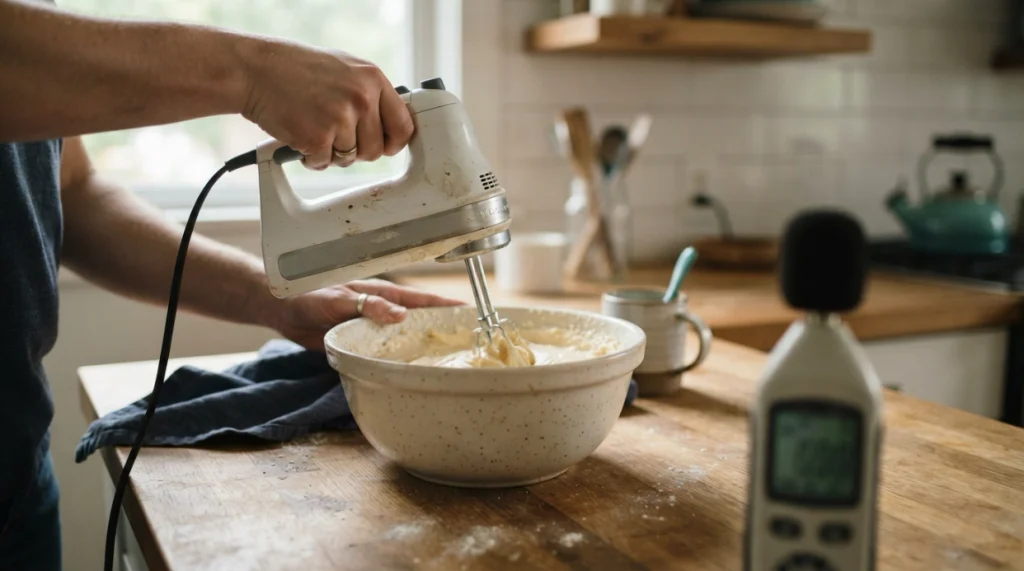
A reasonable real-world expectation for an electric hand mixer is roughly 70–85 dBA, although individual readings can fall outside that range. Speed, load, measuring distance, room acoustics, and mixer construction can all change the result.
Manufacturers also don’t consistently publish standardized decibel ratings for hand mixers. That makes direct model-to-model noise comparisons harder than comparing watts or speed settings.
What does dBA mean?
dBA means A-weighted decibels. A-weighting adjusts a sound measurement to better represent how the human ear responds to different frequencies.
Decibels use a logarithmic scale, so a small numerical increase can represent a substantial increase in sound energy. This is why an 85 dBA appliance can feel dramatically more intrusive than a quieter one.
| Sound level | Useful comparison | What it means for mixer users |
|---|---|---|
| 60–70 dBA | Normal conversation range | A particularly quiet mixer may feel relatively unobtrusive. |
| 70–80 dBA | Noticeably louder household sound | Conversation beside the mixer becomes less comfortable. |
| 80–85 dBA | Loud appliance territory | High-speed mixing may dominate a small kitchen. |
| 85 dBA+ | Hearing-exposure guidance becomes relevant | Duration and repeated exposure matter more as sound rises. |
The first thing I notice during mixer testing isn’t always the meter reading. A high-pitched motor whine can seem more annoying than a deeper sound with a similar reading.
Section Takeaway: Most hand mixers are loud enough to interrupt conversation, but their exact noise level varies widely. Decibel readings need context, especially distance and operating speed.
Why Do Hand Mixers Sound So Loud?
A hand mixer packs a motor, cooling system, gears, and fast-moving beaters into a small housing. Several sounds therefore reach your ears at the same time.
The electric motor creates the basic hum
The motor produces both airborne sound and vibration through the mixer housing. Higher speed settings usually make this sound more noticeable.
Compact construction gives manufacturers less space for acoustic insulation. That helps explain why a small hand mixer can sound surprisingly aggressive.
Gears and bearings add mechanical sound
The motor must transfer power to two rotating beaters. Gears, shafts, bearings, and their tolerances influence how smooth that process sounds.
- Smooth mechanical sound: Usually presents as a consistent hum or whir.
- Loose rattling: May indicate an attachment isn’t seated correctly.
- Grinding: Can suggest abnormal mechanical wear or damage.
- Sudden new squealing: Deserves investigation if the mixer previously ran smoothly.
A mixer doesn’t need to be silent to be healthy. What concerns me more is a new change in its normal sound.
The food itself changes motor load
Whipping egg whites requires much less torque than moving through cold butter or thick cookie dough. The mixer can therefore sound different even when you haven’t changed the speed control.
I’ve found dense mixtures especially revealing. You can often hear the motor tone deepen as resistance increases.
Section Takeaway: Hand mixer noise comes from more than the motor. Gears, attachments, ingredients, vibration, and bowl contact all contribute to what you hear.
Can a Hand Mixer Be Too Loud for Your Hearing?
A short home mixing session isn’t the same exposure as spending an entire work shift around industrial machinery. Still, both sound level and exposure duration matter when evaluating noise.
The National Institute for Occupational Safety and Health uses 85 dBA averaged over eight working hours as its recommended occupational exposure limit. Its guidance also explains that allowable duration decreases as sound levels rise.
Should you worry about a five-minute mixing session?
For most people, occasional short use is quite different from continuous exposure. A hand mixer commonly runs for a few minutes rather than several hours.
However, repeated loud-appliance exposure can add to your total daily noise. This can matter more for professional bakers, commercial kitchens, or anyone using noisy equipment throughout the day.
- Keep some distance: Don’t place your ear close to the motor housing while it runs.
- Limit unnecessary runtime: Turn the mixer off while scraping or adding ingredients.
- Watch for warning signs: Ear ringing or temporary muffled hearing deserves attention.
- Measure unusual noise: Use a proper sound meter when you suspect a mixer is exceptionally loud.
Noise irritation and hearing danger also aren’t identical. A shrill 75 dBA sound may annoy you even though another appliance with a deeper tone feels easier to tolerate.
Section Takeaway: Duration matters as much as loudness. Occasional short mixing is different from repeated or extended exposure near 85 dBA and above.
What Makes One Hand Mixer Quieter Than Another?
Motor power alone doesn’t tell you how loud a hand mixer will be. A higher-wattage mixer can still sound smoother than a poorly balanced lower-powered model.
Motor and housing design
Good balancing helps reduce vibration transferred into the handle and outer shell. Housing rigidity also affects whether that vibration becomes buzzing or rattling.
This is one reason I don’t judge a mixer by watts alone. Sound quality tells you something that a power specification cannot.
Speed control matters
A broader selection of speeds lets you avoid maximum power when the recipe doesn’t need it. The current KitchenAid hand mixer range, for example, includes models offering several speed settings for different mixing tasks.
Starting slowly can also prevent ingredients from flying around the bowl. It won’t make the motor silent, but it can reduce unnecessary high-speed operation.
Attachments can change the sound
Metal beaters striking a hard bowl create noise separate from the motor itself. A quiet motor can therefore seem loud when attachments repeatedly contact the bowl.
Breville specifically describes the Handy Mix Scraper as using scraper beaters designed to minimize clinging and clanging against the bowl. That illustrates how attachment design can influence perceived sound without changing motor power.
- Wire whisks: Often create lighter airflow and ingredient noise.
- Traditional metal beaters: Can sound sharp if they touch a bowl.
- Flexible-edge beaters: May soften bowl-contact noise.
- Dough hooks: Put the motor under heavier load with dense dough.
Section Takeaway: A quiet hand mixer depends on motor balance, speed control, housing construction, and attachment design. Wattage by itself isn’t a reliable noise rating.
How Do You Measure Hand Mixer Noise?
The best way to compare hand mixers is to measure each one under the same conditions. Changing distance or recipe can change the reading enough to make a comparison misleading.
Use a consistent test setup
- Choose one room. Avoid switching between a tiled kitchen and a carpeted room.
- Fix the measuring distance. Keep the microphone in the same position for every test.
- Record background noise. Turn off nearby fans, dishwashers, and range hoods first.
- Measure each speed. Note low, medium, and maximum settings separately.
- Repeat with food. An unloaded mixer won’t sound identical under mixing resistance.
- Record the attachment. Beatters, whisk, and dough hooks can produce different readings.
The measurement should be listed as dBA when you’re comparing sound in terms of human hearing. Also record the approximate distance from the mixer.
A reading described only as “75 dB” isn’t enough for a rigorous comparison. You need to know how and where it was measured.
Can you use a phone?
A smartphone app can provide a useful screening measurement, but accuracy depends on the phone and microphone calibration. I use phone readings mainly for repeatable comparisons rather than treating every number as laboratory data.
If your goal is to verify potentially hazardous sound exposure, a calibrated sound-level meter is the better tool. That removes much of the uncertainty caused by different phone microphones.
Section Takeaway: Keep distance, room, speed, attachment, and recipe consistent when comparing mixer noise. Without a standardized setup, two decibel numbers may not be comparable.
How Can You Make a Hand Mixer Quieter?

You cannot eliminate normal motor noise, but you can often reduce unnecessary rattling, vibration, and bowl contact. Start with simple changes before assuming the mixer is faulty.
Use the lowest effective speed
Don’t automatically select maximum speed. Many mixing jobs work well at low or medium settings.
The Cuisinart hand mixer range demonstrates how manufacturers provide multiple speeds for tasks ranging from light mixing to denser batters. Using an appropriate speed also gives you better ingredient control.
Keep the beaters away from the bowl
Repeated metal-on-metal tapping can be louder than the motor itself. Hold the mixer so the beaters stay immersed without scraping the bowl sides.
Check that attachments are seated correctly
A partially inserted beater may wobble or rattle. Turn the mixer off and unplug it before removing or inspecting attachments.
- Remove and reinsert beaters: Make sure each one locks into its correct socket.
- Check for bending: A bent shaft can create vibration while rotating.
- Inspect for damage: Cracks, looseness, or unusual movement need attention.
- Test another bowl: Thin metal bowls can amplify contact sounds.
- Avoid overloading: Extremely stiff dough may exceed what a light hand mixer handles comfortably.
Know when noise isn’t normal
A sudden grinding, scraping, electrical buzzing, or burning smell shouldn’t be treated as ordinary mixer noise. Stop using the appliance if the sound suggests an internal fault.
Pro tip: Don’t open a sealed mixer housing or bypass a safety feature unless the manufacturer’s instructions specifically permit the procedure. For internal electrical or mechanical problems, use manufacturer support or a qualified appliance repair technician.
Section Takeaway: Reduce noise with sensible speed selection, correct attachment installation, less bowl contact, and reasonable mixer loads. New grinding or electrical sounds require troubleshooting rather than noise reduction tricks.
Hand Mixer Noise FAQ
Are hand mixers louder than stand mixers?
Not always. Noise depends on the individual motor, gearing, speed, load, housing, and measuring distance rather than appliance category alone.
Is 80 dB loud for a hand mixer?
Yes, 80 dBA will sound noticeably loud in a kitchen and can interfere with normal conversation. However, exposure duration matters when considering hearing risk.
Why does my hand mixer get louder when mixing dough?
Dense dough creates more resistance at the beaters. That increases motor load and can change the sound of the motor and gearing even when the selected speed remains unchanged.
Why is my hand mixer suddenly making a grinding noise?
A new grinding noise isn’t typical operating sound. Stop the mixer, unplug it, check the attachments for damage or incorrect installation, and contact the manufacturer if the grinding continues.
Can a quiet hand mixer still be powerful?
Yes. Motor power and noise aren’t directly interchangeable specifications because gearing, balance, housing, cooling, and attachment design all affect sound.
Does using a metal bowl make a mixer louder?
It can. Metal beaters touching a stainless-steel bowl create sharp impact noise, while careful positioning or softer contact surfaces can reduce that part of the sound.
Should I wear ear protection while using a hand mixer?
Most short household mixing sessions won’t automatically require hearing protection. If your mixer measures unusually high, you use it for extended periods, or the sound causes ear discomfort, reducing exposure and seeking hearing-safety guidance is sensible.
How loud are hand mixers? For everyday use, think of them as moderately loud appliances whose sound can range from conversation-like to intrusive depending on the model and task. A practical expectation is around 70–85 dBA, but measure your own mixer if noise is an important concern.
For a quieter kitchen, focus on controlled speeds, smooth motor operation, secure attachments, and less beater-to-bowl contact. If the sound suddenly changes, treat that as a troubleshooting clue rather than simply accepting a noisy mixer.
