Quick Answer
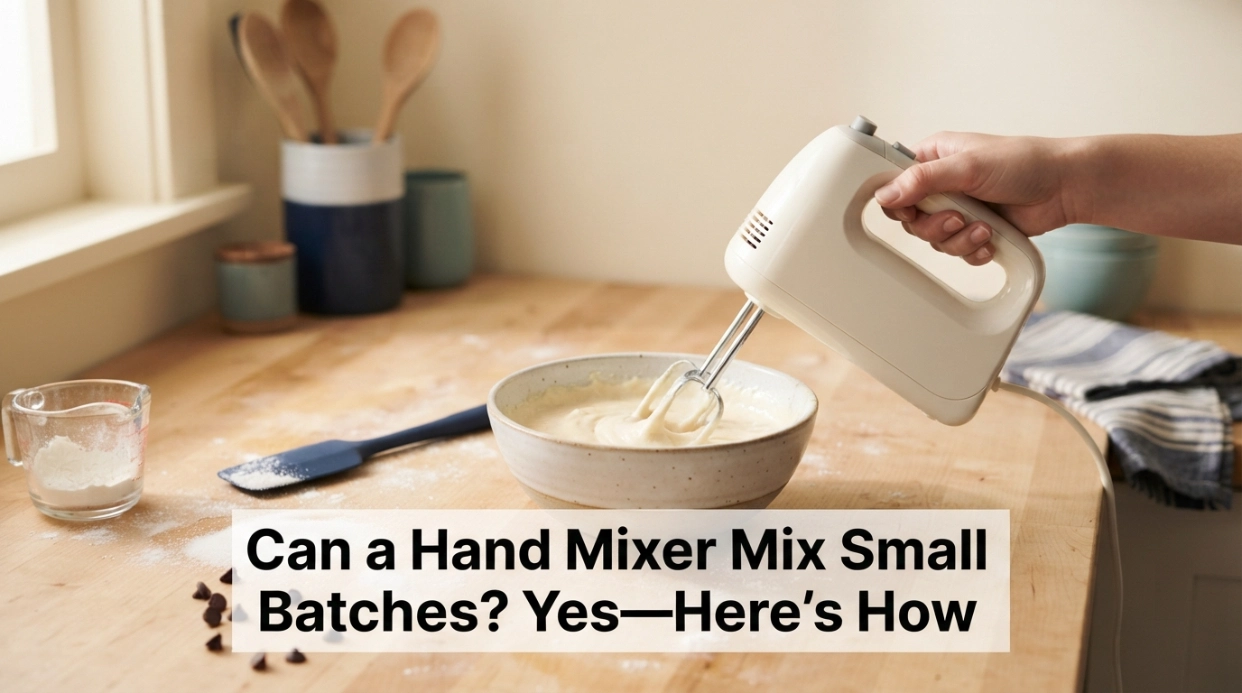
Yes, a hand mixer can mix small batches well, and small or light recipes are one of its strongest uses. The key is using a bowl that keeps the beaters sufficiently submerged, starting slowly, and choosing a whisk when the quantity is too tiny for both beaters to contact the food effectively. KitchenAid also describes hand mixers as useful for small-batch recipes.
Small-Batch Mixing Rules
- Choose a narrow bowl: It keeps shallow ingredients concentrated around the beaters.
- Start on low: Low speed reduces flour clouds, splashing, and ingredients climbing the bowl.
- Tilt when needed: A slight bowl tilt can create a deeper pool for cream, eggs, or frosting.
- Move the mixer: Guide the beaters through the whole mixture instead of holding them in one spot.
- Know the lower limit: One egg white or a spoonful of glaze may be easier with a whisk.
I reach for a hand mixer often when a full stand mixer feels excessive. For a half batch of frosting, a small cake, or a little whipped cream, the compact tool can make more sense.
Small quantities do create one challenge. The ingredients must be deep enough for the beaters to grab, circulate, and aerate them properly.
In This Guide
Can Hand Mixers Handle Small Batches Effectively?
Yes. Hand mixers are particularly practical for small and medium batches because you can choose the bowl rather than being tied to a fixed mixer bowl.
That flexibility matters more than many people expect. A large, wide bowl can spread a small amount of food so thinly that the beaters barely reach it.
Definition: Small-batch mixing means preparing less than a typical full recipe while still giving the mixer enough ingredient depth for its attachments to work effectively.
A hand mixer solves part of this problem because you can move it manually. You can guide the beaters toward thicker areas and sweep around the bowl.
- Cakes and cupcakes: Half recipes usually suit a hand mixer well.
- Frosting: Small quantities of buttercream or cream cheese frosting are easy to control.
- Whipped cream: A narrow container helps keep the cream around the beaters or whisk attachment.
- Eggs: Two or more eggs usually give the attachments more working depth than one.
- Cookie dough: Small soft batches work, provided the dough does not become excessively dense.
My practical rule is simple: choose the bowl before choosing the speed. Bowl geometry can decide whether a tiny batch mixes smoothly or spends most of its time underneath the beaters.
Section Takeaway: A hand mixer is well suited to small batches when the bowl keeps the food deep enough for effective beater contact.
What Counts as a Small Batch?
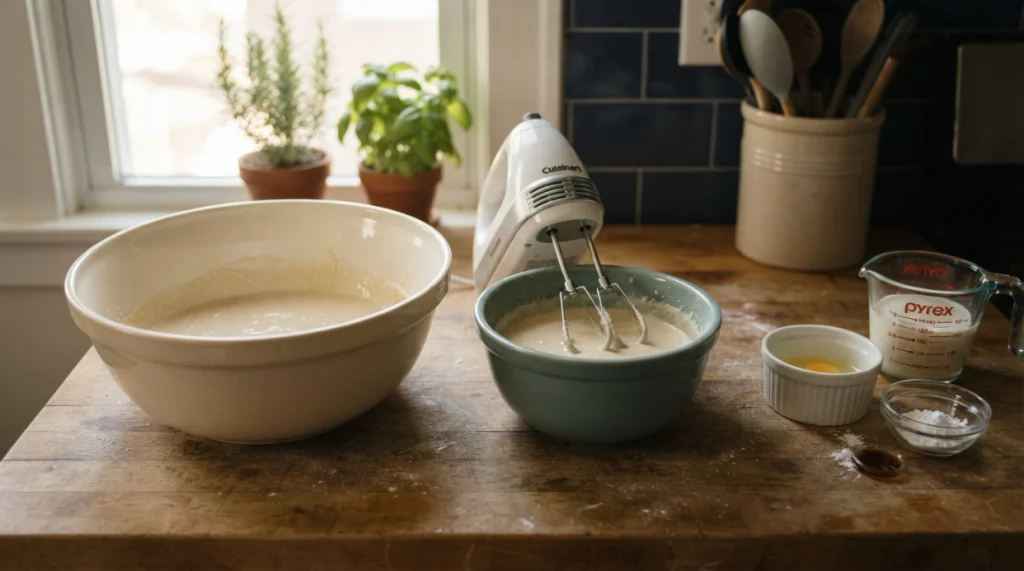
There is no universal volume that manufacturers call a “small batch.” Recipe type, bowl shape, attachment design, and ingredient thickness all change the useful minimum.
A half batch of cake batter may be easy. Half an egg white is a completely different challenge.
Think about depth, not just volume
The beaters need to enter the ingredients far enough to move them. If only their tips touch the food, circulation becomes weak.
This is why a narrow two-quart bowl can outperform a broad five-quart bowl for the same small recipe. The ingredients sit deeper instead of spreading across the bottom.
| Example | Hand Mixer Fit | Practical Approach |
|---|---|---|
| 1 egg white | Often awkward | Use a narrow cup-compatible whisk or whisk by hand |
| 2–3 egg whites | Good | Use a narrow, clean bowl and whisk attachment if supplied |
| 1/2–1 cup cream | Good | Keep cream concentrated in a narrow bowl |
| Half batch frosting | Excellent | Start low, then increase after sugar is incorporated |
| Half cake recipe | Excellent | Use standard beaters and avoid overmixing |
These examples are practical guidelines rather than rated mixer capacities. Your model’s manual should take priority when it gives minimum or maximum quantities.
Which Small-Batch Foods Work Best With a Hand Mixer?
Small recipes that need beating, whipping, creaming, or moderate mixing are the best candidates. Thick bread dough and foods needing chopping belong in other categories.
Whipped cream
Whipped cream is a natural hand-mixer job because the main goal is aeration. A narrow bowl helps the attachment repeatedly pass through the cream.
Start at a controlled speed and increase gradually. Stop when the cream reaches the peak stage your recipe needs.
Buttercream and cream cheese frosting
Small frosting batches work particularly well because softened ingredients stay around the beaters. Low speed is useful when powdered sugar first goes into the bowl.
- Soften the fat properly: Rock-hard butter makes the mixer work harder.
- Add sugar gradually: This gives you more control over dust and texture.
- Scrape with the mixer off: Bring material from the bowl walls back into the center.
Eggs and meringue
A hand mixer can beat whole eggs or whip egg whites, but bowl cleanliness matters for foams. Grease can interfere with egg-white aeration.
If you are preparing food containing raw or undercooked eggs, follow current FDA egg-safety guidance.
Cake and pancake batter
A half-size cake recipe is often easier with a hand mixer than a large stand mixer. You get powered mixing without needing a large fixed bowl.
Do not assume faster is better. Once flour enters a cake batter, excessive mixing can develop more gluten than the recipe needs.
Soft cookie dough
Many softer cookie doughs can be handled in smaller quantities. Stop if the mixer begins laboring heavily or twisting against the dough.
Section Takeaway: Small batters, cream, frosting, eggs, and soft doughs suit hand mixers because they need controlled beating rather than heavy kneading.
How Do You Mix Small Batches Without Splashing?
Start slowly and keep the attachments inside the ingredients before increasing speed. Most small-batch messes happen because the mixer starts too fast in a shallow mixture.
- Use the smallest suitable bowl. Choose enough room for the beaters without spreading the ingredients unnecessarily.
- Insert the attachments securely. Follow the socket markings on your mixer if the beaters are not interchangeable.
- Place the beaters in the mixture first. Do not run them above loose flour or liquid.
- Begin at the lowest useful speed. Let dry and wet ingredients start combining.
- Move around the bowl slowly. Guide ingredients from the sides into the active mixing area.
- Increase speed only when needed. Higher settings are more useful for whipping than initial combining.
- Switch off before scraping. Wait until the beaters stop completely.
Try a slight bowl tilt
Tipping the bowl a little can deepen a shallow pool of cream or egg. Keep the bowl stable and avoid allowing the rotating attachments to strike its sides.
I find this more useful than immediately reaching for maximum speed. Better ingredient contact usually solves the problem more cleanly.
Do not chase food with spinning beaters
Small ingredients can cling to the bowl wall. Turn the mixer off, scrape with a spatula, then resume mixing.
For electrical safety and appliance certification information, UL Solutions covers household food-preparation appliances within its small-appliance testing work.
Pro tip: If a mixer stalls, smells hot, sparks, develops a damaged cord, or makes unusual mechanical noises, stop using it. Check the manufacturer’s manual or consult a qualified appliance technician rather than opening a sealed electrical housing.
Section Takeaway: Low speed, the right bowl, full beater contact, and deliberate movement matter more than maximum mixer power when working with a small batch.
Hand Mixer vs. Whisk vs. Stand Mixer for Small Batches
A hand mixer usually occupies the middle ground. It offers more speed than a manual whisk without the size and setup of a stand mixer.
| Factor | Manual Whisk | Hand Mixer | Stand Mixer |
|---|---|---|---|
| Tiny quantities | Excellent | Model/bowl dependent | Often less convenient |
| Small cake/frosting batch | More effort | Excellent | Capable but larger |
| Hands-free operation | No | No | Yes |
| Heavy dough | Poor fit | Model dependent | Usually better suited |
| Cleanup/setup | Minimal | Low | Higher |
KitchenAid’s hand mixer vs. stand mixer comparison similarly positions hand mixers around smaller, lighter batches. Stand mixers become more useful when mixtures are large, heavy, or need longer hands-free mixing.
For one egg, a spoonful of glaze, or a tiny dressing, I would not automatically plug in an appliance. A whisk or fork may finish the job before you have attached the beaters.
When Is a Hand Mixer the Wrong Tool?
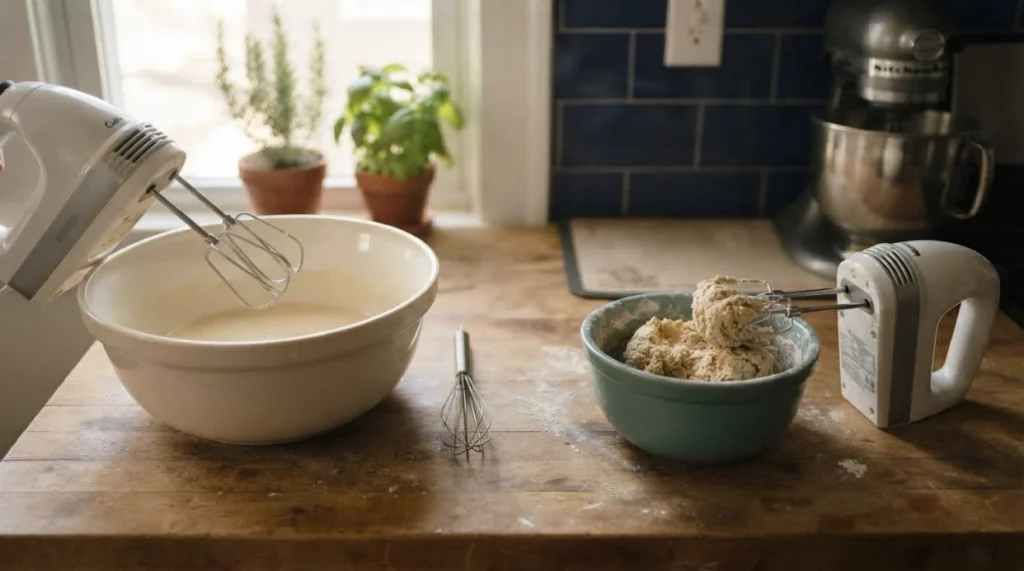
A hand mixer can be too large for an extremely tiny amount and too small for a demanding heavy mixture. Knowing both limits prevents frustration.
When the quantity is too shallow
If both beaters spin mostly above the food, changing speed will not fix the basic contact problem. Use a narrower container or switch to a whisk.
When the mixture is too dense
Stiff bread dough, chilled cookie dough, or other dense mixtures can place a heavy load on a handheld motor. Dough hooks do not automatically mean the mixer can handle every bread recipe.
- Stop for stalling: Do not force stalled beaters through a dense mixture.
- Watch for heat: Unusual heat can signal excessive load.
- Follow duty limits: Use the operating times and capacities in your model manual.
- Use the proper tool: Heavy or prolonged kneading may suit a capable stand mixer better.
When you need chopping or pureeing
A hand mixer is not a blender. Beaters combine and aerate food, while blender blades cut and puree ingredients.
As of 2026, the basic choice has not changed: use a hand mixer for compact powered mixing, not as a substitute for every countertop appliance.
Section Takeaway: Switch tools when the quantity is too shallow for the beaters or the mixture is heavy enough to strain the mixer.
Small-Batch Hand Mixer FAQ
Can a hand mixer whip one egg white?
Sometimes, but one egg white can be too shallow for standard twin beaters in a normal mixing bowl. A narrow container, suitable whisk attachment, or manual balloon whisk often gives better contact and control.
Can I make half a cake recipe with a hand mixer?
Yes. A half cake recipe is usually a good hand-mixer task because the batter remains substantial enough for the beaters while avoiding the setup of a larger stand mixer.
What size bowl is best for small batches?
Choose a bowl that gives the beaters free movement while keeping the ingredients reasonably deep. Narrower bowls often work better than broad shallow bowls for small amounts of cream, eggs, or frosting.
Can a hand mixer make a small batch of whipped cream?
Yes. Small whipped-cream batches work well when the cream surrounds enough of the attachment. Start at a controlled speed, increase as the cream thickens, and stop once the required peak stage develops.
Why is my hand mixer not mixing the bottom of the bowl?
The bowl may be too wide, the ingredient level may be too shallow, or the attachments may not reach the mixture effectively. Switch to a narrower bowl and guide the mixer around the mixture instead of increasing speed immediately.
Is a hand mixer better than a stand mixer for small batches?
A hand mixer can be more convenient because you choose the bowl and need less setup. A stand mixer still has advantages when a recipe requires long hands-free mixing, heavier dough, or a larger batch.
Should I buy a hand mixer mainly for small recipes?
It can be a practical choice if you regularly prepare cakes, frosting, whipped cream, eggs, pancakes, or soft cookie dough in modest amounts. Look for useful low-speed control, comfortable handling, suitable attachments, and straightforward cleanup.
A hand mixer does not need a full-size recipe to be useful. Match the bowl and attachment to the amount of food, start gently, and let ingredient depth guide your choice of tool.
For the smallest quantities, keep a whisk nearby. For everything from half-batch frosting to a compact cake recipe, your hand mixer may be exactly the right size.
