Quick Answer
A hand mixer is worth using when you want fast electric mixing without the size, weight, and setup of a stand mixer. It works especially well for cake batter, whipped cream, frosting, eggs, mashed potatoes, and many small-to-medium baking jobs. A hand mixer buying guide can also help you compare speeds and attachments before choosing one.
Why people use a hand mixer
- Quick setup: Insert the beaters, plug it in, and start mixing without assembling a large appliance.
- Easy storage: Its compact body usually needs far less cabinet or counter space than a stand mixer.
- Flexible bowls: You can work in many different mixing bowls instead of using one dedicated mixer bowl.
- Good control: Multiple speeds make it easier to move from gentle mixing to faster whipping.
- Simple cleanup: Most everyday jobs leave only the beaters and mixing bowl to wash.
Know its limit
- For heavy bread dough, long kneading sessions, and oversized batches, a stand mixer is usually the more suitable tool.
If you bake occasionally, a hand mixer can be one of the easiest electric tools to justify. It gives you much of the speed of powered mixing without permanently occupying part of the counter.
I think of it as the middle ground between a whisk and a full stand mixer. It saves effort on repetitive mixing while remaining simple enough to grab for a five-minute job.
In This Guide
What Is a Hand Mixer and Why Use One?
A hand mixer is a compact electric appliance that rotates removable beaters or similar attachments while you hold the motor body. You guide those attachments around a bowl to beat, mix, cream, or whip ingredients.
Definition: A hand mixer is a handheld powered mixer designed to automate repetitive stirring, beating, and whipping tasks that would otherwise require a whisk, spoon, or spatula.
The main reason to use one is efficiency. Electric beaters can repeat the same mixing action far faster than most people comfortably can by hand.
It fills the gap between a whisk and a stand mixer
A balloon whisk is cheap and precise, but whipping cream or egg whites manually takes effort. A stand mixer removes that effort, yet it occupies more space and requires more setup.
A hand mixer sits between them. You get powered mixing while keeping the appliance small and portable.
- Choose a whisk for tiny quantities, gentle sauces, or jobs lasting only seconds.
- Choose a hand mixer for batters, cream, frosting, eggs, and everyday baking.
- Choose a stand mixer for dense mixtures, large batches, and lengthy mixing sessions.
Current manufacturer ranges also show that a hand mixer does not have to be a one-speed tool. KitchenAid currently offers several hand mixers with different speed ranges, while Cuisinart sells models with multiple speed settings and attachment options.
You can see examples in the current Cuisinart hand mixer range.
What Are the Biggest Benefits of a Hand Mixer?
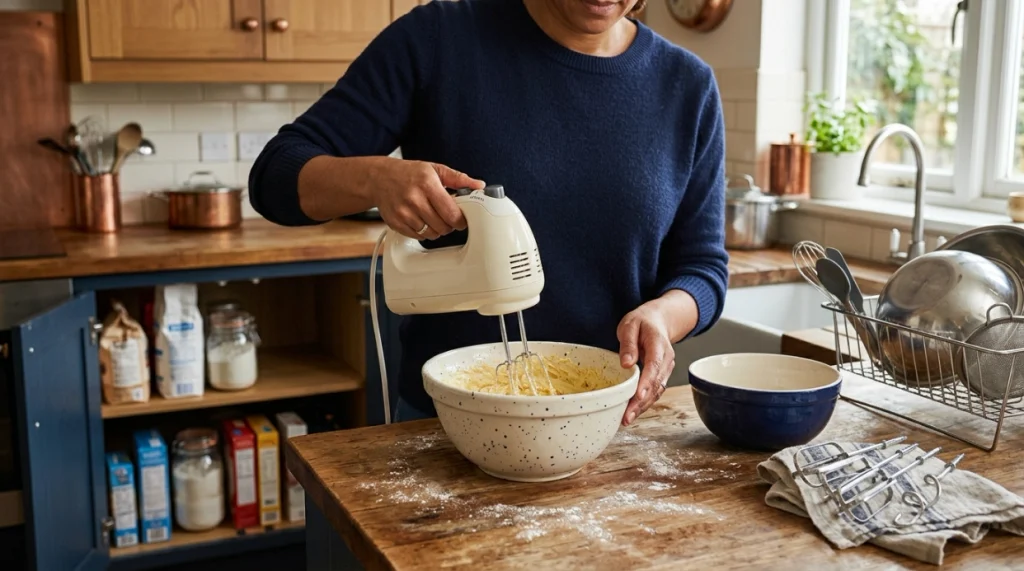
The strongest advantages are convenience, control, storage, and flexibility. Those benefits matter most when the cooking job is too demanding for a whisk but too small to justify a stand mixer.
1. It takes up little space
Small kitchens quickly run out of usable countertops. A hand mixer can usually be stored in a cabinet after every use instead of becoming a permanent countertop appliance.
This matters in apartments, dorm-style kitchens, RV kitchens, and homes where several appliances already compete for space. Compact storage is one of the clearest reasons to choose a hand mixer.
2. Setup is fast
There is little assembly. Attach the correct beaters, place your ingredients in a suitable bowl, and you are nearly ready.
That simplicity makes the appliance attractive for short recipes. I would rather use a small mixer than set up a larger machine for one bowl of frosting.
3. You can use different bowls
A handheld mixer is not permanently attached to one bowl. You can choose a deeper bowl for splash-prone batter or a wider bowl when you need room to move the beaters.
KitchenAid also identifies this ability to work in different containers as a practical distinction between hand and stand mixers in its hand mixer versus stand mixer comparison.
4. Multiple speeds give useful control
Low speeds help combine dry and wet ingredients without immediately throwing flour across the counter. Higher settings are useful when incorporating air into cream, egg whites, or frosting.
The important part isn’t chasing the highest speed number. Good low-speed control is often more useful during everyday baking.
5. Cleanup can be quick
For many jobs, cleanup means ejecting the beaters and washing them with the bowl. The motor housing normally only needs exterior cleaning according to its manufacturer instructions.
Section Takeaway: A hand mixer earns its place by making ordinary mixing faster without adding much setup, storage, or cleanup.
What Is a Hand Mixer Best Used For?
A hand mixer performs best with light and medium mixtures that benefit from repeated beating or whipping. Common examples include cake batter, cream, frosting, eggs, cookie mixtures, and mashed foods.
Baking batters
Cake and cupcake batters are natural hand-mixer jobs. The beaters combine ingredients quickly while letting you move around the bowl and check for unmixed pockets.
Start slowly when flour is still visible. Increase the speed only after the dry ingredients have begun combining with the liquid.
Creaming butter and sugar
Many cookie and cake recipes ask you to cream softened butter with sugar. Powered beaters reduce the arm work required for this repetitive step.
The goal is usually a lighter, more even mixture rather than maximum speed. Stop and scrape the bowl when ingredients collect along the sides.
Whipped cream and egg whites
Whipping works by incorporating air. A hand mixer can maintain rapid, consistent movement without requiring several minutes of manual whisking.
Watch the food instead of relying only on a timer. KitchenAid notes that mixing speed and beater design can change how quickly a mixture reaches the desired texture.
Frosting and mashed foods
Buttercream, cream-cheese frosting, and similar mixtures are common uses. Some cooks also use a hand mixer for potatoes, although overmixing potatoes can create a gluey texture.
- Cake batter: useful for smooth, evenly combined mixtures.
- Whipped cream: saves substantial manual whisking effort.
- Egg whites: useful for building foam toward soft or stiff peaks.
- Frosting: helps blend fats, sugar, and flavorings evenly.
- Cookies: suitable for many standard doughs before they become excessively dense.
- Mashed potatoes: workable with care, but stop before the starch becomes overworked.
Manufacturer guidance lists similar tasks. KitchenAid describes hand mixers as useful for mixing, whisking, whipping, beating, frosting, baked goods, and eggs on its hand mixer usage guide.
Hand Mixer vs. Stand Mixer: Which Should You Use?
Use a hand mixer when portability and speed of setup matter most. Use a stand mixer when batch size, mixture density, or mixing duration becomes the bigger concern.
| Factor | Hand Mixer | Stand Mixer |
|---|---|---|
| Best batch size | Small to medium | Medium to large |
| Dense bread dough | Usually not ideal | Generally better suited |
| Hands-free mixing | No | Yes |
| Storage footprint | Compact | Substantially larger |
| Bowl flexibility | Works with many suitable bowls | Uses the mixer’s fitted bowl |
| Portability | Easy to move | Usually stays on the counter |
| Long mixing sessions | Requires you to hold it | Runs hands-free |
A hand mixer therefore isn’t a miniature stand mixer in every respect. Its strength is handling everyday recipes with less equipment.
Stand mixers usually make more sense for regular bread baking, thick dough, and recipes that need prolonged mixing. They also keep your hands free for measuring or preparing the next ingredient.
For someone who makes pancakes, cakes, cookies, cream, and frosting but rarely kneads bread, the smaller tool may cover most routine needs. That’s the practical distinction.
Section Takeaway: Choose according to the mixture, batch size, and mixing time rather than assuming the larger appliance is always better.
When Should You Not Use a Hand Mixer?
A hand mixer has clear limits. Dense mixtures can strain the motor, tire your wrist, or cause the mixer to twist in your hand.
Heavy bread dough
Some models include dough hooks, but that does not mean every hand mixer is suitable for every dough. Dense whole-grain or low-hydration bread dough can demand much more torque than cake batter.
Follow the specific model’s manual. If the motor slows sharply, becomes unusually hot, or struggles to turn, stop rather than forcing it.
Very large batches
Large bowls require more movement and longer run times. A stand mixer can be easier because its bowl and mixer remain fixed while the motor works.
Recipes needing extended hands-free mixing
A hand mixer must be held during operation. Even a lightweight unit can become tiring during a long recipe.
Tasks that need specialized attachments
Stand mixers may support pasta rollers, grinders, food-processing accessories, and other attachments. A basic hand mixer focuses on beating, whipping, and mixing.
The best tool is the one designed for the job. Don’t make a small handheld appliance do heavy-duty work simply because it fits in the bowl.
How Do You Get Better Results From a Hand Mixer?
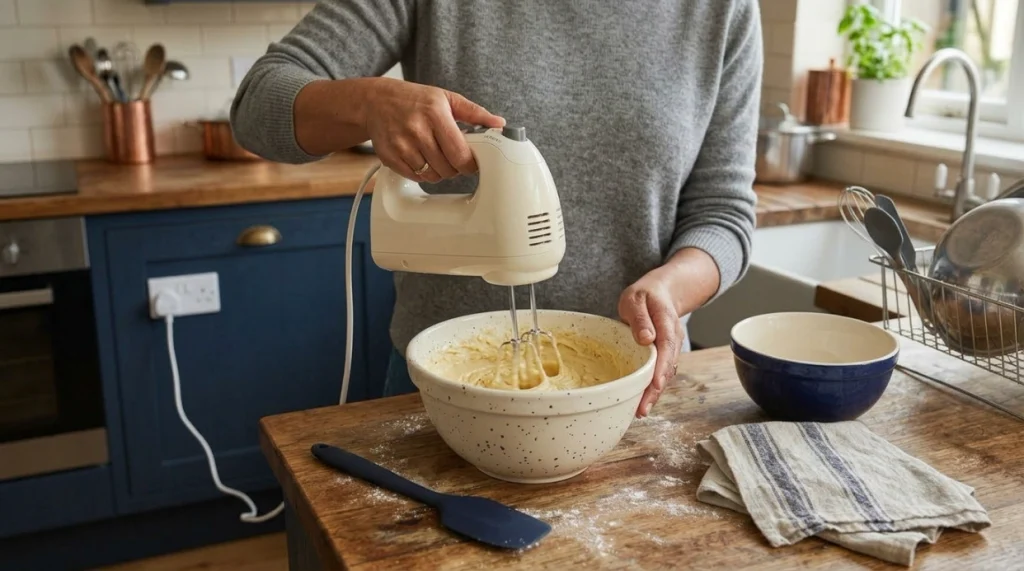
Good hand-mixer technique starts with choosing the correct attachment and beginning at a controlled speed. Most messes happen when the mixer starts too quickly.
- Use a deep enough bowl. Extra height helps contain flour and liquid splashes.
- Insert attachments securely. Confirm both beaters are properly locked before switching the mixer on.
- Start on low speed. Combine loose ingredients before increasing the setting.
- Move around the bowl. Guide the beaters through the center and edges for more even mixing.
- Scrape when necessary. Switch off the mixer before using a spatula around the beaters.
- Watch texture. Stop when the recipe reaches the required consistency rather than automatically mixing longer.
- Unplug before cleaning. Remove attachments only as directed by your model’s instructions.
KitchenAid specifically advises unplugging its hand mixers before cleaning the exterior. Always follow the manual supplied with your own model because cleaning instructions can differ.
Pay attention to safety certification and the manual
Electrical appliances should be used according to their manufacturer’s instructions. The UL Solutions small-appliance program explains the role of safety testing and certification for household food-preparation appliances.
You can also check the U.S. Consumer Product Safety Commission for recalls and broader consumer-product safety information. Stop using a mixer with a damaged cord, cracked housing, exposed wiring, or other obvious electrical damage.
Pro tip: Don’t open a sealed hand mixer or bypass a safety feature to repair an electrical fault. Check the manufacturer’s manual or use a qualified appliance repair technician.
Frequently Asked Questions About Hand Mixers
Is a hand mixer worth having?
Yes, if you regularly make cakes, frosting, whipped cream, cookies, eggs, or similar foods. A hand mixer gives you powered mixing without requiring the storage space and setup associated with a full stand mixer.
Can a hand mixer replace a stand mixer?
It can replace a stand mixer for many small and medium mixing jobs. It is less suitable for large batches, dense bread dough, long kneading sessions, and recipes where hands-free operation matters.
Is a hand mixer better than mixing by hand?
For repetitive beating and whipping, a hand mixer is usually faster and requires less physical effort. Manual mixing can still be better when a recipe needs gentle folding or only a few seconds of stirring.
Can I use a hand mixer for cookie dough?
Yes, many ordinary cookie doughs can be mixed with a hand mixer. Stop if the dough becomes too dense for the appliance, and fold chunky ingredients by hand when that gives you better control.
Can a hand mixer whip cream?
Yes. Whipped cream is one of the most practical hand-mixer jobs because powered beaters rapidly incorporate air. Begin at a controlled speed, increase as needed, and stop when the cream reaches the required peak stage.
How many speeds does a hand mixer need?
There is no universal ideal number. A useful mixer needs enough control to start gently and increase speed for whipping; current mainstream models commonly offer several selectable speeds rather than one fixed setting.
Can you knead bread with a hand mixer?
Some hand mixers support dough-hook attachments and light dough work, but model capability varies. Dense dough can overload a handheld unit, so check the manual and use a stand mixer or hand-kneading method when necessary.
Final takeaway: A hand mixer makes the most sense when you value quick setup, compact storage, flexible bowl choice, and enough powered mixing for everyday recipes.
As of 2026, it remains a simple alternative to both manual whisking and a bulky stand mixer. Match the appliance to the food, start slowly, and don’t force it through mixtures beyond its intended workload.
If you’re deciding whether to add one to your kitchen, think about what you prepare most often. If cakes, cookies, cream, frosting, eggs, and small batches dominate your routine, a hand mixer is an easy tool to put to work.